Wednesday, April 16, 2025
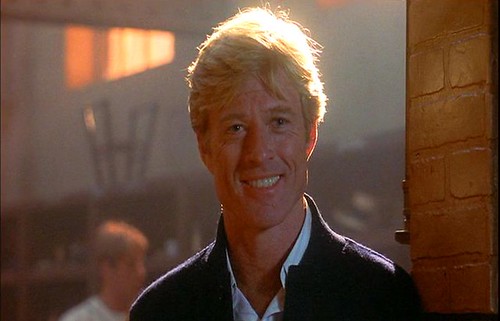
The Alto Knights
Thursday, August 1, 2024
What Just Happened
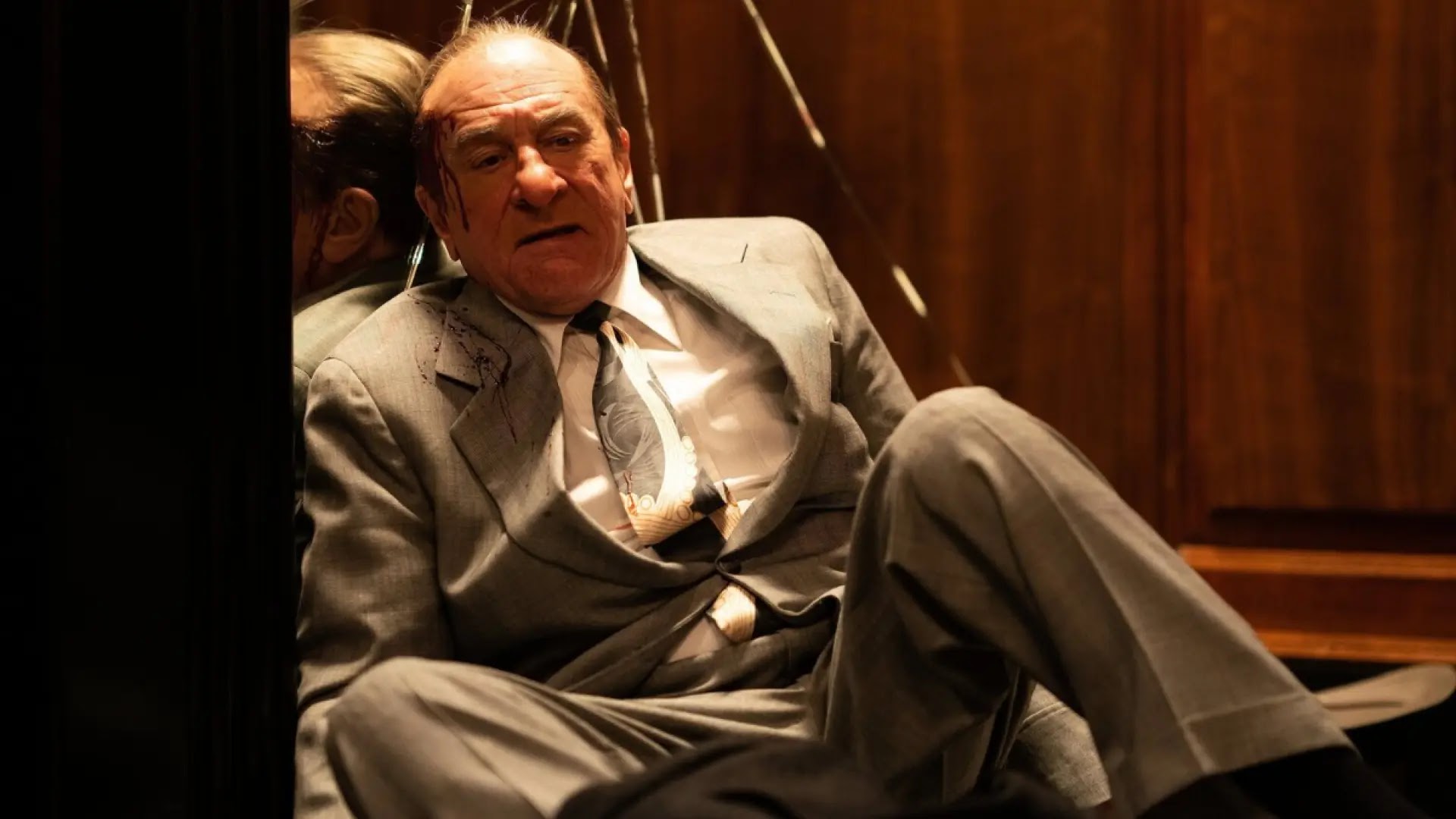
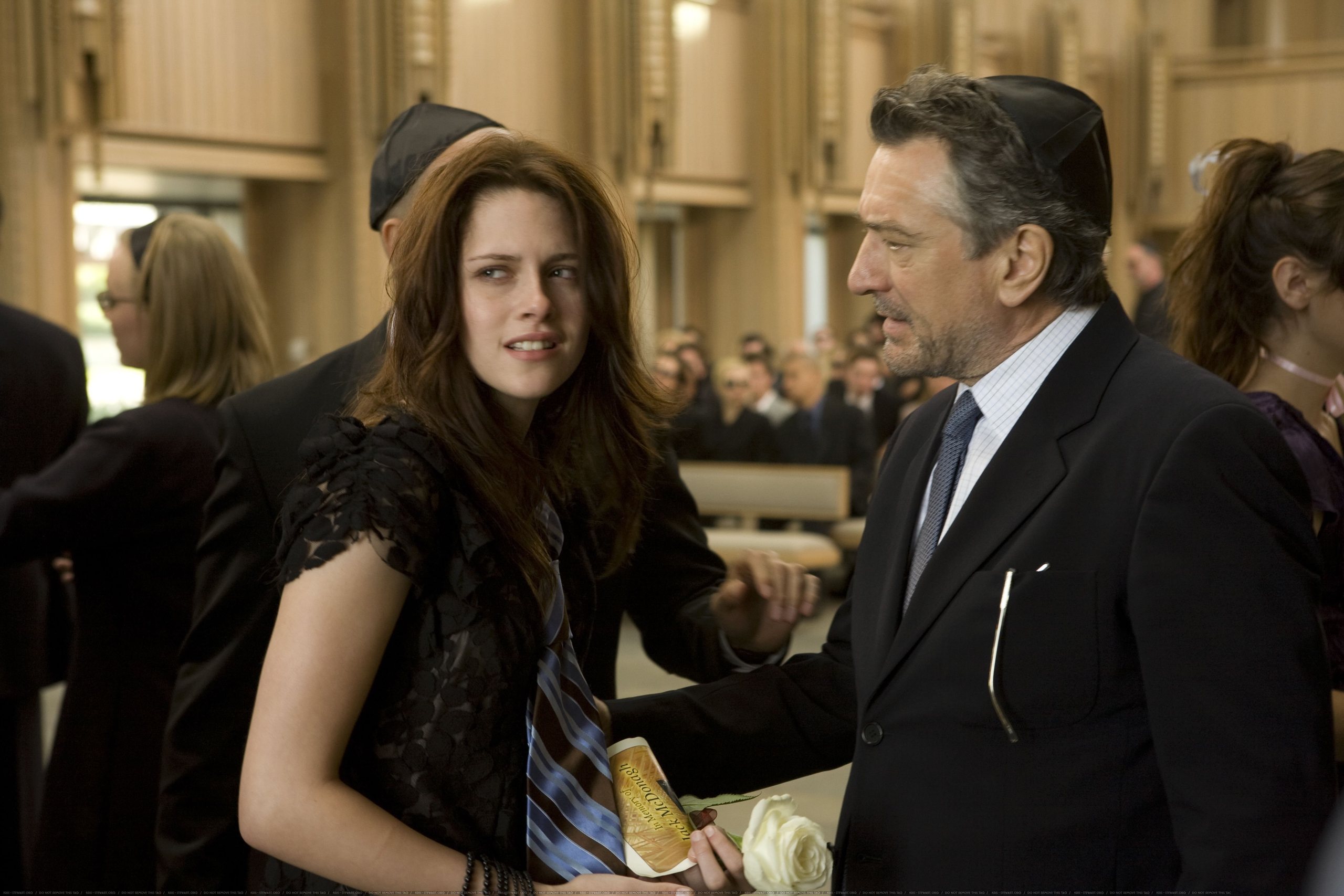
What Just Happened (Barry Levinson, 2008) Ben (Robert De Niro) is a producer in Hollywood and he has a tough life. His new movie starring Sean Penn just previewed and the audience reaction cards don't look good. The director, wanting to be "edgy," has a scene where the bad guys shoot Penn's dog, then kill Penn. Audiences are upset about the dog. The studio (run by Catherine Keener) is upset about the audiences and wants to re-cut the film, the director is upset about his "vision" being changed and refuses to cooperate. Ben wants the to keep the director happy, the studio happy, the audiences happy, the two ex-wives (including Robin Wright) and three ex-children (including Kristen Stewart) happy, while still worrying about where he's standing in a Vanity Fair "Power in Hollywood" photoshoot.On top of that, he's got a big budget movie starting its shoot on Friday and the star (Bruce Willis playing Bruce Willis) is being payed $20 million to star in it, but there's one little hitch—he's grown "a Grizzly Adams" beard, and the studio is panicking—people want to see Bruce Willis when they see Bruce Willis and they want Ben to coax the temperamental star to shave it off, which he refuses to do for "artistic reasons."* Ben's life is an endless soliloquy of superficial arguments, hastily-composed rationalizations and insincere ego-stroking in the gamesmanship of Hollywood, played over a Blue-Tooth behind the wheel of a constantly in-motion Lexus.
Based on producer Art Linson's book (sub-titled "Bitter Hollywood Tales From the Front Line") and adapted by him for this film, it's a nice study of how removed from reality, logic and best practices the industry is. But, at the same time Barry Levinson's film of it, while duly making note of the sliding loyalties Ben displays, also seems to expect you to feel sorry for him. One would, if one didn't want to have this life. There is no tragedy here, merely minor inconveniences that whittle away at Ben's soul and career. But, he still has a roof over his head. He has a car (and the insurance for it), a cell-phone, a blue-tooth, a fancy-schmancy espresso machine, the ear of many Hollywood players, and the phone numbers of ambitious actresses. Boo to the Hoo. Yes, Hollywood's crazy...but it's not homeless and crazy.
That's why backstage dramas in tinsel-town are really only good when played for laughs, and should only be reserved when the writer-director-producer has completely run out of ideas (and when that happens, they should read a book, instead). You look at movies like The Oscar, or The Big Knife, with the hand-wringing of the elite, and you can look right into the soul of industry people who have lost touch with their audiences**...like Norma Desmond screeching about her woes. It's why Sunset Blvd. is such a classic gem of a movie. Norma is crazy...and pathetic...and clueless.
Howard Hawks had it right. After awhile, he was making movies about making movies—but, they were well-veiled allegories. Anytime Hawks had a group of disparate people coming together with a single goal in mind, he was talking about what he and his crew did for a living...only they were flying the mail, or capturing live rhinos, driving the cattle, getting the headline, or battling the monster at the research station...anything but making movies. That would be as much fun as watching sausages being made. If you want to complain about being in the entertainment industry, try pumping gas...then, have a drink or climb onto the shrink's couch. Don't get "meta" on the audience. They go to the movies to escape their troubles, not hear about yours.But, like Fellini, pretty soon the writers start penning their autobiographies. Linson might be thinking that he did a good job changing the names to protect the innocent, but listening to his DVD audio commentary with director Levinson, one hears the vagueness, the "rote"-ness of his expressions, as if he's just passing through, and once the credits come up, he's already out the door (he's gone before the "A Barry Levinson Film" credit comes up). The two were in separated facilities recording their tracks, and as Linson gets up he says "Good seein' ya, Barry" "uh...talking to ya," says Levinson. "Oh. Yeah...well..." says Linson. "We should get together when you come to New York."
Yes, we "really" should.
* True story, although I won't mention the movie or the star (it's easily found, actually). But, it reminds me of the struggles Richard Donner had while making Superman, the Movie—making a man fly was easy compared to star-negotiations. Donner had a meeting with Marlon Brando, where the actor was pitching character ideas that would keep him from having to appear on camera, like playing Superman's kryptonian father as a suitcase or "a green bagel," and Gene Hackman didn't want to shave his moustache to play Lex Luthor. Donner finally said to Hackman on-set. "Look, Gene, you shave yours off and I'll shave mine off." Hackman agreed, shaved and came back on-set. "Okay, now it's your turn." Donner then peeled off the fake moustache he'd been wearing, which delighted Hackman.
** (The same could be said for politicians—anybody in Washington looking at cutting the health-plans for those in the legislative branch...if not, why not?)
Sunday, June 28, 2020
Don't Make a Scene: The Natural
That will be Opening Day of the shortened 2020 baseball season.
I would advise that not just the catcher wear a mask.
The Set-Up: It has been a disappointing season for the New York Knights. But, this year more than most: the addition of 34-year old rookie Roy Hobbs (Robert Redford) has changed the fortunes of the Knights, putting them three games ahead of their nearest rivals for the pennant. At a banquet, Hobbs comes down with food poisoning—an attempt by a local gambler to sway the outcome of the season and Hobbs is laid up for three games, which the Knights lose putting them even with their rivals. Hobbs is informed that a bullet from a decade-past shooting incident has been removed from his stomach, and that because of the condition of his stomach-lining, he should retire from baseball. But, Hobbs is adamant to play for several reasons, even resisting an attempt of bribery by the team's owner to throw the game. He pays a visit to the clubhouse to see Manager Pop Fisher (Wilford Brimley) and Assistant Manager Red Blow (Richard Farnsworth).
Play Ball!
POP FISHER: I wanted to win that pennant worse than I wanted any goddamned thing in my life. You'd think I could just this once, wouldn't you?
FISHER: I didn't care nothing about the Series. Win or lose, I would have been satisfied.
FISHER: I'd have walked away from baseball, and I'd have bought a farm.
ROY HOBBS: Nothing like a farm.
HOBBS: Nothing like being around animals, fixing things.
HOBBS: There's nothing like being in the field...
HOBBS: ...with the corn and the winter wheat.
HOBBS: The greenest stuff you ever saw.
FISHER: You know, my mother told me I ought to be a farmer.
HOBBS: My dad wanted me to be a baseball player.
FISHER: You're better than anyone I ever had. And you're the best goddamned hitter I ever saw.
FISHER: Suit up.
The Natural
Words by Phil Dusenbury and Roger Towne
Pictures by Caleb Deschanel and Barry Levinson
The Natural is available on DVD and Blu-Ray on Home Video.
Saturday, June 27, 2020
Disclosure (1994)
Disclosure (Barry Levinson, 1994) Handsome, but su-leeeeeeazy mounting of the Michael Crichton story about sexual politics in the work-place. With Michael Douglas heading the cast, the film could be confused for Fatal Attraction II, and one wonders just how far the makers were going for that, what with Douglas top-lining ...Attraction and Basic Instinct and Demi Moore, late of Indecent Proposal. Unfortunately, where those films whetted the national apetite for dangerous sex-capades, Crichton's cold-shower-of-an-idea seems tame.
At a cutting-edge Seattle software firm* experimenting in virtual reality, Tom Sanders (Douglas) thinks he's getting a promotion from his slick-as-shit boss (Donald Sutherland). He gets passed-over for Meredith Johnson (Demi Moore, all power-suit, push-up bra and stiletto heels), who's robotically quick with company-approved schpiel, with just a bit of predator to her. She's also an ex-girlfriend of the Douglas character.
Wuh-oh! Better watch out, Mike!
But because it's a two-hour movie, when Meredith invites him for an after-hours conference with some wine and her tongue in his ear, he goes--rather than saying, oh, I don't know--they've got e-mail at this high-tech Seattle firm?--"Hey, let me draw up a complete scenario of where we've been for that last three months with documentations and e-mail that to you, and then we can tackle it fresh in the morning." No, he doesn't do that, he's a little slow. Meredith, though, is pretty darn quick. When she starts unzipping his pants, what does he do? Stop her? Nooooo...When the simulated sex act begins? Noooooo. (I should mention that, at this point, Douglas does the patented Sharon Stone "pleasure" move from Basic Instinct--cock your head back so your neck is bent double and spasmodically open and close your mouth in a guppy fashion).
Finally, after the two are in a quasi-missionary position, the panting Douglas grows a conscience and decides to leave the office, after which Meredith follows him screaming "Get back and finish what you started, or you're dead, do you hear me?!" Since the office is in Pioneer Square, just about every bar-patron and driver on the Alaska Way Viaduct could hear her. As does the cleaning lady.
Anybody think this is a bit dumb?
It is. It gets dumber, when the Douglas character sues for sexual harassment, and she sues back. Crichton is making a point about sexual politics in a predatory environment in the work-place, but the message gets a bit dulled, and then the film-makers make a last-minute bid for political correctness that works as well as it did in The Bonfire of the Vanities, that is, not at all. Crichton was a hell of a writer, but his female characters were usually lacking personality (not that his male characters were ever fully developed), but were particularly and inexplicably fickle in their thinking. He was hardly a person to be objective about the battle of the sexes.**
Even the high-tech elements are a little suspect, with a virtual environment that evidently sucks so much CPU that it slows down the "Delete" process long enough to make it a race to amp up the drama.Disclosure is a by-the-numbers package deal combining the movie-making cachet of Crichton, Douglas and Moore, in the hope it would translate to big bucks at the box-office. In that way, it resembles nothing so much as the fly-by-night computer companies that took a collective dive when the hi-tech bubble burst. Both had similar problems.
No one was buying.
* One of those very rare films set in Seattle that is actually filmed in Seattle rather than Vancouver, BC. Even Battle in Seattle about the WTO riots was filmed in Canada. Okay, they did come to town for a week-end to shoot pick-ups.
** His non-fiction book, "Travels" has a couple of episodes where I got the impression that the author was not only a chauvinist, but an unapologetic one.
Friday, June 23, 2017
The Natural
The Natural (Barry Levinson, 1984) Bernard Malamud's novel "The Natural" took America's penchant for mythologizing its sports-heroes, and combined it with Arthurian legend to create one of the great sports novels of all time.
The cast is crowded with good actors doing some great work—not just Redford, whose own mythical presence of Aryan American brings its considerable WASP-ish weight to the story, but also Glenn Close, Wilford Brimley, Richard Farnsworth, Robert Duvall, Barbara Hershey, Joe Don Baker, Darren McGavin and Basinger. Layered over the top of the confection is Randy Newman's score—a combination of boogie-woogie, keening Americana and heraldic brass.*
Front-loaded with so much talent one would think of the natural as a grand-slam, the mythology built up to accentuate suspense** (Will Hobbs hit the game-winning home run? Will it kill him? What about his new-found family? Will the gambling interests destroy him, no matter what?) It comes down to the last pitch and a finale so overblown that the only thing that could top it would be Hobbs ascending into Heaven, forget the impossibility of the stadium-wide natural fireworks display of the type pulled off by Levinson and crew. The crowd I first saw it with burst into spontaneous applause at the denouement, so, obviously it was a hit with audiences, despite what I considered an error on the play. Me? I thought the game was rigged.
For in Malamud's novel, Hobbs strikes out, is damned by the press and public and fades away, a passing moment of the age, when miracles happened unsullied by the evils of the world like the Knights of Olde. Hobbs is defeated by the times. Not the movie-Hobbs, who is given his triumph and more, a return to simplicity, the sinking sun of previous shots now giving him a roseate glow,*** a Disneyfication of Malamud's intent.
* Redford, according to Newman, wasn't fond of the score: "I don't like horns" he was reported to have groused to the composer. Cooler heads prevailed. During an interview broadcast on Bravo, Newman said that there were half-hearted lyrics for the fanfaric Main Theme: "Look at that man/The Nat'ral/As nat'ral a man as can be/He hits the ball/And that's not all/So Na-tu-ral/Is he."
** I would put a "Spoiler Alert" on this review, but, really, the outcome is never in doubt, telegraphed by the score's hushed anticipation, and that everything joyous in the film, is presented in weighty slow-motion. Besides at that point in his career, Redford didn't want his characters to be weak—he had turned down the fallible lead character in the legal drama The Verdict, a role his pal Paul Newman snapped up and for which he won a Best Actor Nomination.
*** The term used for those hours of twilight and dawn with the sun at its lowest point, providing long shadows, and a rose-colored glow is "Magic Hour."