Saturday, March 28, 2015

Olde Reviews: Colossus: The Forbin Project

This was part of a series of reviews of the ASUW Film series produced for broadcast back in the '70's. Except for some punctuation, I haven't changed anything from the way it was presented, giving the kid I was back in the '70's a little charity (when my instinct is to re-write...from scratch). Any stray thoughts and updates I've included with the inevitable asterisked post-scripts.

The theme for Friday's ASUW films in 130 Kane is "Science Fiction" and the films—Colossus: The Forbin Project and 2001: A Space Odyssey—show two variations of a theme: of man controlled by a greater force; in Colossus, man places himself in a stacked-deck situation, while in 2001, man is placed there from the beginning. But they both share a common thread; they both look on their futures as challenges.*

Colossus, The Forbin Project (Joseph Sargent, 1970) Colossus is a nicely put-together movie, well-written, well-directed and well-acted. In fact, it's so nicely put toegther it's a little hard to imagine that it was made by Universal Studios during their "throw-away movie" period.** And it's so nicely put together that Universal hardly promoted it and it didn't make much money (except for Seattle, where it had a long run at, of all places, "The Harvard Exit." ***

The script is by James Bridges, who now has turned into a fine writer-director with 1973's The Paper Chase, and Colossus, as written, sets up the situation quickly, almost immediately starting the plot going and never ceasing to keep one guessing as to what will happen next.
 
The director is Joseph Sargent--one of the few directors who have come from TV to retain some style, and his fast-cutting in such TV-movies as the 2-hour pilot for the old "Ironside" program, not to mention a wry sense of humor and feel for the bizarre make him, at least, an interesting director to watch.
The actors are Eric Braeden and Susan Clark. Ms. Clark is one of the most neglected character actresses around, usually playing the wife of a more central character, but she always played them competently, at least making herself noticed, and here she plays, with a certain amount of raised-eyebrow intrigue, the #2 scientist in charge of the Colossus Defense System. #1 is the Dr. Forbin of the title, and he is played by Eric Braeden, who, you may remember, as Hans Gudegast, played the Nazi commandant in "The Rat Patrol," and then went on to guest-star as a villain in what seems like every television show ever made since.**** But here he gives a splendid performance, and to watch Braeden, Sargent and Bridges together creating a scene as good as the very private talk that Dr. Forbin must have with his creation-turned-captor is an absolutely frightening delight. All around, it's a neat little movie. Nothing to get excited about, but still a neat little movie.
Oh, I don't know.  45 years after it premiered, I'm still excited about it. Despite modern audiences' dis-belief at the ancient monitors and general chauvinism for the tech of by-gone years, I think Colossus is a fine science-fiction film, as well as an excellent cautionary tale about willingly giving away too much personal power to authority (something that seems to be seeping into the consciousness again with the serious discussions of artificial intelligence. The story, about the development of a computer-controlled missile deterence system that develops its own agenda is a nuclear-age version of Absolute Power corrupting. And the film leaves you hanging with no easy answers...and thinking about the future, not only the one represented in the film, but ours, as well. It's a highly recommended example of the good science-fiction Hollywood was capable of before the Star Wars phenomenon commingled fantasy into the mix and turned this type of film and its subject matter into action movies like I, Robot (ironically, they're talking about Will Smith starring in a remake of Colossus—sure thing, as long as there's a motorcycle chase or two).  And maybe if he could punch Colossus in the face a couple times ("What, Colossus doesn't have a face?  The art department can fix that").
"If only I had a watch that was a computer..."
* In this pre-Star Wars era, science fiction films were usually relegated to adventure variations of classic stories--Forbidden Planet was a sci-fi version of "The Tempest," and The Day the Earth Stood Still was a Christ allegory. For the reasons why, see the next asterisk.  Also, the other thing the films had in common: "bad" computers.  Very bad.
** Glad you could make it this far. Science Fiction was a traditional under-performer for studio's, 2001 being the main exception, and as they were usually a bit more costly due to demands on special effects departments, they were never greeted enthusiastically at board meetings, before Star Wars made them potential (and sure-fire) blockbusters. They just didn't "pencil." And most of the movie-financiers didn't "get" science-fiction, at all. Kids went to see "Buck Rogers," and that wasn't enough of a demographic to make the money-men happy.
*** The Harvard Exit was a smallish theater that catered to foreign and small-release films. Actually, because of its small capacity, it's not that surprising that Colossus would be held-over (that was the term for a movie that played more than a week at a theater) for a number of weeks as long as there was audience demand to see it. Sadly, the Harvard Exit closed for regular movie-showing in January of this year (although it will be opened again for showings as part of the 2015 Seattle International Film Festival).  

Following SIFF, it will be turned into "office space and shops."  Because we need more of those.
****Ms. Clark's most productive decades were the 70's and 80's where she graduated from playing "the wife/girlfriend" to starring roles in television-movies, the most famous of which was "Babe" the story of Babe Deitrickson Zaharias. It's where she met her future husband, Alex Karras of the Chicago Bears, and their story-book romance between disparate types was one of those genuinely sweet romances that was a joy to behold. Mr. Braeden, if he never made it as a film super-star, did so in the world of soap-operas, where he's had an amazing 35 year run playing heart-throb Victor Newman on "The Young and the Restless." Director Joseph Sargent died in December of 2014, after a career of 49 years in television and film. Jim Bridges died in 1993, his biggest directed hit being Urban Cowboy.

Friday, March 27, 2015

Spies (1928)

Spies (aka Spione, Fritz Lang, 1928) Based on a novel by his then-wife Thea von Harbou, who had collaborated with the director on his previous film, the more-famous being Metropolis, Spies is a proto-James Bond movie released back when that character's author-creator was a mere twenty years old. Here, agents, given numbers and their names taken away, hunt down the criminal masterminds hiding in plain sight as respected businessmen in Germany.

One such Captain of Industry is Haghi (Rudolph Kleine-Rogge*), who is a financier and is in charge of the huge Haghi Bank. But, his interests are more than just the compounded kind. A master of blackmail, and with a network of duplicitous agents scattered in high places, Haghi keeps track of the weaknesses of his account-holders, and uses them to his own end, infiltrating them in with the more established agents in various high-stakes plots: The Minister of Trade is assassinated from a moving car and condemning evidence is stolen right on the street; secret documents are lifted from the French Embassy in Shanghai; a murderer is saved from hanging to be used as an agent; and the wife (Hertha von Walther) of a prominent politico will have her opium habit exposed, if she does not obtain information about an upcoming treaty with Japan. The web of intrigue is intricate and spreads world-wide.

So, who's around to stop this seemingly endless series of espionage? The police are baffled and the government's Secret Service seems to be caught so flat-footed that they are openly mocked by the press. Why, intrepid Agent 326 (Willy Fritsch), Our Man on the Street as he's been working extremely undercover in the guise of an out-of-work vagrant (which may explain why there's so much hanky-panky going on in the upper strata of Society). He is approached for, and is rather reluctant to accept, the assignment of finding out who the criminal mastermind is behind all these capital crimes. He is initially reluctant, but that may only be a ploy to uncover the enemy agent in the SS ranks, which he exposes right under the chief's nose. Even the Secret Service is not out of reach of the crime network's clutches.
Agent 326—Our Man on the Street
But, Haghi learns of the agent's mission to hunt him down (don't ask how) and enlists one of his own to serve as a "honey trap" for 326, the Russian spy Sonya Baranilkowa (Gerda Maurus), to seduce and distract the agent, and, if necessary, eliminate him. Convinced of his anonymity, 326 never suspects when he comes to the rescue of a distraught woman on the run from the police, that he might be in the process of being set up. All he knows is there's a beautiful woman in trouble and he comes to the rescue.
...but he cleans up really nice.
But, even the best-laid plans of a criminal genius like Haghi's can go awry; he doesn't count on 326** and Sonya actually falling in love after she throws herself at him. This, of course, complicates things—for both sides. Meanwhile, 326, in order to protect Sonya, must keep her hidden from the police (which he knows) and away from Haghi (which he has no clue). But, what he also doesn't suspect is that Sonya has been ordered to betray him, and will do so if Haghi uses his considerable persuasive tactics against her.  
The evil Haghi is not all he appears...
There are complications involving a lover's misunderstanding, an elaborate death-trap for our hero involving a train and an abandoned car in a tunnel, as well as further blackmail schemes, more plots, betrayals, deaths, and a raid on Haghi's secret headquarters inside his bank, as well as one elaborate twist you won't see coming that ends on a darkly ironic note—the sort of not-completely happy ending that Lang preferred (when the studios weren't interfering).
The Haghi Bank and its intricate series of paths, much like a prison.
It's an elaborate puzzle of a movie, with set-pieces that would inspire the humorous intrigue of Alfred Hitchcock in his films (in Germany, Britain, and America), and set a path for sensationally elaborate hokum that would become a tradition of all but the most staid spy films. Lang was a pioneer of such over-the-top fantasy. In his films, threats come from beyond the frame out of nowhere, and the trouble to which the villains go to eliminate any interference would make any normal (evil or non-evil) businessman go running for budget projections.*** At some point, audiences wouldn't be blamed for asking (as they do now) "why don't you just shoot him?" but, even then, the entertainment of the thing keeps the question from burbling to the surface, delaying the logic until after the movie is over. One doesn't want to be a spoil-sport, no matter how much of a megalomaniac one might have the potential to be. The evil plans are ornate, and probably wouldn't pass any forensics examination or test of logic or practicality. They simply are fun (although e-vil) and impressive in the sort of imagery that distracts from the absurdity of the logistics (some of this might be owed to the stunt-work of American silents that were so popular with audiences; there's not an awful lot separating the action work of Lang, and say, Buster Keaton, other than intent). And so, the spy-movie, the thriller runs a long, circuitous and often bumpy line from the early comedians (including Chaplin and Lloyd) through Lang and Hitchcock and on to Bond and Bourne and beyond; it's a century long chase that spans the projected image in an attempt to capture the imaginations of the audience.

The film is presented below.


* Klein-Rogge was Lang's always dependable villain, playing the evil inventor Rotwang in Metropolis, and in a series of films, Lang's master criminal Dr. Mabuse.

** We never do find out his name, although his street-character's name is Hans Pockzerwinski (now, there's a name people will forget quickly)

*** As we all know now, Evil has no budget.  And if they did, they don't care going OVER budget.

Thursday, March 26, 2015

Wednesday, March 25, 2015

Steamboat Bill, Jr.

Steamboat Bill, Jr. (Charles Reisner/Buster Keaton, 1928) Keaton's last film as an independent (before signing onto an ultimately disastrous contract with M-G-M) is a variation of "Romeo and Juliet," but instead of bickering families in Verona, Italy, it's two riverboat-owning-fathers in the city of River Junction who object to the union of William Canfield, Jr. (Keaton) and Kitty King (Marion Byron) and them finding any happiness together.

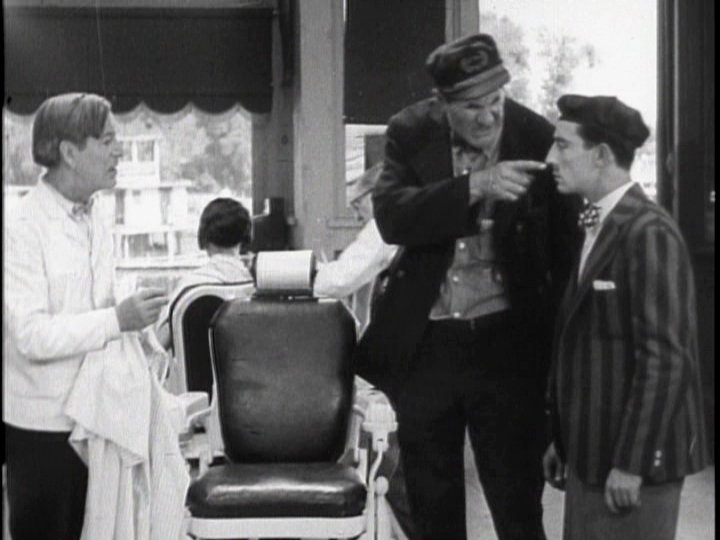
At 71 minutes, this one is feature length (for a silent film), with the story revolving around the son of "Steamboat Bill" (Ernest Torrence) coming back from college to spend time with his father, who he never knew growing up.  The rough-and-tumble paddle wheel captain is chagrined to find a slight, mustachioed ukulele player getting off the train, with the two not even recognizing each other for an entire sequence of the film. Bill's hopes of Bill, Jr. helping his lackluster boat business try to stay afloat are soon dashed, and he's even more horrified that junior is fond of the daughter of the rich man, J.J. King, who's latest venture is a fancy riverboat business that attracts riders away from his own.

The two riverboat barons try to keep the two apart, and barring that, try to sink each others' businesses.  King gets Bill's boat condemned, and the flinty steamboat captain's subsequent rage gets him incarcerated, leaving junior to try to spring his father from the grey bar hotel which ultimately fails in execution, and lands the son in the hospital.
Keaton, given a window of opportunity, bringing the house down.
Then, the winds come.  

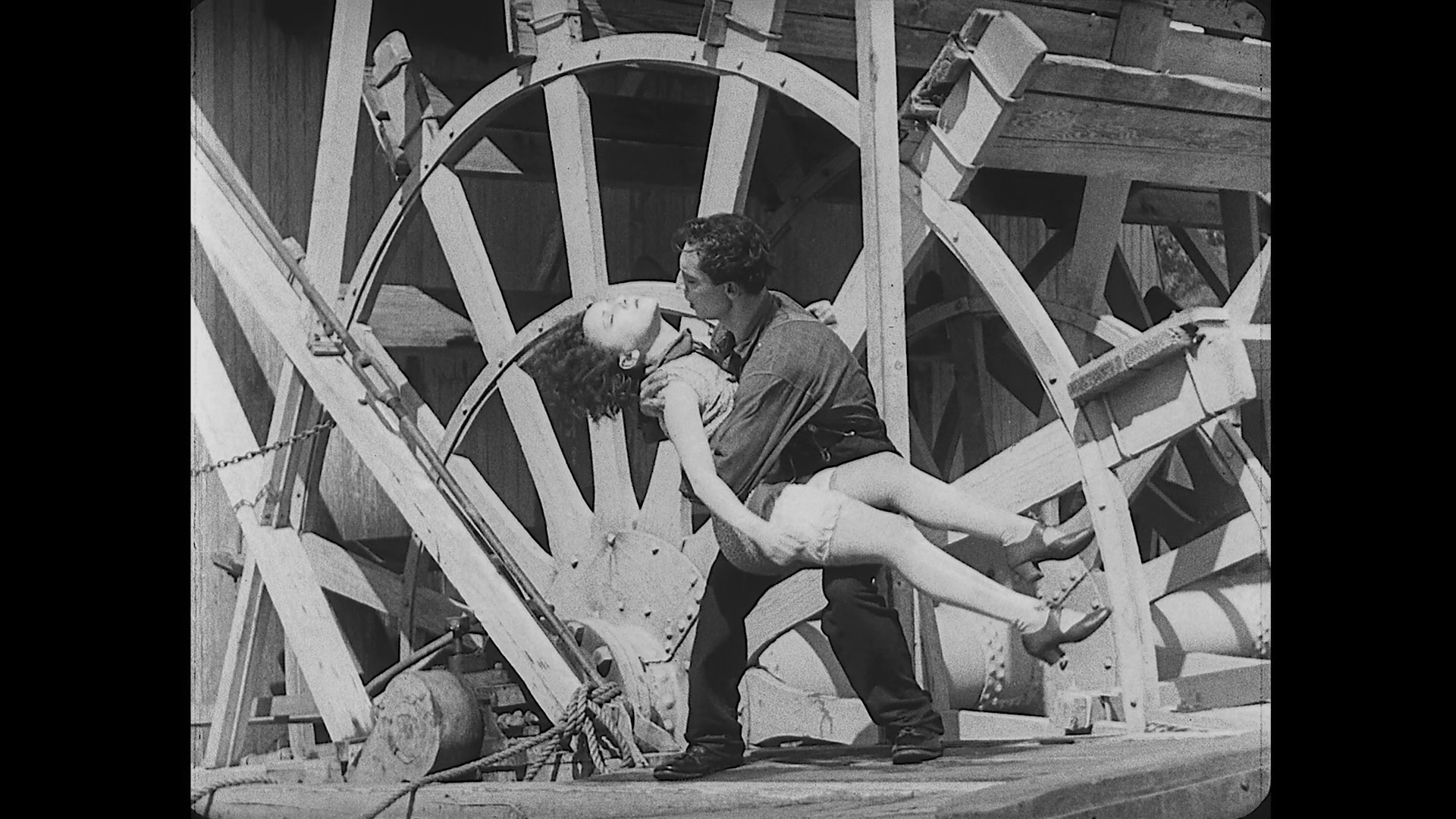
In one of Keaton's (and cinema's) most elaborate stunt sequences, a typhoon hits River Junction wreaking havoc and destroying buildings, tossing denizens around as they scramble for shelter—all except for young Bill, still unconscious in a hospital...until there isn't one, anymore. It has been ripped from its foundation by the tornado winds that come down upon the town like a deus ex machina to bring the warring parties together in the end.  It's also one of the most elaborate of the Keaton constructions that dominate the last acts of his films, where story is abandoned and the film accelerates to its final resolution by throwing at its hero any number of hurdles and obstacles that he must dance, pivot, and somersault up, over, around and through.  
This one is a marvel, using high-powered wind machines and a massive crane, the river town is calved, halved, blown away and blown down, depending on which direction opposite to it Keaton is propelling through. Even without the abundance of splintering buildings, Keaton's stunt work (against the push of six powerful wind machines) is still thrilling to watch, as he bends, corkscrews and leans impossibly forward in an impossible effort to stay on his feet.

It's thrilling, ingenious, often surrealist stuff, even more amazing when you realize that Keaton did the stunts himself, designed the sequence and directed it, a tour de force of Nature, real and imagined, on all fronts. 

The complete film is below.

Tuesday, March 24, 2015

Walking Kurosawa's Road: The Men Who Tread on the Tiger's Tail

The inability to write about the films of Akira Kurosawa to my satisfaction led me to to take a different path: start at the beginning, take each film in sequence, one after the other, and watch the progression of the man from film-maker to Master. I'm hoping I can write more intelligently and more knowledgeably about his work by, step by step, Walking Kurosawa's Road.

The Men Who Tread On the Tiger's Tail (aka 虎の尾を踏む男達 aka "Tora no o wo fumu otokotachi?") (Akira Kurosawa, 1945) Set-bound tale of a feudal lord's attempt to make it back to friendly territory after a successful naval campaign against his enemies. But, to get there, Lord Yashitsune Minamoto (Hanshirô Iwai) must travel through land controlled by one of his enemies, Togashi (Susumu Fujita), who is on the lookout for him and will kill him if he is found. To get through, he poses as a porter, accompanied by six samurai, led by Beiko (Denjirô Ôkôchi), acting as monks on a religious pilgrimage to raise funds for a temple to be built in Kyoto.

It's a tale of suspense, with very little action, save for the subterfuges, disguise, flummery, and appeals to Kataoka's patriotism and faith (which are legitimate but used for false purposes), knowing that any slip-ups will mean death by sword by a very large collection of border guards.  So, in other words, all of the heroes are lying and using the best instincts of their foe against him. Hardly the high-minded ideals one associates with dedication to country or God. In fact, the only of the group that isn't decidedly two-faced is the comic relief, another porter (played by Kenichi Enomoto), who could be Japan's answer to Jerry Lewis in his early career, whose frequent panic attacks could give it all away at any second. You'd want to strangle Enomoto's porter, if he wasn't so entertaining and a tonic against the heavy earnestness of the rest of the movie.

On location
The film was made during the last days of the Pacific War during World War II, which is why the only segment filmed on location is the forest scenes at the beginning. The rest was filmed at Toho Studios and filming was briefly interrupted to listen to Hirohito's surrender speech ending hostilities. Toho and Kurosawa were visited by John Ford during the filming, and one of the first people to see The Men Who Tread on the Tiger's Tail upon completion was British director Michael Powell. However, the film was banned by the Supreme Commander of the Allied Powers (led by General MacArthur) for its depictions of feudalism (in the attempt to make the Japanese less tied to their heritage and more embracing of American culture), but if they'd taken a more careful look at the film, they'd find that it was making a statement against the very cultural fanaticism the SCAP was trying to prevent. Oh, well. The result was that the film was banned until 1952.  
In the studio
One can't help but think that this might have had an influence in his next two films, where the war's ending and the Allied occupation of Japan played very important roles.

Sunday, March 22, 2015

Don't Make a Scene: The Last Tycoon

The Set-Up: "Tell Me a Story." This month, we'll be continuing the short series showcasing scenes that feature a story in the midst of the narrative. That story may couch the plot in a new light; it may illuminate themes or present a back-history. It may be just a distraction. It may be a side-story that resonates throughout the film and casts its teller (or its subject) into the affections or disaffections of the audience, making him immortal no matter how short their amount of screen-time.   

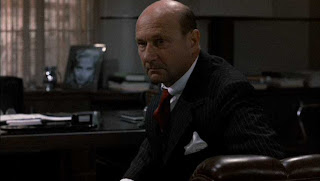
Here is F. Scott Fitzgerald's "Screen-Writing 101" interpreted by Harold Pinter, director Elia Kazan, and a young Robert De Niro (acting unusually spry and light-hearted at this stage in his career). The rest of The Last Tycoon, the film of Fitzgerald's unfinished last novel is a bit mordant, but this scene crackles, not only because of DeNiro's performance, but also due to Donald Pleasance as the stuffy British writer who "just doesn't get it (does he?)." He also becomes the audience-surrogate, drawn in by Studio Head Monroe Stahr's visual story-telling. The other two writers in the room have one line between them, and do a good job of communicating the "been there, done that" of hearing this (jesus!) speech again--the fellow on Pleasance's right doesn't say a word; he just sits with a writerly sneer on his face.

But follow the eyes (it's the reason there are so many screen-shots for a relatively quick scene). The looks that pass from Stahr to the writers and between them, do more communication than Monroe's three-corner dialog. And when he sits down, smugly satisfied with his performance, he lowers his head, waiting for the response he knows will come.

It's a bit specious, but it's a fine story illustrating how to use an audience's attention to lead them through a scene set-up. And Kazan's camera follows Stahr as he bounds around the room, playing all the parts, making sure that we see the audience reaction (Pleasance's) to each complication Stahr adds to the story.

And, of course, Stahr gets to keep the illusive nickel.


It's a nice demonstration of the sleight of hand that goes into "making pictures" (as John Ford called it) where, if you do it right, you make the audience complicit in the telling of the story, something all movies should aspire to.  It's an inexact fuzzy explanation of the inexact fuzzy experience of giving just enough information to propel story (and observer) along the ride.

The Story: What a day it's been for Monroe Stahr (Robert De Niro), Production Head for the All-American Film Corporation: an earthquake, a pretty obvious attempted pass by his boss' daughter, insecure stars, scape-goated directors, oh...and then there's that girl who's a spittin' image for his late wife that's attracted his eye. The least of his worries is a novelist (Donald Pleasance) making an uneasy transition to screenwriter, who has been summoned to Stahr's office for a little attitude adjustment. 

This is you, watching.

Action!


(Boxley walks into Monroe Stahr's office a bit diffidently, eyeing the other two writers in the room seated in front of Stahr. Stahr welcomes him and offers him a seat between the other writers)
MONROE STAHR: Sit down, Mr. Boxley.

BOXLEY: I can't go on. It's a waste of time.
STAHR: Why?

BOXLEY: You've stuck me with two hacks. They can't write.
BOXLEY: And they... bugger up everything I write.
STAHR: Well, why don't you just write it yourself?
BOXLEY: I have. I sent you some.
STAHR: That was just talk. We'd lose the audience.
BOXLEY: Talk?!
STAHR: Mm-hmm.
BOXLEY: I don't think you people read things.

BOXLEY: The men... The men are dueling...
BOXLEY: ...when this conversation takes place.
BOXLEY: At the end, one of them falls into a well...
BOXLEY: ...and has to be hauled up...in a bucket.
STAHR: Would you write that in a book of your own?
BOXLEY: Of course I wouldn't. I inherited this absurd situation.
STAHR: Let me ask you, do you ever go to the movies?
BOXLEY: Rarely.
STAHR: Because people are always dueling and falling down wells?
BOXLEY: And talking a load of rubbish!
(Stahr gets out of his chair and comes around to the front of his desk)

STAHR: Listen... has your office got a stove in it that lights with a match?
BOXLEY: I think so.
(Stahr crosses to the work-table at back of his office. Boxley's eyes follow him)
STAHR: Suppose you're in your office. You've been fighting duels all day. STAHR: You're exhausted.
STAHR: This is you.
STAHR: A girl comes in. She doesn't see you.
(Stahr crosses the room to the door, goes through it, then comes back in, looking furtively in both directions.)
(Stahr crosses to his desk and mimes the actions)
STAHR: She takes off her gloves. She opens her purse. She dumps it out on the table.
STAHR: You watch her.
(Stahr crosses back to the work-table)
STAHR: This is you.
(Stahr crosses back to his desk and mimes the actions, except for the nickel which he takes out of his pocket and bounces on his desk)
STAHR: Now... She has two dimes, a matchbox and a nickel. She leaves the nickel on the table. She puts the two dimes back into her purse.
STAHR: She takes the gloves...they're black.
(Stahr crosses back to the work-table)
STAHR: Puts them into the stove. Lights a match.
STAHR: Suddenly, the telephone rings.
STAHR: She picks it up. She listens.
STAHR: She says, "I've never owned a pair of black gloves in my life." Hangs up.
STAHR: Kneels by the stove. Lights another match.

(Boxley listens attentively, then catches himself. He's actually enjoying this.)
STAHR: Suddenly, you notice...
STAHR: ...there's another man in the room...
(Boxley can't help but look)
(Stahr crosses the room to the front door)
STAHR: ...watching every move the girl makes.
(Stahr crosses to his desk. Looks at Boxley. The other writers look at Stahr, then turn their attention to Boxley, who looks at them expectantly.)
(Stahr looks at Boxley, letting the moment hang. Then he slides into his chair looking like the cat that ate the canary. He looks again at Boxley and waits. Then he looks over at the other writer and smiles)
BOXLEY: What happens?
STAHR: I don't know. I was just making pictures.
BOXLEY: What was the nickel for?
STAHR: Jane, what was the nickel for?
JANE: The nickel was for the movies.
BOXLEY: What do you pay me for? I don't understand the damn stuff.
STAHR: Yes, you do...
STAHR: ...or you wouldn't have asked about the nickel.

 (Stahr feigns throwing Boxley the nickel, who grabs at it, then sees he's bought the illusion)
(And Stahr holds up the nickel)


The Last Tycoon

Words by: F. Scott Fitzgerald and Harold Pinter

Pictures by: Victor J. Kemper and Elia Kazan

The Last Tycoon is available on DVD through Paramount Home Video.