Sunday, August 3, 2014

Don't Make a Scene: Tinker Tailor Soldier Spy (2011)


The Story:  This week, George Smiley from 2011's extraordinary adaptation of Tinker Tailor Soldier Spy.  TTSS had the ghost of the multi-hour mini-series starring Alec Guinness (directed by John Irvin) to contend with.  When it was announced that Peter Morgan had done a draft for a new movie version of Tinker..., there were already raised eyebrows—John Le CarrĂ©'s thick, intricate, character-driven book is immense and covers a lot of ground, internationally and over time.  How could one cram all that into a single two to three hour film?

Director Tomas Alfredson managed to do it, and with scriptwriters Peter Straughan and the late Bridget O'Connor even managed to touch the highlights while adding a quiet depth to the characters, mostly without dialogue, and with a different style than mini-series and book.

Take this scene.  In the book, it's a description over dinner; the miniseries does it in flashback.  Not here.  The dialogue is mostly the same.  But the location and the way it's told is different.  The setting is Smiley's HQ for his investigation into double-agent treachery in Britain's secret service; the scene between Smiley and his "player on the other side," Karla, is described and mimed for the benefit of Peter Guillam, solely as a drunken reverie overlain with regret by Smiley.  It's haunting, peculiar and is much more effective than the earlier presentation.  There, Karla is very real, played silently and cynically by Patrick Stewart (before his career hit warp-speed) and is a fairly powerful presence, still with an air of inscrutability—an unknown quantity.

But in the film version, he's an empty chair, a memory, unseen (as he is throughout the film, his only sign of presence being the lighter that Smiley obsesses over, here—Karla's trophy from their earlier encounter that provides inside information for his plot to infiltrate "The Circus").  Unknowable, not even distinctive enough to remember (although one suspects Smiley may be obfuscating), he is a phantom, much more powerful in the not-knowing...and in his influence.

The Set-Up: Asked by the Home Secretary to look into the matter of a "mole" (a double agent) high up in the ranks of "The Circus" (code name for British Intelligence), George Smiley (Gary Oldman), former No. 2 man under "Control" (John Hurt) is leading an investigation for the traitor in the ranks.  His "inside" man is Peter Guillam (Benedict Cumberbatch), who has just risked exposure stealing documents from the Circus records room.  Under suspicion from "The Gang of Four" heading the Circus (CiarĂ¡n Hinds, Toby Jones, Colin Firth, David Dencik), Guillam begins to suspect that their chief source for information, Ricky Tarr (Thomas Hardy) might be lying to them.  Smiley, sensing Guillam's doubts, fills him in on some background that might prove useful—and painful—to Guillam in the near-future.

Action!

150 INT. HOTEL ISLAY - SMILEY’S ROOM - NIGHT 150
The two men are finishing off a bottle of Scotch. Unusually, Smiley is drunk - a result of the alcohol and the lack of sleep.
Guillam lies on one of the single beds, staring at the PHOTOGRAPHS of the four suspects Smiley has pinned on his chessmen.
PETER GUILLAM I’m sorry.
SMILEY What for?
PETER GUILLAM I wanted to believe Tarr was lying. (Beat) All this time, thinking I’m fighting a war. It’s a sham. Karla won years ago and we didn’t even know it.
Smiley watches Guillam, estimating how badly all of this is affecting him.
SMILEY (Beat) I met him once. Karla.
SMILEY   Karla.  In fifty-five. 
SMILEY   Moscow Centre was in pieces. Purge after purge. 
SMILEY   Half their Agents were jumping ship and I travelled around signing them up. 
SMILEY   Hundreds of them.
Guillam raises himself up on an elbow, listening.
SMILEY (CONT’D) One of them was calling himself Gerstmann. 
SMILEY He was on his way back to Russia, and we were pretty sure he was going to be executed. 
SMILEY Plane had a twenty-four lay over at Delhi, and that’s how long I had to convince him to come over to us instead of going home to die.
Smiley stares at the room around, projecting his memory of the Delhi cell onto their present surroundings.
SMILEY (CONT’D) Little room...I’m sitting here...he’s sitting there...
He points to an EMPTY CHAIR in front of him.
SMILEY (CONT’D) The Americans have had him tortured.
He holds up his right hand.
SMILEY (CONT’D) No fingernails.
SMILEY It’s incredibly hot. I’m very tired and all I want to do is get this over with and get back home.
SMILEY Things weren’t going well with Ann.
Guillam flinches a little, but Smiley doesn’t notice, lost now in the past.
SMILEY (CONT’D) I give him the usual pitch... Come to the West and we can give you a comfortable life. After questioning. Or you can catch your plane and fly home and be shot, like Bykov, Shur, Muranov...
He stares at the CHAIR as if expecting an answer, and slightly drunkenly Guillam finds himself turning to the CHAIR for a response.
PETER GUILLAM (Beat) What did he say?
Smiley doesn’t answer - STARES AT THE CHAIR - the silence stretching - it’s all becoming a little surreal.
SMILEY (To the chair) Think of your wife. 
SMILEY You have a wife, don’t you? 
SMILEY I brought you some cigarettes, by the way.
He mimes placing cigarettes on an invisible table, between him and the chair.
SMILEY (CONT’D) Use my lighter.
He mimes placing the lighter beside the cigarettes.
SMILEY (CONT’D) “We could arrange for her to join you, we have a lot of stock to trade. If you go back, she’ll be ostracised. Think of her. Think about how much she...”
He breaks off in sudden impatience with himself.
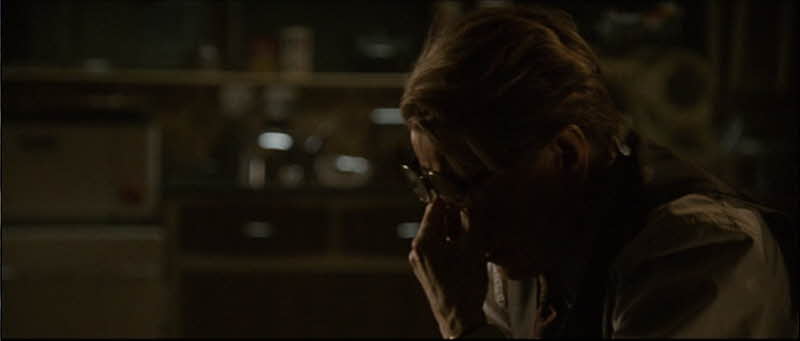
SMILEY (CONT’D) Kept harping on about the damn wife! 
SMILEY Telling him more about me, than... 
SMILEY Should have walked out, of course, but for some reason...it seemed important to save this one. (Beat) So I go on. 
“Know you’re a chain-smoker, help yourself,” 
SMILEY “We’re not so very...
SMILEY ...different you and I..”
He makes a vague “Etcetera” gesture, stares at...THE EMPTY CHAIR... something unsettling about it, as if somehow it is acquiring the GHOSTLY PRESENCE OF KARLA.
SMILEY (CONT’D)(To the chair) Look, we’ve both spent our lives looking for the weaknesses in one another’s systems. 
SMILEY Don’t you think it’s time to recognise there is as little worth on your side as there is on mine?
Silence. Smiley sits back, dropping the game.
SMILEY (CONT’D) Never said a word. 
SMILEY Not one word. 

SMILEY Next morning he got back on his plane, 
SMILEY ...gave the pack of cigarettes back to me, untouched - 
SMILEY ...this was a chain-smoker, 
SMILEY ...mind - and flew off to what he presumed would be his death. 
SMILEY He kept my lighter. 
SMILEY It was a gift - “To George, from Ann. 
SMILEY ..All my love.”
Guillam is still staring at the chair, a little awe-struck.
PETER GUILLAM That was Karla? 
PETER GUILLAM And he flew back to die rather than give in?
SMILEY Yes. (Beat) And that’s how I know he can be beaten. 
SMILEY Because he’s a fanatic. 
SMILEY And the fanatic is always concealing a secret doubt.
PETER GUILLAM What did he look like?
SMILEY That’s the thing. (Beat) I can’t remember.
He stands up, crosses to the window, embarrassed by what he has to say next.
SMILEY (CONT’D) After today, Peter... 
SMILEY ...you have to assume they’re watching you. 
SMILEY If there’s anything you need tidied up... 
 SMILEY ...now’s the time.
Guillam stares at him, realising what he’s talking about.


Tinker Tailor Soldier Spy is available on DVD from Universal Home Video.
The same meeting from the BBC mini-series
Karla (a "Pre-card" Patrick Stewart) and Smiley (Alec Guinness)


A Most Wanted Man

What Allah Provides 
or
"No.  Yes.  Maybe"

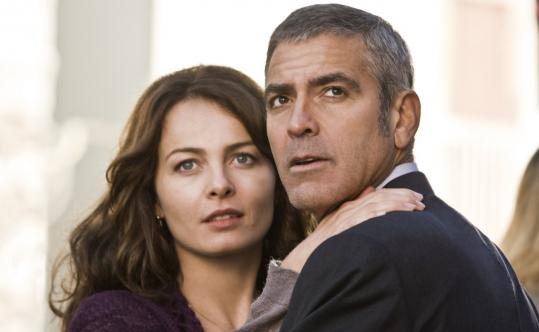
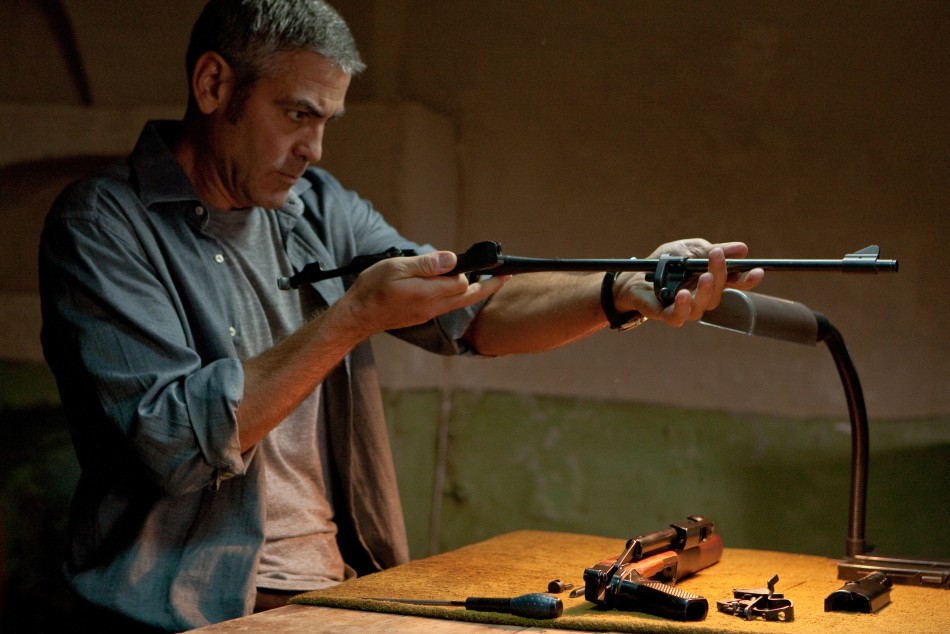
The last movie Anton Corbijn directed was The American, a pretty good movie about one particular gun-for-hire, in a network of them, that is considering retirement before being retired permanently and against his will. Starring George Clooney, it had the feeling of a Western set in the more rustic parts of Italy and clothed in the dark shades of spy-paranoia (Corbijn's previous film was Control, a bio-pic of singer Ian Stuart and, before that, music videos for the likes of U2 and Metallica) that was only undermined by a last-minute jag of sentimentality and heavy symbolism.

His latest doesn't run too far afield of that genre, an adaptation of John Le Carré's post-9/11 anti-terror study
A Most Wanted Man.  Le CarrĂ© wrote the best of the spy novels of the 60's and 70's (still does, in fact), catching attention with "The Spy Who Came From the Cold," his "Smiley/Karla" trilogy—"Tinker Tailor Soldier Spy," "The Honourable Schoolboy" and "Smiley's People." As he was a former cog in British Intelligence, le CarrĂ© wrote of spies realistically as rumpled, foibled functionaries, in stark contrast to the notorious spies of the Bond decade; heads turn when James Bond's supposedly "secret" agent walks into a room, whereas le Carre's could enter and then leave without ever being noticed...or cared about.  He stuttered a bit when the Berlin Wall fell and the Cold War ended—his "The Russia House" and "The Tailor of Panama" showed intelligence operatives struggling to maintain their relevance...and operating budgets—but after 9/11, Le CarrĂ©, ever the humanist, turned his baleful eye to the gears of government security and how human beings can be buried in an avalanche of metrics, statistics and damnable lies. 


I've always seen his "The Russia House" as an Eastern-bloc version of Casablanca, where "the problems of two little people" not only amount to more than "a hill of beans in this crazy world," but are actually more important than the high-stakes gamesmanship of self-important foreign powers. That's a theme running throughout his books, which has only increased as he's railed against U.S. tactics in the war on terror, where there is more "bully" than "pulpit."

McAdams watches Dobrigyin be caught in the middle
The titular man most wanted is Issa Karpov (Grigoriy Dobrigyin), a half-Chechen, half-Russian Muslim who has escaped torture and imprisonment and washes up in Hamburg to hide out from his pursuers and lay claim to a fortune banked away by his gangster-father. He is hooked up with a human-rights attorney Annabel Richter (Rachel McAdams) to secure the funds from banker Tommy Brue (Willem Dafoe), who had done business with his father. But Karpov is being watched by a secret anti-terrorist investigation unit headed by GĂ¼nter Bachmann (Philip Seymour Hoffman, in his last completed role before his death from drugs), whose operatives are shadowing Karpov, and deflecting the objections of the more hard-line Hamburg intelligence (led by Rainer Bock).
Bachmann (Hoffman) in his office.  The cluttered cork-board has lately
become a signifier of a crazy person in film-culture.
Bachmann and his team (including Daniel BrĂ¼hl and Nina Hoss) are keeping constant track of Karpov—one of the amusing though-lines of the movie is that, however unlikely, you find his operatives in the background of so many scenes, blending in—but don't see him as a terrorist threat, but merely a means to an end. For awhile, they've been tracking Dr. Faisal Abdullah (Homayoun Ershadi), a publicly moderate Muslim lecturer and philanthropist, who they suspect of funneling money to terrorist groups, and Karpov's inheritance may be just the thing to draw his operation out. For most of the movie, Bachmann works two fronts—out on the streets with his informers and operatives and new recruits and in the boardrooms with the officials and other units, all looking for the "big score" and devote as much time to how they can stab each other in the back as much as their foes.
Bachmann out in the cold
It's an unglamorous, ugly side of espionage, as le CarrĂ© always presented it, with secret agendas among the secret agents. Hoffman is brilliant in this, gutted on many levels, a seducer of all sorts, turning his extended network to his aims by exploiting their best hopes and away from their worst fears, while he assuages himself with a steady stream of booze and cigarette smoke. Lies are at the heart of every spy story—of the benign facade covering evil intent and the exploitation of good intent to accomplish it, even at the risk of expunging the good in the erasing of evil.

And that's the tragedy of it, as le Carré has always presented it. You can't make a better world by simply eliminating the worst elements of it. You have to replace it with something better, or evil will simply exist in another form, and we will end up making the same mistakes again and again.

Because what's the use of Intelligence, if you don't learn anything?

Friday, August 1, 2014

The American (2010)

"It's Endangered"
or
"Good-Bye, Mr. Butterfly"

After a Main Title trip through an appropriately myopic tunnel, the "mechanic" ("I'm no good with machines," he says to several people, quite rightly) emerges into a wide, scenic Italian landscape bi-sected by a winding motorway, then stops at a phone-booth on a narrow cobble-stone street in a rustic Italian town. He's boxed in, surrounded by two-story piazzas with open windows, with only two directions he can go—forward or backward. 

But the bullets can come from anywhere. Because that is what he would do.

He stands half-way out of the open door of his rental car, standing at the transom. He sees an man fixing a tractor, an woman sweeping her stoop, watching him, and a caffe habitue peering at him over his newspaper. The bullet can come from anywhere. He has only an Entrance and an Exit.

Stay or Go?  Commit or Run?

"The American" harkens back to a kind of film they don't make anymore: the art-house action film, where the locales and the characters are more important that the edit-to-shot ratio.* Where today's action films feature the locales as a blur, the soundtrack overwhelms, and characterization is defined by the quality of quip after a kill, this one, with its long lens shots, its whole blocks of time without any dialogue (or explication of any kind) and unknowable character-cyphers is a challenge to the ADD'd afflicted audience, who expect all suspense films to defy that description and merely be FPS's.**
"The American" of the title is a "Man with No Name" like the many anti-heroes of the Sergio Leone films.*** He is also a man of many names: to his phone-contact, Pavel (Johan Leysen), he is "Jack;" his "client" calls him "Mr. Butterfly"—he's into lepidoptery, and he bears a stylized pappilon tattoo between his shoulder blades; he signs into his hotel as "Mr. Clarke;" his voluptuous Italian hooker-lover (Violante Placido) knows him as "Edward."**** 

But, nobody knows him. And he doesn't reveal much. George Clooney plays him much the way Cary Grant played his government op in Notorious, bland, cool, serious, not reacting and never risking a smile. Not even the requisite 
smirk.***** Clooney's gunsmith-for-hire is thin, wiry, sports the same chopped salt-and-pepper hair-cut that, when worn by Harrison Ford, signalled that his character was "repressed," and is addicted to routine—the better to spot something out of the ordinary that might come hurtling at his neck. There may be nothing but doubt there behind the hooded, suspicious eyes, that are always searching, searching, searching for the muzzle flash (which he might survive), or the echoing discharge (which he probably won't). All he knows is that he can't let down his guard. It's the rule of most men on the run: Suspect everyone.
Because there's a lot of space, visual and aural, in the film, unaccompanied by exposition, director Anton Corbjin (Control, which I've never finished watching) has enough respect for his audience to let the pictures do the talking.  The film may reference Leone, but it's the style of Michelangelo Antonioni that Corbjin is emulating, and there's enough symbolic cinematography that one has a hard time distinguishing dream and reality, just as Clooney's gun-smith has difficulty distinguishing suspicion and reality.  So much of the movie depends on "the unseen possibility," that pretty soon you're sucked into the mind-set, watching the corners of frames, searching out the change of expressions (among the circle of assassins it happens rarely) that might signal an ambush.  That also jams it into the magazine-clip of "paranoid thriller" films popular in the 70's, post-Watergate.

But, like many of the art-house suspense films it reminds one of, the pace allows a great weakness: heavy-handed symbolism.  In fact, the final scene (which, if one thinks about it, strains credulity) is so over-layed with symbolism, that it actually undercuts the seriousness of the scene, evoking chuckles from the audience I saw it with.

Be that as it may, for most of its length, The American is compelling film-making, even though, in its dour staging, it tends to take itself too seriously,  a trap that film-makers have been trying to avoid since film-making began.  It's hard to determine whether it's a step forward or a step back.

* This caused a lot of consternation to the Tacoma audience I saw it with: the three-some in front of me grumbled at the end, and the hip-hop wannabe's next to me loudly cursed their contempt.  "I slept through half that m*****-f*****!"  "That was SHIT!" said the other (he'd missed the best part to take a phone-call in the lobby, after dropping his cell under his seat—which I helped him find).  "It was good!" I defended, "just a little heavy on the symbolism is all."  "Man, you are stu-pid," said the guy I'd helped.  "F*****' stu-pid," said the other.  I was going to mention that they'd both paid full-price for it, while I'd gotten a discount, to base my idea that stupidity might have economic consequences, but I demurred.

** And I know that I only have to explain this to the older half of my audience—an FPS is a type of video-game, described as a "First Person Shooter."

*** (Leone is paid prominent and unsubtle tribute in this film, as a classic scene from Once Upon a Time in the West appears on a TV-screen, and the soundtrack in moments of high stalking suspense pays tribute to Ennio Morriconne's (and Jerry Goldsmith's) esoteric "thumping" suspense cues).

**** Heh.

***** Grant's agent in Notorious was "Devlin," (or as Grant pronounced it "De-ve-lin"), as if to point out that, if he DID have a soul under that icey manner, it probably belonged to darker forces.