Showing posts sorted by date for query The Spectacular Now. Sort by relevance Show all posts

Friday, August 21, 2026

Update: Now I've Seen Everything Dept.: Steven Spielberg (Part 4 of 4)

Steven Spielberg, Senior Year

One of the exciting things about seeing movies over an extended period of time is seeing the growth of a genuine artist. Despite reservations about his early output, it was obvious from the outset that Steven Allen Spielberg was a dynamic story-teller and a wizard in communicating with a camera. His training manuals were the classics of the film-makers of spectacle—the David Lean's and Alfred Hitchcock's and Cecil B. DeMille's, the guys who made expansive roadshows that appealed to a mass audience. They made movies of exotic places and large personalities that could fill a Cinemascope expanse with adventure and color and grandeur. They could also manipulate an audience with their technique to fill them with awe and wonder, or propel them out of their seats in an explosion of popcorn. Movies were a thrill-ride, but with better scenery. From the beginning, Spielberg had that impresario spirit to look at an audience as a territory to be conquered: give them bread and circuses and chases. Tell them a story and give them a thrill. Very quickly, he became his own brand: "A Spielberg Film" was something to see.

The events of 9/11/2001 weighed heavily on Spielberg (as it did all of us) resulting in films where the usual sense of wonder was replaced by a loss of innocence. The shocked expressions of Dakota Fanning in War of the Worlds, and the blank look of his "Pinocchio" in A.I. were no longer the awe-inspired faces displayed in so many of his movies. Spielberg's subject matter became darker—even in Tintin—and he seemed to be grasping for stories that illustrated the problems of the world...and how we might best overcome them. At the same time, he became a subtler film-maker, and his collaborators the top of their field.  


War Horse (2011)  Spielberg likes to tell the story of meeting John Ford ("So you want to be a 'picture-maker'") and having Ford make him look at his Remington prints and observe the horizon line of the paintings. "When you're able to appreciate why the horizon is at the top of the picture or at the bottom of the picture, then you might make a pretty good picture-maker. Now get the f#&% outta here!"

War Horse proved that Spielberg had learned his lesson and quite a few other things as well.  Sure it's a horse story, but it's not like the usual "boy/girl loves horse" type of "growing up responsible" tale.  It's gritty, tough and incorporates an Equine Odyssey that offers an objective but not disinterested view of the best of man's instincts and its worst, and so much of it is done without words (and the words, by Lee Hall and Richard Curtis, are quite well done). Pictorially, it is amazing—lush, full, going from verdant Irish hillsides to man-made trenches of death, with the horse (as it would be, anyway, to the audience) the focal point of the story as his human masters fall in and out of his story.  It reads deceptively simple, but Spielberg makes the most of the visual aspects that provide a pictorial sub-text to the story, giving it far more resonance than words on the page could provide.  And there is one episode in the story—a brief truce between Germans and Brits during the first World War that is a grimly humorous reminder of the uselessness of war and how a common goal can shatter a conflict like a disagreement can shatter the peace. War Horse is an overlooked gem.


Lincoln (2012) Spielberg's long-in-the-planning biography of the almost canonized saint of the U.S. Presidency. With the help of his master craftsmen and his Munich scribe Tony Kushner—who manages to convey what was so special (and so irritating) about the man, the team focuses on the last months of Lincoln's life (Kushner's script was voluminous and Spielberg ultimately decided to concentrate on his last months), combining his relationships with the world of his family, compatriots, and enemies at the end of the Civil War, the passage of the 16th Amendment, and his death, while not treading the traditional paths of every other film that touched on the subject—Spielberg doesn't even show Lincoln's assassination at Ford's Theater, choosing instead to show the event through the eyes of his beloved son, Willie. It's a stellar cast, all providing exceptional work but dominated by James Spader's lobby-lizard and Tommy Lee Jones, whose Thaddeus Stevens has reasons for delivering the controversial amendment both ideological and personal, and, of course, Daniel Day-Lewis, whose imaginatively scholarly work on the man creates a moving portrait beyond the static images of Matthew Brady, breathing life and voice into them, making the man less of a monument, more of a man, and no less monumental for it. Much more so, the film is an exercise in showing the messy business of democracy—of seeking agreement for the greater good, despite the polarization inflicted by the various points of view, at a time when the nation was warring over higher ideals that are timeless over the short-sighted goals of economy.  Lincoln is an education in the best sense of the term, providing perspective on the man and his times...and ours.


Bridge of Spies (2015) Spielberg and Tom Hanks reunite to tell the story of insurance lawyer James B. Donovan who was roped into the no-win job of defending a communist spy (a standout performance by Mark Rylance) during the height of the Cold War and, through a combination of ideals and empathy with the man, ended up taking his case, first, to the Supreme Court to save his life, and then, later, to Berlin's Checkpoint Charlie to return him to Russia in exchange for Francis Gary Powers, the captured pilot of an American spy-plane. The film is entirely unflashy, muted and solid, has an impeccable sense of period (with no compromises for younger audiences—which is more unusual than you'd think) and still manages to be intriguing, even when one suspects how it will end—it is, after all, based on a true story. With a script by Mark Charman, it got a polish from the Coen Brothers with an emphasis on ideals...and ideals in the face of pressures, bureaucratic, autocratic, whichever side of The Wall they're on, both sides weigh in on the spirit of morality and grace. Ultimately, it is a story not about winning or gaining advantage, but of aspiring to the better part of humanness, and standing true to it.


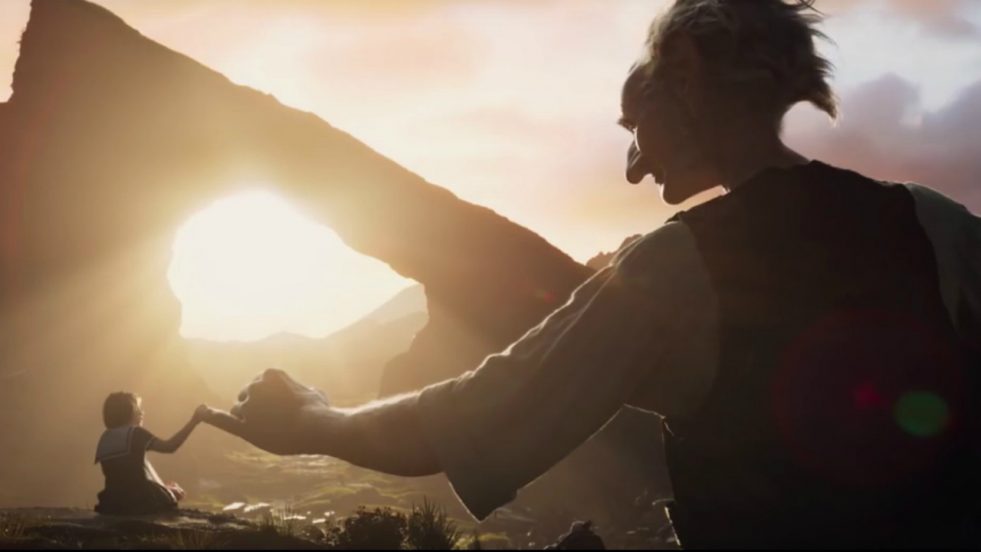
The BFG (2016) The BFG is remarkable—stunning in all sorts of applaudable ways. The effects work is stellar, making up the vast majority of the mise en scene of the movie with a fluidity and attention to detail that draws one in with fascination. This is spectacular world-building, similar to the care and beauty that went into Disney' 2016 version of The Jungle Book from earlier that Summer. And the motion-capture performances of Mark Rylance (who was the very sly stand-out for his underplayed work in Spielberg's Bridge of Spies), Jemaine Clement and the other giant actors is truly amazing, completely stepping over "The Uncanny Valley" as nimbly as if there truly were giants of great stride. Spielberg also retains his reputation as a deft director of children, getting a terrific performance from newcomer Ruby Barnhill as the heroine of the story, Sophie.

I was dissatisfied with the film, however, despite it hitting all its marks, and bringing the wonders and chills of childhood to the fore. A great children's film should also appeal to adults, as well. And I found that the film dragged (despite my delight that it wasn't a roller-coaster). Bits of business and Spielberg's scrupulous sense of place by making sure the audience knows where it is at all times bogs the movie down no matter how fluid the camera work and intricacy of the choreography. I found myself drifting off, losing focus and the sense of caring about what was going on. Perhaps it was the circumstances under which the film was made. Maybe the filmmakers couldn't bear to part with a single word or sequence that had been worked out by "Our Melissa"—screenwriter Melissa Mathison, who'd written Spielberg's E.T., and who died from cancer while the film was in production. Gifted she is, but in the editing room, a filmmaker must be equal parts story-teller and butcher. Maybe the affection for the screen-writer overwhelmed the cruelty of the knife that is required to make a tight, concise film that isn't in love with itself, so determined is its aim to win over the audience. I think this was a case of too much affection for the material to the point of protection, and maybe some hubris that a Spielberg children's film was a certain home-run. Nothing is certain in the market-place. This one may be big, it may be friendly, but its quite a few feet below giant stage.


The Post (2017) The Post was squeezed into Spielberg's schedule while post-production continued on Ready Play One and casting hit a snag on another project. The first feature script by Liz Hannah (where it was put on 2016's annual "Black List" of interesting scripts), it has a textual and sub-textual significance during the turbulent Trump years: the obvious, textual one involves the publication of the so-called "Pentagon Papers" (comprised of a Department of defense study on the handling of the Vietnam War from the Truman administration on) by The New York Times and The Washington Post; the sub-textual one involves the struggle of Post owner and publisher Katharine Graham (played superbly by Meryl Streep) to deal with a potentially ruinous and lawfully risky decision to publish when she is being bombarded from all sides by a manfully aggressive phalanx of government and Wall Street types to go against her instincts as a newspaper publisher. Spielberg can be accused of hitting some of the points a bit hard here, but there are extraordinarily nuanced sequences, culminating in one amazing sequence of a pressure-cooker of a phone-call where all the arguments in the world cannot dissuade the publisher from the role she was born to play and, because of societal and traditional women's roles that she has blithely gone along with, she has been denied. The production summarized the story by saying it was "the week Katharine Graham became Katharine Graham" and the pay-off feels more important, personally, than just defying a governmental attempt to suppress the Press, than the breaking free of a woman's lifetime of suppression. It's quite the nifty Big Statement. 


Ready Player One (2018) When Spielberg does dystopian, of course he's going to come up with an alternative to it. The extensive CGI landscapes and characters that suffuses the VR Reality "The Oasis" in Ready Player One is where folks go to when they want to "escape" the reality of life in "The Stacks"—large towers of manufactured homes that have supplanted high-rise apartments as the solution to a growing population and the breakdown of society. Of course, they never really escape—they're just playing at it. The gist of the story is that the creator of "The Oasis" bequeaths his Virtual Empire to whoever can crack the many games contained in that world. The entire world is competing for the prize (including well-funded corporate interests) but the ones who seem to be closest are a motley group of "gunters"—a mongrelization of "egg-hunters"—who call themselves "The High-Five" (having only met as avatars) and who have the best synergy to get to the end-game. But, the Big Irony of the competition is that the guy who gets there is the guy who can appreciate not having it the most. He who desires it the least wins the most.

It's a VR version of "Willy Wonka" (with a bit of "Oz" thrown in), celebrating gaming culture, while subverting it at the same time with the Big Picture. It's Spielberg at his cagiest and most ingenious.


West Side Story
(2021) Robert Wise's 1960 film of the Leonard Bernstein-Stephen Sondheim-Arthur Laurents street-tough re-working of "Romeo and Juliet" was always a favorite of the director's since childhood. But—like everybody else who's ever watched it—he realized that, as great as it is, it is flawed. And—working with Tony Kushner—Spielberg took pains to improve on them.

And he does. Some of the tent-pole songs were out of place where they were. They're switched to better spots and with better motivations. New York is no longer an abandoned silent city while the songs are sung full-throated in the foreground. The male lead, Tony (played by Ansel Elgort), now has a back-story where both his hopes and his risks are higher, the leader of The Jets, Bernardo (David Alvarez) is a professional boxer, and the city is visibly going through a displacing urban renewal project to make room for the building of Lincoln Center—where the musical would play in 1968—and there is no compromise in casting Latino's for the Jets. Important? Yeah. It is. Especially when you include Rachel Zegler and Ariana DeBose...and Rita Moreno. Also, Mike Faist is a stand-out as Riff. And Spielberg's direction is smart, assured, and, for the first time in a while, bravura. Reviews were laudatory, but audiences stayed away. Online comments were ludicrous—"I hear that 'they' speak Spanish without subtitles" (Yes, they do, but nothing crucial, just overlapping dialogue and "bridge"-statements) and (my favorite) "Why did they have to remake this?" (I dunno. Why remake "Romeo and Juliet"?). It's subtle, smart and energetic, and in every way surpasses the first version.

The Fabelmans (2022)
Spielberg's past has informed his films subtly, sometimes metaphorically. The Fabelmans, however, comes right out and spells it out. The movie
originated as a 1999 script "I'll Be Home" by Spielberg's sister Anne, and as Tony Kushner and Spielberg worked on other projects, Kushner kept pushing the director to concentrate on bringing it to a final form, something they worked out over Zoom meetings during the pandemic. It is Spielberg's first co-authored screenplay since A.I.: Artificial Intelligence, and is a clear-eyed look at his influences, drive, and conflicts as he set out to make something of himself, in a family split between the practical (his father was a computer engineer) and the fanciful (his mother was a pianist). Along the way, he sees how his dreams can conflict, rather than enhance, his reality and the cost of devotion. It's a great film, much more personal than what he has been doing of late (although his dedication to his craft has never wavered) and his look back may be the final putting away of "childish things." But one doubts that. Spielberg, even as he approaches his 80th spin around the sun, still informs every frame with the enthusiasm of a "whiz-kid."


Disclosure Day (2026) Spielberg's fourth film about humans and extra-terrestrials has a different spin than the previous three. And as those films were of their times and so, too, is this one. All four have something to say about the effect that visitors from another planet would have on Earth society.
 
But, this is the first one where Earthers are the "bad guys". 
 
Sure, the aliens are a little manipulative in getting their message across to human society (see "alien abduction," one of the many UFO "conspiracy theories" that have been marketed since the old "flying saucers" days that Spielberg references in the film), but, for the most part they are benign (the only time they weren't in a Spielberg film was in his version of The War of the Worlds in 2005). Here, it's the governments, researchers, and specialists who are the real enemy, who are determined to suppress the information that we are not alone AT ALL COSTS (Spielberg used that theme much more lightly in CE3K and E.T.) and to a pathological and homicidal degree far beyond the worth of doing it. Are you worried about aliens and "the replacement theory?" This movie makes a very good argument in favor of it.
 
The result is a roller-coaster ride of a movie where two "everyday people" (Emily Blunt and Josh O'Connor) become awake to the possibility that they were "indoctrinated" by aliens and tasked to deliver the message of alien visitation...much like apostles. They become fugitives for the entire movie, dodging bullets, tasers, and parapsychic attacks that escalate to the ludicrous point where they are pushed into the path of a speeding train leaving them clinging to a disintegrating car only to be shot at by a paralleling government vehicle. It sounds like one of those unbelievable "Fast and Furious" stunt sequences, but Spielberg films it with nail-biting glee. 
 
There are two Spielberg directing modes, and usually only one shows up per movie project. But, Disclosure Day sees him firing on all his filmmaking cylinders, both as Earnest Message Man and as The Sadistic Carny at the Roller-Coaster.
  
 
What's next for Spielberg? There are rumors that he wants to make a new Bullitt movie, starring Bradley Cooper, but it's just in the rumor stages for the moment. Tony Kushner's script of David Kertzer's The Kidnapping of Arturo Mortara (a historical piece about a Jewish boy raised Christian in Italy) looks to be next. After that, it's hard to say, as he frequently changes his mind in mid-pre-production about what's "right" to direct (for the longest time he was set to direct Memoirs of a Geisha, then abandoned it, and his long-time project Interstellar ended up being directed by Christopher Nolan). Robopocalypse was in pre-production, but isn't anymore. James Mangold directed "Indiana Jones 5". One suspects that Spielberg hasn't completely put away childish things—his directorial sense is still infused with a youthful enthusiasm. But his films have grown darker, more considered, and less feeling like contraptions.

Whatever his future work holds in store, it will be interesting, provocative, maybe even indelible.

A preview trailer of a five-part video essay on Spielberg on Indiewire.
Highly, highly, highly recommended.

Tuesday, October 29, 2024

House of Wax

House of Wax
(André de Toth, 1953) Oh, the money studio mogul Jack Warner invested in 3-D, only to see it fade away when the craze lost its "zhuzh" and no longer distracted Americans from their newly bought black-and-white broadcast television sets (epic films with wide-screen dynamics was more successful). The 1950's "3-D craze" had a little less dimension to it, fad-wise (and not very many other major studio productions were made in that format) but, that doesn't take away from the fact that Warner's investment in House of Wax created a technological achievement in film, being the first color 3-D movie with stereophonic sound—a feat that made it a surprisingly big hit at the box-office (more so than the monophonic color 3-D film, Bwana Devil) when it was first released (to those theaters that could actually accommodate the new processes), and also, ironically, made the film a staple of those new-fangled television sets (which is where I constantly ran into it in my youth). It also managed to revive the status of Vincent Price, who would spend the rest of his career starring in horror films, sometimes being the most expensive items in their budgets.
Jerrod and his Marie Antoinette—the wax-figure is "portrayed" by lead actress Phyllis Kirk
 
Based on an earlier Warner film, 1933's The Mystery of the Wax Museum—that was directed by Michael Curtiz in two color Technicolor—it tells the story of gifted sculptor Professor Henry Jerrod (Price), who is having a bit of a falling-out with his principal investor Matthew Burke (Roy Roberts)—Burke wants to see Jerrod's wax museum become a bit more sensational to attract business while Jerrod wants to concentrate on more life-like attractions on a par with his sculptures of Cleopatra, Joan of Arc, and his personal favorite, Marie Antoinette. While Burke is upstairs going over the books, Jerrod takes a meeting with art critic Sidney Wallace (Paul Cavanagh) to see if he'd be interested in buying Burke out.
Wallace is funding some archaeological dig of other and will be out of the country for three months, but fully intends to fund Jerrod's expansion of his wax museum when he returns. This is promising news for Jerrod, but not for Burke who won't wait three months and turns on Jerrod, starting a fire in the museum to burn the place to the ground to collect the insurance money. That he has left Jerrod unconscious in the burning building is of no concern to him. And the gas-lights in the structure only ensures the sculptor's doom, creating a spectacular explosion that destroys the man...and his life's work.
The unseemly Mr. Burke cashes his insurance check for 25k—nobody being very good at checking for accelerants in 1902—and doling out just enough of it to attract gold-diggers like Cathy Gray (a blonde, pre-"Addams Family"
Carolyn Jones), reassured that the body of Jerrod was never found. He shouldn't be so presumptive, as when he goes to stash the remainder of his money in his safe (fireproof, I hope!), he is attacked in his room and strangled by a mysterious black-cloaked figure, who then takes a rope and hangs the body in the walk-up's elevator shaft to make it appear a suicide.
Cathy is preparing for her upcoming date with a new fella, being helped into her frills by her housemate, Sue Allen (
Phyllis Kirk). Sue is having trouble making the rent, but Cathy assures her that she'll lend her some money if Sue's attempt to get a job as a hat-check girl falls through. It does, but after a shakedown by her landlord, Sue goes to her room and checks on Cathy, only to find her dead, and the perpetrator still in the room—a black-cloaked figure with a misshapen, scarred face. She screams and escapes through the window with the figure in hot pursuit.
She manages to lose the strange murderer in the foggy streets and finds shelter at the home of a friend (Angela Clarke) and her son Andrew (
Paul Picerni), and the next day, they go to the police (in the form of Frank Lovejoy and Dabbs Greer), who are a bit skeptical of Sue's story. But, then, they're not much help in the case of Cathy's murder—as her body has gone missing from the morgue! It's the latest in a string of disappearing corpses that they can't explain.
 Price, a young Charles Bronson, and Cavanagh
 
But, remember that art critic Sidney Wallace? He comes back into town to meet with Professor Jerrod, who is quite alive, but wheelchair-bound and his hands burned so horribly that he can only supervise the work of his assistants: Carl Hendricks (Nedrick Young) and the deaf/mute Igor (Charles Bronson, but at the time going by Charles Buchinskey). Jerrod has changed his mind about things since the previous museum's fire—now he's going to only focus on exhibits of the macabre, a chamber of horrors, if you will, of the past and present day. Including one exhibit of the suicide of Matthew Burke...with a remarkably life-like wax figure that, in the first real incident of fragrant 3-D usage falls forward into the screen—realistically enough that it must've seemed like it was falling in people's laps. With that little shock comes...
It's the half-way point of the film, and a reel change was required, but with both projectors each showing one part of the 3-D image, the proceedings had to be interrupted to manage it. I used to run projectors, but nothing as sophisticated as in the theaters, so how they managed to keep everything in sync, I wouldn't know (what happens if the film in one of the reels breaks...do they have to swap out as many frames in the other reel?*). Anyway, that's not the most interesting thing about the 3-D process. The most interesting thing was that director Andre dé Toth was blind in one eye and wore an eye-patch over it, so he couldn't have seen the 3-D images if he tried!
It's in the second part of the film where the 3-D tricks really start coming in fast, threatening to invade the audience's space: there are two more fainting spells toward the camera (as a result of squeamish reactions to Jerrod's house of horrors) as well as a rather gratuitous sequence involving the museum's barker enticing ticket-buyers with a paddle-ball breaking the fourth wall by threatening to knock the audience's popcorn out of their hands) and an equally unnecessary can-can sequence where the dancers threaten to kick out jaws, and one chorine throws her derriére in your face (the 3-D version of putting butts in seats?). But, there are subtler things—flying angel decorations, splintering doors, one prominent fist. And it must have been a shock to suddenly see Charles Bronson's henchman pop up in the frame during a critical juncture. It's not can-can girls, but it probably caused a lurch in the customers.
Still, the strength of the movie is
dé Toth's direction, done in long, tracking takes (which would have really showed off the changing perspectives in 3-D), especially the tours of each of the wax museums usually done in one sweeping tour, aided by Jerrod's "waxing" poetic about his creations. And dé Toth had a good eye (but only one) for composition, so that when he did cut away, it was always to something interesting and striking.
And, say what you will about the "Perils of Pauline" style-finish, it is a nerve-jangler with our heroine threatened to be entombed in her own wax coffin for display, and if the elaborate device used to do so isn't exactly practical, it is impressive looking, rivaling the sparking laboratories of previous screen-villains, and there's another sequence involving split-second timing with a guillotine that provides an unexpected jolt (enough that the actor involved did it under protest).
But, dramatically, the movie doesn't fool anyone. One can guess the identity of the black-cloaked figure on a murderous (and covetous) rampage in turn-of-the-century New York nearly as soon as he appears—unless you're six (which is what I was when I first saw it and the revelation was as shocking as finding out who Darth Vader was much later in my film-watching) and have had no previous experience with movie-making sleight-of-hand. You'd have to be conked in the head with a paddle-ball to be surprised by it (hmmm...maybe that's why they did it...!). But, the movie is true to its melodramatic roots (the original play on which it and the earlier version premiered in 1932).
House of Wax was voted into The National Film Registry in 2014 for being "culturally, historically, or aesthetically significant." Given its breakthroughs in color 3-D and stereophonic sound one should add "technologically" as well.

* Answer: Yeah, they did, or the resulting de-synchronization of images would cause headaches or even nausea faster than you could say "des-synchronization"!
 
"The film's out of SYNC!!"
 

Sunday, July 28, 2024

Don't Make a Scene (Redux): Paths of Glory

Last Friday would have been Stanley Kubrick's 95th birthday. I don't know if this blog will be around for the centennial, but, for the moment, here's another look at a classic scene from a classic Kubrick film.

The Set-Up:  The Kubrick Trap. There are those who see it as a maze, but it is usually more lethal than that. People don't just lose their way...they're constantly being threatened with losing themselves...or their lives. The machinations that threaten to grind the souls in Kubrick's movies take many forms: they may be societal or social—political systems, class systems—military, technological, even supernatural. They may even be hard-wired into the folds and curves of the protagonists' grey-matter (talk about your mazes!). And the people who populate in the chess-master Kubrick's films are merely pawns to those designs.

But even pawns can occasionally take a King.

Rarely.

Because I don't talk about Stanley Kubrick enough,* I'll be eventually putting up some scenes from Kubrick films that show those traps being set. This one is one of the best, from an early film in Kubrick's career—Paths of Glory—a controversial** small-budget film set during World War I, for which Kubrick had the luck to get an actor the caliber of Kirk Douglas to star.*** Paths of Glory tells the story of one attack that goes wrong, slipshod in planning and impossible in execution. The general whose idea it was to launch it in the first place is outraged and humiliated that the troops could not pull it off. And so he decides to set an example by court-martialing and executing members of the troop. He cynically decides that he will bury the evidence, blaming the men for the failure, and blustering his demands for satisfaction. He has the power and he will use it. In the chateau headquarters of the generals, the war is a game of advancement, and General Mireaux will not fall on his sword for anyone.

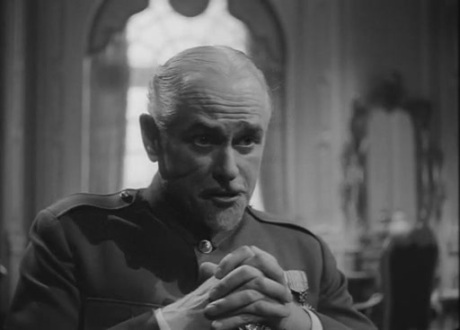
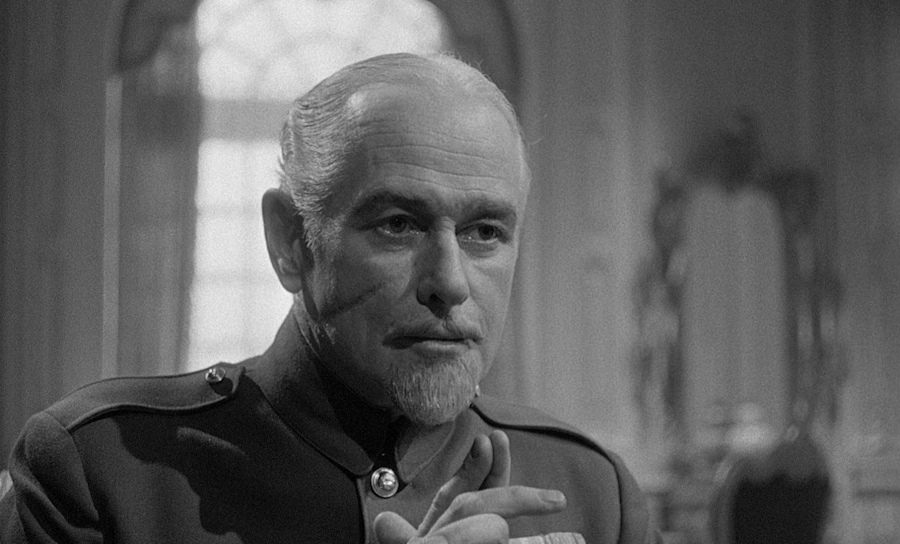
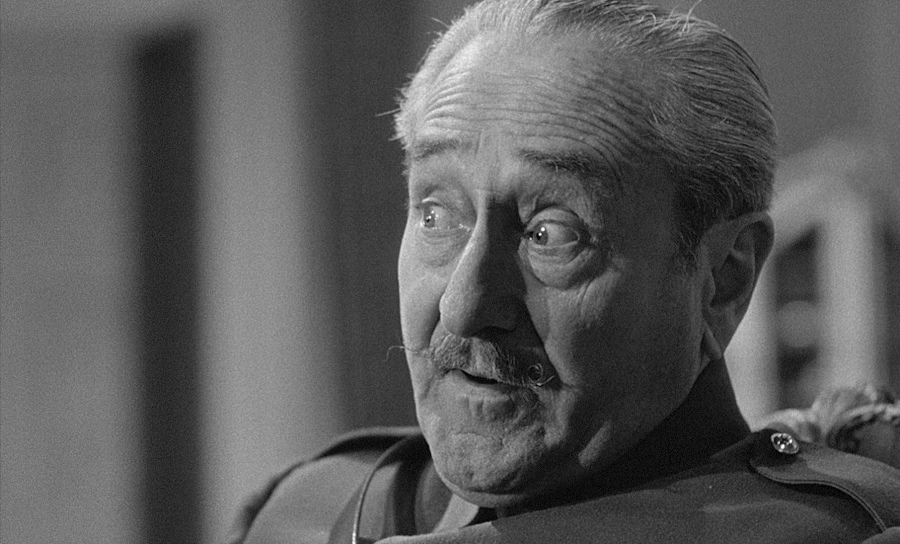
This meeting, directly after the attack, is a triangulation between strata of power—Mireaux will dress down his subordinate, Dax—in command of the troop—in front of the older, craftier General Broulard, who serves as referee, negotiator and Master of Ceremonies. Broulard is a political animal in the military game, assuaging egos, keeping his eye on both The Big Picture and his ambitious subordinates. Far from the front, he specializes in watching his back. He is the master manipulator by not choosing sides—other than his own. Mireaux, however, is a martinet—vain, egotistical and callous, seeing the war as a personal stepping stone for advancement and his greater glory. Dax, on the other hand, is literally in the trenches, making due with the situation as it is handed to him. Orders are orders, but orders come from men and men are flawed.
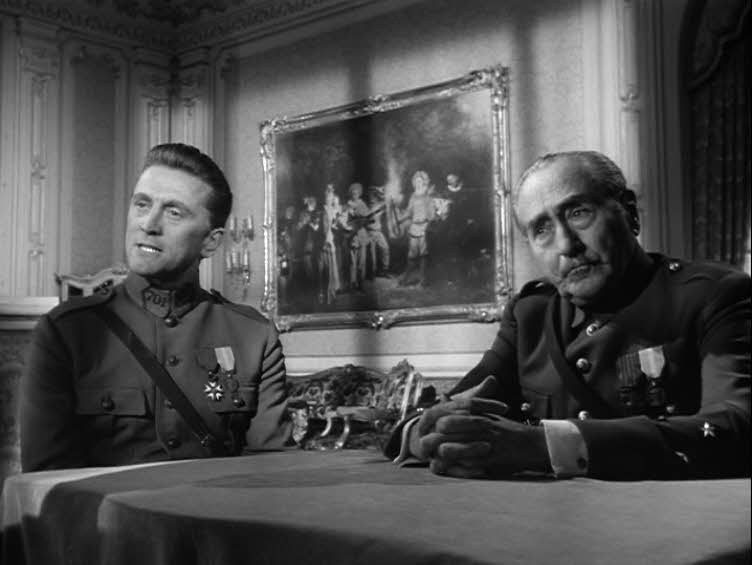
But you can't say that. Not to the men who control your life...and see lives as disposable...and a means to an end. So, Dax is in the uncomfortable position of being caught between the men who depend on him and the men who don't care. He is fighting two fronts: the simpler fight at the trenches with a common enemy with its deadly consequences, and the more complicated political fight above, with the men who control all Fates.

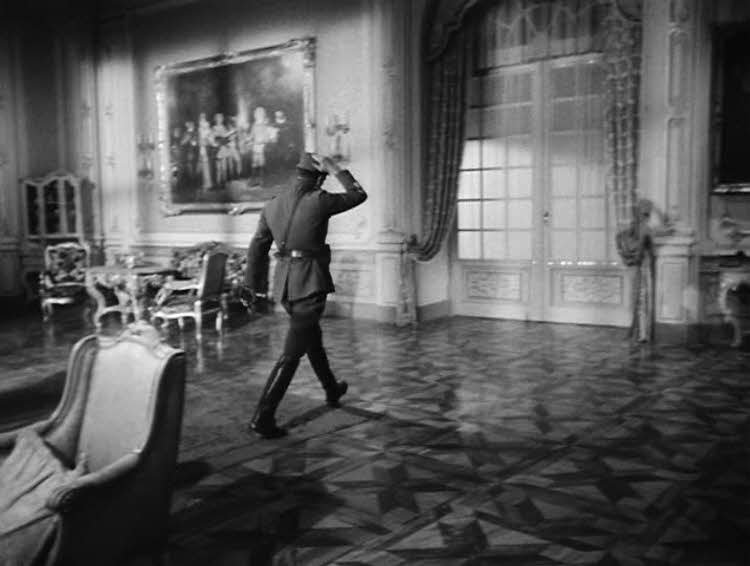
The fight for the Ant Hill done (a spectacular sequence, shot with only two simultaneously running cameras), Kubrick concentrates next on the fallout, away from the close-quarter muddied trenches and the chaos of the battlefield, in the immaculately airy rooms of the Neoclassic French headquarters that don't look like they've ever seen the destruction of war. Kubrick stages it literally for its triangulation (as he will stage the subsequent court-martial as a chess-match). The set-ups reflect the politics and advantages of the argument and the participants' relative position in it. Isolating medium shots of individuals. Close-ups for emphasis. Bonding two-shots (if one can call it bonding).

The editing more closely follows reactions than words (as usual, with the Sunday "Scene" we put the dialog only contained in the individual shots, and here the dialogue is pointedly broken up, emphasizing the visual rather than the dialog), eyes darting from one man to the other searching for political advantage, seeking the important "two against one." Even when Mireaux is at his most emotional ("For cowardice!"), Kubrick is focusing on the reactions of Dax and Boulard, the former surprised and outraged while the latter looks away, betraying a slight embarrassment at the out-burst and Mireaux's lack of civility. Kubrick saves his most looming close-up for Broulard, who must finally rein in Mireaux's self-pitying melodrama ("I was talking of [executing] a hundred men. Now we're down to 12.") for the sake of a compromise that neither of the other two parties is comfortable with.

And the dialogue is blunt, direct and brutal...but not without insinuating nuance. A product of Kubrick, Calder Willingham and early Kubrick collaborator Jim Thompson—he of the brutal pulp fiction novels, including The Killer Inside Me—it reflects Thompson's ability to see the worst in people and have them express it without their having any sense of self-examination or discretion—the ultimate in ego, bordering on pathology. The frankness of the dialogue—despite the political under-pinning that restrict it—has a tension all its own; add Kubrick's insistence on focusing on the reactions to it and you have a very full, very tense scene of one-ups-manship. Production will be starting soon on Lunatic at Large, a "lost" Kubrick project,**** written by Thompson in the late 50's. 

The Story:  The French attack on The Ant Hill, an insignificant scrap of land save for advantage and the vain-glorious ambitions of General Mirieuax (George Macready) has not gone well. Led by Colonel Dax (Kirk Douglas), the infantry were cut down almost immediately—some of the men not even able to leave the trenches.  Incensed, Mirieuax even attempted to have French guns fire on the troops to provoke them. The aftermath of the battle is a debriefing and dressing down of the Colonel by Mirieux in the luxurious headquarters of General Broulard (Adolphe Menjou), both mens' superior and a particularly political military man.

Action!


MIREAUX: I ordered an attack. Your troops refused to attack.
DAX: Our troops did attack, sir, but they could make no headway.
MIREAUX: Because they didn't try, Colonel. I saw it myself. Half of your men never left the trenches.
DAX: A third of my men were pinned down because the fire was so intense.
MIREAUX: Don't quibble over fractions, Colonel.
MIREAUX: The fact remains that a good part of...
MIREAUX: ...your men never left their own trenches. Colonel Dax, I'm going to have ten men from each company in your regiment tried under penalty of...
MIREAUX: ...death for cowardice.
DAX: Penalty of death? -
MIREAUX: For cowardice!
MIREAUX: They've skim milk in their veins instead of blood.
DAX: It's the reddest milk I've ever seen. My trenches are soaked with it!
MIREAUX: That's just about enough out of you.
DAX: Well, I'm not going to mince words and stand by when--
MIREAUX: Colonel Dax...
MIREAUX: ...If you continue in this manner, I shall be forced to place you under arrest.
BROULARD: I believe the colonel has a point, even though he makes it rather bluntly. This is not a trial...
BROULARD: ...but it does bear certain aspects of one, and Colonel Dax technically is cast...
BROULARD: ...in the role of the defense. In view of the gravity of the charges, a court of law would grant him all possible latitude in...
BROULARD: ...presenting his case.
MIREAUX: Latitude is one thing, insubordination another.
BROULARD: I am merely offering an opinion, General. Please do not feel constrained to accept it.
MIREAUX: I'm perfectly willing to accept it, General Broulard.
DAX: I'm sorry, sir. I certainly didn't intend to be insubordinate.
DAX: My only aim is to remind you of the heroism these men have shown on every...
DAX: ...occasion in the past.
MIREAUX: We're not talking about the past. We're talking about the present.
DAX: But don't you see, sir? They're not cowards, so if some didn't leave the trenches, it must have been because it was impossible.
MIREAUX: They were ordered to attack. It was their duty to obey that order.
MIREAUX: We can't leave...
MIREAUX: ...it up to the men to decide whether an order is possible or not.
MIREAUX: If it was impossible, the only proof of that would be their dead bodies lying in the bottom of the trenches.
MIREAUX: They're scum, Colonel. The whole...
MIREAUX: ...rotten regiment is a pack of sneaking, whining, tail-dragging curs.
DAX: Do you really believe that, sir?
MIREAUX: Yes, I do. That's exactly what I believe. And...
MIREAUX: ...what's more, it's an incontestable fact.
DAX: Then why not shoot the entire regiment?
[Broulard scoffs at the notion]
DAX: I'm perfectly serious.

BROULARD: Well, now, Colonel, you're missing the point entirely. We don't want to slaughter the French army. All we want to do is to set an example.
DAX: Oh, well, if it's an example...
DAX: ...you want, then take me.
BROULARD: Take you? 
DAX: Yes, sir. If it's an example you want...
DAX: ...one man will do as well as a hundred. The logical choice is the officer...
DAX: ...most responsible for the attack.
BROULARD: Come now, Colonel. I think you're overwrought.
BROULARD: This is not a question of officers.
BROULARD: Paul, we don't want to overdo this thing.
BROULARD: Suppose we just make it a dozen.
MIREAUX: I was talking of a hundred men. Now we're down to 12.
BROULARD: Paul, let's not haggle over this thing anymore.
BROULARD: Let's get it settled once and for all...
BROULARD: ...so we can all live with it.
MIREAUX: Well, perhaps I was a bit too anxious to see proper justice meted out. I've spent my entire life in the army. I've always tried to be true...
MIREAUX: ...to my principles. That's the only mistake I can ever be...
MIREAUX: ...accused of. I'll settle for this: Have the company commanders select one man from each company in the first wave. Three...
MIREAUX: ...in all.
BROULARD: Well, that's very reasonable of you, Paul.
BROULARD: The court martial will meet at the chateau at 3:00 this afternoon.
MIREAUX: Will that be...
MIREAUX: ...convenient for you, General? -
BROULARD: Oh, I won't be there, Paul.
MIREAUX: You won't be there?
BROULARD: No. I think it best that you handle this matter on your own.
MIREAUX: Probably so.
DAX: General Mireau,
DAX:...if it's at all possible...I'd like to be appointed counsel...
DAX: ...for the accused.
MIREAUX: I'll take the matter under consideration.
BROULARD: Oh, we can permit that here, Paul.
BROULARD: Consider it settled, Colonel.
DAX: Thank you, sir.
BROULARD: Well!
BROULARD: Noon straight up, Paul. I hope that you can stay for lunch, Colonel.
MIREAUX: George, I'm afraid the colonel won't have time.
BROULARD: Don't deny it, Paul, you've been hiding this man. Keeping him for your own. I think that was very selfish of you.
DAX: Thank you for your courtesy, General, but I'm afraid there isn't much time between now and 3:00.
BROULARD: Of course, Colonel. I shall look forward to the pleasure of seeing you again.
Dax snaps a salute, and exits the room.

Paths of Glory

Words by Jim Thompson, Calder Willingham and Stanley Kubrick

Pictures by Georg Krause and Stanley Kubrick

Paths of Glory is available on DVD from M-G-M Home Entertainment and on DVD and Blu-Ray from the Criterion Collection.

* This is sarcasm.  If anything, I talk about Kubrick and his films too much, and actually I try to avoid it, spacing them out to avoid some sort of overload.

** Because of its harsh depiction of the French military, it was banned in France—and if it was shown at Cannes, no doubt Kubrick would have been made "persona non grata," as Lars von Trier was in 2011.

*** Subsequently, Douglas, when producing Spartacus, replaced director Anthony Mann (no slouch in the directing department) with his young "find," Kubrick. The experience created a fine film, but soured Kubrick from ever again making a "Hollywood" picture again. From then on, it would be his projects with his rules.

**** Literally, it seems. Kubrick was going to film it after collaborating with Marlon Brando on the pre-production of One Eyed Jacks but Spartacus became his next project. Then, amidst his notes and papers and books on just about everything, the script was misplaced—something that Kubrick, it is reported, always regretted. I wrote the above piece in 2011. In 2010, it was reported that "Lunatic at Large" was being pursued for production with actors Sam Rockwell and Scarlett Johannson slated to star. As of 2024, nothing has come of it. Yet.