Showing posts sorted by relevance for query ready player one. Sort by date Show all posts

Wednesday, April 4, 2018

Ready Player One

Full Tilt Boogie (Midnight at the Oasis)
or
Virtual Encounters of the Shallow Kind

During the break that was required for the extensive special effects in Ready Player One, Steven Spielberg prepped, cast, shot, edited and released The Post, a very fine film that did get some attention for its historical material that, given the world at large, seemed all the more relevant today.* Ironically, the gee-wizardry of his new film does not feel relevant—unless someone has lived under a rock or in Mom's basement since the 1980's—as RP1 is a monument to nostalgia of the most puerile and shallow kind, piling on pop-culture references on top of each other as they flash, then die, on the 3-D IMAX screen, only to be replaced by others upon others along the way. This movie could conceivably fund its own edition of Trivial Pursuit next Christmas—and it is sure to be the most "paused" movie of the last (and next) quarter-century.

Look, I'm not a gamer. I choose to waste my time watching movies and writing about them on this worthless blog (so, who am I to judge?), so to see Spielberg do his "take" on the immersive experience with the same peripatetic verve that he gave to The Adventures of Tintin is not my idea of the director progressing as an artist, no matter how much of a roller-coaster thrill ride this film might be. It hearkens back to the Spielberg, who grew up frightening his sisters with his horror stories. It's the same Spielberg of the intimate, brilliant detail—like cutting away (in Jurassic Park) while a jeep is trying to out-pace a Tyrannosaurus Rex to a shot of a side-mirror, with the etched warning that "Objects May Be Closer Than They Appear." That Spielberg is here in abundance, unafraid to toss in asides and joking references, which he'd never dared with his more serious films like Lincoln, Bridge of Spies, or The Post. This is Spielberg on top of Play-Mountain.

Oklahoma, City in the Year 2045, not so soon after "The Corn-Syrup Shortage" and "The Band-width Wars," and the cultural hub of the world, while looking like a dystopian nightmare that would depress Calcutta and Jo-burg. The populace lives in "The Stacks," literally motor-homes and trailers stacked on top of each other, under a drab pollution-filled sky. One imagines we're in Oklahoma City because the coasts have since flooded and drowned, and that things are in such a sorry state because through every window of those trailers, people are escaping their realities by entering "the Oasis."
"The Oasis" is its own alternate reality, with its own rules, its own culture, and its own economic system, built on lives and bonuses accrued during play. It is the product of a company called Gregarious Games, a somewhat ironically named corporation as its messianic co-founder, James Halliday (Mark Rylance in a performance that resembles a morose version of Rick Moranis' accountant in the original Ghostbusters) is hardly the gregarious type. He and his former partner, Ogden Morrow (Simon Pegg) established the gaming platform, which has virtually and literally supplanted the drudgery of real life, in which the participants can compete against each other using avatars of their choice accumulating personal fortunes that can be used to improve their game and their alternate lives.
The Game 1 Grand Prix containing such vehicles as the Back to the Future Delorean, the 1960's TV Batmobile, Steven King's "Christine," the V8 interceptor from Mad Max, the van from "The A-Team", K.I.T.T. from "Knight-Rider", and the Mach 5 from "Speed Racer".

The story revolves around Halliday's be-quest announced after his death of his challenge for control of the Oasis and Halliday's personal fortune of over a trillion dollars, which can be one by winning three particular games, each rewarding a key that will unlock the ultimate challenge to win the Oasis' easter egg that will give control to the virtual kingdom. Obviously, this is a really big deal to the world at play, setting up ultimate challenges between "gunters" (the term for "egg-hunters") and a corporate conglomerate (only one?) named Innovative Online Industries—an Oasis outfitter, run by a former Gregarious intern Nolan Sorrento (Ben Mendelsohn), who wants to corporatize the Oasis for his own ends—he has already run studies that he can commercialize 80% of the Oasis' playing surface before his flashing graphics induce seizures in players.
The High Five's—Sho, Aech, Parzival, Art3mis and Daito—
talk to the Curator of the Oasis archives.
That's the hissable villain. Who are the heroes? They are the "High Five," competing gamers who form their own coalition to study notes, compare strategies and research Halliday's life—in the Oasis' virtual archives—to gain an advantage in the competition, dubbed Anorak's Quest. They are Wade Watts (Tye Sheridan), a somewhat doughy 18 year old who plays as the avatar Parzival, his mechanic friend "Aech" (revealed to be Lena Waithe), the brothers "Daito" and "Sho" (Win Morasaki and Philip Zhao) and the mysterious "Art3mis," (she's ultimately Olivia Cooke), Wade's chief rival and finally partner in the quest for the keys. While they're all putting their minds together virtually, Sorrento is trying to learn their secrets in the real world to gain an advantage in the game.
Aech blows away Freddy Krueger and sets his sights on Duke Nukem.
Spielberg sets up the duel-matches as full-tilt battles royale whether in the neon -graced corridors of The Oasis or the begrimed back-alleys of Oklahoma City—it's just that the Oasis side has so much merch and copyrighted imagery that it's tough for the real world to compete (it's not too distant from another Spielberg production—Robert Zemeckis' Who Framed Roger Rabbit?—where the real world suffers mightily in comparison to the wonders of "Toontown"). And the three game-set-pieces are so splendidly realized (especially, for me, the second one which I won't reveal other than the clue that inspires it—"The creator hates his creation") that one's interest is drawn to the world within a world, which is probably the point, even while Spielberg is showing the exploitable madness of it all, frame by meticulous frame. I mean, didn't you rather live in Willy Wonka's Chocolate Factory—the thread and thrust of which this film has in its digital marrow.
So, yeah, everybody wants to be in the Oasis—it's bigger, flashier, and something of a shit-storm for the hyper-active and hyperbolic. So, why is the movie so melancholy, especially when, after the solving of every puzzle, the film goes into a post-traumatic depression when contemplating the inner life of Halliday, The Man Who Built Everything? It's because the whole thing is an Oz-ian "there's no place like reality" info-mercial designed to teach the sad lessons of Halliday's life...by example. By the end of it, the most deserving will win the prize, but only by appreciating the clues along the way and learning the lessons to the keys of life that are merely trinketed as competition goals. The ultimate victory in the competition is in appreciating life beyond the Oasis. He who desires it least wins the most.
There's something almost biblical there. And, as with the Bible (or Willy Wonka and Chocolate Factory), in Spielberg's fable, the winner is the one who can look beyond the competition, and look deeper to the lessons inherently learned, and—in that gaming environment—put away childish things, including hero-worship, to become one's own hero, avatar's be damned.
Ready Player One is a smart little reflection of one of the simplest goals of a game—to get a life. And walk away from the table.


* He did, basically, the same thing back in 1990, where, while prepping the special effects for Jurassic Park, he oversaw the production of Schindler's List—which he was only allowed to make if he did the more popcorn-oriented film.


Wednesday, October 6, 2021

The Card Counter

Defying All Expiations
or
God's Lonely Flagellant (You Want Hearts and Diamonds, But Get Clubs and Spades)
 
I take a journal to movies; I write notes in the dark while the film is playing, scribbling down some nice turn of dialog, diagramming a frame, noting performances and trying to suss out relationships, plot-lines and actors and sometimes highlighting possible "Don't Make a Scene" material (and there's a couple, one after the other, in this one). I usually spend a good hour after the movie trying to make head-way out of the indecipherable ink-spots I put on the page.
 
The thing is, it's one of those college ruled composition books, exactly like the one into which Oscar Isaac's character, William Tell, etches his thoughts in Paul Schrader's new film, The Card Counter. Having it under my arm as I was exiting the theater earned me a couple of worried looks from the other patrons and I wanted to say "nothing to see her, everyone go home, let the people do their work." I don't think it would have helped.
Because William Tell (real name Tillich) is another one of Schrader's existential loners, like Taxi Driver's Travis Bickle or American Gigolo's Julian Kay or Light Sleeper's John Le Tor or Pastor Toller in First Reformed, who are all closed off men whose closest relationship is locked up inside their heads and only spills out in the form of a journal that they keep for themselves or for some kind of self-therapy. They live simply, apart, and are somewhat ascetic in their habits and disciplines, in part due to some deep-seated guilt that they can only erase through some long-in-gestation act...or by writing those deepest, most private (and twisted) thoughts in their composition books. The journal only delays the inevitable.
Tell ticks off all the boxes. A wandering gambler, he's ascetic because, while traveling from casino to casino, he takes two valises—one for his clothes and the other for sheets and twine, so he can cover all the furniture in his motel room (for one night only, paid in cash). Disciplined in his lack of expression and the limited pallet of his wardrobe, he has the perfect poker face, while sitting at the table with the trademark strategem—wait, wait, wait, until something happens to take advantage of. Tell writes that he likes having a routine...a regimen—it's why he adapted to his eight years in prison better than he expected.
Wait a minute. He was in prison? Yes, technically a military prison, for his part in the Abu Ghraib prisoner abuse scandal. He realizes that he did wrong and totally accepts his punishment, but that doesn't stop the guilt for his responsibility in it or the nightmares that squirm through his brain at night (Schrader's depiction of which utilizes a lens-arrangement that wouldn't work for anything except a horror film). His affinity for isolation and his tamping down of emotions is also a strategy—it keeps the bitterness that his senior officers, specifically one (played by Willem Dafoe) walked away from Abu Ghraib scot-free, while Tell (being one of the ones with his face in front of the camera) is court-martialed and sent to his own form of Guantanamo.
There, with so much time, he learned card-tricks and the discipline of counting cards. It's why he does well at the casino. Blackjack, poker—he recommends only betting black or red on the wheel to those without skills, given the casino's odds—he wins just enough to not give anything away or arouse suspicion from the surveillance suits. Then, he moves on to the next stop, those two valises his only companions.
But, he has been noticed. Le Linda (Tiffany Haddish, serious this time, but her comedy background plays nicely) runs a "stable" of gamblers and she offers to stake Tell if he's willing to do some professional gambling tournaments, which he rejects. It's too conspicuous. He has a face and he doesn't like the scrutiny. But, in Atlantic City, he comes across a security-industry seminar, one of the guest speakers he recognizes—his old Abu Ghraib commander. He watches, but he leaves and quickly. But, he's followed by a kid, Cirk—"with a c"—(played by Tye Sheridan of Ready Player One), who gives him his number and says they should talk.
It takes awhile, but eventually Tell calls him and they meet. Cirk's story is an obsessed one—his Dad was at Abu Ghraib, too, and it broke him. Mom left. Dad abused the kid. And the kid did his research and wants to make that commanding officer pay—which disturbs Tell, and so much so that he comes out of his shell a bit—telling Le Linda he's all in for tournament poker, and taking the kid under his wing, driving him around, telling him to watch and learn. At least, it gets the kid out of his apartment and out of his own head.
Writer-director Paul Schrader has always done good work, but it's never been complacent work. His protagonists are always withdrawn outsiders—much like you'd imagine a writer to be—who are sparked (and often ignited) out of their self-imposed head-space into taking action, turning from hermit to Hamlet by whatever incentive they might have. And his Calvinist upbringing makes him one of those rare film-makers who know right from wrong, and makes sure that the audience sees it, too, not turning a blind eye to the evil of the world. Actually, he sorta revels in it, like dangling the threat of Hell over a Catholic student...and enjoying it. He and Scorsese are linked in that way—Marty set up the bankrolling entity for the film and "presents"—and it makes for an interesting antidote to the casual carnage of other films. Oh, there's carnage here, but Schrader doesn't dwell on it, skirting over it in a camera move, or simply staging it off-camera with sounds and letting your imagination do the work.
 
It's tough stuff, with a bit of a righteous indignation thrown in, and won't be everybody's sure bet for entertainment, but I was all in.


Thursday, January 30, 2014

Now I've Seen Everything Dept.: Steven Spielberg (4 of 4)

Steven Spielberg, Senior Year


One of the exciting things about seeing movies over an extended period of time is seeing the growth of a genuine artist. Despite reservations about his early output, it was obvious from the outset that Steven Allen Spielberg was a dynamic story-teller and a wizard in communicating with a camera. His training manuals were the classics of the film-makers of spectacle—the David Lean's and Alfred Hitchcock's and Cecil B. DeMille's, the guys who made expansive roadshows that appealed to a mass audience. They made movies of exotic places and large personalities that could fill a Cinemascope expanse with adventure and color and grandeur. They could also manipulate an audience with their technique to fill them with awe and wonder, or propel them out of their seats in an explosion of popcorn. Movies were a thrill-ride, but with better scenery. From the beginning, Spielberg had that impresario spirit to look at an audience as a territory to be conquered: give them bread and circuses and chases. Tell them a story and give them a thrill. Very quickly, he became his own brand: "A Spielberg Film" was something to see.

The events of 9/11/2001 weighed heavily on Spielberg (as it did all of us) resulting in films where the usual sense of wonder was replaced by a loss of innocence. The shocked expressions of Dakota Fanning in War of the Worlds, and the blank look of his "Pinocchio" in A.I. were no longer the awe-inspired faces displayed in so many of his movies. Spielberg's subject matter became darker—even in Tintin—and he seemed to be grasping for stories that illustrated the problems of the world...and how we might best overcome them. At the same time, he became a subtler film-maker, and his collaborators the top of their field.  


War Horse (2011)  Spielberg likes to tell the story of meeting John Ford ("So you want to be a 'picture-maker'") and having Ford make him look at his Remington prints and observe the horizon line of the paintings. "When you're able to appreciate why the horizon is at the top of the picture or at the bottom of the picture, then you might make a pretty good picture-maker.  Now get the f#&% outta here!"

War Horse proved that Spielberg had learned his lesson and quite a few other things as well.  Sure it's a horse story, but it's not like the usual "boy/girl loves horse" type of "growing up responsible" tale.  It's gritty, tough and incorporates an Equine Odyssey that offers an objective but not disinterested view of the best of man's instincts and its worst, and so much of it is done without words (and the words, by Lee Hall and Richard Curtis, are quite well done). Pictorially, it is amazing—lush, full, going from verdant Irish hillsides to man-made trenches of death, with the horse (as it would be, anyway, to the audience) the focal point of the story as his human masters fall in and out of his story.  It reads deceptively simple, but Spielberg makes the most of the visual aspects that provide a pictorial sub-text to the story, giving it far more resonance than words on the page could provide.  And there is one episode in the story—a brief truce between Germans and Brits during the first World War that is a grimly humorous reminder of the uselessness of war and how a common goal can shatter a conflict like a disagreement can shatter the peace. War Horse is an overlooked gem.


Lincoln (2012) Spielberg's long-in-the-planning biography of the almost canonized saint of the U.S. Presidency. With the help of his master craftsmen and his Munich scribe Tony Kushner—who manages to convey what was so special (and so irritating) about the man, the team focuses on the last months of Lincoln's life (Kushner's script was voluminous and Spielberg ultimately decided to concentrate on his last months), combining his relationships with the world of his family, compatriots, and enemies at the end of the Civil War, the passage of the 16th Amendment, and his death, while not treading the traditional paths of every other film that touched on the subject—Spielberg doesn't even show Lincoln's assassination at Ford's Theater, choosing instead to show the event through the eyes of his beloved son, Willie. It's a stellar cast, all providing exceptional work but dominated by James Spader's lobby-lizard and Tommy Lee Jones, whose Thaddeus Stevens has reasons for delivering the controversial amendment both ideological and personal, and, of course, Daniel Day-Lewis, whose imaginatively scholarly work on the man creates a moving portrait beyond the static images of Matthew Brady, breathing life and voice into them, making the man less of a monument, more of a man, and no less monumental for it. Much more so, the film is an exercise in showing the messy business of democracy—of seeking agreement for the greater good, despite the polarization inflicted by the various points of view, at a time when the nation was warring over higher ideals that are timeless over the short-sighted goals of economy.  Lincoln is an education in the best sense of the term, providing perspective on the man and his times...and ours.


Bridge of Spies (2015) Spielberg and Tom Hanks reunite to tell the story of insurance lawyer James B. Donovan who was roped into the no-win job of defending a communist spy (a standout performance by Mark Rylance) during the height of the Cold War and, through a combination of ideals and empathy with the man, ended up taking his case, first, to the Supreme Court to save his life, and then, later, to Berlin's Checkpoint Charlie to return him to Russia in exchange for Francis Gary Powers, the captured pilot of an American spy-plane. The film is entirely unflashy, muted and solid, has an impeccable sense of period (with no compromises for younger audiences—which is more unusual than you'd think) and still manages to be intriguing, even when one suspects how it will end—it is, after all, based on a true story. With a script by Mark Charman, it got a polish from the Coen Brothers with an emphasis on ideals...and ideals in the face of pressures, bureaucratic, autocratic, whichever side of The Wall they're on, both sides weigh in on the spirit of morality and grace. Ultimately, it is a story not about winning or gaining advantage, but of aspiring to the better part of humanness, and standing true to it.


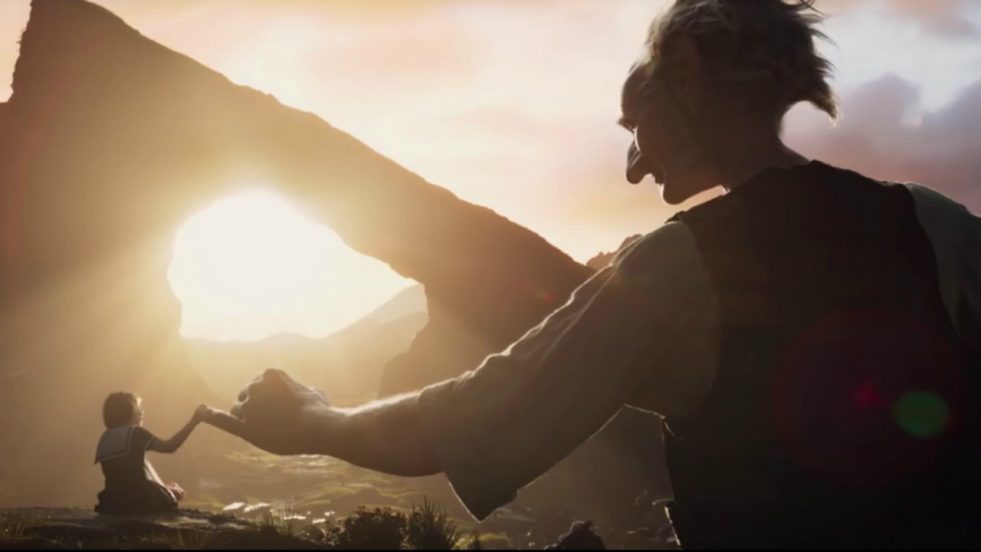
The BFG (2016) The BFG is remarkable—stunning in all sorts of applaudable ways. The effects work is stellar, making up the vast majority of the mise en scene of the movie with a fluidity and attention to detail that draws one in with fascination. This is spectacular world-building, similar to the care and beauty that went into Disney' 2016 version of The Jungle Book from earlier that Summer. And the motion-capture performances of Mark Rylance (who was the very sly stand-out for his underplayed work in Spielberg's Bridge of Spies), Jemaine Clement and the other giant actors is truly amazing, completely stepping over "The Uncanny Valley" as nimbly as if there truly were giants of great stride. Spielberg also retains his reputation as a deft director of children, getting a terrific performance from newcomer Ruby Barnhill as the heroine of the story, Sophie.

I was dissatisfied with the film, however, despite it hitting all its marks, and bringing the wonders and chills of childhood to the fore. A great children's film should also appeal to adults, as well. And I found that the film dragged (despite my delight that it wasn't a roller-coaster). Bits of business and Spielberg's scrupulous sense of place by making sure the audience knows where it is at all times bogs the movie down no matter how fluid the camera work and intricacy of the choreography. I found myself drifting off, losing focus and the sense of caring about what was going on. Perhaps it was the circumstances under which the film was made. Maybe the filmmakers couldn't bear to part with a single word or sequence that had been worked out by "Our Melissa"—screenwriter Melissa Mathison, who'd written Spielberg's E.T., and who died from cancer while the film was in production. Gifted she is, but in the editing room, a filmmaker must be equal parts story-teller and butcher. Maybe the affection for the screen-writer overwhelmed the cruelty of the knife that is required to make a tight, concise film that isn't in love with itself, so determined is its aim to win over the audience. I think this was a case of too much affection for the material to the point of protection, and maybe some hubris that a Spielberg children's film was a certain home-run. Nothing is certain in the market-place. This one may be big, it may be friendly, but its quite a few feet below giant stage.


The Post (2017) The Post was squeezed into Spielberg's schedule while post-production continued on Ready Play One and casting hit a snag on another project. The first feature script by Liz Hannah (where it was put on 2016's annual "Black List" of interesting scripts), it has a textual and sub-textual significance during the turbulent Trump years: the obvious, textual one involves the publication of the so-called "Pentagon Papers" (comprised of a Department of defense study on the handling of the Vietnam War from the Truman administration on) by The New York Times and The Washington Post; the sub-textual one involves the struggle of Post owner and publisher Katharine Graham (played superbly by Meryl Streep) to deal with a potentially ruinous and lawfully risky decision to publish when she is being bombarded from all sides by a manfully aggressive phalanx of government and Wall Street types to go against her instincts as a newspaper publisher. Spielberg can be accused of hitting some of the points a bit hard, but there are extraordinarily nuanced sequences, culminating in one amazing sequence of a pressure-cooker of a phone-call where all the arguments in the world cannot dissuade from the role she was born to play and, because of societal and traditional women's roles she has blithely gone along with, she has been denied. The production summarized the story by saying it was "the week Katharine Graham became Katharine Graham" and the pay-off feels more important, personally, than just defying a governmental attempt to suppress the Press, than the breaking free of a woman's lifetime of suppression. It's quite the nifty Big Statement. 


Ready Player One (2018) When Spielberg does dystopian, of course he's going to come up with an alternative to it. The extensive CGI landscapes and characters that suffuses the VR Reality "The Oasis" in Ready Player One is where folks go to when they want to "escape" the reality of life in "The Stacks"—large towers of manufactured homes that have supplanted high-rise apartments as the solution to a growing population and the breakdown of society. Of course, they never really escape—they're just playing at it. The gist of the story is that the creator of "The Oasis" bequeaths his Virtual Empire to whoever can crack the many games contained in that world. The entire world is competing for the prize (including well-funded corporate interests) but the ones who seem to be closest are a motley group of "gunters"—a mongrelization of "egg-hunters"—who call themselves "The High-Five" (who have only met as avatars) have the best synergy to get to the end-game. But, the irony of the competition is that the guy who gets there is the guy who can appreciate not having it the most. He who desires it the least wins the most.

It's a VR version of "Willy Wonka" (with a bit of "Oz" thrown in), celebrating gaming culture while subverting it at the same time with the Big Picture. It's Spielberg at his cagiest and most ingenious.


West Side Story
(2021) Robert Wise's 1960 film of the Leonard Bernstein-Stephen Sondheim-Arthur Laurents street-tough re-working of "Romeo and Juliet" was always a favorite of the director's since childhood. But—like everybody else who's ever watched it—he realized that, as great as it is, it is flawed. And—working with Tony Kushner—Spielberg took pains to improve on them.

And he does. Some of the tent-pole songs were out of place where they were. They're switched to better spots and with better motivations. New York is no longer an abandoned silent city while the songs are sung full-throated in the foreground. The male lead, Tony (played by Ansel Elgort), now has a back-story where both his hopes and his risks are higher, the leader of The Jets, Bernardo (David Alvarez) is a professional boxer, and the city is visibly going through a displacing urban renewal project to make room for the building of Lincoln Center—where the musical would play in 1968—and there is no compromise in casting Latino's for the Jets. Important? Yeah. It is. Especially when you include Rachel Zegler and Ariana DeBose...and Rita Moreno. Also, Mike Faist is a stand-out as Riff. And Spielberg's direction is smart, assured, and, for the first time in a while, bravura. Reviews were laudatory, but audiences stayed away. Online comments were ludicrous—"I hear that 'they' speak Spanish without subtitles" (Yes, they do, but nothing crucial, just overlapping dialogue and "bridge"-statements) and (my favorite) "Why did they have to remake this?" (I dunno. Why remake "Romeo and Juliet"?). It's subtle, smart and energetic, and in every way surpasses the first version.

The Fabelmans (2022)
Spielberg's past has informed subtly, sometimes metaphorically, his films. The Fabelmans, however, comes right out and spells it out. The movie
originated as a 1999 script "I'll Be Home" by Spielberg's sister Anne, and as Tony Kushner and Spielberg worked on other projects, Kushner kept pushing the director to concentrate on bringing it to a final form, something they worked out over Zoom meetings during the pandemic. It is Spielberg's first co-authored screenplay since A.I.: Artificial Intelligence, and is a clear-eyed look at his influences, drive, and conflicts as he set out to make something of himself, in a family split between the practical (his father was a computer engineer) and the fanciful (his mother was a pianist). Along the way, he sees how his dreams can conflict, rather than enhance, his reality and the cost of devotion. It's a great film, much more personal than what he has been doing of late (although his dedication to his craft has never wavered) and his look back may be the final putting away of "childish things" but one doubts that. Spielberg, even as he approaches his 80th spin around the sun, still informs every frame with the enthusiasm of a "whiz-kid."

What's next for Spielberg? There are rumors that he wants to make a new Bullitt movie, starring Bradley Cooper, but it's just rumor stages for the moment. Tony Kushner's script of David Kertzer's The Kidnapping of Arturo Mortara (a historical piece about a Jewish boy raised Christian in Italy) looks to be next. After that, it's hard to say, as he frequently changes his mind in mid-pre-production about what's "right" to direct (for the longest time he was set to direct Memoirs of a Geisha, then abandoned it, and his long-time project Interstellar ended up being directed by Christopher Nolan). Robopocalypse was in pre-production, but isn't anymore. James Mangold is directing "Indiana Jones 5". One suspects that Spielberg hasn't completely put away childish things—his directorial sense is still infused with a youthful enthusiasm. But his films have grown darker, more considered, and less feeling like contraptions.

Whatever his future work holds in store, it will be interesting, provocative, maybe even indelible.

A preview trailer of a five-part video essay on Spielberg on Indiewire.
Highly, highly, highly recommended.

Thursday, May 26, 2022

Free Guy

BFD for the NPC
or
Thumb-Twitching at the Movies
 
Guy (Ryan Reynolds) wakes up every morning, feeds his fish ("Good morning, Goldie!"), pulls out his usual outfit—short-sleeved blue shirt, khakis—from a closet full of short-sleeved blue shirts and khakis, brushes his teeth, eats breakfasts, grabs a coffee (medium coffee, cream, two sugars) and goes to his job as a bank teller ("Don't have a good day. Have a great day!")...which will be robbed...every day. Without fail.
 
Oh, I didn't mention the commute.
 
Guy lives in Free City, which is a video-game. Walking to work, he is constantly witness to all sorts of disasters, natural and unnatural, none of which can kill him if he's on his normal route to the bank. He is an NPC—a non-playing character, an extra, a background figure. He's coded, but he's robotic. Unless something hits him and kills him, he's going to do the same thing, go the same route, be the same Guy, a nobody, a drone, a cog, a non-essential worker.

And I know how he feels.
Guy's a part of the landscape, but Free City is constantly invaded by the muckery inflicted by real-world players, all represented by avatars wearing sunglasses. The chaos they cause is just part of the routine, until Guy notices a woman (Jodie Comer) walking down the street, bopping to the Mariah Carey song "Fantasy" which he recognizes. Why, you may ask? Well, that would be spoilery (and, frankly, a little unbelievable—but, go with it). He's intrigued by her, wants to know who she is, and inspires him to don player sun-glasses he's acquired from one of the bank-heist perps.
What he finds is a real-player's perspective of his world—pixelated mind blown! He is made aware of an entirely new world in which he is not merely a part, but could become a participant; he has some measure of control and he knows that the woman—named "Molotovgirl"—is somehow involved. So, he must find her, and find out what he needs to know to become the master of his own fate.
Tough work. But, the cast—especially in the Free City sections—makes it enjoyable. Because that whole area is a fantasy and anything can happen (including cameos) there are surprises and Easter eggs galore, plus it has Ryan Reynolds at his most winsome. The movie is more of a slog out in the real world where the issues are creative rights over code rather than self-actualization, and despite the best efforts of these actors—
Taika Waititi tries damned hard for laughs and Comer's real-life programmer Millie has less jolt than Molotovgirl—these sections of the film must be endured, rather than enjoyed.
Of course, you've seen it before...and better. The "Simulation Hypothesis" has been around since people decided they liked their dreams better than being awake. The trope was used in a lot of "Twilight Zone's" and other sci-fi/fantasy product like
Rainer Werner Fassbinder's World on a Wire, the "Men in Black" series, The Matrix (of course) and Ready Player One. One of my favorite instances was in an episode of "Star Trek: The Next Generation"—"Ship in a Bottle"—where, after trapping a hologram of Professor Moriarty in a small cube version of a holo-suite, Captain Picard muses "Who knows? Our reality may be very much like theirs, and all this might just be an elaborate simulation, running inside a little device sitting on someone's table." 
 
Just so.
The concept is so fascinating that real-world people can abandon their limited lives to immerse themselves in the video-worlds to imagine themselves as better versions (in the things they admire—like kill-ratios) while their biological clock is ticking down, all in the quest of earning more imaginary lives. Video games are the crypto-currency in our biological banking system. But, do they value their psuedo-lives more? Than their actual lives? Results may vary.  I sense a screenplay synopsis coming on.
For me, I don't play video games anymore. I find them a waste of my dwindling time here on Earth. So, I didn't "geek" over Free Guy, a lot of the inside referenced going right over my head. But, I enjoyed enough of it that I didn't care—and the movie plays well enough without insider knowledge. I also liked the fact that I got to watch it on free HBO while staying in a hotel in Oregon, a way to pass the time where I didn't "want those two hours of my life back"—real or virtually.

Thursday, October 24, 2024

Saturday Night

"I Didn't Tape the Dress Rehearsal"

 or
"Who Are You in the Metaphor?"
 
I like director Jason Reitman's work, whether he's swinging for the fences (Thank You for Smoking, Up in the Air) or playing it safe (Ghostbusters: Afterlife, Juno, Young Adult). I'm sure with every single one of his projects he did not believe he was "playing it safe." All of his films, I'm sure, had challenges that I'd never be privy to, that affected his decisions to make the film, or how he made them. 
 
Maybe it's because these projects all hover around the same theme, "Lies we tell ourselves," which seems to show up in all of his work, where we're never sure if anybody's telling the truth because it's our instinct to believe the lie. That's quite a sophisticated thesis and sometimes the movie doesn't warrant the effort and sometimes it does, but it's a very American trait, and given his willingness to go back to it again and again, I don't think Reitman could ever make a movie not set in the United States. We seem to have that weakness, whether it be hope or hubris or merely sleeping through the sedative of "The American Dream".
It's hard to say where Lorne Michaels (played, again brilliantly, by
Gabriel LaBelle of The Fabelmans) falls in those options. I'd wager on "hubris" these days, but back in the days when "Saturday Night" (the first title of what would become "Saturday Night Live"*), who knows what it might have been. Lorne Michaels was Canadian, for one thing, but he'd had a lot of success in the States as a writer and when NBC was in one of their little tiffs with "Tonight Show" host Johnny Carson, they decided they wanted to prove to their late night star that they didn't need him and that they didn't have to fill an empty Saturday late-night slot with another re-run of one of his past shows. NBC Late-night "suit" Dick Ebersol (played by Cooper Hoffman) was charged with filling the time.
The idea was a "live" sketch comedy show with prominent musical acts who didn't show up on the likes of "The Dean Martin Show" and more in spirit with "The Smothers Brothers Comedy Hour" (which had been canceled after many problems with the network over material deemed too controversial), but without regular hosts—initially the idea was to have rotating hosts of Lily Tomlin (Michaels had produced one of her specials), Richard Pryor and George Carlin, but Pryor made NBC nervous—and, with that spirit, aimed for a younger audience demographic and a hipper crowd than NBC was used to garnering. Michaels wanted to make a show that parodied television for an age-group that grew up watching television (and now, ironically, is making a version that for kids who grew up watching "Saturday Night Live"!)
Having read the oral history "Live from New York: The Complete Uncensored History of Saturday Night Live as Told by Its Stars, Writers, and Guests" (by James Andrew Miller and Tom Shales), and I know a lot of the stories culled for Reitman's Saturday Night, some of which happened, some of which only happened later during the chaotic first season, and some of which didn't happen at all—the bit with Milton Berle (J.K. Simmons) dressing down Chevy Chase (Cory Michael Smith) didn't happen (although Berle did show off the size of his penis to SNL writer Alan Zweibel...at Zweibel's curious request). Yes, a lot of it is true (and Reitman goes into the whole Johnny Carson dilemma with the moment it's decided to go "live" with the show or roll the Carson tape being the dramatic high-point), but some of it is left out...like character actor George Coe's short tenure as a "Not Ready for Prime-Time Player" and an awful lot of short shrift is given the writers. But if you put all of it in, it would have been epic-length—not unlike Michaels' 3 hour dress rehearsal that has to be cut down to an hour and a half.
Even with the deletions, Reitman has to move his movie fast and it hurdles along in long tracking shots until it finds a conversation of interest or an arresting image—frequently involving a llama—then swings his camera between each side of the discussion before veering off with a passer-by who'll act as tour-guide to the next section, as sub-plots whirl in the background. It's not done in one continuous shot—something this complex would make Alfonso Cuaron's head, or
Alejandro GonzĂ¡lez IĂ±Ă¡rritu's continuity director, explode—but one gets the simulation of continuous unbroken action for a good part of the film and it ramps up the tension, if the myriad disasters falling around Michaels' head—be they flaming scripts or newly-installed studio lights or a Belushi-hurled ash-tray—weren't enough. 
Of course, it's tough to give this stuff any verisimilitude without threatening to turn it into caricature—Labelle assiduously avoids the Michaels-based "Dr. Evil" voice, for example**—but one wonders if the audience cares, since they know Chevy Chase from endlessly repeating "National Lampoon" movies or his "older" roles and probably don't know any of the writers at all. Some of the passing references to other "Saturday Night" bits might go over their heads. And one, rather sheepishly, admits that the movie will probably play with "the older crowd" beyond the show's originally intended demographic so that it becomes an episode of nostalgia. Yikes.
I remember "Saturday Night", initially, because it aired in rotation with NBC "Weekend", a brilliantly written news program with Lloyd Dobyns and Linda Ellerbee, that was a favorite of mine and I was always fairly irked when it wasn't on and "Saturday Night" was. It grew on me, however, when Paul Simon and then Richard Pryor hosted (in one of the best overall episodes of the show's first season). And although I think the past couple of seasons have been pretty strong, one can't help but be chagrined that the show is 50 years old and that it's audience is about the same as our folks' when they were watching "Dean Martin."
It would have been the ultimate irony if Reitman had ended the film with an acknowledgment of that fact. One would doubt it would get the approval of Michaels and his production company Broadway Video who had little to do with this movie other than to say "well, we won't say you can't can't do it" (and the "disclaimer" about "work of fiction" and "persons, living or dead" is a briar-patch of timorous legalese). Even self-described "revolutionaries" get old and stale after awhile...just as sure as "Generalissimo Francisco Franco is still dead".
The very first sketch on "Saturday Night":
Head-writer Michael O'Donahugh, John Belushi and Chevy Chase
* The reason they didn't use the the "SNL" title initially was because competing network ABC already had a variety show called "Saturday Night Live"...hosted by...Howard Cosell?
 
** And kudos must go to Nicholas Braun, who plays both Andy Kaufman AND Jim Henson.
 
Competing posters of Saturday Night
which, more, in spirit, tells of the difficulties they had.