I'm re-running this piece as today marks the 100 Anniversary of the publishing of The Great American Novel, "The Great Gatsby".
It is in the public domain; the copyright expired January 1, 2021.
"There are no second acts in American lives"
F. Scott Fitzgerald
Maybe in America, but in Hollywood, there are. We call them "remakes." Like Dashiell Hammett's "The Maltese Falcon"; Warner Brothers did three versions beforethey got it rightand then, wisely, they stopped. If they tried it again, the end-result would be reviled, because it would inevitably and unenviably be compared to the 1942Humphrey Bogart-John Huston version and it would be found lacking, not only as a film, but as an adaptation of the source material. It is so close, in spirit, if not the letter, there'd be no point. You can't improve on it. But not "the great American novel"—"The Great Gatsby," written in 1925 by F. Scott Fitzgerald, who was finding his feet trying to define the American culture that was exploding out of the fortunes garnered during The Industrial Age into The Post-Gilded Age. It seems that every decade somebody unearths it from American Literature 101 and tries again to do right by it. And the attempts started the year after it was published...
"For we must consider that we shall be as a city upon a hill, the eyes of all people are upon us; so that if we shall deal falsely with our God in this work we have undertaken, and so cause Him to withdraw His present help from us, we shall shame the faces of many of God's worthy servants, and cause their prayers to be turned into curses . . ."
John Winthrop, 1630
(Herbert Brenon, 1926) Based on the Broadway adaptation byOwen Davis and directed byGeorge Cukor, the silent adaptation in the words ofNew Yorker critic Richard Brody "got the parties right"—why wouldn't they being so close to the source?—and featuredWarner Baxteras Gatsby,Lois Wilsonas Daisy Buchanan,Neil Hamiltonas Nick Carraway andWilliam Powellas George Wilson (eh? Powell could have played either Gatsby...or Tom Buchanan...and nailed it), this version (despite extensive searches) is one of those silent films that has been lost through the ususal causes of time, neglect, poor storage and the explosive nature of its nitrate stock. The only evidence remaining of it is the trailer, which you can see below, old sport.
Reportedly, Scott and wife Zelda saw it in 1927 and walked out half-way through. Their opinion Zelda mentioned to their daughter Scottie in a letter: "We saw The Great Gatsby at the movies. It's ROTTEN and awful and terrible and we left."
The secret of a great success for which you are at a loss to account is a crime that has never been found out, because it was properly executed.
Balzac
(Elliott Nugent, 1949)Richard Maibaum—who is best known for scripting so manyJames Bond films—was the guy behind the '49 version, urging friendAlan Laddto make it. As producer-writer of the film, Maibaum had casting control, and as Ladd saw it as a great acting opportunity (and Paramount had him under contract), the studio used it as a carrot to influence Ladd to do other films. Maibaum and the original director John Farrow(interestingly, father ofMia, see below) disagreed over who should play Daisy and when Farrow wouldn't let go of the idea ofGene Tierney, he was canned over Maibaum's choice, Betty Field. This version starts in the present as Nick Carroway (Macdonald Carey) and Jordan Baker (Ruth Hussey), old married couple, visit Gatsby's simple grave ("But it's not him, Nick, it's not his style." "No, he'd have fancied something like Grant's Tomb.") etched with an inscription from the Bible—Proverbs 14:12 (which is "There is a way that seemeth right unto a man but the ends thereof are the ways of death.")
Just to position us time-wise, Carey's Nick lamely has to add "He seems like someone we knew in another time, another life, another world..." Well, it was "the Jazz Age" and Prohibition and, since then, there'd been a world war (with selfless rationing) where everyone was doing their part (as legend goes), but it is only useful hand-holding for those who have no idea the story takes place in the past (it doesn't help that knowledge that the fashions and dances are more contemporary, but the cars have a vintage feel). One would think one could get a clue from the dates on the head-stone, though.
This moral distancing from the story probably served a short-sighted convenience at the time, post-World War II, but it certainly doesn't serve the story very well. Perhaps it was to provide an enveloping "Happy Ending"—it all turned out all right in the end for Nick and Jordan, the secondary characters, so everything's fine. Too bad about the folks the story is about, though, huh?
In the book it is rumored that Gatsby once killed a man, but the 1949 makes it clear that he has...at least one...as he guns down a car full of holes and sends it crashing while on a bootlegging run. Ladd's Gatsby is less a man of mystery than a man of many mysteries, none of them seeming to ring true. We see Gatsby accompanied by Myron Lupus (Ed Begley) and "man" Klipspringer (Elisha Cook, Jr.) the day Gatsby drives up to "the valley of ashes" to find the lavish house at West Egg. Lavish it may be, but this version of "Gatsby" has a studio feel to it, all back projection and false sky-prosceniums. It's slightly claustrophobic and, despite the abundance of faux-white marble around, looks fairly cheap. Gatsby buys the West Egg mans' and walks outside through studio-"fog" to see the beckoning light from the Buchanan dock "just" across the way.
Cut to a party with Nick Carroway in attendance, but no idea why he's there. He runs into Gatsby purely by accident, suspecting him to be just another partyer and, after "bouncing" one of his "bootlegger" pals from the premises, imposes on Nick to host "the get-together" with cousin Daisy (Betty Field), he takes the opportunity during one of his parties to explain his history with an out and out fabrication that even Nick sees right through, so he tells another one about working for a man who bequeaths him a tidy sum of money. "That was in the old days when I was a sucker. Then I wised up." He doesn't waste any time asking Nick—second-cousin to Daisy Buchanan—to arrange a meeting, even offering some stock market business: "Every man has his price, Mr. Carroway. What's yours?"
The meeting is arranged with an anxious Gatsby and an ambivalent Nick and the affair between the two parted lovers begins anew. At least, that's what we're lead to assume—Ladd was so concerned about his image that he does not allow his Gatsby to be shown kissing a married woman. In fact, there's a lot of self-censorship going on: it's okay to show Gatsby plugging away at his gangster rivals, but any extra-marital affairs, whether between Gatsby and Daisy (or Tom Buchanan (Barry Sullivan) and Myrtle Wilson (Shelley Winters, nice casting that) or lost between scenes; there's even an attempt by Daisy and Tom to try to warn Gatsby that he's being hunted by a murderous George Wilson (Howard DaSilva), just to show you that they're not "bad people," despite all appearances to the contrary. That's just not the book.
Where the movie shines is in Ladd's portrayal of Gatsby—movie-star confident, but almost child-like in his devotion to Daisy (when the Buchanan's attend a Gatsby party, Ladd's host is only too anxious to steal her for a dance and the look on his face is ecstatic), which leads to a dull confusion of realization when his dreams go south. It's a nice portrayal, even if it's been buffed to appease the censors. And there's something of a practical casualness when he's seen shooting people at the beginning, a reflection of the casual cruelty that will lead to his down-fall later in the movie.
(Jack Clayton, 1974), The only reason Paramount's head of production,Robert Evans, wanted to make a movie of "The Great Gatsby" was because his wife (at the time) Ali MacGrawwanted to play Daisy Buchanan.*That was enough for Evans—at the time, the Paramount "golden boy"—to start an elaborate pre-production of a multi-million dollar picture, hiring his Godfather directorFrancis Ford Coppolato write the script and Jack Clayton to direct. Then, MacGraw signed to doThe GetawaywithSteve McQueenand the Evans-MacGraw marriage collapsed. Evans was not about to continue the picture with MacGraw in thelead, so he went casting to no real satisfaction, untilMia Farrow, who'd worked with the producer on Rosemary's Baby wrote him a note that said "Bob, can I be your Daisy?" She was signed, which rounded out an otherwise excellent cast, which included one veteran from the 1949 version—Howard DaSilva, who played the cuckolded George Wilson in that version, plays Meyer Wolfsheim "the man who fixed the 1919 World series" (who was identified as "Myron Lupus" in the 40's version—showing that the latter film wasn't afraid to tackle the anti-semitism of the novel or the prejudices of the moneyed upper-class as expressed byTom Buchanan, played snakily byBruce Dernin "the Redford version").
This was the first adaptation I had seen, and my memories of "The Great Gatsby" are always associated with the season of Summer. I read the book during a vacation and this one was released in that season and it's reflected in the shimmering cinematography suffused with scrimmed lenses and star-filters as well as the veneer of sweat carefully applied by the make-up staff that provides its own kind of veil for the stars. The '74 Gatsby has a distance to it that separates its audience with a gauzy wall that undercuts the drama and makes us not care a fig about the people in it. Everything looks great, but the figures in the center could use some work.
Part of the fault lies in the stars: Robert Redford is a great choice for Gatsby as a vision of the man, but Redford is an intelligent actor who has always fought his looks, and here he overthinks it. His meeting with Nick is faltering, fumbling, and a bit embarrassed, it is not that of a man setting up the gambit for which he has compromised his integrity and risked his soul. The only time you see a flash of how good Redford could be is when he nearly comes to blows with Tom Buchanan—Clayton cuts to his fist tightening, then to a close-up of Redford flashing his million dollar smile. He wants the fight. He's the poor boy who didn't get to marry the rich girl and wants to paste the face of the guy who did.
William Goldmandesperately wanted to do the screenplay for Gatsby—at the time Truman Capotewas taking a stab at it—but came away delighted with Coppola's screenplay. Not the movie made from it, however ("they basically ignored it" said Coppola). Goldman blamed Clayton's direction—"Jack Clayton is a Brit...he had one thing all of them have in their blood...a murderous sense of class," he wrote in his follow-up to "Adventures in the Screen Trade", "Which Lies Did I Tell?" The people, the revelers, are fools and he shows the squalor, rather than the foolish hope that befalls every one that burns the candle at both ends, gambles on a "get-rich-quick" scheme, or thinks that there might be a reckoning.
That's the spirit you want to end the Tragedie of "The Great Gatsby." What does Clayton's version leave us? With a tacked on credit sequence of decamping partiers over a squeamish version of "Ain't We Got Fun?" Maybe they wanted to leave us with something upbeat to walk up the aisle to, rather than contemplate what has gone before. I remember seeing that part of the movie as a slap in the face. It made a facile treatment only that more cynical.
* Well, maybe not the only reason—Evans still harbored the idea of becoming a movie-star despite having much more power in Hollywood that a mere actor would. Given his ego and the dream-world in which he lived, he might have imagined himself in the Gatsby role, as he certainly lived the lifestyle. He certainly must have saw himself as some prototype of Gatsby. But, after this movie's box-office, his productions became more desperate, less sure—he was set up to star with Jack Nicholson in the second part of the Chinatown trilogy—and he became addicted to drugs and it all came crashing down. He must have certainly read the Gatsby novel...he just didn't heed it.
"Yours in Great Depression" During the Baz Age or I'm Half Crazy All for the Love of You....
There have been several versions of F. Scott Fitzgerald's Great American Novel that have hit the big screen since the novel was first published in 1925, and nobody seems to get it right, if "right" can be got at all. There's a "lost" silent version with Warner Baxter, a 1949 version adapted by Richard Maibaum with Alan Ladd that emphasized Gatsby's gangster roots, the Robert Evans vanity production of 1974 with Robert Redford and Mia Farrow, directed bloodlessly by Jack Clayton. It's a challenge to produce such a tragedy that has a boisterous first act, and such a downer of a second, but that is what makes it so special, and so American. In fact, the best version must be taken out of the novel, which was written in the midst of the period in which it was set, and take into account future events—the stock market crash in 1929 and the following "Great Depression," which sounded the death-knell for The Jazz Age with a long sustained flat note. Fitzgerald's prescient, cautionary novel proved historically accurate with 20/20 foresight to the extent that you cannot make a movie of it un-ironically, given the past that was its future, and you cannot make a complete movie of it while remaining blind to what it did not foresee in reality, but captured artistically and thematically.
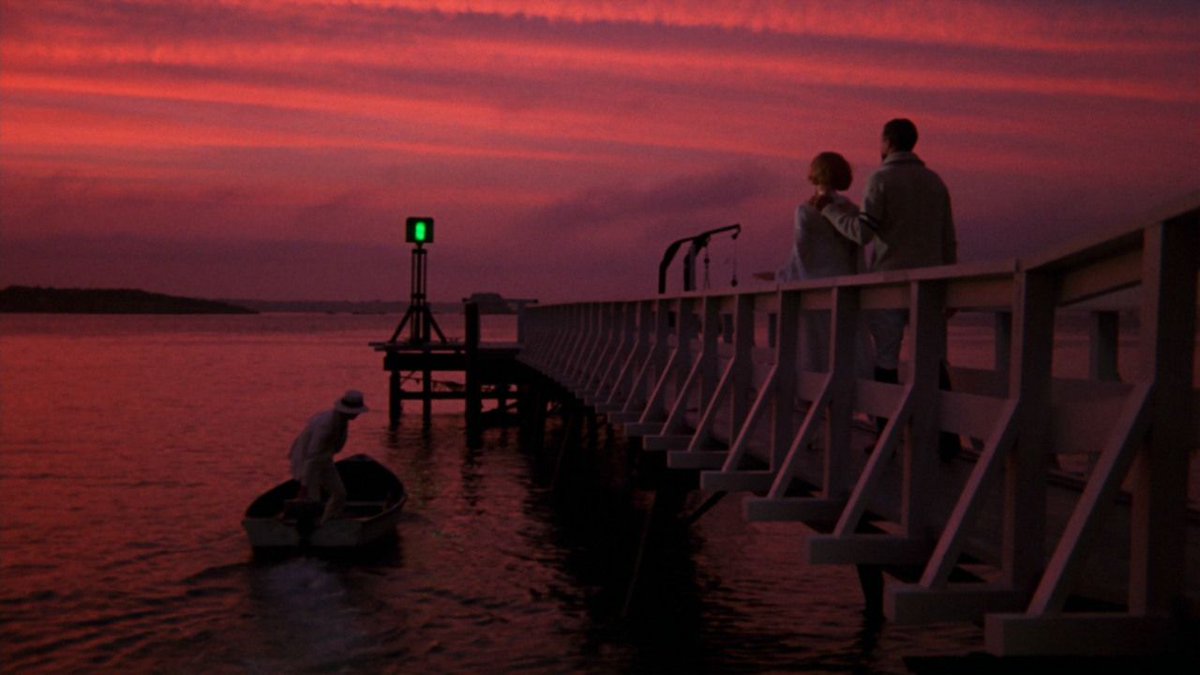
Baz Luhrmann's version of The Great Gatsby jumps into that irony with both feet and splashes around in it, kicking and squealing like a child drunk with a secret. It was a weird decision to film it in 3-D, but given the way Luhrmann uses it, in vivid eye-popping colors, emphasizing the swoop of camera moves and the solidness of glass partitions, and the illusion of the reflections shimmering over it—and particularly in how he photographs our last views of East Egg, in a way that rather lovingly visualizes the novel's last line ("So we beat on, boats against the current, borne back ceaselessly into the past")—one begins to wonder any other way to do it.** In a way, the movie feels like one big "Vertigo zoom" in three-dimensions (starting at the beginning credits) with an art-deco pattern that falls away to the production company logos and ending with an unfamiliar one—until you see it pop up again in Jay Gatsby's monograms.
Then, we begin the touchstones, green light on the dock, the Egg's, the parties, the infinite closet of shirts, the infidelities, "the man who fixed the 1919 World Series" (played by Bollywood superstarAmitabh Bacchan...) Dr. T.J. Eckleburg, Oculist (correctly spelled this time—it wasn't in the 1974 version), the fights, all done in Luhrmann's hyper-speed (which is maintained throughout, as opposed to his previous filmAustralia, which flagged after the first 45 minutes), in a style somewherebetweenPreston Sturges, Sam Raimi, andTex Avery, making the performances somewhat inconsistent (but more on that later). The swooping, veering style allows for some fore-shadowing plummets down skyscrapers and serves as a visual counter-point to Jay-Z's thumping, pumping soundtrack, which is surprisingly synchronous, although slightly discordant and certainly anachronistic. It does lend the film a sense of vital excitement, however shallow, that communicates to the spirit of those times to the "youngsters" in the audience.
"One big 'Vertigo' zoom"
The neatest touch that the director throws into this Great Gatsby is the framing story paralleling F. Scott Fitzgerald, as Nick Carraway (Tobey McGuire), incarcerated in a sanatorium to dry out, composes the story at the behest of his psychiatrist (Jack Thompson), which allows Fitzgerald's words to flow out and become part of the story (the name of the sanatorium is Perkins Sanatorium, after Fitzgerald's editor, the brilliant Max Perkins, a nice little in-joke) and become part of the narrative, succinctly and effortlessly, providing a touch of elegance and perspective to the visual shenanigans.
Even that is a little problematic, as you can't believe those words and that phrasing are coming out of McGuire's googly-eyed Candide in this version—Sam Waterston's Nick in the '74 vintage and even Paul Rudd's in the 2000 BBC take, both have the mature feel for Carraway's observer/muse/co-dependent enabler—something you can't see in McGuire. It's a miscalculation, but not due to any mis-casting issues, so much as Luhrmann's ADD approach to direction.
Leonardo DiCaprio's Gatsby is prone to such inconsistency as well. After establishing Gatsby as a figure of extravagant mystery and a certain false style, Luhrmann has him marching up to Nick's cottage, servants in line behind, an image that recalls a parade. It brings a laugh, but is far too comic for the character. Sure, he's nervous, anticipating the forthcoming tea, and he's slightly out of his element. But the effect takes away from all aspects of the character, even though it plays into Gatsby's too-romantic notions of reclaiming his past. Nor does it help that DiCaprio still looks like a boy-child here.
But where the casting falls off the most isCarey Mulligan as Gatsby's lost-love, Daisy Buchanan, the instrument of his downfall. It's a tough character to cast, as difficult asGone with the Wind's Scarlett O'Hara, seemingly worldly-wise (but actually sheltered), and fatally shallow, selfish in the moment, and murderously practical in the long run.** She needs to be someone who can dash all hopes by merely averting her gaze, and fascinating enough to attract it. And she has to evoke some sympathy for her acts, despite her flaws and practiced weaknesses. As good an actress as Mulligan is (and has been), her Daisy comes across, finally, unknowable and not interesting enough to be an object of obsession, as she must be for the whole tale to work.
In fact, it would be tough to think of a modern actress who could be so cool in her actions, and attractive to risk everything for. Stanwyckcould do it, and Hepburn (Katherine), but it would take a full infusion of actorly personality to pull off. With Mulligan, there's no spider's web of promise, only a longing weakness, around which the story can revolve. And at the pace Luhrmann spins the film, that character needs to have a substantial spine to keep it from flying apart, to make you realize what someone would risk everything for, and that spine can't be made of pixel-dust.
It's not there. Luhrmann provides substantial spectacle and very crowded frames with detailed evocation of the times, but the people caught in it cannot hold the thing together. It's just another variation of the theme. As such, it's an interesting, but not a great "Gatsby." Maybe—in another decade, after the book has aged a century—some entrepreneurial spirit, with hope and devotion in their eyes, will take on "Gatsby" and, rather than repeat, try to re-create the past and give us a truly great "Gatsby."
"Gatsby believed in the green light, the orgastic future that year by year recedes before us. It eluded us then, but that's no matter—tomorrow we will run faster, stretch out our arms farther...And then one fine morning--
So we beat on, boats against the current, borne back ceaselessly into the past."
F. Scott Fitzgerald
"The Great Gatsby"
** The 3-D also helps the special effects, which, in Luhrmann's vision have a distant postcard version of things and see quite a bit distanced from the real live action going on out front. In fact, I imagine the film looking pretty crummy in 2-D, especially in the shots where the large estates look like models (this was confirmed when I later saw it on television).
** “Her face was sad and lovely with bright things in it, bright eyes and a bright passionate mouth, but there was an excitement in her voice that men who had cared for her found difficult to forget: a singing compulsion, a whispered “Listen,” a promise that she had done gay, exciting things just a while since and that there were gay, exciting things hovering in the next hour.”
Sydney Irwin Pollack was born July 1, 1934 in Lafayette, Indiana, where he lived until moving to New York in 1952. There he studied atThe Neighborhood
Playhouse School of the Theatre in New York where he studied with acting guru Sanford Meisner. After a stint in the Army, he taught acting at the Playhouse, marrying one of his former students. He did stage acting, television series work and eventually directing for the small screen. His movie debut as an actor came in 1962, where he met one of his closest collaborators and friends, a young actor named Robert Redford.
Pollack was not "gifted" in the way that I interpreted the word for the role, no, but damned good...and a very good student And intelligent, which was conveyed through his films and their subject matters. They were committed and with issues in the back of them that made you think, long after the film's images had faded from your retinas: The nature of truth in Absence of Malice (which, was a counter-argument to his thriller Three Days of the Condor); the idea of ownership and position in (of all things) Out of Africa; culture clashes—in OoA, Havana, Jeremiah Johnson, The Yakuza; gender roles, and the yoke of women in Tootsie; and the randomness and fragility of love in The Way We Were, Bobby Deerfield, Sabrina, Random Hearts—most of his films, really. Romance had to have roadblocks, some insurmountable, in Pollack's films, but they were more fueled by hope than by commitment. One got the impression no one dared "work" in a relationship in Pollack's movies. He was at his best without a sure track, and his best films—Jeremiah Johnson, Tootsie, and Out of Africa—seemed to find their hearts in the editing room, more than in the direction.
"That's really where the film gets made. I'm not good at editing while
I'm shooting. They're two different processes to me, and I can't quite
discipline my brain to do both of them at the same time. While I'm
shooting, I'm searching for something. Then, in the editing, it becomes
like sculpting. Editing is the process I enjoy the most. It's the one
time when you're alone and you don't have to go through an army of 200
people to get what you want. On the set, I have to go through a
cinematographer, a gaffer, a production designer and use the right lens,
the right camera movement, the right lighting, the right clothes, and
so many specific practical disciplines to translate my subconscious
wishes. What you want to say to everyone is: 'Can't you just reach into
my brain and do what it is that I'm daydreaming?' When you're editing,
you're in a dark room, you can try anything you want and it's
instantaneous."
The Slender Thread (1965) "All things human hang by a slender thread," wrote Ovid. "And that which seemed to stand strong suddenly sinks and falls to ruin." Inspired by the creation of the first "Crisis Center" in 1964 in the city of Seattle, Pollack's first theatrical feature (following years of television work—and it still shows here) focuses on a college volunteer (Sidney Poitier) who receives a phone call from a suicide (Anne Bancroft) and his attempts to find and reach the woman before she dies from an overdose of barbituates. Great thriller material as it's a race against time and Poitier's volunteer can only sit and coordinate efforts among emergency services to try and save her. Designed to reflect real time with real locations in Seattle, it reminds one of the cinema verite experiments in the 1940's, if it weren't for things like Pollack's "Laugh-in" camera zooms at a discotheque (called imaginatively "The Go-Go"). I must admit it's a kick to see all that familiar geography ("Hey, she nearly clobbered somebody driving off Nickerson onto the Ballard Bridge!").
Anne Bancroft contemplating the fountains at the Pacific Science Center.
This Property is Condemned (1966) Tennessee Williams' one-acter adapted by Francis Ford Coppola, Fred Coe, and Edith Sommer about an encounter a new-to-town railroad employee (Robert Redford in his first film for Pollack) has with the "town pump" (Natalie Wood), ill-used by her mother (Kate Reid) to attract business—she runs a boarding-house—and men. The script is a mess—it supposedly wasn't completed when filming started and reports were that many scenes were ad-libbed. Along with the stars, there are appearances by Mary Badham (Scout from To Kill a Mockingbird) and future stars Charles Bronson and Robert Blake. The deck is stacked in this one—the only two attractive people in the movie are Wood and Redford, so, of course, you're expected to root for them and empathize, despite that Wood's Alva Starr is a bit of a flake and Redford's Owen Legate is an obstinate jerk. John Houseman produced and James Wong Howe shot the film, producing startling images like the one below. Wood was always beautiful, but Howe (and Pollack) brought out something preternaturally magical in her.
The Scalphunters (1968) Fur-trapper Joe Bass (Burt Lancaster) has just spent a winter getting pelts and, just on his way to sell them, he gets bushwhacked by Kiowas, who take the furs and leave him with Joseph Lee (Ossie Davis), an educated runaway slave. Following the bandits, the two see the group wiped out by a band of scalphunters, who turn in the hair for reward money, the "dirtiest, rottenest trade that ever turned a dollar." They're led by Jim Howie (Telly Savalas), a low-down snake in the grass, who has a soft spot for madam Kate (Shelley Winters) with her traveling band of whores. Now that they have the pelts, they're making their murderous way to Mexico, but Bass and Lee doggedly follow them, plotting, changing sides, and generally making nuisances of themselves. A whimsical western with murderous background, The Scalphunters doesn't have much to say about race relations (which was its intention for the times), and there's not much depth here—the scalphunters, other than Howie, are characterless cyphers as much as the Natives are. Some of Pollack's set-ups are good. Some are just strange, but Lancaster still has the best teeth in the West, and it's always fun to watch Davis, who keeps you guessing throughout the entire picture.
Castle Keep(1969) During WWII in the Ardennes "eight walking wounded misfits of the American Army walked into a castle in Belgium." The castle is Maldorais and the troop—featuring Patrick O'Neal, Scott Wilson, Peter Falk, Tony Bill, Michael Conrad, James Patterson, and Al Freeman Jr. is led by Col. Falconer (Burt Lancaster, sporting an eye-patch). With the cautious permission of the Count (Jean-Pierre Aumont), the men are given permission to bivouac there—and, more surprisingly, he ignores the fact that his wife (Astrid Heeren) begins an affair with Falconer. The castle is a marvel of architecture and houses all manner of classic artwork, but it's just a strategic point on a map; there's every indication that the Germans will be marching through (and were probably previously staying there as well). While Falconer prepares and beds the Countess, and O'Neal's Capt. Beckman frets about the art, the other men spend time at the local brothel and Falk's Sgt. Rossi, a baker back home, takes up with the local baker's widow. It's one of those "war-as-myth" movies, where the most realistic thing is the carnage put on-screen, but there's no sense of strategy or coordination with any other part of the war effort. It's just "hold the castle" while the men crack wise in writerly sorts of ways—"This whole place has an ineffable, dream-like quality" (which sounds like description from William Eastlake's 1965 book, not dialogue). Oh, and it's another one of those 1960's movies that displays that a Volkswagon "beetle" floats. One might think the movie was an "anti-war" movie if it didn't take such care blowing things up. The castle, by the way, was made of styrofoam and the film has a similar feel of unreality.
They Shoot Horses, Don't They? (1969) Yowza! Horace McCoy's distillation of The American Dream into a Depression-era dance marathon—"The Dance of Destiny"—makes a compelling, focused film (hard to believe that it was originally going to be a collaboration between Harold Lloyd and Charlie Chaplin!) that extrapolates the fates of down-on-their-luck couples all trying to land the "Big Prize" of $150,000 in silver dollars by outlasting every other contestant, who are eliminated by exhaustion, physical injury, and even death. It's Survival of the Fittest...or, at least, the stubbornest. The stubbornest is Gloria (Jane Fonda, never better, never less sentimental), who is the definition of a hard-luck kid, who has a stranger named Robert (Michael Sarrazin) thrust on her as a last-minute partner in the marathon. But, Gloria is determined to win and Robert just as determined to get her there. Also, competing are a married couple (Bruce Dern and Bonnie Bedelia), an actress seeking the limelight (Susannah York) and a WWI Naval veteran (Red Buttons—amazing!), who is quite a capable dancer...in a sprint.
The emcee (Gig Young, who won an Oscar for his role)—serving as both Greek chorus, false-cheerleader, and Mephistopheles—eggs them on and ramps up the suspense among the thrill-seeking audiences watching the dancers crumble. If you want the best movie to display the "Every Man for Himself" cage-match that is American Capitalism, it's this one, where luck, stamina, and brute strength are the weapons of success. I think of this movie every time the news mentions the lottery hyping the glory, but negating the odds (it flashes in my mind at those TV "talent" competitions, too) that the entire system is rigged and that somebody is getting rich, just not who you think. They Shoot Horses, Don't They? is one of the best films leading into the downbeat 70's, without some of the stylistic weaknesses that have aged other films of the time. It's smart, tough, and brutal.
Amazing Grace(1972/completed 2011/released 2019) The
film is a filmed recording of two nights that Aretha Franklin spent singing at
the Watts New Temple Missionary Baptist Church recording the album that
would be called "Amazing Grace,"
the best-selling live gospel recording of all time and Franklin's
best-selling album in her career. It would be like watching a film of
The Beatles making "Sgt. Peppers'" but instead of endless planning and
re-takes (calculation), replacing it with inspiration and the power of
vaulting faith...and doing it in one "take". Accompanied by the Rev. James Cleveland and the Southern California Community Choir—and
Aretha's discreet house-band—she recorded the album, which, as
dominating as she is, still feels like a community effort. There's
brilliance on all sides of the performance.
Sydney Pollack was assigned to do the film and he set it up, Woodstock-style—lots
of cameras (there is no attempt to hide the phalanx of cameramen
running around, angling for shots) with a live audience. It's all grainy
16mm footage and just as rough-looking as everything coming out of 1972
looked. There are the rare flashes of end-rolls, the
focus-on-the-fly-racking, and a perpetual shakiness and desperation to
the shots. But, it's a faithful chronicle...and that first night. Man!
Oh...and
the delay in release? It seems that one can chalk this up to "technical
difficulties" as nobody in post-production could sync up the film with
the recordings...Pollack didn't use a clapperboard to mark takes as the
songs were long and there were just too many cameras, and the footage
just sat in a Warner vault until it could be transferred to digital
media and only once speeds were set in 1's and 0's could they marry the
recordings and the footage. Pollack died in 2008, and producer Alan
Elliott supervised the assemblage, managing to finish it in 2011, only
to have Franklin sue to prevent its release, ostensibly to maintain
control over her image and likeness—especially in footage that had been
severed from its earlier compensation deal. Evidently, she had seen the
film before her death and there are conflicting opinions about her
thoughts on it.
Jeremiah Johnson (1972) If I have a favorite film of Pollack's, it's this one. Originally prepared for Sam Peckinpah to star Clint Eastwood (before it exploded in slow-motion) it is spare, exquisitely photographed, and does as little talking as it can get away with. This yarn (based on the passed-down stories of John "Liver-Eating" Johnson) was written by John Milius (who can be heard in the dialog—"Don't lose your top-knot" has stuck with me for years) with contributions by Edward Anhalt (an odd pairing, that) and shot on a shoe-string in the Utah countryside (Warner Brothers wanted to shoot it on its backlots and to accomplish the location work, Pollack mortgaged his house). Johnson comes west after spending time in the military, determined to make his way as a trapper. Between blind luck and tough lessons, he stumbles upon another mountain man "Bear Claw" (Will Geer), who gives him extensive training in surviving the wild and negotiating his way with the various Native tribes, primarily Crow, Blackfoot and Flathead, each of which will play parts in his life for good or ill. He forms partnerships, settles with a "found" family, and once he returns to the wild, finds himself the measure of courage for Crow warriors sent out to kill him. The story comes full-circle as he must make his way through the dangers of Man and Nature. Redford is amazing in this—he's always at his best when not talking—and the film plays out as travelogue, tone-poem, and song-story that never feels forced or out of step. Supposedly the picture came together in an extensive editing phase and is one of those movies that feels iconic and (ironically) blazing new trails in form—it clearly had influence on Eastwood when he took over The Outlaw Josey Wales. Redford and Pollack disagreed on how the movie should end, but manage to reach a coda that makes its own peace without telling the end of the story.*
The Way We Were (1973)Arthur Laurents' soap opera about political and personality opposites attracting is hardly repellent. But, it ain't great, either (even the author didn't like the finished film with what Pollack had done with it—but then, some of the typewriters the film passed through belonged to Dalton Trumbo, Herb Gardner, Paddy Chayefsky, and Francis Ford Coppola so he might have been a bit biased). One of the first pictures to feature the Hollywood Blacklist as a subject, The Way We Were tells the story of Katie Morosky (Barbra Streisand), a campus radical who meets a wasp-ish under-achiever Hubbell Gardiner (Redford in his third film with Pollack), their subsequent relationship after the war, and their tensions during the 1950's. It is a film killed by compromise—a lot of the politics is left out (although it probably seems like too much for some) in favor of a love story that works only due to the chemistry of the two leads (which, in itself, is something of a miracle) and can be summed up by "she loves the way he looks and he loves the way she looks at him." And "that" song. But, even then, some of the editorial choices are, frankly, jarring—honestly, weren't you a little thrown by the break-up scene? Still, like some past romances, folks choose to remember only the good parts, which is why it is ranked number six on AFI's top 100 romantic movies. The Oscars it won were for Best Score and for "that song."
The Yakuza (1974) With a story by Leonard Schrader, a screenplay by his brother Paul Schrader and re-writes by Robert Towne, The Yakuza should feel as literate and unique as what we would come to expect from such talent. Pollack's film, however, feels like one cliche after another. Attacked at the time for being too violent, one looks at it now and, given the nature of the fights and the rituals of cutting off one's little finger to pay off a debt, one could make a case for it not being violent enough. It's supposed to be a tough-as-nails gangster film, but doesn't want to get too squeamish. Still, Robert Mitchum is a good choice for the long-in-the-tooth American serviceman-turned-detective who is brought back to Japan by an old Army buddy (Brian Keith) to investigate the kidnapping of his daughter, but finds himself enmeshed with a decades long struggle of organized crime and having to partner with an embittered rival (the amazing Ken Takakura) before his work, which has many twists and turns, can be completed. Another director might have made more of this, but the film would have been more controversial. Maybe that's a good thing.
Three Days of the Condor (1975) Redford (Pollack film #4) plays Joe Turner, a CIA researcher in the "book section," who comes back from lunch to find that his co-workers have been murdered. He contacts CIA HQ and is told to come in for his safety. But at that meeting, he is nearly killed, and he goes into hiding to find out who set up the hits and why, and without anyone he can trust. The film came out post-Watergate, but was in production when that conspiracy went down, so there are minor influences owing to the tenor of the times ("Boy, what is it with you people? You think not getting caught in a lie is the same thing as telling the truth?" is a line that haunts). Where the film is prophetic is in its main root cause—oil—and the CIA's capacity for conducting operations inside the boundaries of the U.S. In the 20/20 of hindsight, one of the most unusual things is Turner's abduction, use, and eventual seduction of a total stranger (Faye Dunaway) to help him with his plans, including the kidnapping of his bureau chief (Cliff Robertson). That seems "formula" for a thriller in the 40's (studio demand for a love interest being the motivation), but it feels forced and strange and more than a little criminal these days. It also makes Dunaway's character seem a bit crazy. I mean, Redford is handsome and all, but, come on... A competent thriller, but what I remember fondly is Turner's conversation with the puckishly ironic assassin, Joubert (Max von Sydow) who suggests that to stay in hiding, he should become an assassin himself, as he seems to have "skills."
von Sydow's rather happy assassin
Bobby Deerfield (1977) An adaptation of Erich Maria Remarque's "Heaven Has No Favorites" but moved from its original 1948 setting to the 1970's. Francois Truffaut was originally slated to direct, but Pollack was given the script by actor Dabney Colman (with the suggestion that Gene Hackman star). Catherine Deneuve actively pursued the role of Lillian, the "hot-chick-born-yesterday" that Deerfield meets at a sanatorium when he goes to visit a fellow race-driver who's been injured in an accident that haunts him. Al Pacino, hot after The Godfather, Serpico, and Dog Day Afternoon, plays the emotionally-distant title character whom the mysterious woman he becomes obsessed with describes as "driving around in circles." Apt. Although, that accident has been on his mind...a lot...and won't drive again until he finds the answer. Alvin Sargent, the screenwriter, has echoes of his adaptation of The Sterile Cukoo to it and that would be fine if the two leads had a more charming touch with comedy. But, they don't, no matter how much composer Dave Grusin tries to overlay a "light touch" with his score. The fact is, the movie doesn't know whether to be a drama or a comedy from one moment to the next and the result is disorienting, leaving the audience as perplexed as Deerfield, an American in Europe, is. Like the running gag of Deerfield not understanding any language, it just doesn't translate.
The Electric Horseman(1979) Redford (movie #5 with Pollack) was hot and Fonda (movie #2 with Pollack) was trying to rehabilitate her career after her political activities in the '70's. They'd starred together in the movie version of Barefoot in the Park (and The Chase, too, as I recall), so it's a bit like "old-home week" with the two's previously displayed chemistry still on-display and repeatable, although Fonda could no longer be believed as a coquettish scatter-brain and Redford the blond pretty-boy (roles which I'm sure they both loathed). Redford plays Sonny Steele, former rodeo champ, who's making ends meet by being a spokesman for the "Ranch" cereal company, riding around on a city-tour, currently in Vegas, where the idea is for him to show up on horseback on-stage in an electrified suit. To do this, they've had to drug the horse into practically catatonia, which awakens the last vestige of integrity in Sonny and he rustles the horse to release it into the nearby desert—hopefully after it snaps out of the drugs. Parallel stories about being free and "true to your roots" blah blah blah...Fonda plays a reporter who's following the story and is the obligatory love interest. It was the first movie Willie Nelson appeared in, and the second for crusty Wilford Brimley—both veterans of just about everything but movie-acting. The Electric Horseman is so incongruously inoffensive, simultaneously cashing in on the "cowboy-bar" phase the country troughed into in the late 70's (probably as an answer to "disco" and its excesses—this time it was mechanical bulls and oxycontin) while railing against corporate appropriation of "self" and "genuineness," put out by, not one, but two movie-making corporate entities while promoting Vegas at the same time holding it up for ridicule. The movie is more than a little smug and self-satisfied.
The Electric Horseman was the last film Pollack shot in wide-screen for a period of time as he was appalled by how his films looked when broadcast in the "pan-and-scan" process.
Absence of Malice (1981) A Miami reporter (Sally Field) gets wind of a story from confidential sources about suspicions around the death of a union rep and runs with it, thinking she's scored a big scoop. Turns out the story is a fishing expedition from an over-zealous prosecutor (a hyper Bob Balaban) who thinks that Michael Gallagher (Paul Newman), a liquor wholesaler whose father was a prominent mobster, had something to do with the rep's disappearance. The front-page story throws an unwanted spotlight on Gallagher and his business and, facing financial ruin, he decides to play offense by doing some double-dealing of his own. If a prosecutor can get away with planting a story, why can't he?
It's a good idea for a script (credit Kurt Luedtke), but some of the casting is a bit off. Newman plays it opaque and earnest, while Field plays a put-upon victim and neither one is those actors' strengths and there's little chemistry between the two. However, one performance shines through and that's the late-in-the-proceedings appearance of Wilford Brimley, who'd had moments in Pollack's The Electric Horseman and in The China Syndrome, and, refreshingly, sweeps away all the bullshit.
Tootsie(1982) Tootsie did not start out as a Sydney Pollack film. It was a project that Dustin Hoffman was fostering based on a play called "Would I Lie to You?" by Don McGuire and controlled by producer Charles Evans, who had become aware of the property from Buddy Hackett, who wanted to play the talent agent in the story. Dick Richards was to direct and worked on a screenplay with Evans and Robert Kaufman. Richards left and took over producing chores, instead. The screenplay went through many hands for tinkering—Larry Gelbart did a full re-write and such hands as Elaine May, Barry Levinson and Murray Schisgal put their fingerprints on it—and Hal Ashby was hired to direct. An extended post-production on another picture took Ashby away and that's when it fell to Pollack, who, after being badgered by Hoffman, took the role of his agent—after not having acted in almost two decades.
Such development antics usually spell disaster (too many cooks!), but Tootsie—the story of an out-of-work actor, Michael Richards (Hoffman) who only finds work posing as an actress and becomes a soap-opera sensation—is that rare movie that hits all the marks—funny when it means to be, dramatic in ways that surprise you, while managing to be a well-veiled statement on sexism, not by appealing to the brain but to the heart. The cast is astonishing: Hoffman, Pollack, Jessica Lange, Teri Garr, Charles Durning, Dabney Coleman, George Gaynes, Geena Davis—in her first role—and an uncredited Bill Murray, who slays—"That is one craaazy hospital!" It was nominated for 10 Academy Awards, and only won for Jessica Lange's Supporting Performance. It was voted into the National Film Registry in 1998.
Out of Africa (1985) Pollack's Best Picture winner. And possibly his best film, as well.
Many prominent film makers had attempted to make a film of author Karen Blixen's years in Africa after Bennet Cerf published it in 1937. Among them, David Lean, Orson Welles—who professed a love for her writing and for her—and at one point, it was even suggested as a return picture for Greta Garbo, but the closest was Nicolas Roeg, who planned to film a Robert Ardrey screenplay and cast Julie Christie as Blixen. When the option on the filming rights for the book lapsed, it was snatched up and Pollack, Kurt Luedtke (and eventually David Rayfiel) spent two years on a new screenplay, putting more emphasis on Blixen's love life than just her remarkable years living in Africa trying to maintain a coffee plantation. Pollack's films have had a tendency to meander unless the script is polished to a fine diamond, and Out of Africa, with its flashback structure—and that it's source, the book written under the pen name "Isak Dinesen", also tended to wander—still manages to convey the story of how an exploitive colonialist can be changed by the experience more than the place colonized.
But, every movie needs a miracle, no matter how good the script, and Pollack's miracle is Meryl Streep, who is in almost every frame of the movie, and makes Blixen a tart, complex character, who manages to have her privileged sharp edges sanded down by circumstance and tragedy and still come out of it with something like grace. She dominates a cast with such heavy-hitters as Redford (whose Denys Finch-Hatton doesn't even attempt an accurate accent), Klaus Maria Brandauer, Michael Kitchen, Michael Gough, and Malick Bowens. The whole production is aided immeasurably by the beautiful photography of David Watkin, and elevated by John Barry's music (Dave Grusin's soft jazz is nowhere near this).
It won the 1986 Academy Award for Best Picture, Best Director, and Best Screenplay, Best Cinematography and Best Music.
"I had a farm in Africa...at the foot of Ngong hills"
Havana (1990) Redford's seventh (and last) movie with Pollack features him as Jack Weil, a wheeler-dealer American in Cuba with the looming revolution on everybody's mind. He's always the smartest guy in the room and can read anybody and knows the score before the police can find out. He's a professional gambler, a pick-pocket, and—according to Bobby Durán (Lena Olin), who is connected to the rebels and utilizes him to smuggle military radios into Havana—arrogant. "I try and stay out of the way of things I don't understand," he says at one point. In other words, he sticks his neck out for nobody. If that line sounds familiar, it's deliberate because the problems of two little people still amount to a hill of beans in a crazy, unstable world, be it Havana or Casablanca. The timeline's just moved up a bit in this one. Alan Arkin (always a pleasure) slots himself into the role of Col. Renault, thinking he knows Jack...but, he "knows Jack." There's also good work done by Tomas Milian as a Batista loyalist and particularly by Daniel Davis. Director Mark Rydellhas an amusing turn as mobster Meyer Lansky. Even Richard Farnsworth is in this.
Raul Julia has a significant cameo, but is un-billed in the film.
The Firm (1993) John Grisham's break-out best-seller is a cautionary tale about a an upwardly mobile first year lawyer (Tom Cruise), who gets hung up in his "to-die-for" position at a prominent law firm when he has to choose between the job and ethics. But, with the added incentive that his law partners may have him killed if he decides to "do the right thing."
If you've read the book, there's a "fugitive"/timing element that is riveting. In the movie, it just isn't there. In fact, the film stays pretty much focused on Cruise's character Mitch McDeere, looking trapped and running around cities, back-alleys and building basements. And Grisham's book solution for McDeere and his wife (played by Jeanne Tripplehorn) just isn't good enough for screenwriters David Rabe, Robert Towne, and David Rayfiel—good writers all!—whose own solution buttons everything up nice and neat, but strains credulity while at the same time being underwhelming. It apparently wasn't enough for Cruise's hero to escape the problem, as much as solve the problem.
Sabrina(1995) Remake of the 1954 Billy Wilder film (itself broadly based on a Samuel Taylor play "Sabrina Fair") and one of those instances where one of the things wrong with the original could be corrected in the remake. As anyone who's seen Wilder's Sabrina knows, Humphrey Bogart was just the wrong age to be the eventual love interest to Audrey Hepburn. Pollack's Sabrina corrects that by casting the younger and hunkier Harrison Ford as the cold-fish business whiz who sweeps the younger daughter (Julia Ormond) of the family chauffeur (John Wood) away from an irresistible younger brother (Greg Kinnear) who is already betrothed in a mutually beneficial business-marriage (to Lauren Holly).
Trouble is...it still doesn't work!
Seeing it on it's debut Christmas Day of 1995, I found it underwhelming. A recent revisit astounds at the great cast—Paul Giamatti has a bit part!—, a sophisticated John Williams score, and sumptuous cinematography by Giuseppe Rotunno, but for all that, this Sabrina is missing the "Wilder Touch," the slightly more vinegary version of "The Lubitsch Touch." It's not fair to compare Ormond to Hepburn (Hepburn was a preternatural creature meant for the movies) and Ormond is a worthy successor(if you can ignore Hepburn) and as winning and winsome as Harrison Ford can be, there is always a touch of reluctance in the way he plays romantic scenes. In another actor, this could be seen as vulnerability; in Ford, (where vulnerability doesn't quite translate), it's lack of a character's commitment.
Random Hearts (1999) He's a D.C. Internal Affairs Sergeant. She's a New Hampshire Congressman running for re-election. What do they have in common? Both of their spouses are cheating on them, but they only find out when the plane the cheating couple were taking to Miami ends up nose-first in the Potomac. Both Sergeant William "Dutch" Van Den Broeck (Harrison Ford) and Kay Chandler (Kristin Scott Thomas) both get the double-whammy that their spouses are dead and that each lied to them about their destination plans. And Van Den Broeck, being a detective, just can't seem to let go of the story discrepancies and ultimately discovers that his wife (Susanna Thompson) and Chandler's husband (Peter Coyote) were having an affair. Once he discovers that, he starts bugging Chandler for any information she might have had about if she knew about it (short answer that he doesn't seem to "get": she didn't). One can make a case that Ford's character is so dogged he could be considered quilty of harassment, and that, although the two do indeed have a lot in common, they're the least likely pair, then, to fall in love and have an affair.
And yet that's what the screenplay (by Darryl Ponicsan and Kurt Luedtke) has them do. Although both characters have opposite ways of dealing with the loss and betrayal, we're led to believe that they "need" each other during the grieving process. And the closest explanation the writers give us is when they have Chandler explain "we were more than friends; we were survivors." The property had been in development for 15 years, first with Dustin Hoffman, and then with James L. Brooks and Kevin Costner and it just goes to show you that sometimes intriguing ideas have an expiration date with the social zeitgeist (not unlike Bobby Deerfield)and although things have been contemporized from the 1984 Warren Adler novel on which it's based, it still feels horribly dated. Some nice acting though from the principals as well as Charles S. Dutton, Bonnie Hunt, Dylan Baker, Dennis Haysbert, Richard Jenkins, Lynne Thigpen and Pollack himself, who's alarmingly convincing as a political media consultant.
The Interpreter (2005) After years of designing films for how they'd look on pan-sand-scan broadcasts of television, Pollack aggressively embraced the wide-screen format (that had come back into fashion with wide-screen TV's, DVD letter-boxing and acceptance of the originally intended aspect ratio) to make this film set in the United Nations amidst a cowardly new world of terrorism. Nicole Kidman plays Silvia Broome, a UN interpreter from the South African country of Matobo, now being run by a rebel leader turned autocratic dictator. His regime has become involved with ethnic cleansing, the elimination of all political rivals (resulting in the deaths of Broome's entire family) and the General assembly is debating indicting the leader for war crimes. The country's head, Zuwanie (played by the great Earl Cameron), is traveling to the UN to plead his case and the Secret Service is charged with his protection. One of the investigators is Tobin Keller (Sean Penn), who zeroes in on Broome as a person of interest because of her family and past history with Zuwanie's foes. Sure enough, rumblings of an assassination attempt on Zuwanie start to become known and, somehow, Broome is awfully close to some suspicious incidents. It's an above average thriller with some great location work—they were allowed to shoot in the U.N., the first time for a fiction film—and Pollack with a wide-screen to work with is far more artful than before.
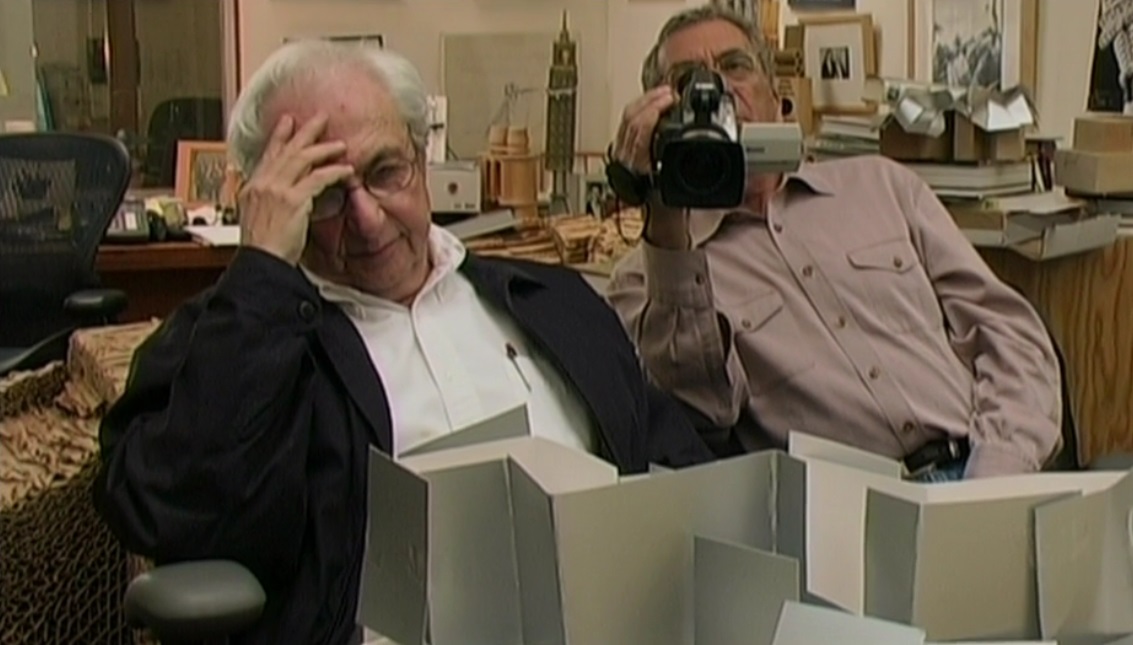
Sketches of Frank Gehry (2005) "That is so stupid-looking, it's great!" Frank Gehry chuckles at a cardboard cut-out of a building that he is in the process of designing. It starts as a squiggle, a rat's nest of charcoal lines. And then the modelling starts—cardboard, wood, wire, plastic—and the changes start with all the nuanced little details. The discussion of materials, the physics of the thing, the practicality of it—will it fall down, will it leak—and the aesthetics of it in how the form reflects function. And the light. Does it use light inside and does it reflect light and life outside? Where does the plumbing go? Pollack follows Gehry around his work-spaces, the workshop and a construction site and just talks about the process and the individual feelings he goes through while he's designing—the clearing off of the desk, the fear, the procrastination, the spark. Then the process of changing it for however long it takes. Years, at least. Gehry says he can't look at a building of his for at least a year to appreciate it. Then, he might find some objectivity. Maybe. Made for PBS' "American Masters" series, it's Pollack's last film and a fascinating look at a guy who just has fun doing what he likes to do and seeing how he can stretch it.
"Look at the influence it has, look at the economics it commands, look at
the preoccupation in all cultures of the world, look at its power to
spread ideas, look at it as a political tool, look at it as
entertainment, no matter what point of view you look at it from it would
be hard, other than the Internet, let's say, to find something that's
changed and affected the world strongly. I mean, certainly it's the
single biggest event, I think, in terms of popular entertainment, or art
even, if you say that, of the 20th Century. It's been film. It's the
20th Century's real art form."
* The truth is Johnson died in 1900 (after a subsequent stint in the Cavalry and serving as both a deputy sheriff and town marshal in Montana) at the estimated age of 76 in a Santa Monica rest-home (not unlike Jack Crabbe in the earlier Little Big Man) and buried in a veterans' cemetery. After the movie came out, a campaign by students led to Johnson's disinterment and new burial spot located in the "Old Trail Town" in Cody, Wyoming in 1974. One of the pallbearers at the re-burial ceremony was Robert Redford. I like the way the Italian release of the film makes it look like a violent "spaghetti western"—the title translates as "Red Crow You Will Not Have My Scalp!"
 "There are no second acts in American lives"



 "Yours in Great Depression" During the Baz Age