Showing posts with label Victor Mature. Show all posts

Thursday, March 28, 2024

The History of John Ford: My Darling Clementine

When Orson Welles was asked what movies he studied before embarking on directing Citizen Kane he replied, "I studied the Old Masters, by which I mean John Ford, John Ford, and John Ford." 

Running parallel with our series about Akira Kurosawa ("Walking Kurosawa's Road"), we're running a series of pieces about the closest thing America has to Kurosawa in artistry—director John Ford. Ford rarely made films set in the present day, but (usually) made them about the past...and about America's past, specifically (when he wasn't fulfilling a passion for his Irish roots). 

In "The History of John Ford" we'll be gazing fondly at the work of this American Master, who started in the Silent Era, learning his craft, refining his director's eye, and continuing to work deep into the 1960's (and his 70's) to produce the greatest body of work of any American "picture-maker," America's storied film-maker, the irascible, painterly, domineering, sentimental puzzle that was John Ford, John Ford, and John Ford.
 
My Darling Clementine (John FordLloyd Bacon, 1946) Stuart Lake's 1931 biography of Wyatt Earp, "Wyatt Earp: Frontier Marshal," had already inspired two previous Earp moviesone in 1934 and one in 1939, both titled Frontier Marshaland in 1946, he published another book "My Darling Clementine." John Ford took an interest in the latter and bought the film rights, using it to make the last film he owed on his contract with 20th Century Fox.

Ford had revolutionized the Western genre with his 1939 film of Stagecoach and My Darling Clementine was his return to making horse operas since that film. Ford also wanted to make the film as he had conversed with the real Wyatt Earp during his silent-movie days, and he wanted to make an accurate depiction of the frontier town of Tombstone and of the climactic Gunfight at the O.K. Corral, a 30 second skirmish in the city's streets that author Lake had mythologized in "Frontier Marshal".
There are those who say this is Ford's best Western, though, as great as it is, I find it slightly problematic. Great, but there are little details that paw at the dirt. For the first point, it is wildly inaccurate about events during Earp's tenure in the law while he was in Tombstone. He was never sheriff as the film depicts—that was his brother Virgil (played in the film by 
Tim Holt)—the Earps weren't cowboys but gamblers and pimps...and opportunists. Old Man Clanton (played by Walter Brennan at his most repellent) who, in the film, is the instigator of the bad blood between the Earps and the Clanton and whose killing of Virgil leads to the famous "gunfight"—which also *cough* took place in 1881, not 1882—died before any of this took place. Doc Holliday was a dentist, not a surgeon, and there was never any "Clementine." One isn't even sure of the details of that gunfight, even though Ford says he staged it as Earp described it to him when the two found themselves on the same silent film-shoot. But, who lived and who died in real life is nothing like presented in the film.
Earp was well-known for "polishing his badge" in interviews—and Blake Edwards, in his 1988 film Sunset has Earp say "that's just how it happened...except for a lie or two." Certainly, Lake's biographies are rife with inaccuracies, due to writerly creativity, Earp's sketchy relationship to Truth and the efforts of Earp's widow, Josephine, to white-wash history in her husband's favor.

But, then we're also talking about John Ford, who, in two years, would make Fort Apache where John Wayne's Cavalry Captain Kirby York would lie to the press about the actions of his fallen superior Lt. Col. Owen Thursday (Fonda again) "for the sake of the Corps" and who would articulate the sentiment in 1962's The Man Who Shot Liberty Valance when a member of the press says "This is the West, sir. When the legend becomes fact, print the legend." Ford mythologized the West in his movies, even if, in later films, he would puncture those myths for a more nuanced perspective on "Manifest Destiny."
There's a story of Ford being confronted by a historian of the Old West about all those fictions in Clementine and Ford replied "Well...did you like the picture?" to which the guy said he did very much. To which Ford hammered back "What more do you want?"
 
Good argument, that. Really.
But, the other issue I have is that director's credit. What we have now as My Darling Clementine isn't exactly the film Ford made. 20th Century studio head Darryl Zanuck thought it was okay, but wanted to make changes to it—and employed studio employee Lloyd Bacon to shoot other scenes, while Zanuck trimmed some 17 minutes out of the film. Those non-Ford scenes include 
Henry Fonda's Wyatt Earp talking over the grave-site of his brother James (Don Garner), killed in an ambush by the Clantons. The other big change? The ending, where Earp bids farewell to Clementine. In Ford's version they shake hands. But, preview audiences felt...unfulfilled. So, Zanuck had Bacon shoot a new close-up of a farewell kiss. Afterwards, when Zanuck offered Ford another contract to do more movies at Fox, the director turned it down to make films, without Zanuck's interference, through his own studio, Argosy Pictures. 
So, what do we have in My Darling Clementine, that odd mixture of fiction and legend? History as we'd like it to be. Simplistic delineations between good and evil out on the edge of civilization. And where young Wyatt Earp has revenge on his mind—that part's certainly historically accurate—for the harm done to his family, it's a case of Good versus Bad (certainly less complicated than the testimonies given at the Earp's real-life trial after the incident) with Good triumphing and even getting the girl. Maybe it was Zanuck's treatment of it talking, but Ford dismissed it as "essentially a film for children."
Ford was toiling in the fields of Myth, not History. He was telling a far bigger story than the one leading to the rumble at the O.K. Corral; Ford was examining the story of the dawning of a frontier civilization. When the town of Tombstone is first introduced by old man Clanton he describes it as "wide-open". That's an understatement; it's not even a town, just a single row of "growing concerns"—a hotel, a boarding house, a saloon, a brothel, a store, "that" corral...and a barbershop. There isn't even a defining thing as a street—the doors of buildings face open landscape, interrupted by transitory covered wagons. It's rough and in its genesis.
It's certainly no place to raise a family, the only examples of which are the Earps and the Clantons, polar opposites—one defining anarchy and the other abiding by the rules, such as they are. The Earps come to Tombstone for a respite from the trail, leaving young brother James to look after their herd, only having that moment of relief lead to the young man's death, presumably ambushed by the Clantons. The Earps settle in town—after Wyatt resolutely handles a disturbance—ultimately to settle scores.
Their positions as law-men will be a challenge to the Clantons, but also to Tombstone's most prominent citizen, "Doc" Holliday (
Victor Mature), once a surgeon, now a drinker, gambler, and gun-fighter. He has come to—appropriately—Tombstone to die, running from his past life to the drier desert, hoping it will help his tuberculosis. He has come to town a dead man walking, and he's lost hope...in his health, himself, and in everything. His existential crisis is first irritated by the presence of the Earps—he can't exactly throw his callousness around anymore—but it comes to a respectful kindredship. He begins—against a thousand reasons not to—to hope.
Part of this transformation is due to his friendship with Wyatt, who is centered, contained, confident, and unflappable. Henry Fonda's interpretation of Wyatt is not given to overzealousness or going off half-cocked. He's steady...even in a crisis...in stark contrast to the Clantons who know no bounds or ethics. The man who no longer believes in anything, starts to find purpose. And the rough-hewn Earp begins to gradually become more dapper, in no small part due to the presence in town of Holliday's former flame and assistant, Clementine Carter (
Cathy Downs), who has come there to try to bring Holliday back to his old life.
The balance of Tombstone shifts from merely trying to persevere against adversity to appearing to thrive, to build, and—once the Clantons are taken care of—why, they even presume to hire a schoolteacher. How's that for putting down roots and hoping for the future? 
You boil down those "legends of Wyatt Earp" (forget all those troublesome details)—and you get the story of the building of community, which is far less exciting than the turf-battles and gun-fights of less-considered examples of the Western, but the more protracted, difficult story of mending fences.

That's the story of My Darling Clementine. Not "the taming of the West" but the taming of our worst instincts.

Saturday, February 17, 2018

Kiss of Death (1947)

Kiss of Death (Henry Hathaway, 1947) Another of Henry Hathaway's neo-realist film noir's that aped the post-war Italian film penchant for shooting dark themes in real locations without glamour and emphasizing the grit.  This one, about the rise and fall and rise of heist-criminal Nick Bianco (Victor Mature), starts out in the sky-scrapers, jail-houses, and police offices that reverberate with the realistic sound that you can't acquire in a sound-baffled soundstage, but once the mayhem starts, the film scurries back to the safety of studio sets.  It's rough in the mean streets of noir. Safer to make your own.

Bianco is an ex-con who can't find a job, and with a wife and two kids to support, he decides to make his own work—robbing a jewelry business in downtown Manhattan.  The job goes South and he ends up on the street with a police bullet in his leg and a stretch awaiting him at the gray-bar hotel.  He's offered a chance by assistant D.A. Louis D'Angelo (Brian Donlevy) to supply evidence on his cronies, but Bianco sticks to the criminal code—he won't squeal, sing, or rat, even when D'Angelo offers him an early parole so he can see his kids.  But Bianco won't bend.  His family is being "taken care of" by his sheister of a lawyer (Taylor Holmes), who visits him in prison to keep tabs on Bianco's loyalty.
But, in prison, Bianco gets wind that things aren't going so well.  And a visit to the prison library newspaper galleys tells him his wife has committed suicide, his kids are now orphans, and his silence has bought him nothing.
Hathaway's direction is no-nonsense throughout, but stylistic, anyway, and the scenes in the initial robbery, in the D.A.'s office and the lock-up have a drab, utilitarian look to them—the robbery has a nice touch in it, as the crooks' target is on the 44th floor of a Manhattan skyscraper, and the post stick-up elevator ride (with plenty of stops) provides a particularly teasing kind of tension.  Mature is fine, Donlevy's abilities aren't taken advantage of, and there are bit parts by Karl Malden and one of my character actors, the short-lived Millard Mitchell (who played Gene Kelly's producer buddy in Singin' in the Rain).
But Kiss of Death is also the feature debut of Richard Widmark, who plays the cheap gangster killer Tommy Udo.  You don't see him kill too many people, but one of them is indelible in its cruelty and vicious enthusiasm.  Widmark's performance is amazing, looking like a wire-thin Dan Duryea, with Cagney's ability to hold the eye in every scene he's in.  His dialogue isn't the greatest (even though the script is by Ben Hecht and Charles Lederer) and limited, and repeated over and over, but Widmark punctuates it with a goonish laugh that implies a sarcastic inner amusement that he knows he's stringing you along. 
Hathaway, knowing what he was getting from the young actor, pulled out all the stops for his performance. There's one scene where someone's waiting for udo, who's holding court in a curtained-off restaurant back-room. Hathaway holds on the curtain, elongating the wait, then cuts to a close shot of the part in the curtains, where all you can see is the glint in Udo's eye before he gets up and makes his way to the camera. It's an amazing shot and one that shows the director's confidence in his young actor's ability to hold an audience's attention, even when he isn't actually seen.
It's curtains for Widmark's Tommy Udo

Tuesday, April 18, 2017

The Shanghai Gesture

The Shanghai Gesture (Josef von Sternberg, 1941) So, what would happen if a film-stylist like Josef von Sternberg had directed a programmer like Casablanca

It would be a lot like The Shanghai Gesture (made a year before Ilsa walked into Rick's), with a disparate group of diaspora all gathered around a central community house.

But, instead of Rick's Cafe Americain, it's Mother Gin-Sling's Casino, a casino of ill-repute that the Shanghai city-fathers (all white, all Brits) frequent with abandon, even while they're plotting to get rid of it ("I am shocked, SHOCKED that gambling is going on in this establishment!") The script is by von Sternberg, Gerza Herczeg, and Howard Hawks' scripter Jules Furthman, with emphasis on the smart-aleck remark, witty patter and easy irony. The writing is smart, the acting mannered (but in the von Sternberg manner of haughtiness and exaggeration for effect), and everything else from costuming, set design, and photographic style is elaborate.
Boris Leven's design for Mother Gin-Sling's Casino resembles a multi-level Pit of Hell
The men are von Sternberg's collection of stiffs, drones, and leering rakes (heck, von Sternberg turned Gary Cooper into one of the latter in Sahara). Walter Huston plays the stiff, a reforming developer who runs afoul of Mother Gin-Sling, while the latter is in the form of Victor Mature's "Dr. Omar," a Muslim "doctor of nothing," except one assumes, for a memorized expertise on "The Rubaiyat of Omar Khayyam."
The women are von Sternberg's complicated, well-lit archetypes, more devils than angels, the way he used Marlene Dietrich. They had to do a lot of cleaning up of the original play by John Colton, resulting in a "coded" film that "suggested" what was really going on.* The original location was a house of ill repute—a brothel (hinted at by the caged women ringing the casino's playing area, which, as designed by Boris Leven, looks like the Pit of Hell), the floosie (Phyllis Brooks) that Omar picks up in the street is a hooker, not a "dance-hall girl, in the play "Mother Gin-Sling" is named Mother Goddam, and the addiction the young thrill-seeker Gene Tierney plays isn't gambling (as in the film), but drugs, as suggested by her name "Poppy." So, yes, a lot of self-censorshp, but sophisticated audiences could see through the veiled references to see what the issues were.
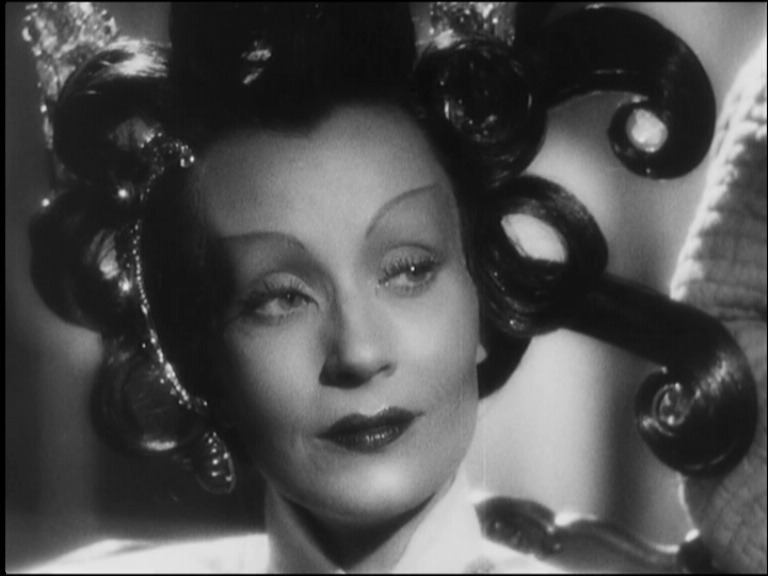
Von Sternberg was a stylist with an emphasis on glamor photography—his work with Dietrich is some of the most scrupulously accomplished shadow work in movies—and his capturing of Ona Munson, Brooks, and especially Tierney is a tightly controlled use of light to emphasize the contours of the face. Munson's wild hair-styles suggest nothing so much as a medusa, and Tierney, once her slide down the slippery slope of..."too much gambling"...begins, is all broken doll in her body language, a marionette with some strings slashed (something foreshadowed by von Sternberg early on)

Both Michael Curtiz (who directed Casablanca) and von Sternberg were directors who had penchants for filling up the screen-frame, but Curtiz kept things naturalistic, with his performers squarely rooted in specific places. Von Sternberg's close-ups are frequently floating heads, backed by a light pattern that has nothing to do with their surroundings.
But, that's where comparisons end: The Shanghai Gesture is a bizarre bazaar of weirdness, a combination of kitsch and creepiness, a glamorized descent into degradation and venality (beautifully shot, though!), with possibly the worst example of mother-love demonstrated on screen.  It is the dark side of entertainment, gussied up with glamour to make the proceedings seem tolerable, something that could be said for all of the work of von Sternberg, master of both light and darkness.
The Shanghai Gesture is also unique for giving a credit to the extras.


 * Furthman was great at that: in The Big Sleep he and Hawks suggested nymphomania by having the character suck her thumb.