Showing posts with label Linda Darnell. Show all posts

Thursday, March 28, 2024

The History of John Ford: My Darling Clementine

When Orson Welles was asked what movies he studied before embarking on directing Citizen Kane he replied, "I studied the Old Masters, by which I mean John Ford, John Ford, and John Ford." 

Running parallel with our series about Akira Kurosawa ("Walking Kurosawa's Road"), we're running a series of pieces about the closest thing America has to Kurosawa in artistry—director John Ford. Ford rarely made films set in the present day, but (usually) made them about the past...and about America's past, specifically (when he wasn't fulfilling a passion for his Irish roots). 

In "The History of John Ford" we'll be gazing fondly at the work of this American Master, who started in the Silent Era, learning his craft, refining his director's eye, and continuing to work deep into the 1960's (and his 70's) to produce the greatest body of work of any American "picture-maker," America's storied film-maker, the irascible, painterly, domineering, sentimental puzzle that was John Ford, John Ford, and John Ford.
 
My Darling Clementine (John FordLloyd Bacon, 1946) Stuart Lake's 1931 biography of Wyatt Earp, "Wyatt Earp: Frontier Marshal," had already inspired two previous Earp moviesone in 1934 and one in 1939, both titled Frontier Marshaland in 1946, he published another book "My Darling Clementine." John Ford took an interest in the latter and bought the film rights, using it to make the last film he owed on his contract with 20th Century Fox.

Ford had revolutionized the Western genre with his 1939 film of Stagecoach and My Darling Clementine was his return to making horse operas since that film. Ford also wanted to make the film as he had conversed with the real Wyatt Earp during his silent-movie days, and he wanted to make an accurate depiction of the frontier town of Tombstone and of the climactic Gunfight at the O.K. Corral, a 30 second skirmish in the city's streets that author Lake had mythologized in "Frontier Marshal".
There are those who say this is Ford's best Western, though, as great as it is, I find it slightly problematic. Great, but there are little details that paw at the dirt. For the first point, it is wildly inaccurate about events during Earp's tenure in the law while he was in Tombstone. He was never sheriff as the film depicts—that was his brother Virgil (played in the film by 
Tim Holt)—the Earps weren't cowboys but gamblers and pimps...and opportunists. Old Man Clanton (played by Walter Brennan at his most repellent) who, in the film, is the instigator of the bad blood between the Earps and the Clanton and whose killing of Virgil leads to the famous "gunfight"—which also *cough* took place in 1881, not 1882—died before any of this took place. Doc Holliday was a dentist, not a surgeon, and there was never any "Clementine." One isn't even sure of the details of that gunfight, even though Ford says he staged it as Earp described it to him when the two found themselves on the same silent film-shoot. But, who lived and who died in real life is nothing like presented in the film.
Earp was well-known for "polishing his badge" in interviews—and Blake Edwards, in his 1988 film Sunset has Earp say "that's just how it happened...except for a lie or two." Certainly, Lake's biographies are rife with inaccuracies, due to writerly creativity, Earp's sketchy relationship to Truth and the efforts of Earp's widow, Josephine, to white-wash history in her husband's favor.

But, then we're also talking about John Ford, who, in two years, would make Fort Apache where John Wayne's Cavalry Captain Kirby York would lie to the press about the actions of his fallen superior Lt. Col. Owen Thursday (Fonda again) "for the sake of the Corps" and who would articulate the sentiment in 1962's The Man Who Shot Liberty Valance when a member of the press says "This is the West, sir. When the legend becomes fact, print the legend." Ford mythologized the West in his movies, even if, in later films, he would puncture those myths for a more nuanced perspective on "Manifest Destiny."
There's a story of Ford being confronted by a historian of the Old West about all those fictions in Clementine and Ford replied "Well...did you like the picture?" to which the guy said he did very much. To which Ford hammered back "What more do you want?"
 
Good argument, that. Really.
But, the other issue I have is that director's credit. What we have now as My Darling Clementine isn't exactly the film Ford made. 20th Century studio head Darryl Zanuck thought it was okay, but wanted to make changes to it—and employed studio employee Lloyd Bacon to shoot other scenes, while Zanuck trimmed some 17 minutes out of the film. Those non-Ford scenes include 
Henry Fonda's Wyatt Earp talking over the grave-site of his brother James (Don Garner), killed in an ambush by the Clantons. The other big change? The ending, where Earp bids farewell to Clementine. In Ford's version they shake hands. But, preview audiences felt...unfulfilled. So, Zanuck had Bacon shoot a new close-up of a farewell kiss. Afterwards, when Zanuck offered Ford another contract to do more movies at Fox, the director turned it down to make films, without Zanuck's interference, through his own studio, Argosy Pictures. 
So, what do we have in My Darling Clementine, that odd mixture of fiction and legend? History as we'd like it to be. Simplistic delineations between good and evil out on the edge of civilization. And where young Wyatt Earp has revenge on his mind—that part's certainly historically accurate—for the harm done to his family, it's a case of Good versus Bad (certainly less complicated than the testimonies given at the Earp's real-life trial after the incident) with Good triumphing and even getting the girl. Maybe it was Zanuck's treatment of it talking, but Ford dismissed it as "essentially a film for children."
Ford was toiling in the fields of Myth, not History. He was telling a far bigger story than the one leading to the rumble at the O.K. Corral; Ford was examining the story of the dawning of a frontier civilization. When the town of Tombstone is first introduced by old man Clanton he describes it as "wide-open". That's an understatement; it's not even a town, just a single row of "growing concerns"—a hotel, a boarding house, a saloon, a brothel, a store, "that" corral...and a barbershop. There isn't even a defining thing as a street—the doors of buildings face open landscape, interrupted by transitory covered wagons. It's rough and in its genesis.
It's certainly no place to raise a family, the only examples of which are the Earps and the Clantons, polar opposites—one defining anarchy and the other abiding by the rules, such as they are. The Earps come to Tombstone for a respite from the trail, leaving young brother James to look after their herd, only having that moment of relief lead to the young man's death, presumably ambushed by the Clantons. The Earps settle in town—after Wyatt resolutely handles a disturbance—ultimately to settle scores.
Their positions as law-men will be a challenge to the Clantons, but also to Tombstone's most prominent citizen, "Doc" Holliday (
Victor Mature), once a surgeon, now a drinker, gambler, and gun-fighter. He has come to—appropriately—Tombstone to die, running from his past life to the drier desert, hoping it will help his tuberculosis. He has come to town a dead man walking, and he's lost hope...in his health, himself, and in everything. His existential crisis is first irritated by the presence of the Earps—he can't exactly throw his callousness around anymore—but it comes to a respectful kindredship. He begins—against a thousand reasons not to—to hope.
Part of this transformation is due to his friendship with Wyatt, who is centered, contained, confident, and unflappable. Henry Fonda's interpretation of Wyatt is not given to overzealousness or going off half-cocked. He's steady...even in a crisis...in stark contrast to the Clantons who know no bounds or ethics. The man who no longer believes in anything, starts to find purpose. And the rough-hewn Earp begins to gradually become more dapper, in no small part due to the presence in town of Holliday's former flame and assistant, Clementine Carter (
Cathy Downs), who has come there to try to bring Holliday back to his old life.
The balance of Tombstone shifts from merely trying to persevere against adversity to appearing to thrive, to build, and—once the Clantons are taken care of—why, they even presume to hire a schoolteacher. How's that for putting down roots and hoping for the future? 
You boil down those "legends of Wyatt Earp" (forget all those troublesome details)—and you get the story of the building of community, which is far less exciting than the turf-battles and gun-fights of less-considered examples of the Western, but the more protracted, difficult story of mending fences.

That's the story of My Darling Clementine. Not "the taming of the West" but the taming of our worst instincts.

Tuesday, June 16, 2015

A Letter to Three Wives

A Letter to Three Wives (Joseph L. Mankiewicz, 1949) One of the better movies of Mankiewicz's career of well-made films. This one was nominated for Best Picture, Best Director and Best Screenplay (Mankiewicz was directly responsible for the latter two, and indeed, for the first, although the producer team usually gets the laurels). None of the actors were nominated, although there are many very subtle and intricate performances throughout, with little touches of brilliance that go beyond the dialogue (which, in itself, is subtle and brilliant).

Based on a Cosmopolitan story, the film owes its roots to The Women, but tops it in terms of psychology and structure, while still maintaining that film's level of cattiness.

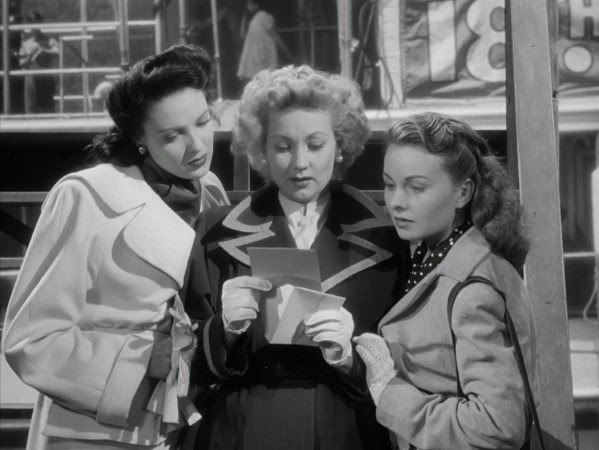
That is provided by the opening narration by one Addie Ross (voiced by Celeste Holm in a creepy "know-it-all" tone that reminded me of the disembodied voice-overs of "Desperate Housewives"). She sets the scene—and the motion picture—by moving away from the New York suburb from her "friends" Deborah Bishop (Jeanne Crain), Rita Phipps (Ann Southern), and Lora Mae Hollingsway (Linda Darnell), and leaving them all a "good-bye" note, the dear thing, on the very day all three women are out of town helping underprivileged children at a day-camp.
Thoughtful, but not in a good way. Scheming, more like it. The letter from Addie (known for always doing "the right thing at the right time") has a zinger of a farewell—informing the three that she has taken one of their husbands with her.  And to rub salt in the wound, she doesn't even tell them which one.

Bitch.
All three husbands (Jeffrey Lynn, Kirk Douglas and Paul Douglas, respectively) had been acting a little reserved and distant that morning, off to their little pursuits, knowing full well the wives are doing some community service that they're committed to. They'll be gone all day, leaving the men to whatever rendezvous awaits them. They hadn't given it a second thought before. Now, it's all they can think about. 
Darnell, Southern and Crain look at the last telephone they'll see all day.
As the women move forward to that day-camp across the lake, all they can do is move backwards and reminisce about their marriages, what's right and what's wrong (and one of the things that's wrong they all share—their husbands think the world of Addie Ross). All afternoon, when they should be thinking of others, they are at their most self-absorbed. There's not even a pay-phone (pay-phone? Yes, kids, there was such a thing) out at that camp for them to ring home in the hope someone answers.

They all have their issues: Deborah met husband Brad during the war and had no ties to his small-town roots. She was an outsider who inherited the Phipp's, the Hollingsway's...and Addie. They were all chummy and comfortable and Deborah is anything but...wanting to make a good impression, but knowing she has a lot of time and history to make up. Her first "coming-out" get-together with the couples at "the club" does not go well—her dress is none-too-stylish (although Rita does some alterations that are altogether flimsy) and to loosen up, she gets a little tipsy. Then, that galoot of a husband, Brad, decides to whirl her around the dance floor, creating one of Mankiewicz's few attempts at enhanced POV.
Deborah on the dance floor...
Darnell, Ford, Southern and Douglas in an alcoholic haze.
With such an inferiority complex, she's sure Brad's the straying husband. But Rita has her doubts and self-doubts, as well. She's a writer of soapy radio dramas while husband George is an English teacher, who makes no secret of his contempt for the "low-writing" that suffices as entertainment these days. Mankiewicz throws in some sharp barbs about pablum and sponsored writing, but of the three, the only thing she's concerned about is her time spent away from George doing constant re-writes at the behest of the soap-peddlers. She doesn't consider the time that he spends away grading papers.
Then there's Lora Mae—gorgeous, smart, calculating. She remembers her days playing the field with all the good prospects in town. And those aren't shoulder-pads in the get-ups she wears on her many dates so much as chips on her shoulders. Lora Mae grew up on the wrong side of the tracks...and very close to them, as they trains rumble by, threatening the plates several times a night. There, she squabbles with her Irish mother (Connie Gilchrist) and her best friend Sadie (Thelma Ritter, her third movie but still uncredited)—who also happens to be the Phipps' maid. She plays the field, but it appears to be narrowing to her divorced, rough-hewn, older boss Porter Hollingsway (Paul Douglas, his first big role after being a Broadway success in "Born Yesterday"). He's bitter, she's passive-aggressive and their conversations are like verbal boxing matches.
Sisterly conflict (with Thelma Ritter sparring)
Southern and Douglas don't have much chemistry and clashing acting styles—they barely seem like a couple. Crain and Lynn don't register much together—he's barely around (dramatic music here) and is such a non-entity he's not missed. But sparks fly between Douglas and Darnell, despite the fact that they're so mis-matched; he's older and charmless and she's fiery and gorgeous, they both gotten what they want out of the marriage, but neither one of them is satisfied or happy and the two actors make the most of their interplay—they crackle and spit and even with their mouths shut and the focus on others, their eyes throw daggers at each other. It was Douglas' film debut...and maybe he overplays it a bit...but the scenes between him and Darnell make you sit up and take notice.
So who's the philandering husband? Not saying. From the writer-director perspective synching with the wives', it could be any of them, and Mankiewicz (the writer) has fun dropping clues and suggestions. It will keep you guessing...except that Mankiewicz crafted a clever soap-opera. The next year, he would oversee his masterpiece—All About Eve.