Showing posts with label Rhys Darby. Show all posts

Thursday, September 8, 2016

Hunt for the Wilderpeople

Shit...Just...Got...Real!
or
"I've Got Me Own Thing: Ricky-Town. Population: Ricky"

New Zealand Child Services pulls up to a house at the edge of a "million hectares of wilderness" and drops off a lump of a kid, Ricky Baker (Julian Dennison)—an incorrigible ("A real bad egg...He's a bit of a handful—and that's just the stuff we know about")—who's been bounced from foster-home to foster-home and lands here in the care of Bella (Rima Te Wiatta), who couldn't be more delighted with the prospect. 

The kid wanders around the humble farm-house, instantly hates it and gets back in the car, while the CS woman, Paula (Rachel House), talks down just how difficult the kid is. She pulls the kid, Ricky Baker, out of the car (which he does reluctantly) and sniffs: "Alright, time for the inspection!" She stays in place, looks around casually and says "Up to our high standards! Looks fine" and heads out in the local squad car (with a joking "...and remember, no returns!", leaving Bella and Ricky to get acquainted.
Ricky may be a bad egg, but Bella is a good one and she is delighted with the prospect of the Maori pre-teen becoming part of the family. She shows him around the farm—such as it is—and they encounter Hec' (Sam Neill): "You can call him 'uncle' if you like" "No, he can't!" is Hec's gruff reply. Heck is a generally disagreeable sort, off set by Bella's force of nature maternal generosity that seems to overflow, admonishing Hec' when he says at dinner "So, have you ever worked on a farm or are you just ornamental?" Bella has an innate ability to figure out what a kid needs, supplying Ricky with a cozy room, a hot water bottle under the sheets and a large knife on the nightstand "to kill monsters in your dreams."
Although Ricky appreciates the hot water bottle, his nature ("I didn't choose the skuxx life, the skuxx life chose me") compels him to grab a torch and run away, traveling all night in the wilderness until he falls asleep. When he wakes up, there's Bella, congratulating him that he made it that far after traveling all night, and telling him breakfast is ready. He's made it 200 metres. Ricky may fancy himself a bad-ass, but he's clearly a bad-ass with no discernible (or broad) goals. But, breakfast sounds good. He follows Bella back to the farm-house.
Life is relatively good. He and Bella have a good relationship—after Bella kills a wild boar with only a knife, he realizes she has far more street cred than he does—and considering that, after a series of bad matches with foster-homes, his next stop would be "juvey," he decides to make the best of it, making friends with the farm-dog "Dag" and grunting acquaintances with Hec', who sees Ricky as a passing phase, not even being impressed that Ricky composes primitive haikus for his anger management. That fringe of a relationship will be tested by circumstance, forcing the two to come to grips with their situation and each other, as they go on the run in that "million hectares of wilderness," living by their wits and, ultimately, becoming outlaws, running from authorities who have no understanding of their situation. What starts out as an odd-fellow relationship comedy turns into a tall-tale of a chase movie, where two vagabonds discover the value of family, however loose that definition may be.
Hunt for the Wilderpeople is odd, quirky, and laugh-out-loud funny, a Twain-ian coming-of-age story (based on the book "Wild Pork and Watercress" by beloved Kiwi author Barry Crump—known affectionately as "Crumpie") adapted by filmmaker Taika Waititi, whose last film was the hilarious vampire comedy What We Do in the Shadows. Waititi has the innate ability to mine laughs out of the corners of the lives of outsiders, who must deal with the same everyday inconveniences that we all do, that, combined with their own idiosyncrasies, makes them simultaneously curious and relatable. He is helped immeasurably by kid actor Julian Dennison, who has the inscrutable quality of not appearing to be doing much acting while projecting at full volume, and with a razor-sharp sense of timing in his dialog. As so much of Waititi's humor is pacing, Dennison is an able co-conspirator.
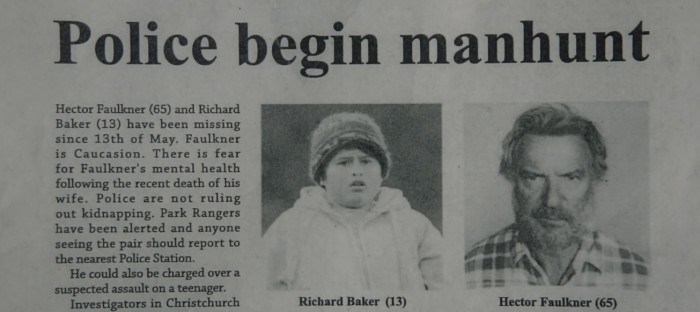
And Sam Neill is a revelation. So much of what he's relied on in the past has been star-charm and a twinkle in the eye, but there's none of those old tricks here. This is some of his best work since his very early unsentimental film days. His "Uncle Hec" is crusty and not very likable, but, like the kid, grows on you the more screen-time he has, which is considerable, as Dennison and Neill soon become the sole focus of the film.

It's one of those rare instances where the less said about the film, the better so as to not spoil it, other than to say that I was actually sorry to see the movie end. And movies like that are getting few and far between.

Thursday, April 9, 2015

What We Do In The Shadows

"Funny And/Or Die Presents..."
or
"WE Are Some Un-dead and Crazy Guys!"

Being a fan of "Flight of the Conchords" (the group and the show) made me want to see What We Do in the Shadows, the new "mockumentary" by Jemaine Clement and Taika Waititi, written and directed by the two with ample opportunities for ad-libbing, off-the-ruffled-cuff remarks and (excuse this) biting satire, as is the New Zealanders' style.

WWDITS is a great idea for a comedy; it's an absurdist documentary about the life (or after-life) of vampires in the modern age. It begins with an alarm clock going off, and a hand snakes out of a coffin and slaps it quiet. It's sunset and Viago (379 years old and played by Waititi) gets up and makes "the rounds" to wake up his "flat-mates" and announce an upcoming flat-meeting, which is greeted with mixed enthusiasm. Petyr ("8,000 years old" and played by Ben Fransham) looks like Nosferatu and expresses his intent to miss the meeting by lunging at Viago and hissing. Vladislav (862 years old and played by Clement) yells he'll be there when his commingling with succubi is done, and Deacon (the youngest at 183 and played by Jonathan Brugh), hanging upside down in a closet and looking the worse for wear, trudges to the meeting.
Vladilav, Viago, Deacon, Petyr, Nick and Stu
The meet and greet is done for the camera as Viago takes the documentary crew on the rounds—a title card explains that "each crew member wore a crucifix and was granted protection from the subjects." It's necessary. "The subjects" are technically challenged and further, are inhibited by the vampiric rituals: they're all from different eras and so fashion is as subject to interpretation as anything and their lack of mirror-reflection limits their abilities for self-assessment (they're reduced to drawing pictures of each other); in order to stalk their victims, they go clubbing, but they can't go in until they're actually invited in—something the bouncers outside have a hard time understanding.
Yee-es.  Face it, being a vampire actually DOES suck.

But, despite being dead and such and the other inconveniences of vampirism, they also suffer everyday problems, too: "flat-mates" that don't pick up after themselves, leaving bloody dishes in the sink (Deacon), or a spinal column on the floor (Petyr), or the mess that occurs when you miscalculate and hit a main artery (Viago). Vladislav, being 862 years old, has a practical solution: "Why don't we just buy slaves?"

Messy, messy, messy...
Of course. The various vamps, being of different eras and parts of the world, have different approaches to everything, which makes them individual and distinctive, and shows a better understanding of what living the immortal life of a blood-sucker would be like than (say) the "Twilight" series, where Robert Pattinson's centuries old Edward Cullen still acts like a love-sick teenager. The Wellington 4 are a coffin-embedded graph of the advancement of mankind (of a sorts) but still does not paint a pretty picture of the situation—they are, after all, dead and blood-sucking.
That these four ended up together is a matter of tribalism and circumstance. Viago, for instance, followed a woman from Europe to New Zealand, by ship, but missed her by a few years being chained in a coffin in cargo when it (and he) weren't off-loaded. That could happen. Vladislav is there after a protracted battle with a creature he calls "The Beast." Daily (or rather, nightly) activities include the afore-mentioned "clubbing" in Wellington, random encounters with a local pack of werewolves (they taunt them by throwing imaginary sticks, which the lycans can't help but try and fetch—psych!), and generally hunting/gathering. They're careful about this, but every now and again, there's a slip-up, such as when one of their nights hunting produces a new vampire named Nick (Cori Gonzalez Macuer) who has a precipitously flat learning curve when it comes to "the lifestyle," He's also something of a jerk, picking fights with the others and managing to stumble across the down-side to everything. For instance, he has to announce to everybody he's a vampire, which worries the others that it will draw attention to them. Nick points out that they DO have a film-crew following them around, so...
There is one good point to Nick. He brings along with him a rather dull friend named Stu (Stuart Rutherford), who is an IT expert and introduces the vampires to the joys (and toils) of the internet and cell-phones (mirrors may not show vampires, but "selfies" do!).*  
It's a hoot (one would say "howl" but this isn't about werewolves). One wonders how raw the thing will be when you walk in, and it isn't, really, although there are a couple of scenes with geysers of blood, that are actually pretty hilarious, and to see Viago standing, chagrined, in the hall-way, soaked with blood holding a roll of paper towels, has a funny sense of the pathetic along with the horrific. It also has something a lot of movies that are played ad-libbed don't have—a sense of story. Threads of storyline are resolved, sometimes for laughs, sometimes quite winningly. The humor is macabre, a few notches higher than "The Addams Family," but the laughter will squelch any revulsion one might feel. This is "mock-horror," not true horror, and comedy, not tragedy. What We Do in the Shadows is darned funny. And it's hard to be threatened by it when one is giggling. 
* Stray thought: vampires don't appear in mirrors because of the silvered backing?