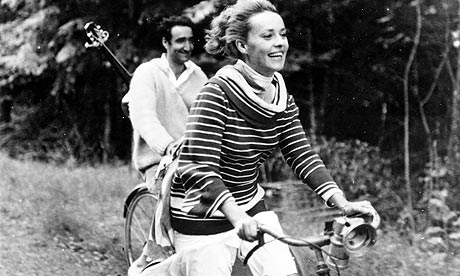
Jules et Jim aka "Jules and Jim" (François Truffaut, 1962) If only the folkies who saw Jules and Jim in 1962 had read it correctly, maybe the free-love era might not have overcompensated with drugs and disco in the '70's.
But, I'm getting ahead of myself.
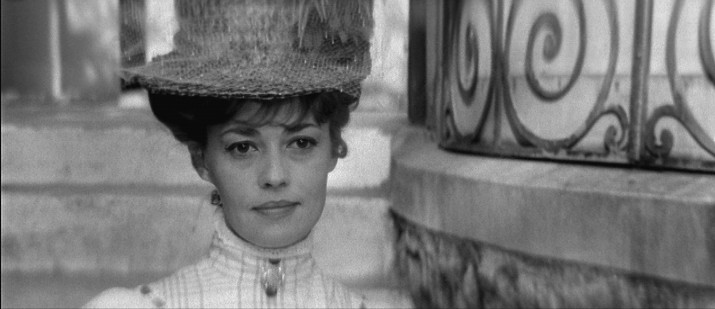
Truffaut's third film is a sprawling time-spanner that starts in 1916 and falls just short of World War II and tells the story of a menage a trois that can't be managed by the participants. Jules and Jim (Oskar Werner, Henri Serre) are two life-long friends, whose friendship is complicated by war and the woman, Catherine (Jeanne Moreau) who comes between them. Their bohemian life-style flaunts society's more's, but living without rules means walking an imaginary line while drunk—even if you knew where you were going, you're unsure of how to get there.
Showing posts with label Oskar Werner. Show all posts
Friday, April 21, 2023
Jules and Jim
* And, "of course," the woman is "the problem," but she is also the driving force—the vitality—that informs the lives of two rootless and feckless men.
Friday, May 25, 2018
Lola Montès
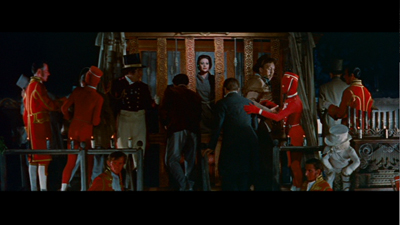
Lola Montès (Max Ophüls, 1955) "The things we do to women"—one of the mantras of fictional President Jed Bartlett in "The West Wing," said several times over the course of the series in the presence of a male audience (but never as much as "What's next?"). The last film of master craftsman Max Ophüls (two years before his death) is a reverie, a cautionary tale of the course of the life of dancer/courtesan Lola Montez, who climbed socially through the world of prominent men until a dalliance with the King of Bavaria (who appointed her The Countess of Landsfeld) created such an uproar, it caused a revolution in 1848. The real Lola lived quite well, though doing it so fast ultimately cost her. She died from pnuemonia after suffering a stroke at age 40 in the United States.
Ophüls' "reel" Lola (played by Martine Carol) lives out her foreshadowed final days as a featured performer of a circus (ring-led by Peter Ustinov), a public spectacle where she is forced to re-live and metaphorically re-enact her scandalous rise and precipitous fall before an audience of French rubes, who, like the rabble they are, shout questions from the dark (and Ustinov's Circus Master smarmily answers, egging them on).
She is the star performer, but trapped—by the schedule, by the spotlight, and finally caged, as a seemingly endless line of paying customers queue up to kiss her hand, paying homage and risking little. She is a prisoner of her fame, her reputation and her life, that once represented a kind of freedom, where she felt she could challenge the limitations of polite society.
For Lola, it must seem a little like Hell, and for director Ophüls, it might have, too. A long, complicated shoot, his first in color and wide-screen (at the producers' insistence), with a star he didn't want (at the producers' insistence), his film's complicated flashback structure, shifting back and forth from the circus' smarmy presentation of incidents to Lola's memories of the events—was re-edited into an uneasy chronological order to get to "the good parts" faster (at...well, you already know), after its premiere. And that version of Lola—with one or two bits of lost footage tacked on over the years—was what the world knew of Ophüls' last film...until 2008. Restored to the structure Ophüls intended, the film wheels between Lola's life in charge and manipulating events, to her being manipulated reliving the events, like a sideshow attraction. And the presentation has an accusatory, sensationalist tone—a show-trial, literally.
It's a cunning look at fame (or infamy), of how one's actions can be sold as just about anything (the director's son in a supplemental interview says "Lola Montès is anti-advertising.")—and ironically the producers took the deception one step further, missing, or ignoring, or even sabotaging, the point.
Meanwhile, Ophüls managed to make the most of his star's lack of range, making her a stoic throughout the self-abasement. Politically, it's an odd film: ostensibly, a "Comeuppance" film where an upstart (in this case, Lola) gets her "just desserts" (if one is thinking uncharitably), suffering humiliation and entrapment at the hands of men—once powerful and influential, she's now powerless. But, that's a simplistic, even a foolish, reading. Lola still holds fascination, draws a crowd, and those lines of men at the end are paying money to kiss her hand and pay their respects. Even the Circus Master betrays his personal devotion to her. Caged she may be, but she's still "got" it.
And Ophüls might have just told the flashback story, but the tragic scenes at the circus provoke empathy for Lola, reliving her lost past, generating understanding, or as Ophüls' son says, "in a spirit of penitence and mortification, benevolence." An audience might not be so sympathetic if Lola wenched her way around the world. getting her way and getting away with it, but the circus summaries exploit and promote her past victories, while placing her in marked contrast with her accomplishments. Like the circumstances of Barry Lyndon (Ophüls was a huge influence on Kubrick), the comedown goes a long way to evoking sympathy for the unfortunate forever caught in the frame.
Critic Andrew Sarris once called Lola Montès "the greatest film ever made." One can see why.
![]() |
Tuesday, April 10, 2018
Fahrenheit 451
Fahrenheit 451 (Francois Truffaut, 1966) As long as we're looking at movies with dystopian society speculations, we should look at an unusual one from the 1960's with a different "take" on things. "Fahrenheit 451" is Ray Bradbury's conjecture, inspired by past Nazi practices during its Third—and final— Reich, the then-current McCarthy era (at the time of its writing) and future projections of thought-control, of a society where the written word is banned as subversive, and "firemen," in a time when houses are fire-proof, are, instead, tasked with burning contraband books. That is, all of them.
In the society of "Fahrenheit 451" (supposed to be in the American mid-West post-1960), books are considered bad, as they offer a different perspective from the government's social engineering efforts to keep the populace passive and controlled. Books stir everything up, confuse and enervate (and inspire), so they are suppressed to keep people placid and "equal" (although some more than others).
Bradbury's book was first published as a novella "The Fireman" in the Galaxy Science Fiction magazine in early 1951 (written on a rented typewriter in UCLA's Powell Library) and expanded for Ballantine Books in 1953. It became a classroom perennial to teach students metaphorical concepts and to keep a wary eye on sponsored group-think (in a time before they all graduated to Facebook).
Fahrenheit 451 tells the story of Montag (played by Oskar Werner, whose role in Truffaut's Jules et Jim made him an international star), who mans the flame-thrower on the fire-man raids on hidden libraries. He is mentored by Capt. Beatty (Cyril Cusack), who coaches him on the purpose and philosophy behind their fiery task. But Montag is pulled in other directions by two women: his wife Linda (played by Julie Christie), a willing product of the government's propaganda and desirous of an easy, uncomplicated life; the other is Clarisse (also played by Christie), an optimistic and inquisitive teacher who questions the status quo, and who elicits suspicion from the government.
Clarisse's curiosity infects Montag, who begins to question what he's doing, and even smuggles away a book during one of the raids, hiding it from his wife and painstakingly teaching himself to read.
He also begins to see the other side of what he's doing. seeing the devotion of the book-keepers, one of whom (Bee Duffel) chooses to be immolated, monk-like, with her beloved books. It shakes Montag right down to his bindings and he begins to see the whole society as having a broken spine, devoid of the passion that the books engender, and he begins to feel more isolated from his co-workers and his wife. After all, he is now a criminal...in his own mind, and in theirs, as well.
Truffaut's film is flawed—his published diaries reveal that is was a difficult "shoot," especially in dealing with actors (especially his former star Werner) and he was never satisfied with the English translation of the script, preferring the French version. Perhaps that is why the film seems to come most alive when he languishes his lens on all those montaged shots of books, as they explode into flame with an almost sensual fervor. Pages crisp and blacken among the collections of controversial books—and even an issue of Cahiers du cinéma, the magazine where Truffaut began his film criticism career—with all the unblinking fervor that Carl Theodore Dreyer used filming The Passion of Joan of Arc. Truffaut mixes the titles notorious at the time of the film with familiar classics long past their time of controversy ("David Copperfield" for instance) to show the wide spectrum of time and how it can outdistance objections of long-ago melted snowflakes.
There are moments that are dodgy—technically, on the effects side, the jet-packed police are clumsily wired in front of a projected back-drop that exposes the searchers as not moving independently in flight. But, on the other hand, the movie does forecast flat-screen television monitors (interactive ones!) and the way the media can invade one's life. Such things are much less jarring in current perspective than jet-packs (however poorly supposed).
In the society of "Fahrenheit 451" (supposed to be in the American mid-West post-1960), books are considered bad, as they offer a different perspective from the government's social engineering efforts to keep the populace passive and controlled. Books stir everything up, confuse and enervate (and inspire), so they are suppressed to keep people placid and "equal" (although some more than others).
Bradbury's book was first published as a novella "The Fireman" in the Galaxy Science Fiction magazine in early 1951 (written on a rented typewriter in UCLA's Powell Library) and expanded for Ballantine Books in 1953. It became a classroom perennial to teach students metaphorical concepts and to keep a wary eye on sponsored group-think (in a time before they all graduated to Facebook).
In 1966, French director Francois Truffaut, part of the French "New Wave," chose Bradbury's book to be the subject of his first English-language film (a language barrier that created a slight frisson with the European actors taking direction from an artist (talented, though he may be, visually) for whom English was an unfamiliar language (is that the reason the dialogue is all dubbed?). On the top of that, Truffaut's version of the future is clean, sterile, upwardly mobile, very "white" and slightly robotic, and heavily influenced by Albert Speer's monolithic, concrete city blocks.
The film's title sequence is a nifty introduction to the concept; over tinted zoom shots of roof-tops with broadcast aerials with no title-text, the credits, instead, being narrated by actor Alex Scott. It sets you up for a world without words, and the movie-proper starts with a call to the local fire-house and a small team of fire-men raiding a book depository, finding hidden books, creating a pile of them and setting them ablaze with ruthless efficiency.He also begins to see the other side of what he's doing. seeing the devotion of the book-keepers, one of whom (Bee Duffel) chooses to be immolated, monk-like, with her beloved books. It shakes Montag right down to his bindings and he begins to see the whole society as having a broken spine, devoid of the passion that the books engender, and he begins to feel more isolated from his co-workers and his wife. After all, he is now a criminal...in his own mind, and in theirs, as well.
Truffaut's film is flawed—his published diaries reveal that is was a difficult "shoot," especially in dealing with actors (especially his former star Werner) and he was never satisfied with the English translation of the script, preferring the French version. Perhaps that is why the film seems to come most alive when he languishes his lens on all those montaged shots of books, as they explode into flame with an almost sensual fervor. Pages crisp and blacken among the collections of controversial books—and even an issue of Cahiers du cinéma, the magazine where Truffaut began his film criticism career—with all the unblinking fervor that Carl Theodore Dreyer used filming The Passion of Joan of Arc. Truffaut mixes the titles notorious at the time of the film with familiar classics long past their time of controversy ("David Copperfield" for instance) to show the wide spectrum of time and how it can outdistance objections of long-ago melted snowflakes.
Fahrenheit 451 does have an aspect to it that makes me regard it fondly, seeing past its flaws—its ending. In it (FLAMING SPOILER ALERT), once Montag has escaped his puppeteered pursuers—and is dramatically and fraudulently "killed" for the cameras—he makes his way along an abandoned railway track to his ultimate destination—a secluded wood that has become the home of the "book-people" who each devote their lives to a single book, memorizing it, archiving it in their minds, so that it can never be destroyed except by death (and even that is maintained with a hand-me-down oral history to the next generation).
It is one of my favorite sequences in film* augmented by an exquisite strings-only score by Bernard Herrmann. As the spken words commingle, Herrmann, whose score has previously gone turgid in moments of action and pursuit, breaks free and creates a delicate melancholy theme that is one of his loveliest compositions, certainly one of the most beautiful in cinema since the sound era. That he ends it with an unresolved blast of strings that resembles a cry of anguish finishes the film with an appropriate flourish of emotion previously not realized in the film.
It moves me no matter how many times I've experienced it.
After a couple of decades of an update being planned, HBO has produced a new version starring Michael B. Jordan, Michael Shannon, Sofia Boutella and Keir Dullea to be directed by Rahmin Bahrani (director of Man Push Cart and Goodbye Solo) which sounds very intriguing. They'll start showing it May 19th of this year.
It moves me no matter how many times I've experienced it.
After a couple of decades of an update being planned, HBO has produced a new version starring Michael B. Jordan, Michael Shannon, Sofia Boutella and Keir Dullea to be directed by Rahmin Bahrani (director of Man Push Cart and Goodbye Solo) which sounds very intriguing. They'll start showing it May 19th of this year.
*
Friday, December 29, 2017
The Spy Who Came In From the Cold
Over Christmas, I had great fun reading "A Legacy of Spies," the new novel by John le Carre. In it, the events of le Carre's earlier book "The Spy Who Came In From the Cold" come back to haunt the British Secret Service—The Circus, as le Carre dubbed it—as those who are still living are sued by living relatives for damages incurred by the events of the story.
Is it some Russian plot? No. It is mere gold-digging. The plaintiffs are blackmailing the Service to reveal what they know...or suspect...if they are not payed handsomely. It is always fun for me to read le Carre but the nostalgia factor of coming back to the old characters, even if in passing, was a bit of a thrill. And whenever Alec Leamas was mentioned in the book, I still had trouble imagining Richard Burton's face and manner. I wrote this in 2011, some time before Tomas Alfredson's excellent version of Tinker Tailor Soldier Spy reached theaters—I should post my review of that here when I'm done with the clutch of Holiday released movies.
The Spy Who Came In From the Cold (Martin Ritt, 1965) With the anticipation of the Christmas release of a film version of Tinker Tailor Soldier Spy, it would do well to revisit the world of George Smiley, "Control," and the duplicity of agent-turned-novelist John le Carré's "kitchen-sink" version of spies. Although Smiley and the others would loom large in his later novels (especially the "Karla Trilogy"), they're mere background characters in The Spy Who Came In From the Cold, the focus of the tale being operative Alec Leamas (Richard Burton), former head of the West Berlin branch of "The Circus," who must go behind enemy lines—in fact, one of the toughest of them, the Berlin Wall—as a potential "mole"* to ferret out who, among their Cold War equivalency on the other side, might be a double agent for the Soviets, the one who is responsible for the death of one of Leamas' contacts. To "Control" (Cyrilm Cusack), the head of "The Circus" it is a rare opportunity to do some damage control and, possibly, if they can take advantage of an agency power-struggle, some harm.
His identity is kept the same—The Circus wants Leamas and his background history out in the open—but he is demoted in rank and stature, and, depressed and drinking heavily, he becomes bait for Soviet recruitment to betray information. That's the mission, become a decoy on the "inside," another "double" feeding the Soviets false information, while trying to find out if there's a player on the other side in The Circus feeding information to the Russians.**
Oh, what a tangled web the Cold War weaves.
Taken to East Berlin, Leamas is interrogated by a suspicious Russian administrator named Fiedler (Oskar Werner) who (rightly) suspects Leamas of being a "plant." Fiedler suspects a British "mole" already underground in the Soviet service and so sweats Leamas for any information to discover who that might be. Ultimately, Leamas is undone by what so many of le Carré's heroes or anti-heroes are susceptible to, the warmth of human contact—a failing that trips up a lot of the author's protagonists. Leamas "comes out of the cold," the world of spies, and his friends, relations or lovers—the thread of decency and honesty they provide—are used against him.
For the fact of the matter is the Spymasters of "The Circus" are cold-hearted bastards ("without sympathy" as "Control," played by Cyril Cusack, ponders)—they have to be to combat their enemies—and they're just as capable of betraying their own as those they fight.
Case in point: George Smiley (played here by Rupert Davies). He would become le Carré's most celebrated character, but here he's a bit of a functionary, and he's just as cold-hearted as the rest. In the "Tinker, Tailor..." timeline, "Control" was long since dead, having been driven out by "the new broom" from his station, which had left him suspicious and paranoid (ultimately with good reason) with Smiley his only trusted colleague.
When the BBC made a television mini-series of "Tinker...", Smiley was famously played by Sir Alec Guinness and (as le Carré amusingly notes in his new forward to "Tinker, Tailor...,") because of that he "lost control" of the character. But Smiley (however sympathetically Guinness played him) is also a "cold-hearted bastard"—if he wasn't, he wouldn't have lost the vital clue that was exploited by his enemies. He gives as bad as he gets, and, even at his most triumphant, takes little joy in what he does.
In such a world, Ritt's direction is entirely appropriate—low-key, almost documentary in feel on the streets of London—in drab black-and-white, not the high-contrast color of other spy films of the era. There is nothing glamorous about it, and the circumstances play out slowly and subtly—in fact, after a debriefing by his boss, the shift in tone is so dreary one suspects one is watching a different film. It is part and parcel of the subterfuge—it works on us as it does for Leamas' Sov' recruiters (most prominently Michael Hordern).
And the script—now there's an interesting tale. A beginning draft was written by Hollywood veteran Guy Trosper, who died subsequently. Taking over was poet-playwright Paul Dehn. Dehn had written the final polish on the James Bond spy film Goldfinger (amusingly, as the two films could not be more polar opposite), and was the mainstay-writer for the "Planet of the Apes" sequels. But, Dehn knew the world of spies well—during the second World War, Major Paul Dehn was the "Political Warfare" officer at the BSC training headquarters "Camp X" (where among the trainees were Roald Dahl and Bond creator Ian Fleming). *** Dehn was well-versed in spy-craft, deceit, and keeping secrets and his distillation of le Carré's novel brings the moral duplicity to the fore, while keeping the audience guessing on whose side is whom.
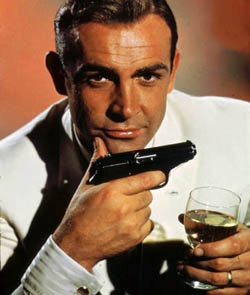
If the film has one flaw, it is the casting of Burton as Leamas. Burton was too good, too charismatic an actor/star to play a functionary like Leamas (it's about the same as "buying" Sean Connery as a spy (which was part of the joke of the Bond series)—he's someone you'd notice walking into a room, and thus, hardly spy material. But, Burton's presence, no doubt, got the film made, so the point is a bit moot. Still, if its ideas and mysteries of the State and the heart you want more than action and fireballs (shall we say if you want to be "stirred and not shaken?"), The Spy Who Came in From the Cold is a fine, bracing tonic.
* The term "mole" is a le Carré invention—his spy-circles code-name for a double agent hiding in plain sight within one of the other spy agencies, Soviet or British, and relaying information to "the other side."
** There has been a rich history of double agents throughout the annals of spy-dom, the most significant of which were "The Cambridge Five"—Kim Philby, Donald Duart Maclean, Guy Burgess, Anthony Blunt, and a fifth (and possibly more)—who'd been recruited during their college years, passed information to the Russians during WWII, and subsequently during the post-War years through the early 1950's. "Tinker, Tailor, Soldier, Spy" (and the other two of the le Carré "Karla" novels) and le Carré's subsequent "A Perfect Spy" are inspired by "The Five" and their Russian puppet-master.
*** And, interestingly, one of the people who asked, and was briefly considered, to run Camp X...was Kim Philby!
The Spy Who Came In From the Cold (Martin Ritt, 1965) With the anticipation of the Christmas release of a film version of Tinker Tailor Soldier Spy, it would do well to revisit the world of George Smiley, "Control," and the duplicity of agent-turned-novelist John le Carré's "kitchen-sink" version of spies. Although Smiley and the others would loom large in his later novels (especially the "Karla Trilogy"), they're mere background characters in The Spy Who Came In From the Cold, the focus of the tale being operative Alec Leamas (Richard Burton), former head of the West Berlin branch of "The Circus," who must go behind enemy lines—in fact, one of the toughest of them, the Berlin Wall—as a potential "mole"* to ferret out who, among their Cold War equivalency on the other side, might be a double agent for the Soviets, the one who is responsible for the death of one of Leamas' contacts. To "Control" (Cyrilm Cusack), the head of "The Circus" it is a rare opportunity to do some damage control and, possibly, if they can take advantage of an agency power-struggle, some harm. His identity is kept the same—The Circus wants Leamas and his background history out in the open—but he is demoted in rank and stature, and, depressed and drinking heavily, he becomes bait for Soviet recruitment to betray information. That's the mission, become a decoy on the "inside," another "double" feeding the Soviets false information, while trying to find out if there's a player on the other side in The Circus feeding information to the Russians.**
Oh, what a tangled web the Cold War weaves.
Taken to East Berlin, Leamas is interrogated by a suspicious Russian administrator named Fiedler (Oskar Werner) who (rightly) suspects Leamas of being a "plant." Fiedler suspects a British "mole" already underground in the Soviet service and so sweats Leamas for any information to discover who that might be. Ultimately, Leamas is undone by what so many of le Carré's heroes or anti-heroes are susceptible to, the warmth of human contact—a failing that trips up a lot of the author's protagonists. Leamas "comes out of the cold," the world of spies, and his friends, relations or lovers—the thread of decency and honesty they provide—are used against him.
For the fact of the matter is the Spymasters of "The Circus" are cold-hearted bastards ("without sympathy" as "Control," played by Cyril Cusack, ponders)—they have to be to combat their enemies—and they're just as capable of betraying their own as those they fight.
Case in point: George Smiley (played here by Rupert Davies). He would become le Carré's most celebrated character, but here he's a bit of a functionary, and he's just as cold-hearted as the rest. In the "Tinker, Tailor..." timeline, "Control" was long since dead, having been driven out by "the new broom" from his station, which had left him suspicious and paranoid (ultimately with good reason) with Smiley his only trusted colleague.
When the BBC made a television mini-series of "Tinker...", Smiley was famously played by Sir Alec Guinness and (as le Carré amusingly notes in his new forward to "Tinker, Tailor...,") because of that he "lost control" of the character. But Smiley (however sympathetically Guinness played him) is also a "cold-hearted bastard"—if he wasn't, he wouldn't have lost the vital clue that was exploited by his enemies. He gives as bad as he gets, and, even at his most triumphant, takes little joy in what he does.
![]() |
| Davies as George Smiley in The Spy... |
And the script—now there's an interesting tale. A beginning draft was written by Hollywood veteran Guy Trosper, who died subsequently. Taking over was poet-playwright Paul Dehn. Dehn had written the final polish on the James Bond spy film Goldfinger (amusingly, as the two films could not be more polar opposite), and was the mainstay-writer for the "Planet of the Apes" sequels. But, Dehn knew the world of spies well—during the second World War, Major Paul Dehn was the "Political Warfare" officer at the BSC training headquarters "Camp X" (where among the trainees were Roald Dahl and Bond creator Ian Fleming). *** Dehn was well-versed in spy-craft, deceit, and keeping secrets and his distillation of le Carré's novel brings the moral duplicity to the fore, while keeping the audience guessing on whose side is whom.
If the film has one flaw, it is the casting of Burton as Leamas. Burton was too good, too charismatic an actor/star to play a functionary like Leamas (it's about the same as "buying" Sean Connery as a spy (which was part of the joke of the Bond series)—he's someone you'd notice walking into a room, and thus, hardly spy material. But, Burton's presence, no doubt, got the film made, so the point is a bit moot. Still, if its ideas and mysteries of the State and the heart you want more than action and fireballs (shall we say if you want to be "stirred and not shaken?"), The Spy Who Came in From the Cold is a fine, bracing tonic.
Smiley's before they were emoji's: Alec Guinness and Gary Oldman
* The term "mole" is a le Carré invention—his spy-circles code-name for a double agent hiding in plain sight within one of the other spy agencies, Soviet or British, and relaying information to "the other side."
** There has been a rich history of double agents throughout the annals of spy-dom, the most significant of which were "The Cambridge Five"—Kim Philby, Donald Duart Maclean, Guy Burgess, Anthony Blunt, and a fifth (and possibly more)—who'd been recruited during their college years, passed information to the Russians during WWII, and subsequently during the post-War years through the early 1950's. "Tinker, Tailor, Soldier, Spy" (and the other two of the le Carré "Karla" novels) and le Carré's subsequent "A Perfect Spy" are inspired by "The Five" and their Russian puppet-master.
*** And, interestingly, one of the people who asked, and was briefly considered, to run Camp X...was Kim Philby!
Subscribe to:
Posts (Atom)