Showing posts with label Matthew Rhys. Show all posts

Friday, January 3, 2020

A Beautiful Day in the Neighborhood

"Oh, God, Lloyd! Don't Ruin My Childhood!"
or
"This is More About YOU Than It Is About Mr. Rogers!"

Tom Hanks plays Fred Rogers and it's just wrong.

Oh, Hanks does a fair imitation, but it's an imitation and Rogers was an original.


The cadence is there and the carefulness, but when Hanks smiles there's a crinkly creepiness that borders on mild irritation and that was something you never saw in Rogers, whether on his long-running "Mr. Rogers' Neighborhood" program on PBS ("THANK you!") or in his public appearances, or in the very well-crafted 2018 Morgan Neville documentary Won't You Be My Neighbor? or the many Rogers tribute compilations trotted out by PBS during their fund-raisers.* Rogers smile was genuine, never calculated, and always seemed to be ready to dawn, even when he was talking seriously.

That's missing in the "Neighborhood" recreations done in A Beautiful Day in the Neighborhood (although every other recreation of the set is meticulous). There was a lack of artfulness to the Rogers persona, which seemed pure, whereas Hanks is pure calculation.
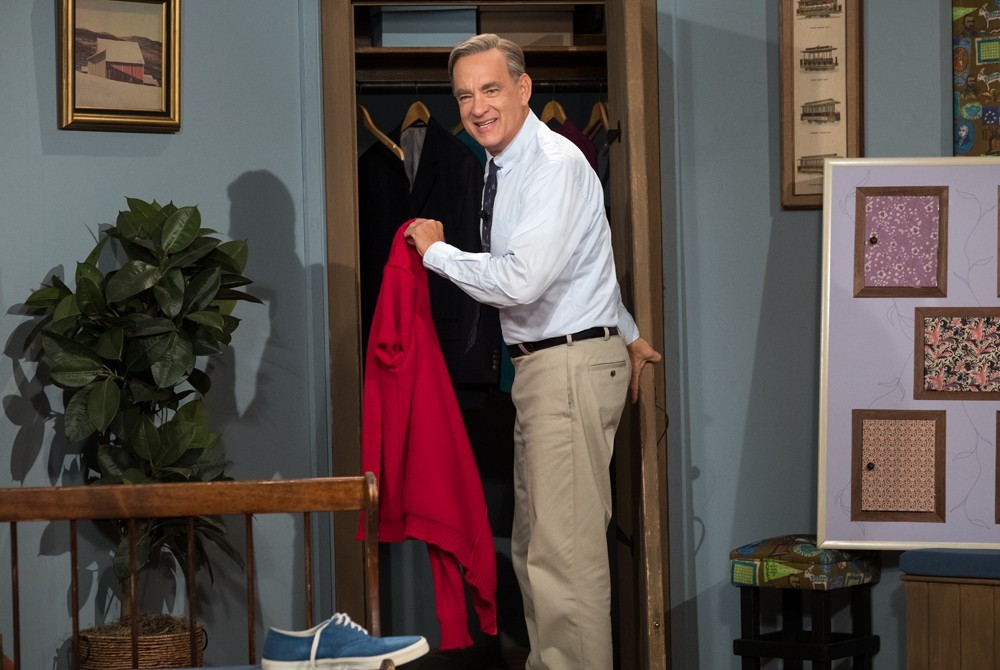
The film starts out preciously, with the standard "Mister Rogers' Neighborhood" open: Rogers walks through the set-door, singing "It's a Beautiful Day in the Neighborhood," his signature song, takes off his sports coat, hangs it carefully, puts on and zips up a sweater, and sits down, taking off his loafers and putting on a pair of boat-shoes. Then presents a picture-board with little doors that reveal members of the cast. Then, he opens a door that reveal a man who looks stunned and a little beat-up: "I want you to meet my new friend, Lloyd Vogle. Somebody has hurt him and not just his face." 
Cut to Lloyd Vogel (Matthew Rhys) in New York—recreated in toy dimensions as if part of Rogers' "Land of Make-Believe"—where he's receiving an award for his writing. Now, you need to know something about Lloyd Vogle. He doesn't exist. The movie is based around a Fred Rogers profile done for Esquire magazine by Tom Junod, who is a fine writer (he wrote the stunning "The Falling Man" article after 9-11) and, if you read that article (which I highly recommend), you'll find a lot of the incidences that A Beautiful Day in the Neighborhood dramatizes. But, a lot of it, certainly the personal stuff about Vogle (as Junod writes in a piece for The Atlanticis entirely the invention of writers Micah Fitzerman-Blue and Noah Harpster, whose screenplay made it to The Black List in 2013 (where it was called "I'm Proud of You"—curiously, also on that year's list was a Rogers biography script entitled "A Beautiful Day in the Neighborhood" by Alexis Jolly).

Now, the film warns us about this with a title that says "Inspired By a True Story" which means it's a couple of steps of separation removed from the usual "Based on a True Story" which, in itself, is no guarantee of veracity. So, there's some futzing going on here, though the general arc of the film is based on the Rogers-Junod story—a cynical reporter finds his "Obi-Wan Kenobi" in Fred Rogers and becomes a better person for it. Close enough for The Movies.
Back to the movie: Lloyd comes home to his gorgeous wife, Andrea (Susan Kelechi Watson) and his new baby boy and is greeted by the news that his father (Chris Cooper) is coming to his sister's wedding. Vogel darkens at the mention of his fathe, so there's history there. His wife asks if this means he's not going to attend? "No, I look forward to Sis' wedding every year..."
Well, it doesn't go well. Not at all. Dad, "Jerry," gets a little drunk, a little egotistical, a little pushy. At the reception, "Jerry" takes Lloyd aside and wants to have "a conversation," which, of course, is the last thing Vogel wants to do. Things are already a little bit antagonistic, and then Jerry's leaving Vogel's mother when she was sick leaving the kids comes up, so do fists. Lloyd socks Dad and a security guard socks Lloyd...but I'm sure the prime rib was delicious. Lloyd can put some on that on the shiner he gets from the incident.
Lloyd goes back to work sporting a black eye that he explains away from a wayward accident playing baseball over the weekend. People politely buy it. That's when he gets assigned the Rogers story by his editor (Christine Lahti), the idea of which Lloyd loathes. But, he does his due diligence, watching hours and hours of "Mr. Rogers' Neighborhood" in preparation for an interview, which after some delay, he gets. Rogers' producer Bill Isler (Enrico Colantoni) doesn't want Fred to do it and has given him some of Vogel's past articles. Despite this, Rogers says yes and quite enthusiastically.
At public television station WQED, he visits the "Neighborhood" studio where Rogers is being visited by an autistic fan-child. The studio crew is getting nervous—Fred is taking too long with the kid and the shooting schedule is tight. The director, crew—everybody—are rolling their collective eyes, but Rogers persists, focusing his attention on the child above all else. Then, he whispers something in the kid's ear, and the kid starts to focus on Rogers and gives him a big bear hug. They leave and Lloyd gets to meet Rogers. His subject is gracious, welcoming, giving him a greeting before starting a scene. When a take is completed and Rogers takes a look at it for his approval, Rogers takes a seat and the interview process begins.
But, it's an interview that Vogle has never experienced before and is, frankly, for him, a little counter-productive. He starts to ask Rogers questions and he answers deferentially, humbly, but then turns it around and starts to ask Vogle questions, asking him what his childhood was like, if he had a "special friend" when he was a kid, and, sure, Vogel had a plush toy that he called "Old Rabbit" and Rogers takes an interest in "Old Rabbit" and asks him about "him" and Vogel is a little freaked out about these questions about a ratty old toy that was tossed long ago, and, hey, he's the one doing the interview here. And Rogers is called away for another segment-taping, but, the conversation will continue soon.
This is where Hanks' interpretation gets a little off-target. Hanks' Rogers listens, but there's an appraising look in his eyes that is less open, more searching, scrutinizing, and there's enough footage of Rogers in interviews and interactions extant that the Hanks seemingly judgmental squint doesn't convey the man he's portraying. It's a small point, but it bugs me. Because I like Mr. Rogers and consider him to be a person that one should aspire to be. But—damn it—get it right, especially in a medium like the movies that could overshadow reality—and especially this movie where the reality is already suspect. "Inspired by...?" Sure. But, not in the way the actual Mr. Rogers inspires.
In the film, Rogers helps Vogel deal with his father when it reaches a crisis point, and, under Rogers' tutelage, there is a resolution and a reckoning and something that feels like closure. Those events in the film didn't happen, but the effect on Vogel is much the same as on Junod, and the two stayed friends and colleagues until Rogers' death in 2003.

And Rogers loved the article, both in the film and in real life.
Where the movie is successful is when it takes something specific that Junod related in the article and just lets it be—Rogers' openness, his taking on of burdens, his one-on-one personableness, his ability to make something good out of tragedy, his inclusiveness and his giving of self.

Where it fails is in the fabrications it imposes in its framework, falling back on inspiring tropes of religious-themed "true stories," those "very special episodes" of TV sit-coms in the 1980's, and of the current crop of dog movies—you know the ones...where a dog presents important life-lessons to his human companions who are struggling through life, when all we care to see is "the dog." And "Mr. Rogers," in this, is "the dog." When I saw the previews for this, that was the impression I was getting. And, unfortunately, the movie bears out those fears.

But, there may be something to that. Rogers represents something that is missing in a cynical age. I worked for a producer ages ago, who was telling me about the wonders the show instilled in her own child, and when she asked him why he was riveted by "Mr. Rogers Neighborhood," the child said simply "He likes me!"

Rogers through the TV-tube was never afraid to look a kid in the eye and tell them they had value, no matter what circumstances they lived in, what afflictions they had, what difficulties they faced in their lives. He did not present barriers to children, only possibilities. He was, and in re-runs is, an adult who could relate to kids, an authority figure who did not flaunt that authority but shared it and gave that singular kid he was looking at through the cathode-ray tube something that they also ascribe to dogs—unconditional love.

The "real" (and very nervous) Fred Rogers charms $20 million from the clenched fists of Sen. John Pastore.


* Those would be "Mr. Rogers and Me" and "PBS Presents: It's You I Like" (hosted by one of Fred Rogers' former employees, Michael Douglas, who would change his name professionally to Michael Keaton

Tuesday, January 16, 2018

The Post

Based on a Truth Story
or
Black and White and Red All Over

Backstory: Robert McNamara was an analyst. He became Secretary of Defense during the Kennedy administration, but he was, in the depths of his soul, an analyst. If he encountered a problem, he asked for a "study" so that he could look at it in black and white terms, and...maybe...somewhere in the details, he could see a solution, or at least a path to the solution. McNamara started his "Vietnam Study Task Force" in June of 1967, not telling President Lyndon Johnson or Secretary of State Dean Rusk about it. But, the task force wasn't instigated with the purpose of finding a solution, but, rather, to have it in writing what went wrong. The tacit implication of the findings that looked at U.S. policy from the Truman administration to the Johnson years was that the Vietnam War was not being won and might not be won—even while a public face of "steady as she goes" was proffered and more and more American soldiers were being drafted to go to that war and maybe die.

By the time the study was finished, a new administration was in office, that of Richard Nixon. When the McNamara study hit the desk of his Defense Secretary, Melvin Laird, it was largely ignored as a relic of a past administration. It probably wasn't even read.

But, it was of interest. Two copies were sent to the Rand Corporation, and it was from there that one of the contributors to the study, Daniel Ellsberg, who had worked for the U.S. State Department in Vietnam for two years, smuggled out a copy of the study, copied it and distributed it to The New York Times, specifically reporter Neil Sheehan. The study became known as "The Pentagon Papers" and, just as suddenly, "A Big Deal."
Today's story: Steven Spielberg took advantage of the long post-production period for his already-shot Ready Play One and a hole in his schedule after a casting fall-through in his planned film of The Kidnapping of Edgardo Mortaro (screenplay by Tony Kushner) to rush through production of The Post, written by Liz Hannah, (her first feature screenplay and chosen to be on 2016's "Black List") and optioned by producer Amy Pascal in late 2016. Meryl Streep and Tom Hanks signed on and Hannah's script was given a once-over by Josh Singer (The Fifth Estate, Spotlight)—for explanations of what the "Papers" entailed and some background on Ellsberg. For their part, The Times, is now grumbling about the billing ("it's a good movie, but bad history," says the Times' then-legal counsel James Goodale), missing the point that the movie might have something more on its mind than just the story of "The Pentagon Papers."
The first few minutes go through the back-story, starting with Ellsberg (Matthew Rhys) going out on a patrol in South Vietnam and witnessing a fire-fight against Viet Cong snipers who are already in place waiting to fire on a U.S. patrol and nimbly changing positions to get a better position in the dense jungle foliage, and ends with Ellsberg glancing over his shoulder as Defense Secretary McNamara (Bruce Greenwood) puts a positive attitude on for the press, after he just saw the Secretary on the plane angrily say that "things are not getting better...that means we're not making any progress." Later, at Rand, Ellsberg takes as many files as he can fit in his briefcase, takes them to a printer's and makes copies that then have the pages numbers cut off, along with the security seal that says "Top Secret - Sensitive."
It's a busy morning for Washington Post publisher Kay Graham (Streep): first she goes over the pending public offering of the Post with her Board Chairman Fritz Beebe (Tracy Letts), then, there's a scolding call from the White House's Bob Halderman griping about a Post reporter sneaking in to First Daughter Tricia Nixon's wedding, and then it's a quick breakfast meeting with Post Editor Ben Bradlee (Hanks), who spends his time waiting for Graham by reading the competing paper, The New York Times. The Tricia Nixon kerfluffle is gone over as well as the IPO, but Bradlee's more concerned about something that ISN'T going on—the Times' Sheehan hasn't published anything for three months. He's onto something, and he wants to know what.
An editorial meeting at the Post has Bradlee (after some polemic about White House wedding protocol**) pay an intern to find out what might be going on...by just walking into The Times' offices and seeing what he can see. Meanwhile, Graham pays a visit to the home of Robert McNamara and, after pleasantries, he warns her that the Times is going to print something bad about him tomorrow and could she...(you know). She expresses sympathy, but tells him she's not going to suppress news even though "he and Margaret" helped out so much when her husband (her predecessor as publisher) (you know) died, which she'll always be grateful for...
It's a nuanced conversation...about loyalties and favors, past kindnesses...but with an understanding about duties, as well, and the roles one is required to play with only the implications that it's understood, but not really saying it. These are not rat-a-tat conversations of the Sorkin variety, like everyone already knows what they're going to say because they were practicing last night; these are interactions that are messy and interrupting and urgent, and Streep is the master of saying things even when she doesn't complete a sentence and moves on. Watching her and Hanks (at that breakfast scene) push each other and Hanks act like he's got the final say and Streep turn her head like it's all over and hum a bit as if she's stifling a rebuke, but the energy of it can't help to rattle in her throat...oh, it's a master-class on acting. And that scene's only breakfast.
I read Peggy Noonan's book about speech-writing for the Reagan Administration and she had a particularly thorny relationship with ABC News' White House Correspondent Sam Donaldson, but she liked Donaldson and the two, who might have seen each other as combatants, were actually quite fond of each other—"Professionals don't bear grudges" was her explanation. In The Post, there is a camaraderie, both social and professional that makes things complicated: Bradlee was pals with the Kennedy's; Graham, with the Johnson's and McNamara, all would be tarnished with the same brush if "The Papers" are published and there is some soul-searching done about it. But, the result of all this is, she marches into Bradlee's office and tells him that McNamara is worried about something in tomorrow's Times.
One of Bradlee's reporters, Ben Bagdikian (Bob Odenkirk) thinks he may know what's going on, so he calls a colleague at the Times, asking about old times and, hey, remember that guy Ellsberg?—but the man's gone missing. Then, during a protest rally, a box of papers is dropped on a nearest reporter's desk. Things are starting to pop on the story and by the time the Post has got the papers, Nixon's White House** has come down with the unprecedented move of a cease and desist order...on a free press...and threats of espionage charges. While Bradlee tries to get the low-down on the pages dropped at their door-step, Bagdikian travels to Boston and finds Ellsberg and all of the papers.
"...just...government secrets"
So...what are you going to do with them? First, find the story. Then, find out if it's worth it (it is). Then, talk to the lawyers and see what the risks are, and there are lots of risks, what with the Nixon Team frothing at the mouth—mind you, frothing—about documents not pertaining to their watch (but Nixon doesn't know that***) and the timing couldn't be worse for the paper, financially. given the recent IPO. As the trailer says, "What are you going to do, Mrs. Graham?"
And here's what makes The Post so special, and why "The Times" wouldn't be so interesting a film: Kay Graham doesn't know. But she knows the stakes: her family has owned the Post since...forever; her father gave the reins to her husband, while she tended to raising the kids and socializing; after the "accident" (it was a suicide, actually), she worked with her institutional family knowledge of publishing and got up to speed to become not just the de-facto publisher, but the "honest-to-God" publisher, and her IPO is to get funds to expand the reporter pool. That's high stakes. Throw in the threat of government interference and even jail-time, and we're looking at something that won't enhance the company, but probably kill it.
On top of that, Graham is uncomfortable with her position—she feels ill-prepared and ill-equipped to deal with the issues. If she didn't have her own doubts, seemingly every man in every room she walks into will be only too happy to tell her that. The Post just might be the first deliberate film (outside of the action genre, at least) to be spoken in the not-too-foreign language of "man-splaining", culminating in what might be Spielberg's tour de force sequence of the film—a multi-lined telephone call in which Streep's Graham is alone in a room (deliberately) while she is getting pressure from all sides to publish or not to publish...given all the stakes...given all the pressures. It's where Streep's performance, at times tremulous, at times aggressively (deflectingly) social, is such an essential co-conspirator in the text. Yes, it's about "The Pentagon Papers," and Freedom of the Press, and defending it from encroaching governmental influence (all topical, as it will always be in a messy democracy), but it is also about finding the weight of the feminine voice and acknowledging that weight against the basso profundo's (real or imagined) sparring with it in the room. It's about Katharine Graham becoming...not "Kay," but KATHARINE Graham. THE Katharine Graham. Owner and publisher of The Washington Post. Unquestionably.
And that's a different story. Hannah (and Spielberg) do a "rope-a-dope", selling the sizzle of "The Pentagon Papers" (and telling that story well), but their focus is on the story of a woman not only establishing her place, but going "all in", relishing it and finding her own comfort in it. Timely? Yeah...even more than the "Press" angle. 
So, yes: important movie. But, as impressive as it is, marks have to be taken off for Spielberg sometimes using his directorial clout to bludgeon a point too far home. Towards the end, Graham makes a remark using her husband's phrase that reporting is the first draft of History and then making the point that it's a perpetual process and walks away, leaving Hanks to say "Yes, it is." It's "nice" that a man deigns to weigh in with his opinion, but they didn't need it. Unnecessary, really. Maybe it's a rebuke that a guy always has to have the last word, but it's ...irritating, especially with what has come before (And I love Streep's last line of the film—"Glad we don't have to THAT again"—it was ad-libbed). And one could make a joke about this being a prequel to All the President's Men—but, in that film, Katharine Graham isn't even portrayed.
So, very good, with some qualifications. But, there are lovely little Spielberg touches (besides the mechanics of that earlier mentioned phone-call). There is a great visual primer on the process of creating hot metal typesetting for printing that will make one immediately nostalgic for "the old days." And it is capped by a shot that will impress those of us who were never newspaper reporters of the old stripe, but will probably seem so commonplace to those that were that it might not be given its prominence. There's a shot of Bob Odenkirk at his typewriter as the massive presses of the newspaper start to roll and the entire room is filled with the muffled sound and the slight agitation of the power of the presses...and by extension, the Press itself.
Katharine Graham and Ben Bradlee leaving court after the decision in their favor.
* That reporter, Judith Martin, would become the charming syndicated advice columnist "Miss Manners."

** Know what's eerie? Hearing the actual tapes of Nixon's phone conversations embedded in the narrative. 

*** Nixon might not have known what was in those documents, but he was afraid of them. During the 1968 campaign, as he was running for President as a private citizen, he had surreptitiously used emissaries to contact the South Vietnamese government to delay peace talks until after the election...where they might get more favorable terms from him. Nixon sabotaged the Peace Talks to get elected (a move that when sitting Pres. Johnson heard about it, called it "treasonous"—but he said that about a lot of things), but that was too late in the game to be covered by the Pentagon Papers study. However, trying to find legally useful evidence of his actions might have been the reason for the Watergate break-in.