Showing posts with label Daniel O'Herlihy. Show all posts

Wednesday, September 29, 2021

Odd Man Out (1947)

 "This story is told against a background of political unrest in a city of Northern Ireland. It is not concerned with the struggle between the law and an illegal organisation, but only with the conflict in the hearts of the people when they become unexpectedly involved."
 
Another film. Another fugitive. Another caveat.
 
Johnny McQueen (James Mason) is an operative of the IRA (although it has a reputation of "The Group That Must Not Be Named" in the film, referred to only as "The Organization"), newly escaped from prison and gone to ground in the flat of Kathleen Sullivan (Kathleen Ryan) and her gran'. To secure funds for their activities, Johnny has been commissioned to rob a mill payroll, and his crew are an odd lot of motley co-conspirators—Nolan (Daniel O'Herlihy, only his second film), Murphy (Roy Irving) and Pat (Cyril Cusack). Given his fugitive status, Johnny is the most at risk, but deems it necessary to lead the plan he has set up.
After the raid goes fairly successfully, the money stolen, the escape goes awry when Johnny is shot in the shoulder and, in the ensuing struggle, he shoots and kills the guard. Panicking, Pat starts to drive the getaway vehicle away, giving the wounded Johnny a last-second chance to dive through an open window and hang on while the gang speeds away. But, he can't hold on and falls and rolls into the street, leaving the others to argue about what to do. When Johnny hears sirens, he makes the decision for them, running off down an alley to take his chances, while the rest of the gang drive off.
Johnny stumbles into an abandoned air-raid shelter and passes out. He is alone, on the run, shot, bleeding out. Then, things get weird. A wayward ball from street-play bounces its way into the shelter and a little girl follows to retrieve it. But, Johnny doesn't see a little girl—he sees a copper staring mutely and the shelter his former jail-cell. He has been suffering from vertigo since his prison stay, but now, it becomes acute turning into hallucinations and fever-dreams, which he can't be sure of. Johnny's world is now an interior one and, in his predicament, he can't trust the reality of the outside-world.
He shouldn't trust it, anyway. The police are at the top of their game—a guard has been killed and the man who killed him is armed and on the run. Meanwhile, the men on the raid with him are looking out for themselves. They're either looking for Johnny or simply don't care. They're trying to save their own skins with the police on high alert. But, so are the towns-people, two of the gang get shot down in the streets after a tip-off. Johnny is found by another and deflects the attention of the coppers and allows Johnny to escape his trap.
But, anywhere he goes his shelter is only temporary...or downright dangerous. The city is one of conflicts—revolutionaries against police, faith versus politics, the samaritans versus the opportunists—and Johnny is caught up between all of them, even as he is stumbling, careening between life and death. Two women bring them into his home only to cast him out when the man of the house objects. A cab-driver finds him hiding in his hack and heaves him back into the cold. At a pub, he is hidden, but passed off to an obsessed painter (Robert Newton). Another just wants the reward. Kathleen (Kathleen Ryan), in love with Johnny, tries to find him and the local priest (W.G. Fay) just wants to save his soul.
Johnny's situation becomes more desperate and as he weakens, we see the film become more and more surrealistic, the straight lines of the night-time city streets giving way to melting interiors and perspectives that we can't trust, reflecting Johnny's failing faculties and his own sense of desperation.
Odd Man Out is disquieting and beautiful simultaneously. With a stand-out performance by James Mason—it's the film that made him a star—and a script that, for the most part, is stark and unsentimental, it would fit neatly in the noir niche, while careering into an inevitable fatalism that draws you in, slowly and inexorably, until its last dark moments of mercy, which don't feel like mercy at all, but a last resort. Reed's direction has a great deal to do with that, as he turns any space—even the city-streets—into a claustrophobic nightmare ready to suffocate at any time. Credit Robert Krasker for the cinematography making spectacle of alley-ways drenched in long shadows blasted by a single source of light and the cobblestone streets back-lit by luminous puddles that you could imagine their tread underfoot.
Odd Man Out was the first film to receive a BAFTA as "Best Film." And it is the favorite film of Gore Vidal, as well as Roman Polanski—probably as it reminded him of his experiences hiding out from the Nazi's in the Krakow ghetto during WWII, which would inform his film The Pianist.
 

Saturday, January 23, 2021

King of the Roaring Twenties: The Story of Arnold Rothstein

Saturday is traditionally "Take Out the Trash" Day here.

King of the Roaring Twenties: The Story of Arnold Rothstein (aka The Big Bankroll) (Joseph M. Newman, 1961) In the early 1960's, "the Roaring 20's" was a big deal. "The Untouchables" was on TV and there was even a series called..."The Roaring 20's." It seemed to break up the glut of westerns, gumshoes, and family-comedies—as well as the Kefauver Hearings—that saturated small screens in the 1950's.  

Amidst all this, there were a spate of low-budget movies that also looked back at those days, but it was not what you would call a trend. Mickey Rooney starred as "Baby Face" Nelson. Rod Steiger as Al Capone. Charles Bronson as "Machine Gun" Kelly. There was Studs Lonigan. Just before this film was The Rise and Fall of Legs Diamond.

And at the tail end of the cycle was King of the Roaring 20's: The Story of Arnold Rothstein. Rothstein was featured in Legs Diamond. Nicknamed "The Brain", he is credited with putting the "organized" into organized crime, turning the scatter-shot "wild west" approach of mobstering into a business model of bankrolling potential racketeering schemes (but just be advised to check your receipts). I suppose at the end of the film-cycle, after finishing all the tommy-gun action, they had to include the accountants. You're not done until you do the paperwork.
KOTR2:TSOAR (geez, even the abbreviation is too long!) follows Rothstein's rise  in turn of the century New York as a troublesome kid-grifter (played by Jimmy Baird), giving the local police guff and his upright, serious father (Joseph Schildkraut) so much tsuris for not applying his mathematical gifts to rabbinical studies like his older brother. Rothstein (eventually played by David Janssen) would rather calculate odds and gamble, and eventually, partnering first with a neighborhood pal (Mickey Rooney) on booking centers and poker networks and then with "Big Tim" O'Brien (Jack Carson) on casinos and bigger game.
The film is a little vague on what made Rothstein so successful, other than a careful sizing up of the percentages, making sure that he got his cut and finding strategies that would either undercut the pay-out to his partners or negotiate deals that would have lucrative rewards to himself if his partners screwed up and have to sell out.

One such long con is the eventual prosecution of a tarnished cop (Dan O'Herlihy) who always made sure Rothstein got nicked from boyhood on. The obsession—at least in Jo Swerling's treatment (his last credit)—would prove to be his undoing, as well as a long-held desire to win a poker game with a royal flush. Everything else is as spur-of-the-moment as a dice-roll, and with as much attention as that requires, such as selling out his friends and a "fair-weather" marriage to a chorus girl (Dianne Foster).
That would take somebody extraordinarily charismatic to pull off, and the saddest thing about King of the Roaring 20's is that David Janssen, fine as an actor as he could be, is incapable of doing it. Always an interior kind of actor—as he proved in his long stretch as TV's "The Fugitive"—Janssen is more than capable of luring the audience in and winning their respect if not sympathy, without resorting to theatrics. But here the role is so repellant than no amount of casual inscrutability provokes any interest. And his lack of remorse—or much of anything beyond surface cool—inspires nothing but our own indifference. The audience reflects the performance.

It's too bad because the cast is flush with good character actors—Rooney, O'Herlihy, William Demarest, Keenan Wynn, Diana Dors (in a "blink-and-you'll-miss-her" role), and, one of my favorites, Jack Carson in his last role before his death. But, they're circling around an empty suit, and there's not even enough venom in Janssen's performance to inspire that he get his just desserts, which occurs in a contrivance that's too "on-the-nose." All the way around, the movie's just a bad bet.

Tuesday, October 13, 2015

The Adventures of Robinson Crusoe (1954)

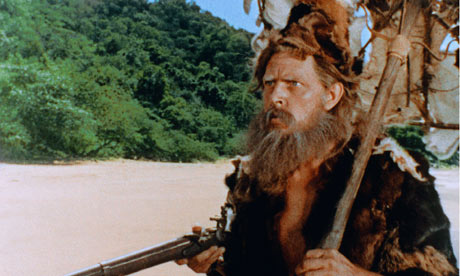
The Adventures of Robinson Crusoe (Luis Buñuel, 1954) This is another of those films that seems to be remade every few years (the attraction of the property being in the public domain is irresistible), but it would be tough from an overall perspective to improve on Bunuel's English language version (which was also made in the director's native Spanish) from 1954.

The story is familiar to everyone (it's been around since 1719)—of the British sailor who is stranded on an island after his ship is wrecked and must eke out an existence there without hope of rescue, despite his lack of experience taking care of himself.  Also, there is the man "Friday," who eventually becomes his companion on the island, leading to the "noble savage" mythology that is trucked around whenever somebody wants to point to relative "worth's" of races within the humanoid one.  

But, Buñuel, one of the peskiest of directors has nothing to do with all that, and the surrealist—and realist—in him, takes this Robinson Crusoe to some little-known parts of the island in this version of the adventure.  For example, Robinson Crusoe is on that ship as part of his work as a slave-trader, its wrecking serving as some kind of retribution for its business, and his exile a learning experience for what it is like for a man to have no choices in the world.
 
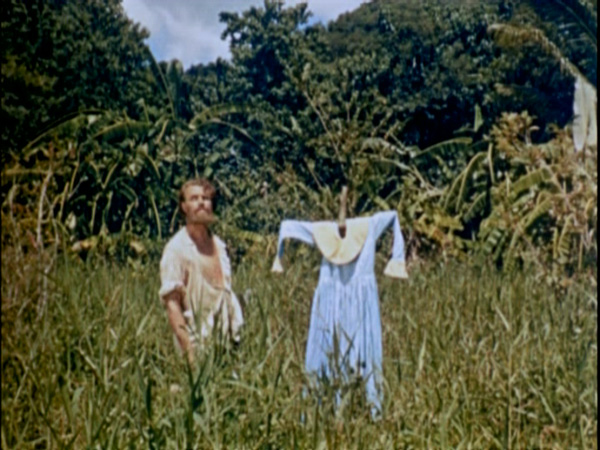
Crusoe is able to swim back to the ship to get a good amount of supplies before it finally succumbs to the sea, and manages to rescue a cat, Sam, from the wreckage. Once back on his island, with a raft so piled with supplies that it must have been in constant danger of sinking, he finds the Captain's dog, Rex, has also survived and made it to land. With that troika of inhabitants comes the most interesting part of the film, where Crusoe explores the island, sets up fire-stations in case a ship should sail by, hunts game, starts to raise livestock from the wild goats that live on the island, builds a walled compound around a make-shift cave where he lives. When he runs out of bread from the ship, he starts to raise wheat and grain and makes his own. A rescued bible provides study, and he even takes up pottery.  He has a lot of time and quite a bit of resources.
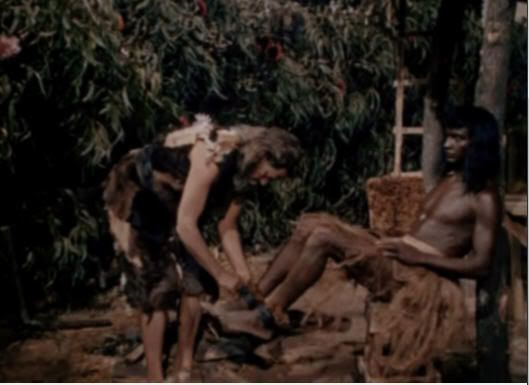
Years go by. Rex dies of natural causes, and Crusoe keeps to his daily routine, living well if eccentric in his ways, until one day he notices that his island has been invaded by cannibals. Being so industrious, you'd expect him to maybe start a small business, given the new source of traffic, but, instead he manages to rescue one of the intended victims and names him "Friday"* (Jaime Fernández) after the day of the week on which they met (Crusoe has an elaborate calendar).
Not sure of Friday's eating habits, Crusoe returns to his old ways and puts the native under metal restraints that he carried over with him from the slave ship. Before long, he learns to trust the man, and one begins to wonder what the hierarchy between them is. The native is "Friday." Crusoe is, disquietingly, "Master." When Friday is barbering Crusoe's hair and the voice-over says it was a sublime time on the island, one is about to protest, when he gets up, the two exchange places and the former slaver cuts Friday's hair in reciprocity. Buñuel, you crafty old Marxist. "We found that two working together could do much more than working separately." We won't spoil the part where Crusoe and Friday debate the Bible.

And as far as surrealism, the closest Buñuel comes to it is in a Crusoe fever-dream, where he is warned by his father (also played by O'Herlihy) never to stray from his native land (Buñuel, a Spaniard was living in Mexico City at the time, after spending a few years in the United States) with the sequence inter-cut with shots of the father (or is it an elderly Crusoe) drowning.

O'Herlihy is mostly known for his later career of playing ancient, menacing autocrats, but here he is a revelation, and it is, frankly, amazing that the film had enough attention that he was nominated for a Best Actor Oscar, the same year as Bogart for The Caine Mutiny, Bing Crosby for The Country Girl (an amazing performance, that), James Mason in A Star is Born, and the winner, Marlon Brando for On the Waterfront. Tough year.

It's interesting to note that Robinson Crusoe on Mars has a release in the Criterion Collection (not to quibble, I regard RCOM fondly), but this adult-oriented family film by one of the great directors of the 20th century is not.

*But, not T.G.I. Friday, because that would be something of a sick joke that nobody'd get until they invented shopping malls.