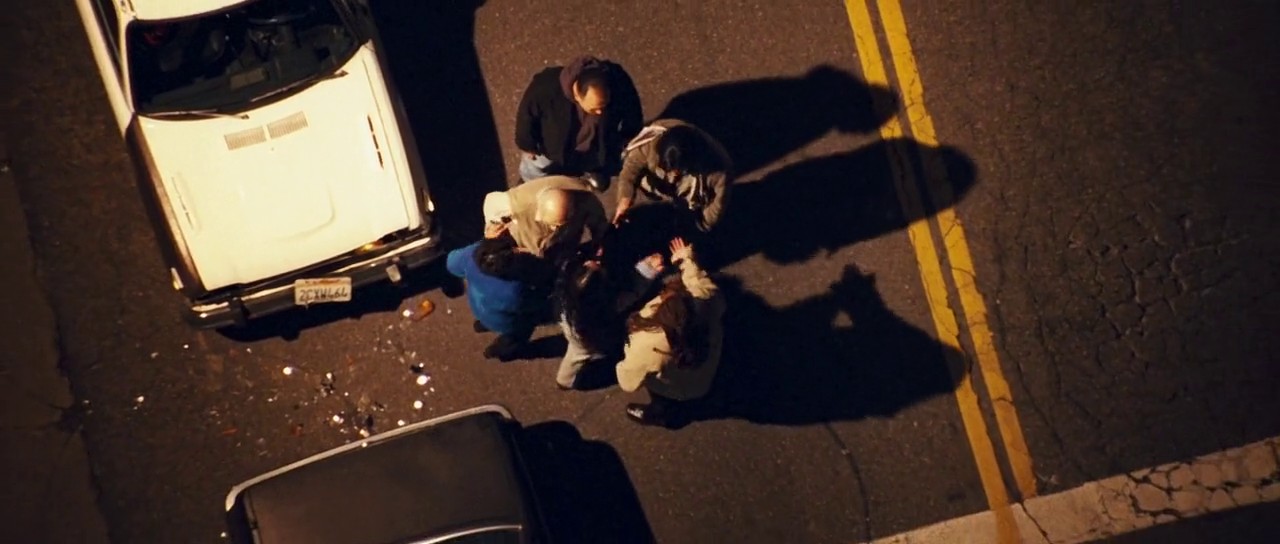
Here's another "Best Picture" article from the archives. It's a bit different in that I was addressing the response to Crash—the 2004 film and not david Cronenberg's controversial 1996 film—and the backlash to it winning its "Best Picture" Oscar. Being as it's something I've written in the past, I made a sweep for dead links and was disturbed that writings I had sighted in this have since gone dead, particularly those by critic Jim Emerson that I addressed. I wish they were here. Emerson's a fine writer and critic and his lack of representation, particularly on the rogerebert.com site (which began at the Chicago Sun-Times website) is a crying shame (it should be noted that Ebert hailed Crash as the best film of that year, but I don't think that has anything to do with any of this, but more that the Sun-Times was clearing out articles from the defunct Ebert site to make room on their servers). Anyway, I wish there was something I could do about that, and, sadly, I can't. These articles are just not available anymore. I think that's a great loss. I did find this, though.
Mike Lippert of the much-read movie blog "You Talking to Me?" (MIA since 2013) is having a blog-a-thon—one of those community drum-circles, where we pound on a theme and and listen to the echoes it creates. I don't participate very often in these, but when something inspires a surge in heart-beats, I plunge in. This time, the theme is "Justify Your Shitty Taste:" find a movie that has been given short-shrift and explain why you like it—defend yourself and your contrary opinion. Well, I had a piece in the hopper that I wrote years ago to a film that has had its share of acclaim—even winning Best Picture at the Oscars—but meets with such condescending sneers every time it gets mentioned in "movie circles" that I've always felt the need to defend it—up to a point...and then I give up. There's only so many times you can hit your head against a brick wall without doing damage to your own exquisite taste (that was written with sarcasm, btw). Here, from the depths of my ignorance (and my ever-growing "Draft" pile) is my justification of Crash.
Hello, my name is James Wilson, and I like Crash (Paul Haggis, 2004).
(Audience response: "Hi, James Wilson")
It's really funny...really funny, to the point of out-loud chuckles...the extreme reactions Crash gets from its many, many detractors—there's even a web-site that compares other Best-Picture winners to whether they're "worse than Crash". When Jim Emerson mentioned it as one of his least favorite movies (he has, in the past, listed it as one of his "sociopathic barbarities")* in a recent blog post, the comments section went up in arms with lemming-like ferocity. "I HATE HATE HATE Crash!" yelled (caps indicative) one of the comments.**
I don't. I like it. With the same rictus smile that I appreciate other cynical films. And the more extreme the reaction to it, the more I smile, because it only drives home the film's point further, and exposes it as true.Now, some (but only some) of the hatred of Crash comes from folks who consider Crash the usurper that took the "Best Picture" Oscar from *sigh* Brokeback Mountain (as if the Oscars are ever truly the indicator of quality). Now, I didn't mind Brokeback--there was much to admire--the stunning cinematography, Larry McMurtry and Diana Ossana's cruel, no-holds-barred/no-feelings-spared screenplay, and Heath Ledger's performance—someone finally captured the essence of the archetypal head-strong, mumbling western dude (and the guy was Australian, fer cryin' out loud!). Plus, there was something altogether shattering about his memorial to his lost love, in lieu of grave-stone. But, there was nothing in Brokeback Mountain that hasn't been done in every sudsy straight soap of the last eighty years. Nathan Lee of the Village Voice put it far better than I: Ann Proulx's bitter post-Oscar diatribe has a lot of empty fire to it, but, c'mon, honey, you were borrowing Faulkner's pen and you know it. And for anyone who thinks gay cowboys are revolutionary, skip right over the Village People and Jon Voigt for a moment and go directly to Red River. Howard Hawks knew it. Lenny Bruce knew it. Montgomery Clift, no doubt, knew it. "Cultural watershed?" Only if you weren't paying attention.But Crash is the better movie. Crash is the subtler movie, believe it or not. Crash deserved that Best Picture Oscar, because it pulled off a great trick: it pissed off a lot of people, only proving its point.
Let me just say one thing about Crash: It's not "about" racism.
Yes, yes, I know, racism is all over the thing, morally repugnant, down and dirty, pig-ignorant racism. From all sides, and all races. And if racism was all it was about, yeah, some of the hatred for the film might have a point, because all the movie does is say "racism exists, and there's nothing you can do about it," which doesn't make it the Feel-Good Movie of the Year. If it was only about racism, then it would truly be committing that great movie sin "exemplifying what it rails against" like, say, Rollerball that says violence is a terrible thing and then rubs your nose in it for two hours. Or an "anti-war" movie that relishes its battle sequences. If it were so, 'twas a grievous fault.

For me, Crash plays like a post-modern film-noir, where the world is crummy, people are tarnished (whether they're rich or poor), but there is no "slumming angel" (as Ross McDonald put it) to try and make things temporarily right—all the characters in Crash have that ability if they choose, if they will, and there is no hand-holding narrator or Stage Manager bringing perspective, merely the dispassionate view from on high. The good that people do are mere slats of light in an all-enveloping darkness, not unlike the the noir's traditional backdrop, the venetian blind, or as the de-focused headlights in the film's credit sequence.
Another criticism: Too many coincidences in Crash? Yep, but that's to be expected with an ensemble cast in a limited area whether it's La Ronde, or Grand Hotel, or even...the acclaimed Babel where the coincidences are hemispheres apart (those butterflies are mighty powerful!). But Crash isn't like any of these films. The one I compare it to, both in tenor and reaction is The Rules of the Game, Jean Renoir's condemnation of pre-WWII French society going to its ruin in selfishness and self-involvement. French folk hated The Rules of the Game, too. In fact, riots broke out in theaters, and to try and save his investment Renoir kept cutting it and cutting it to try to assuage the angry mob. As a result, after the war when the hysteria died down, it was difficult to find an unexpurgated version of The Rules of the Game until...1958. The tyranny of the mob had done its damage and its only by the luck and a little hard work that a longer copy of this classic exists. Fortunately Crash hasn't had to go that far. Maybe people are just more passive-aggressive these days, content to HATE HATE HATE in the relative anonymity of a bogus screen-name. Maybe that's progress?
So, if I'm in a crowd of people and Crash comes up, and folks get angry about it because it's "about" racism but doesn't "do" anything about it (I suppose a cameo by Rodney King might help...?), I don't say anything. It won't do any good. Folks have already made up their minds about Crash and if I try to point out they might be wrong and consider that possibility...no, no, that won't happen. Their thoughts stop at "racism" and go no further, thus proving the movie's point all over again, and proving, once again, why it's such a good film.
Ultimately it's a tough and pointless duty to watch a film with blinders on. It's no way to see a film, and it's no way to lead a life...as Crash, for all its flaws, so ably demonstrates. Afterward (2022): If anything the last 17 years have only cemented my feeling that Crash was important and is important. I've read the criticisms—I don't agree that the whites are inspired to become better persons (I think they'll all stay racist —even Matt Dillon's story after pulling Thandiwe**** Newton out of a burning car) as a result of the movie's stories. I think after "The End" title of Crash everybody is going to continue to be racist and myopic for the same reason everybody really is racist and myopic—they don't know any better and it's easier. It's why I don't believe we're in a "post-Racial" period (as so many "glass-half-full" believers seem to think). The slew of African-American deaths at the hands of police, the resulting "Black Lives Matter" demonstrations, the resulting paranoia about and demonizing of the "Black Lives Matter" demonstrations, the emboldening of hate-groups, of white supremacists, the January 6th insurrection, the hysterical terror of some groups that whites will be a minority in the U.S. by 2045, the "faux" CRT uproar—CRT has only appeared in college-level classes and parents should be more worried about calculus being taught K-12—right on up to the recent Supreme Court hearings just goes to prove that lines are drawn and they're drawn in indelible ink. If anything we're worse. And more myopic. And bolder about being proud of it.***** The bubbles we've created around ourselves have only grown thicker with the Internet. And the only way we're going to get out of our protective bubbles is by accident. And (as Major Kong says in Dr. Strangelove) "that goes for every last one of ya, regardless of your race, color, or creed."
And I've given up on Darwin as there's no evidence that the bad die faster.
Oh. And whether I think Brokeback Mountain should have won over Crash? Nope. And I'll use the words of saloon-keeper Richard Blaine as a reason: "The problems of two little people don't amount to a hill of beans in this crazy world."
In fact, if it was up to me, I would have vastly preferred Munich or Good Night, and Good Luck.
* ...which is a far cry from what he wrote in 2006: "As restrictive as the rules of this cycle may be, Crash still manages to be an unusually mechanical instance of it. With numbing predictability, every positive character is revealed to have a negative side (the good, tolerant cop, played by Ryan Phillippe, commits an impulsive, racially-triggered murder), while every negative character is revealed to have his or her positive (the racist cop, played by Matt Dillon, risks his life to save a black woman trapped in a wrecked car). Just about everyone is an instinctive racist, and just about everyone is a victim of racism, who learns his or her lesson when the tables are turned. Haggis piles up the coincidences that bring his characters together without shame or the slightest restraint; he seems to feel that by emphasizing the contrivances of his plotting, he is in fact revealing a hidden pattern, a secret will, that organizes the world. Turning bad writing into a metaphysical principle is indeed an accomplishment, and one that might well deserve an award – though Best Picture of 2005 is going a bit too far."
From this to "sociopathic barbarity" is quite the change of opinion. The above is reasoned analysis. The latter is just hectoring screed. Hating Crash became easier and more comfortable, then ratcheted up to the extreme. Now, what was Crash saying again?
Emerson does this at times—I'll be shocked if there is ever a Christopher Nolan film that he will praise, rather than merely dismiss it, and he condemned Clint Eastwood's Flags of Our Fathers (without even seeing it) merely because Haggis had a hand in the screenplay—to his credit, after actually seeing it, he praised it. This may sound like bashing the man, but Emerson's is a great voice in film criticism, and I love reading his output, whether I agree with it or not. His is an essential voice in the understanding of the mechanics of how film can touch the eye and the brain and move the heart. If he ever stops writing, I will mourn that day.
** Which reminds me of the George Clooney retort to the web-site that said he was "GAY GAY GAY:" "Two GAY's, maybe, but the third's a little extreme."
*** Chinatown also makes a point of using prejudice, not just racial, but class prejudice, as a distinctive example of reactive, rather than thinking, behavior.
**** That's not a typo and, yes, you remember it as "Thandie," but she's gone back to the original Zimbabwe spelling because...hey, why not...and you can only assuage Hollywood's simplifications for so long.
***** I read a slug the other day they there's some Republican buzz about bringing back miscegenation laws. What the hell?

 starring it was originally just going to focus on the FBI investigation with DiCaprio as White.But DiCaprio had other ideas—he wanted to play "a villain" and so the film was re-tooled by Scorsese and Eric Roth to feature more of the role of Ernest Burkhart, husband of Mollie and his role in the web of deceit and murders...all to obtain the headrights (the land mineral rights owned by full-blooded Osage tribe-members) to their oil-rich pocket of Oklahoma, that made the Osage "the wealthiest people per capita" in the nation. The Osage became prosperous with their oil stipend, creating a power dynamic where they ostensibly ran things in Fairfax, Oklahoma, but they were also targets for any scam and flim-flam the other residents could concoct in order to benefit from their prosperity.
 Burkhart is his primary puppet, lending support to a romance between Ernest and Mollie Kyle (Underwood, who in her mandarin understated way, steals the show as well as hearts), who is already seeing signs of poor health in her family, who have a tendency towards diabetes. And when a "specialist" is needed for some special work to be done, Hale uses his nephew as a go-between, the better to keep his immaculate hands clean.
  But, the center cannot hold. In the community, the deaths become less and less isolated and more overt, culminating in a house-bombing that kills Mollie's sister and her husband, who has been asking questions and connecting dots, while resisting any overtures to share information with Ernest. That signs his death warrant and the egregiousness of the crime—the sheer audacity of it—mandates outside help. Private detectives had been hired before...but had disappeared never to be heard from again. A meeting between tribes leaders and President Calvin Coolidge allows Mollie to make an entreaty...and for once, the Great White Father keeps his word.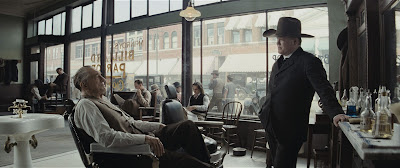
 If the film has a fault in conception, it is in the sheer repetitiveness of the crimes (although, to be clear, the crimes DID happen as depicted and over that long period of time, which shows how frustratingly slow any shred of justice could be brought to so insular and complicit a community). But, the numbing volume of the crimes strains credulity and patience for an audience, even one used to the slow process of justice and the bull-headedness that passes for politics but stinks like conspiracy. Not to minimize the scope of the crimes, but to see every one of them played out through the machinations of Hale through the prevarifications of DiCaprio's Burkhart makes it a long stretch of the same thing repeated over and over.
 Gladstone is the acting highlight of the film, and De Niro—although a bit too long in the tooth to be playing Hale—does a good turn as evil posing as the friendly neighbor.
 DiCaprio, though, is an issue. Sure, he's good box-office (and he's an Executive Producer on the film), but it may be time for the long string of Scorsese collaborations to end. At times, one can see him using Brando tricks and an occasional Jack Nicholson strategy in his acting, but mostly he seems to have based his performance on a frowny-face emoji (😠). His face freezes into the same petulant scowl, no matter the circumstances, whether he's unhappy, concerned, frustrated, murderous or cornered. And, the deeper you get into the movie, the lower the corners of his mouth drop until you wonder if his jaw will just drop off once they carve far enough. It's a disappointing performance, considering how integral DiCaprio made himself to the film.
 As his character is in the film, DiCaprio is the film's weakest link.


.jpg) Ernest Burkhart, Mollie Kyle Burkhart (on the right), and William Hale,
Ernest Burkhart, Mollie Kyle Burkhart (on the right), and William Hale, 


 Clocking in at a back-breaking 3 hours 20 minutes, Killers of the Flower Moon begins where most Scorsese movies do, following the bad guys. Ernest Burkhart (DiCaprio) exits the train to Fairfax after serving in the First World War and receives a warm welcome from his uncle, cattleman William Hale (De Niro), who is perfectly agreeable to taking Ernest under his wing, despite his lack of experience. Under an avuncular pretense, Hale gives his nephew the lay of the land, giving him a book on the Osage people ("Do you read?") and asking pointed questions about his taste in women. Hale speaks the Osage language and extends his avuncular charm to express support for the Native land-owners, especially dealing with the white city officials, the police and Sheriff, the local doctors, even the undertaker (that'll come in handy!). He also is quite familiar with the local underworld (even handier!), and his network makes him less than a town father, and more of a puppet-master.




.jpg)