Showing posts with label Adam Brody. Show all posts

Wednesday, October 20, 2021

Jennifer's Body

Written at the time of the film's release...

"Cluster-Fox"
 
The critical drubbing that horror film/High School satire Jennifer's Body has endured belies its talent behind the camera. After all, it was critics who first pointed out the particular tenor of Diablo Cody's writing in Juno and championed it through its short Film Festival run into theaters (Jason Reitman's previous film Thank You for Smoking, although a nice piece of film-making with a brain in its head, didn't do well at the box office.) Director Karyn Kusama isn't too shabby a director, although Æon Flux was an MTV-ginzu'd nightmare. I was surprised that 2oth Century Fox advertised it as a straight horror movie starring Megan Fox (aiming at—and only at—teenage boys), rather than including girls in the mix. As a result the film "opened soft" (as they say), and the film received decidedly mixed reviews depending on how serious they took it....even serial contrarian Armond White sided with the majority.
But horror films aren't just horror films—they say something about our fears, and more broadly, the "Holy Shite"-geist of society. The proverbially "good" horror movie touches our souls with a chilly finger and reminds us we're all mortal, but whether it's our relationship with God (in Frankenstein) or our relationship with sex and guilt (Halloween), horror films find our soft underbellies and either tickle us or stab up to the third knuckle. 
Jennifer's Body
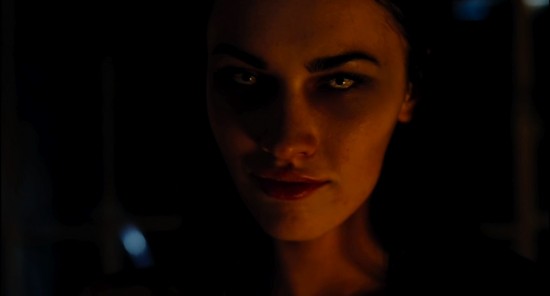
tells the story of Jennifer Check (Megan Fox) and Anita "Needy" Lisnicki (Amanda Seyfried), girl-hood friends in the small town of Devil's Kettle, who've stayed close despite a Mutt and Jeff relationship in high school. Jennifer is a cheerleader, drop-dead gorgeous and just as likely to tell you...to drop-dead, that is. Needy, by contrast is blond, bespectacled, and Jennifer's beard, of sorts, her "Biff" in "Diablo-Code," able to rein her in if she gets too out of control in their adventures. Unfortunately, one night when the pair go off to a local dive to see an up-and-coming indie band, the place goes up in flames and Jennifer's entranced enough with the lead singer (Adam Brody) to go off in the band's van, leaving Needy behind, in a state of shock.
When Needy gets home,
she finds Jennifer waiting for her, pale, crazy-eyed, smiling through bleeding gums, and vomiting a noxious black bile: she's turned into a succubus from Hell, and where in the past she used to merely chew out aggressive boys, now she chews them out (quite literally) and consumes them, leaving behind what one schoolmate describes as "lasagna with teeth." It's up to Needy to keep her Best Friend Forever from being discovered for the fiend she is, while simultaneously protecting her class-mates—a task if she was any good at would effectively kill the movie.
It sounds like very rich material with which to go over the societal strata of High School, if the territory didn't have so many skid-marks running through it already.* One could see it as a revenge flick for
all those sosh's who've terrorized the commoners, but Jennifer is as much a victim as anyone, and is an equal opportunity disembowler. And Needy's loyalties are so divided that you begin to wonder just whose side she's on. Stacked like bodies on top of that, the "males as victims of the woman" angle would seem fresh...if it was done 20 years ago.** Ultimately, the message aspect to it is weak and anemic, so ham-strung is the script by its own cross-messages. 
Good direction would divert your attention from them, but even there, everything comes up short. However cob-webbed the old cliche's, Kusama's rhythm for them is off, with loud bumps in the night that land with a dull thud. Opportunities lurk around every steadi-cammed corner and go un-sprung. Then when something happens, Kusama won't cut away until the carnage becomes so much spewing corn-syrup. In trying to do something different and avoid the standard horror tropes, Kusama can't even deliver any chills.
And, despite what you've heard, Megan Fox isn't half-bad, showing far more depth and humor than, say, other sex-bomb's like Raquel Welch, have in the past. Fox isn't afraid to not look beautiful, and does so frequently, even if it's just with an "I'm Sooo-C'ra-zy" glint in her eyes, but she also has the easier part. Seyfried has to play the "normal" girl, who can be both the ugly duckling and beautiful swan when the circumstances call for it. It shows how weak the material is when J.K. Simmons and Amy Sedaris can't find much inspiration in their parts. There was potential here, but it isn't satirical enough, funny enough, or scary enough to provoke any reaction other indifference. And that's the worst death in a horror film.
The View from 2021: 
But...but...Jennifer's Body was saying something a little different—something about objectification and the male capacity to exploit, rather than a female's capacity to trap using attractiveness (which, I think most critics glommed onto). But, more importantly, it's about BFF's and their power in the lives of young women—that iffy support system that feels like it will never die—and in the case of Jennifer's Body, it doesn't. I mean, it really doesn't.
 
One could blame the marketing by 20th Century Fox—it was promoted as a sexy horror comedy. The trouble with that is, it wasn't. The only characters that matter are Jennifer and "Needy" and the rest of the cast doesn't matter—especially the "gents". It's a revenge fantasy—the  story of a woman sacrificed on the altar of male-bonding (almost literally) and through a misreading of the fine-print of Ritual 101, Jennifer is allowed to come back to life without the burden of a victim mentality, but, instead, with the urge to avenge herself, combined with a supernatural ability to carry it out. And how, objectively, it might look like the wrong thing to do, empathy makes it subjective and contagious. Think Promising Young Woman with "besties" and fangs.
 
And in that context, with the POV of the sacrificed making her an outsider from Society and its natural enemy, it really is a horror film. But, which side is the monster? 
 

* Carrie, Halloween, Alien, Scream, Species, "Buffy the Vampire Slayer" have all staked out the same territory and potential that Jennifer's Body squanders, usually more pointedly and more entertainingly. 

** 50 years if you want to cross-categorize with "film noir."

Wednesday, March 24, 2021

Promising Young Woman

#Me3
or
";^)"

One thing I think everyone can agree on: Promising Young Woman would be a terrible date movie.

But, even as I say that, it might be a very appropriate date movie.

The debut film of Emerald Fennell, showrunner for the second season of "Killing Eve," is a black comedy fueled by rage, inspired by the sort of activity exemplified by the #MeToo movement, more so for the systematic ignorance that was exposed by it, rather than by any surprises that there is existence of sexual exploitation in the name of unequal power dynamics. It's an old story to women. What was new was that it would be called out, that what had been hushed up for so long would be made an open secret, and that, if there was any sort of justice, there would be consequences for it. Payback is a bitch, but the ones using it aren't.  

It's a seizing of power that was assumed wasn't there, not unlike the 1969 Stonewall uprising when gays decided they'd had enough oppression and would not be relegated to the shadows of shame, and once they'd seen the light, saw, too, that they were disarming the very weapons used against them. That is the destruction of the fantasy of power. For power can only live up to its definition if it is agreed to by both parties: the ones inflicting it, and the ones subjected to it. Without that common ground, it does not exist. "No" is a very powerful and forthright tool against it, but only when it is backed up by resolute action.
Cassandra Thomas (Carey Mulligan) has an off-beat dating ritual. She'll go, unaccompanied, to bars and as the evening progresses, alone and drunk, she'll attract the attention of the leering lounge-lizards, hunting in packs. As in Nature, they'll figure out the weakest prey and go in for the kill. Cassandra is easy pickings. We see her, arms out-flung, steadying herself between the headrests of naugahyde couches, when the most aggressive of the pack (Adam Brody) approaches her and takes a charitable stance in her situation. She's obviously in a bad way—she's alone, vulnerable, and three sheets to the wind. He's a good guy and offers to take her home; a knight in shining intentions. He helps her navigate the stairs and into an Uber, and—as long as they're on the way to her place—why don't they stop at his for a little night-cap, hair of the dog?
When "Mr. Nice Guy" gets her behind closed doors, his intentions of getting her home have completely changed, and instead offers her some cumquat liqueur (has there ever been a more ludicrously suggestive-sounding booze?) which she gasps is "terrible," he kisses her—to which she does not respond...at...all—but when she suggests she needs to lie down, he's only too helpful. She's conked out, and right at the point he's taking down her knickers, her eyes pop open, she sits up, looks him right in the eye and says "Hey! What're you doin'?" He can only stammer that she seems more than sober. "I said...'Hey! What're you DOIN'!?"

Bait...and switch.
Run title sequence...set to "It's Rainin' Men."

Cassie, it seems, has been doing this a lot. She's 30 years old, still living in her old bedroom at her folks' (Clancy Brown, Jennifer Coolidge). She has a dead-end job at a coffee-shop and has no intention...actually has no interest...in moving out or moving on. She knows she's stuck—or rather is choosing to be stuck—and the only signs of life in her are her snarky sense of humor and her clubbing activities, which are never violent, but more concerned with teaching self-proclaiming "nice guys" that they're actually misogynistic date-rapists taking advantage of low-hanging fruit.* She's telling these opportunistic letch's that they're assholes. And she's been doing it...a lot.
Maybe for six years. We're looking at obsession, and with that knowledge, a visual joke of Cassie opening her notebook and marking down another notch—among hundreds—at first gasp is a laugh, but on second thought is troubling. Why is she this way? Sure, there's sympathy when she badgers the next guy "We've got a connection? What do I do for a living? What are my interests? What's my NAME?" But, what's the motivation besides an anti-misogyny mission. Is she trying to overthrow a paternalistic power-structure one guy at a time?
We get a little bit of her history when a guy walks into the coffee shop and recognizes her—they went to med-school together. Now, he's a pediatrician and she's...well, she's working in a coffee shop and spitting into his coffee because she dropped out of med-school (even though she was at the top of her class). He asks her out, but she re-buffs him—even though he knowingly drinks the coffee. He comes in again, and he's a genuinely nice guy. They have coffee. They have lunch. They go to a movie. They pass his place and he asks if she wants to go up for....and no. She refuses. Adamantly. He apologizes. She says it's not him, it's her. But she kicks a garbage can in frustration. All alike.
At this point, anything further as far as description will be full of spoilers. But, one can speak in general terms that her encounter with a former school-mate sets off a more specific level of activity, laser-focusing her ambitions to address the past, while also meting out some revenge-lessons to both men and women (she's an equal-complicity judge and jury—as the old Monty Python line goes "she's cruel...but fair!"). No matter the righteousness behind her actions, though, there is the persistent uncomfortableness of them and the fear that she will cross the line—although, any permanent damage she does is to complacency.
It does walk the tightrope, though, and leaves the audience there, as well, slightly off-balance. Fennell is as fearless, challenging comfort-zones, layering the soundtrack with sexualized songs (that contextualize the atmosphere of a predatory and demarcated culture) and pertinent classical pieces—there's also a couple of pointed references to The Night of the Hunter. If the film has a weakness, it might be her use of religious imagery, which she sneaks in subtly, but often enough that you notice, casting Cassie as a Joan of "Arc-hetype," intensifying the risk as she goes off to do battle in a good cause, even if that cause might abandon her. One line hits home hard: one of her victim bleats "It's every man's worst nightmare, getting accused of something like that." She replies "Can you guess what every woman's worst nightmare is?"
"Can you guess what every woman's worst nightmare is?"

Promising Young Woman gives you the same black-comic back-slap as Dr. Strangelove—of admiring the cleverness, but horrified at yourself for admiring it, not knowing whether to laugh or throw up. It's a comic tragedy. It's a martyr's farce. Everybody gets their just desserts in the end, but sacrifices had to be made, so there's no inclination to pump your fist in the air in triumph. The world still sucks, the problems are still there, and the only consolation is that this little film is smart enough that it might make some impact, be they as small as notches in a notebook.

Yeah, maybe it would make a good date movie. The after-film discussion would certainly clue one in as to whether should be another.

* Fennell's casting, like everything in this movie is fascinating. For her collection of assholes she's hired guys who've been TV heart-throbs in the past and probably had their posters on a lot of teens' walls. It's just that little added texture of twisting the knife for any thoughts of complicity.

Wednesday, August 28, 2019

Ready or Not (2019)

Wedding Night Blues (The Family That Plays Together...)
or
"Goddamnit, Emily, Aim for the Center of Gravity!"

There's an old-time comedian's joke as old as Joe Miller's Joke Book that goes "Marriage is a great institution...but who wants to live in an institution?"

For Grace (Samara Weaving, niece of Hugo—and probably the last time any one needs to mention it), marriage is an institution she's been looking forward to for a long time. She's fallen in love with Alex Le Domas (Mark O'Brien) and endured some relationship stipulations from his family, the Le Domas' of the Le Domas games manufacturing fame, who are "big on traditions." But, now, the big day has arrived and she has the usual wedding-day jitters, and as problematic as the family can be ("They just want to make sure you're not a gold-digging whore" says her intended), she's sure about Alex, who has become something of a black sheep of the family. Doesn't mean he won't one day inherit the Le Domas fortune, though, despite the fact that father Tony Le Domas (Henry Czerny) doesn't like her, that his wife (Andie McDowell) is oddly creepy, while Aunt Helene (Nicky Guadagni) isn't just oddly creepy, she's downright horrifying. Then, there's brother Daniel (Adam Brody), "the alcoholic brother who keeps hitting on (her)." For her, the only thing that matters is what Alex thinks, and for that, she's "proud to join your relatively fucked-up family."

Famous last words...
The wedding comes off without a hitch, and it's a dream come true for Grace. An orphan, she's never been part of a family, even one such as this. Well, then again, there IS a hitch: to be truly accepted into the family, she must play a game on her wedding night, which Grace thinks is odd, but she's willing. "If it means your family will accept me, I will play the shit out of checkers."
Led into the substantial mansion's secret gaming room, the extended family is sat around a table, while patriarch Tony tells the story of great-grandfather Victor Le Domas, who made a wager with one Justin Le Bail, who promised him a great fortune, but on the stipulation that any person marrying into the family had to play a game to be chosen by a mysterious box—if they won the game, they would be welcomed to the family and they would all enjoy continued prosperity. That's what they tell Grace, anyway.
What they don't tell Grace is that if she chooses one particular game—"Hide and Seek"—she will be forced to play the game to the death—hers. If she is caught, she will be killed in a ritualistic sacrifice to Le Bail. If she wins, the entire family will suffer a painful and merciless death. Needless to say, the family is very interested in what the outcome of the drawing will be.

Guess what game Grace will be forced to play?
While Grace goes off to find a suitable hiding place where the family can't find her—she is, of course, at a disadvantage as she's the only one who doesn't know the layout of the house or the many secret doorways and passages in the vast mansion—the family arm themselves with ancient weapons to dispatch her, or at least subdue her, so that she can be sacrificed. New husband Alex is forced to stay in a room under guard, so that he can not lend assistance to his newly-wed wife.
Talk about a lousy wedding night. Grace thinks the whole thing is a dumb family tradition, but then, she's not clued in to the fact that the marriage could be viciously annulled at any moment whether by cross-bow, battle-axe, dueling pistol, musket, or bow and arrow. It is only when she comes across one of the servants (who all look like extras from a Robert Palmer video), dead in a case of mistaken identity that she begins to realize that the stakes are very high and that she might not survive it. She is given limited help by Alex, who is under tight family scrutiny, but she's in a white flowing wedding dress with heels in unfamiliar surroundings. The odds are never in her favor.
But, she is adaptable. Plus, she's plucky, and she has a fierce survival instinct. It also helps that the Le Domas family have handicaps—they're not the brightest of bulbs, they are victims of their own sense of doom, and they're rather privileged so the old weapons aren't exactly user-friendly. "The rich really are different." says a depressed Daniel. But, not different in a good way. It also doesn't help that daughter Emilie (Melanie Scrofano) is a coked-out bone-head who tries just a bit too hard and seems to have her best aim when it's directed to one of the servants. Good help is hard to find these days.
If you haven't guessed by now, the film, Ready or Not, is a comedy, but a horrific one. It's laughs are gruesome and grimacing, and only a couple steps less giddy than what you'd find in "The Addams Family." It's gimmicky, but not in the monstrous tradition, more in a comedy version of "The Most Dangerous Game" if the privileged hunters were just as full of themselves, but weren't so competent. Yes, the rich are different, and, these days, they're treated differently, not so much with respect, but with contempt. The Le Domas' (it just occurred to me that the name sounds like "dumb-asses") earned their money the old-fashioned way—they inherited it—and now, their main business is protecting themselves and their dumb-assets from dilution. So, add another hyphenate, this is a satire, as well.
It's something else, as well, but, any other hyphenate would contain spoilers, so we'll leave that one off. Suffice it to say that Weaving's Grace, after some initial whimpering, has an action hero's grit and ability to recover from some pretty scarring injuries, and she has no hesitation about tearing up her pristine wedding dress to make handy tourniquets or garroting material; she's too practical for a trousseau. She is a Bride-zilla with a registry at Cabela's, and as her dress gets more sullied and bloodied, she seems to get more determined to show she's not playing games. 
The directors, Matt Bettinelli-Olpin and Tyler Gillett, seem to take a wicked delight in keeping the thing paced quickly and keeping the tone somewhat bombastic. In fact, this feels like one of those giddy low-budget movies whose social message is buried six feet under a cackling sensibility, like Night of the Living Dead or The Texas Chainsaw Massacre, where the film-makers can't believe they're getting away with it. One is also reminded of the style of Tim Burton without the wobbly art-student design sense or eagerness to please with source pedigree.
Speaking of Burton, it's only a matter of time before he casts Weaving in one of his movies. She has the requisite out-sized porcelain doll's eyes—not unlike Barbara Steele's—that Burton favors as well as the determined stride that his female leads always seem to adapt. But, the Australian actor also has great comic timing, a loose, natural way with dialogue, which, combined with an unguarded buck-toothed smile (that reminds one of John Huston at his most malevolent) that is funny and endearing—you'd root for her even if her opponents weren't so comically incompetent and loathsome. 
Of course, that deck is stacked, she being the underdog, but Weaving's trooperish attitude in an unself-consciously de-glamming performance where she goes from pristine bridehood to looking like a BPA study is a giddy marvel, whatever side of the female empowerment argument you're on. She's great, and one hopes for better parts for her, rather than being perpetually type-cast as Margot Robbie's younger sister.
As gruesome as Ready or Not is, at least it has the good sense to not be too serious about it, taking the tack of that comedy staple, the "in-law" joke. You didn't know you'd be marrying them, too, despite all the warnings signs one sees in the preparation of nuptials. The film might be cathartic for brides made neurotic by "his" (or "her") family, given the universality of the problem. And the film is a fine example of that genre-blending rarity, the comedy-horror film, without skimping on either aspect.

Friday, April 5, 2019

Shazam!

(Let's Just Say It) Captain Marvel II
or
The Big Red Cheese-Fest

One is tempted to quote Gomer Pyle and say "Sha-zayam!" at this, but for the fear of being struck by lightning, let's just say "Holy Moley," this movie is a lot of fun.

It's the second flick within a period of weeks to feature a super-hero named "Captain Marvel" (although he's never actually called that in the movie and the various "noms suprême" given to him during the movie is one of the funny running gags zipping through the movie). Why the double-vision is a complicated story involving lawyers and trademarks, and far better explained by writer (including comics) Mark Evanier from his blog "Notes From ME" than I could ever manage, so go to this link:
https://www.newsfromme.com/2019/03/13/ask-me-59/ 
and you'll find out about THOSE Captains Marvel (and a couple more).
Shazam! follows the latest imagining of the Captain (who's been around since 1939), where, instead of being a radio personality on WHIZ radio, the Captain's alter ego Billy Batson (played by Asher Angel) is your random orphan-kid, living in a foster home run by the Vasquez's (Cooper Andrews and Marta Milans) with a mix of kids, which fits in with the older iteration of the Captain that emphasized family and shared strengths.

And this one is so much fun, especially given the sturm and drang of so many super-hero movies (especially in the DC Movie Universe, but also in Marvel's movies, even the ones designed to be lighter), that one wishes everybody would be a bit more "larky" in their approach.

Now, having said that, be aware that the first twenty minutes of the movie are a bit tough to sit through, if you're expecting a good time. The beginning is very exposition-heavy, telling the story of young Thaddeus Sivana—smart, but mixed-up kid—growing up in a dysfunctional family (headed by John Glover, so you know there are problems) where he is the runt of the litter in a family of privileged jerks. After a traumatic event, he is tested by being offered powers by the aging wizard Shazam (Djimon Hounsou) and is found wanting—and left wanting the power he is denied. As Shazam stands guard over the powers of Solomon, Hercules, Atlas, Zeus, Achilles, and Mercury as well as the Seven Deadly Sins, he's feeling a bit tired, but even if he's in a hurry to be let go of his burden, he can still see that Sivana is not good hero-material. Best to look somewhere else.
Cut to young Billy Batson—troubled, unruly kid—who has run away from the latest in a series of orphanages and foster homes to try and find his mother, who abandoned him after he became lost in an amusement park. Young Billy uses subterfuge to hijack a police car, so he can travel to the next Batson residence on his list to see if his Mom is there. She isn't, and in a way that recalls how Buster Keaton would make an obvious visual gag out of mistaken identity.

Billy goes back to the orphanage where his record of truancy is brought up again—as if he didn't already know—and told that his last chance—his only chance—is waiting out in the other room. It is the Vasquez's, Rosa and Victor, who run a blended and extraordinarily diverse foster home for kids. Billy is skeptical, but it's his only chance and he's run out of addresses on his "Batson" list. 
He meets his other foster siblings: Mary (Grace Fulton), Darla (Faithe Herman), Eugene (Ian Chen), and Pedro (Jovan Armand), and finally his room-mate Freddy Freeman (Jack Dylan Grazer), who is crippled, walks with a brace and is a Class-A nerd, collecting all sorts of superhero memorabilia (his proudest possession being a bullet that bounced off Superman). Billy is stand-offish to Freddy, as he is with everyone in the Vasquez household, and they view him as a potentially good addition if he was only accepting of the situation.
He attends Fawcett Middle School with the rest of the kids and is probably thinking about his first opportunity to ditch when fate steps in—or stomps—in the form of some stuck-up bullies who proceed to beat up Freddy for...well, just being Freddy. Billy sees this as he is walking away and he turns around, picks up Freddy's brace and proceeds to wallop the creeps with it. It is this act that changes Billy's life, and fortunately for us, the movie.
Billy takes the subway and it makes an unscheduled stop—the same Rock of Eternity, where Shazam makes Billy the same offer made to Sivana—"speak my name"—and Billy, in a flash of lightning, becomes Capta—well, much older and in a flashy red spandex outfit and cape (and portrayed by Zachary Levi). It is Shazam's last act, and Billy, panic-stricken, runs out of the cave...and into the real world.
But, not the real world he knows. He's taller, stronger, and there are lightning bolts coming out of his fingers...and he's in this weird suit! His first stop already shows the change in his attitude—he seeks out Freddy. Freddy will know what to do (he doesn't), but he's more than willing to experiment on his friend Billy to find out what his powers are—he can punch through concrete and he can throw lightning from his finger-tips...and...most importantly...he can buy beer!
The whole sequence inside a convenience store is just too much fun to spoil, but it sets up the way the film will go, with two kids with a sudden knowledge of what it's like to be 1) a grown-up and 2) a super-powered grown-up. Here, it takes a page from the late Penny Marshall's Big (there's even a momentary acknowledgment to it) and then flies with it. For Freddy, this is a dream come true, a wish-fulfillment for a smart kid with bad legs to have a super-pal; for Billy, it's a mixed blessing. 
Although he's supposed to have the wisdom of Solomon, he's still a kid and he has no idea how to do this "superhero" thing, but he's going to learn the advantages (he looks like an adult, and more importantly, treated like one, he's big, strong, and can fly) and the disadvantages—people want what he has or put him down in a big way. And he's going to have to grow up pretty fast.
Sometimes being a hero isn't all it's cracked up to be—it's not all rescuing kittens out of trees and getting keys to the city from the Mayor—and it attracts bad people who want to build themselves up by beating him and taking away some of his glory. But, Billy doesn't "get" that, at the beginning. He's content to just wandering around being a "superhero," doing super-tricks and getting himself in a lot of selfies. That should keep him out of trouble. although Freddy is disappointed that he won't be more...yaknow...super-heroic.
But, Billy can't run away from Sivana (grown up to be Mark Strong, who can now do villain roles in his sleep), who now possesses the avatars of the Seven Deadly Sin's—big deal: what do you do with the power of "Sloth?"—and wants Billy's god-like powers, too. It is only when the villain takes his foster-siblings hostage that Capt...uh, Billy must make a stand and become the hero Shazam intended and the world needs.
Forget about what the world needs, what about the movie-going public? The Marvel and DC movies have been so heavy—despite throwing in a humorous line or two—that they're more like watching Shakespeare tragedies than being any fun. It seems like the first movies are okay and then it's inevitable with the second movie that the hero is disenchanted with being a superhero and wants to quit. Quit? What kind of hero is THAT? Having abilities should be a joy, not a burden, and being able to do good for people should be aspirational, not treated like it's a dumb thing to do because you'll only get betrayed in the end.
Thank the Greek gods, Shazam! isn't so melodramatic. It can't be. It's from a kid's perspective and to a kid, having super-powers is totally cool, and the players are wonderfully geeky about expressing the delight and wonder of being able to be fast, and leap buildings in almost a single bound, and doing all those things that superheroes do...like having a "secret lair," or showing up bad guys. 
That puts a big burden on the actors to walk a fine line between "gee-whiz" and irritatingly cloying. And Angel, Grazer and particularly Levi manage to be genuinely energetic but also have a crack comic timing that makes every surprise pay off to its maximum. You enjoy the experience, rather than spending your time looking for "Easter Eggs"
It's a blast. So, go ahead, let Marvel take out half the Universe. Just means there's more room for guys like this. And for movies that actually remember when it was fun reading comics than merely collecting them, bagging them and locking them away for their value to go up (fat chance). This one makes you smile, rather than want to beat somebody up.

Shazam! actually soars.