Friday, January 26, 2018

I, Tonya

The Bull in the China Shop
or
Tonya Harding Accepts Your Damn Apology

"I hear they're making a sequel to I ,Tonya called I, Nancy: it's about a nice lady who gets her knee bashed in by some trailer-park assassin and then 25 years later has to see a great award-winning movie about how she's NOT the victim..."
John Mullaney

I, Tonya (like The Post) was on the 2016 Annual "Black List" of interesting un-produced film scripts. But, it's the description—also used in the film's introduction—that grabs you: "Based on the irony free, wildly contradictory, totally true interviews with Tonya Harding and Jeff Gillooly." 

And thereby hangs the tale. The way the movie sets itself up is as a series of filmed interviews—with Harding (Margot Robbie), Gillooly (Sebastian Stan), Harding's mother Levon Golden (Allison Janney), Harding's "bodyguard" and Gillooly friend Shawn Eckhardt (Paul Walter Hauser), and an anonymous producer from "Hard Copy" the tabloid news syndicated show ("that everybody else has become," the guy snarks) that gives "the bigger picture" on the story—soon settles into a wide-screen narrative of Harding's ascent as an athletic tom-boy in the pristine princess world of figure skating. It quickly establishes that Tonya, growing up (played by Maizie Smith at 3 1/2 and the amazing McKenna Grace at 8) in Portland, Oregon, is a "daddy's girl" who wants nothing more than to ice-skate and do the things she sees the girls on TV do. Her mother strong-arms a skating coach (Julianne Nicholson) to take on the kid—but she has to take on the mother (now divorced again), too, who will not back down from any instinct to correct.
That relationship is abusive, too. But, Tonya ends up, at 9, winning skating competitions over older and more practiced skaters. This is explained by Tonya's tenaciousness (and the occasional bribe by Mom to a heckler—who, in the "totally true interviews," admitted that?). By age 16, Tonya is dating Gillooly (whom she meets—with Eckhardt at his side—at the rink), then after a particularly sticky argument with her mother, she's moving in with him, but after a certain period of adjustment, that relationship turns abusive, too...abusive enough that they get married.  
In the mean time, Tonya wins competition after competition. She is just so doggedly determined that she easily blows everybody off the ice. But, when it comes to national competitions, she can be as good as she can get, but the scores will not reflect it...because Tonya is an athlete rather than a performer, a fighter not a dancer, and compromise does not come easily to her. She plays the game, but harbors a deep suspicion that she will lose to any pixie with no muscles and a cute costume. This might be paranoid if it weren't absolutely true.
But, she still has the talent that pushes her beyond complacency and she begins to push through the prejudices with more and more ambitious programs, culminating in her doing a triple axle in competition (only six women in the world have done it and it's such a tough move that no one even attempted it for the movie—it's accomplished by special effects and some judicial editing). Once Harding is on the map, the pressures of fame and her antic private life combine to lead to what everybody in the movie calls "The Incident."
"The Incident" ("the part you really want to know") is well known on a surface level, but the devil of these things is always in the details and that's where the repetition of half-truths and a tsunami of comedy wash-back has conspired to make it seem as if Tonya took a bat and beat up Nancy Kerrigan herself, instead of the confederacy of dunces that pulled off the attack (clumsily but effectively). All of a sudden, that isolating field of ice started to get very crowded with the weight of coverage, overshadowing any competition being conducted, and turning it into a carnival atmosphere—how could it be anything else with an unprovoked attack making news. Instead of increasing security at these events, it became a circus that the media controlled.
At this point, it's more blood-sport than sport, as anything "sporting" becomes suffused with tabloid trash. It's an industry now, even football games are given a "fairy story" for the viewing public to consume along with their beer and nacho's but it has as much to do with the game as it does with popularity contests at High School. But, the industry will tell you, it "pegs the ol' meter." Blame ABC Sports Producer Roone Arledge's "Up Close and Personal" approach to sports coverage, so that now we can't have a singing contest on TV without the little "personal" film filled with the longings and desires and epiphanies of every single contestant on the show, whether it's pertinent or not. You gotta build the fairy tale...and in competitive figure-skating that applies to every tinker-bell gliding across the frosted ice arena and the starry-eyed judges who don't see it as a competition, but an art...a show, complete with music, costumes, and choreography—thank God, sprinters don't have to be concerned with such nonsense; their only judge is the clock not the prejudiced eye of the beholder. Or the audience.
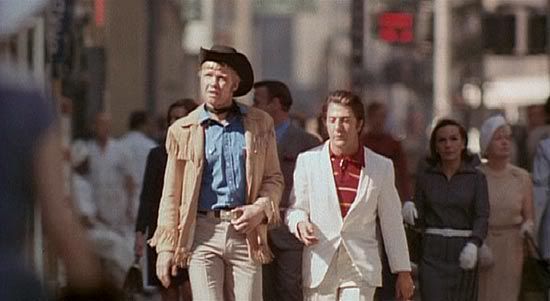
As entertaining as I, Tonya—in its "irony-free" cloaking—may be, it is not unjudgmental. In fact, it seems to wallow in a cruelty to the subjects that reminded me of the nasty tinge with which Midnight Cowboy presented its characters (and bear in mind, these are human beings who are, for the most part, still alive). The movie likes to point fingers and accuse us, the audience, of continuing the cycle of abuse that Tonya Harding grew up in, and stepped in, her entire life. But, the movie is complicit, too, escalating the carnage and being clever in its choice of music to underscore scenes for the sake of "entertainment" and, yes, irony. It is its own "hit-piece" with the cooperation of of the very people it is undermining. There is something very sick and twisted going on there.
But, it didn't actually make me mad until the end-narration where the movie Tonya Harding sums it all up:

I was the second most known person behind Bill Clinton in the world. That meant something. People still wanted to see me. So I became a lady boxer. I mean, why not? Violence was always what I knew anyway.
America, you know. They want someone to love but they want someone to hate. And they want it easy.

But what’s easy? The haters always say, Tonya just tell the truth. But there’s no such thing as truth. It’s bullshit.

Everyone has their own truth. And life just does whatever the fuck it wants.

No. People who don't face facts say that "everyone has their own truth." Because, there is truth; anything else is just perception. And that's not truth, it's opinion. Now, opinion is always easier than truth because truth is complicated with details and timing and motivation, and so it's not something covered in 5 minute segments in a 24/7 news cycle. Truth comes with perspective and objectivity. And it doesn't come easy, so it's often overlooked by the Wisdom of the Tribe, which is easier and comfortable and often 180 degrees wrong in the details. And, whatever, everybody's too busy to really care about the truth...and, whenever a contradiction to their opinion of truth comes along, they'll just forget it. Or deny it. Or discount it. And stick with their own truth.

Which isn't truth. It's opinion. 
So I, Tonya—my opinion (or "my truth" by the twisted parameters of the movie). It's well-done. It's entertaining. I didn't like it, but I am willing to concede that it is the perfect movie for what America stands for right now.

God help us.


Pure Tonya Harding, without controversy, without irony...just talent

Thursday, January 25, 2018

Olde Review: Midnight Cowboy

This was part of a series of reviews of the ASUW Film series back in the '70's. Except for some punctuation, I haven't changed anything from the way it was presented, giving the snarky, clueless kid I was back in the '70's a break. Any stray thoughts and updates I've included with the inevitable asterisked post-scripts.

This particular one is a companion piece to the review of The Sound of Trumpets broadcast on KCMU-FM.


Midnight Cowboy (John Schlesinger, 1969) Midnight Cowboy is a film that has been vastly over-rated over the years. So has its director, John Schlesinger. I haven't seen one film of his that has been consistent—content-wise, or quality. Admittedly, Schlesinger does do some great things in his films. but never for long, and that goes for Far from the Madding Crowd, Darling, his marathon sequence in Visions of Eight, and especially last year's The Day of the Locust. Schlesinger couldn't even pull off a simple thriller like Marathon Man without laying it over with unnecessary cross-cutting and lead-balloon pretensions.

The problem? Schlesinger is a cold director and this coldness of attitude combined with a certain heavy-handedness in technique bring movement, but not life, to the subject matter. Add to this Schlesinger's off-and-on fascination with grotesques—as in Midnight Cowboy—and the situation is nearly impossible.


Midnight Cowboy begins well enough, with a rather multi-layered shot of an empty drive-in movie screen overlapped by the sound of thundering hooves. But not from the screen. From a nearby corral. Joe Buck is leaving the farm to go to New York; putting himself out to stud, so to speak. And Joe Buck's bus-trip to New York is very enjoyable with the exception of some coy flashbacks. But once the Big Apple has been reached, Schlesinger begins to feel the need to be...satirical. And his satire has all the subtlety of a brick through a window, as opposed to the subtlety of The Sound of Trumpets.

Jon Voight gives a fine performance. Dustin Hoffman is all right (but his limp keeps changing, and Schlesinger keeps drawing attention to it!) But, above all, the best thing about Midnight Cowboy is the music for the film by John Barry, whose scores include those for the James Bond films and Born Free. His music provided the best satire, the most feeling, and the best humor in the film. One of these days, I'm going to have to do a tribute to him.

Broadcast on KCMU-FM December 5th and 6th, 1976

That last bit referred to film score tributes, basically three minutes in length, that I did for the station. Barry's died in 2011, his last score being for the Michael Apted film Enigma. He didn't score the whole of Midnight Cowboy but he supervised the music, picking and producing the songs, and writing bits and pieces of score that worked gang-busters in the film. If you want something of a tribute, you can find it here: John Barry.
Frequently, when typing up these elderly reviews from a kid I can't even remember being, I've always resisted the urge to change them, edit them, correct them—but I don't. Or I've wished I could go back in time to tell this little twerp what exactly is wrong with his opinion, and I felt that urge this time when I started reading the review. After all, 1) Schlesinger did settle down and do some good things later in his career, and 2) Midnight Cowboy remains to this day the only X-rated film to win the Best Picture Oscar, and 3) it's still considered a "classic." I may not like it, but the Wisdom of the Tribe has spoken and one shouldn't discount it, no matter how "blinkerdly pig-ignorant" it might be (thanks to Monty Python for the phrase).

But, have you sat through it lately? I mean, sat through all of it? Midnight Cowboy is a mess, jobbing about from one bit to another, and all the parts that are endlessly played on clip shows ("I'm walkin' heyah!," the final bus ride, Joe Buck's walk through the crowded streets of New York, including satire alert-satire alert the guy who's been assaulted (presumably) lying in the street and everybody's walkin' to the tune of "Everybody's Talkin'"—written by Fred Neil, sung by Nilsson—right by him and....that's about it), those are the parts that people remember and inform their opinion about the whole of the film. Maybe, just maybe, people have a better opinion of the film because they're expected to. It's a counter-culture classic, after all, like Easy Rider (and we all know what a masterpiece that is! sarcasm alert) Reading through this review, I went from "You're being too harsh" to "Yeah, point taken." The things that bug me about Midnight Cowboy are the same things that bugged me then, and it had to do with direction, inconsistency, and just the gosh-awful look of some of those sequences, not to mention a tone-deafness that came, possibly, from Schlesinger, a Brit, observing the terrain of New York and wanting to emphasize it more for the folks back home. It's like Schlesinger took Mike Nichols' bag of tricks from The Graduate and decided to use them poorly. 

I'm surprised it won Best Picture, actually.

What was nominated for Best Picture that year? Anne of the Thousand Days, Butch Cassidy and the Sundance Kid, Hello, Dolly, and Z.
 

.............well, given those choices, maybe I'm not surprised it won, then (though Z is a good film).


Wednesday, January 24, 2018

Olde Review: Il Posto (The Sound of Trumpets)

This was part of a series of reviews of the ASUW Film series back in the '70's. Except for some punctuation, I haven't changed anything from the way it was presented, giving the snarky, clueless kid I was back in the '70's a break. Any stray thoughts and updates I've included with the inevitable asterisked post-scripts.

This Friday's ASUW films in 130 Kane at 7:30 pm are Ermanno Olmi's The Sound of Trumpets and John Schlesinger's Midnight Cowboy.* In a broad sense, both films deal with the death of one's dreams. But the approaches of the films and film-makers to that theme are very different, and so, too, are my reactions to them.

The Sound of Trumpets aka Il Posto (Ermanno Olmi, 1961) After a rather depressing day, I was in no mood to see a movie called The Sound of Trumpets—sounded like another war film to me.

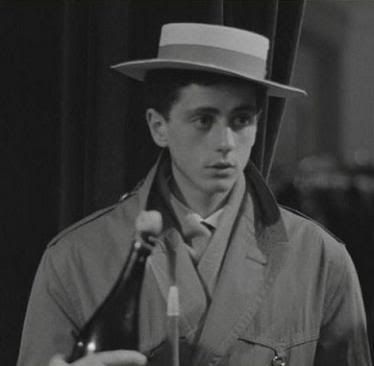
But it is not a war movie: it's original title was "The Job," which wouldn't have been too thrilling a prospect, either. The Sound of Trumpets is a modest little Italian movie about a naive and old-fashioned young man names Domenico, who is gently shoved by his family into looking for a "life-long" job with an important firm.
And this film should be a nostalgic jog for anyone who has ever taken a test, gone job-hunting, had a crush, had a family, worked in an office, or gone to an office New Year's party. In other words, everyone should recognize and enjoy this film.


For me, it was like looking into a mirror, one that looks both inside and outside. For we not only see Domenico's reactions to, say, a test he's taking, but also what he sees—the same things we look at, basically—the ceiling, the other test-takers, the lousy crud who finishes first, anything but the test. And it's all done with wit, subtlety, compassion and economy; at one point during the film a thoroughly irrelevant look at the lives of the other clerks whose jobs Domenico covets, is included for the bloody hell of it. But the segments do so much in so little time that one is thankful that its included, even if you are a trifle anxious to continue with the main story. I think you will be. I think you'll care about the people in this film because the director so obviously did. And a lot of important things are said in this film—about competition, about dreams, about wasted potentials, and about the "security" of a life-long job. I know this is a film you've never heard of, but it's definitely one you should see, because, folks...it's us.

Broadcast on KCMU-FM December 3rd and 4th, 1976


Or it's not "us". That's a little presumptuous to say.


I remember Il Posto being one of the best films I saw in that quarter, and a recent viewing of it showed me that it is pretty universal and is just as charming and insightful as I remember it being. And it has held up over time and competition, as it is a far cry and better (to me) than the "mockumentary" approach to similar situations ala television's "The Office." My memory of Il Posto is of it being absurdly dry for a deliberate comedic effect, and far more formal than the hand-held "busy-ness" of any of the "Office" incarnations (it's gone international, if you hadn't heard). And with far more warmth and humanity than seen displayed in the American or British versions. Plus, Olmi's vision places an emphasis on architecture and its relation to the figures in each landscape. I still recommend this movie, even if its less known than Olmi's most popular film 1978's The Tree of the Wooden Clogs.
And it just goes to show what joys you can experience in the cinema, if you just give a film with a lackluster title a chance, depressing day or no.


Midnight Cowboy will be posted tomorrow.

Tuesday, January 23, 2018

Phantom Thread

Life, After a Fashion
or
"For the Hungry Boy"

Paul Thomas Anderson's Phantom Thread may be his emerging into his Max Ophuls stage, as it is so very well appointed, but where Ophuls usually had a complicated story tinged with irony, Anderson has managed to fashion a taut two hour film out of some thin material. 

Nothing wrong with that, Phantom Thread manages to be engrossing and curiously entertaining in how its short story progresses, rather than making something more dense that might have taken three hours to whittle down to a coherent story. And considering it's story-roots, it manages to boil the essence of it down to what really matters in the film from a character point-of-view without the intrusion of a plot device from third parties that would force a false solution to what really matters—the complicated relationships between men and women.

Meet Reynolds Woodcock (Daniel Day-Lewis) of The House of Woodcock, a fashion couture for the discriminating (hard to place the date but it would appear to be the late 1950's). Reynolds is fastidious and prim, he is a perfectionist when it comes to his creations and his taste—he will broker no argument that he might be mistaken or less than diligent if it comes from any source other than himself. He is a master of his craft, and he creates a world of comfort for his customers that nothing will be left to chance and any fears that they may have in their lives will be easily dismissed with the confidence that his frocks will instill in them. He is very good at his work, which is more of a craft than a profession, something he has done since the age of sixteen when he personally made his Mother her wedding dress for her second marriage. 
In a way, the women inside the dresses disappear once inside them—the dress becomes the focus of attention and they are mere passengers. The dresses are the art, meant to enhance the woman, who has been reduced to a series of measurements very quickly in the process—the time he spends with them is short, very deliberately; he sees them at the fittings and the final presentation, as everything else is about the dress, which is stable, has no moods, and has no questions.
Reynolds is in the final stages of his relationship with a model, who has made the unspeakable wrong of complaining about his coldness during morning breakfast when he is doing rough sketches for future concepts. He leaves it to his sister, Cyril (played very remotely by Lesley Manville) to discard her, while he, having taken care of a big job, goes to the remote family home to decompress. At breakfast, his waitress is Alma (Vicky Krieps) who immediately gets his attention by stumbling into the dining room, but smiling once she's recovered; she is able to take his order efficiently and perfectly, even after he requests to take her order pad away—she will remember, and, indeed, she does. Reynolds is so pleased that he asks her out.
The meal is dinner and a showing of his house and long silences as he stares, pleased, at her. He then asks her to follow him to the loft. But, rather than showing her his bedroom, the loft is his work-place, where he asks if he can make a dress for her. They are soon joined by Cyril, who dutifully jots down her measurements, meticulously, and he sets to work, measuring, cutting and producing for her a comely dress for their next date. This unnerves her, somewhat, but Cyril reassures her that it is alright—Reynolds is relaxed and this is what he does. This is what he loves.
Alma becomes a part of his life, moving into the posh townhouse that is The House of Woodcock, with her own separate bedroom, becoming a part of his work and his life, which are one and the same. But, it soon becomes clear to Alma that though she is a part of his life, she is part of his fiefdom, and she struggles to find a way to be essential to it, when it has such a narrow focus and his boundaries are exact and not to be crossed. How do you negotiate something so intractable?
Although Cyril is intimidating to Alma, she also professes to Reynolds that she is "quite fond of" Alma—a revelation that is a bit startling—when he becomes piqued with Alma's completely innocent indiscretions into his habits and moods.  And he has no compunction to withhold his dissatisfactions, whereas Cyril behaves like a complete cipher, unreadable even to her own brother. But, Alma does not want to be an adornment, a model, a help-mate; she wants to be essential, the fabric to his life that cannot be cut away when it proves to be extraneous. How do you become necessary and not just artifice?
If you're looking for clues about what it all means, look to the literature of the 19th century—Alma is a modern "Jane Eyre", or if you want to go to the previous century's equivalent, "Rebecca". She is a simple, humble woman thrust into a fairy-tale land that is both a dream and a nightmare. The environment is rife with ways in which she can be materially happy, but can wound her soul and her self-worth. She has it better than her predecessors—there are no forbidden wings or unmentionable scandals—but, those are merely plot-devices that obfuscate the real issue—is she deserving of this life that she has been hand-held into? Is she a part of it, or another adornment? Will she fall out of taste or fashion? How can she be equal to the man who controls things, when he does not accept an equal and has become absolutely calcified to his life and his ways of doing things.
Phantom Thread cuts right to the chase and the icy heart of the problem—the man is just unwieldy and his authority is unquestioned, and any woman who trespasses must realize that it is "his way or the highway." That is apparent enough with his clients, but she is not a client. But, what she cannot quite figure out is...what is she? And what must she become to survive in his world? How does she get to this man's heart?
That's where revealing anything must stop, because that's where Phantom Thread leaves the road paved by Bronte and DuMaurier and goes its own way, but not going too far astray from the sensibility of Rebecca's director, Hitchcock, who would chortle at Anderson's solution, even while mopping his own brow in worried identification. It might be a bit base, given the trappings of civility that Reynolds overrules, but it gets the job done, and, in a lovely bit of perverse thinking, makes the two lovers co-conspirators. All's fair...
I can't say I've ever been too terribly fond of Anderson's work. Oh, he works hard at it and you can certainly admire the effort of what he's done before. One is often left wondering what the point of it all is, though. But, Phantom Thread is my favorite of everything he's done in that he is so scrupulous, so refined, and so focused on what is important. It's amazing, and fits in very nicely with the surge of feminist-tinged movies that have hit theaters at just the right time. This one is both lovely to look at, and lovely to consider.


Sunday, January 21, 2018

Don't Make a Scene: Shrek

The Story: Disney has been at the top of the animated castle for a long time now. But, as the film technology behind cartoons has gone from pen-and-ink analog and photography to moving pixels around, they've been seeing challenges from other fronts. Disney got the first releasing dibs for (then acquired) its competitor Pixar, but one of their chief rivals is the team of Steven Spielberg (who executive-produced cartoons for Warners) and Jeffrey Katzenberg—formerly one of their own executives and, while there, responsible for Disney's resurgence in cartoons starting with The Little Mermaid. When Katzenberg reached a brick wall in the Disney hierarchy despite his animation success, he jumped ship, joined forces with Spielberg and David Geffen to form Dreamworks SKG, and set about to head up that up-start start-up's animation department, both by cell and computer.

Shrek, based on William Steig's character (but not his book!), was one of their first successes, a rather crude—by today's standards—CGI film, that battled awkward movement and the Uncanny Valley, but managed to surpass that with such humor and a very snarky attitude towards anything with a sentimental past, that to gripe about the animation seemed...ungrateful.

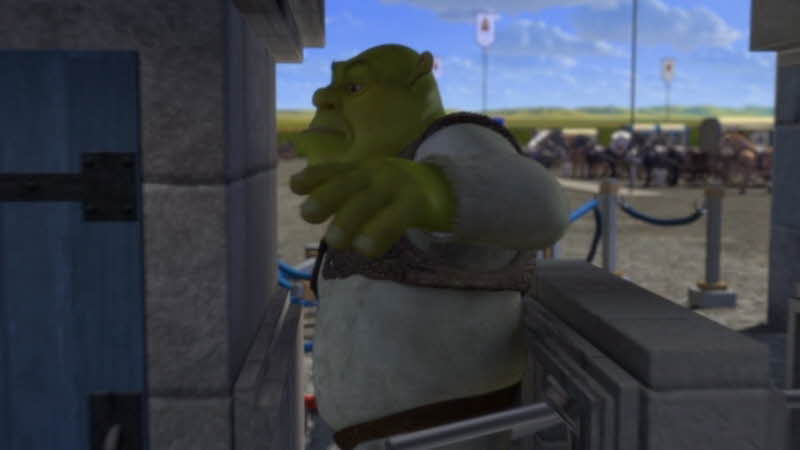
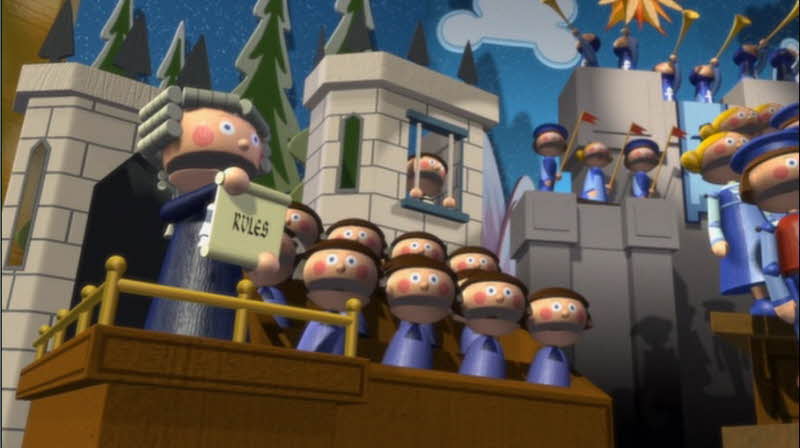
Speaking of which, Katzenberg's former employer got a lot of tsouris in Shrek, most notably in the introduction to the town of DuLoc (that's how it's spelled in the script), with its themed parking lot segregations, serpentine rope lines (embarrassing when no one's waiting), bobble-headed crowd referees, surprise insta-pics, and most cleverly, one of their attractions, the "it's a small world" ride,** created by Disney for the UNICEF pavilion (sponsored by Pepsi) for the 1964 New York World's Fair*** to promote world brotherhood (in the wake of the Cuban Missile Crisis). It's the best zinger at Disneyland's expense since the "Sleeping Beauty" episode of "Fractured Fairy Tales" from "The Rocky and Bullwinkle Show" (included here)****, over which Uncle Walt nearly sued producer Jay Ward (Ward's usual reply to lawsuits was "Go ahead. We need the publicity!").

But the final punch-line: after making comedy hay out of the concept, they un-apologetically created their own "Shrek 4-D" ride at Universal Theme Parks...because, evidently, they don't understand irony when it comes to themselves...or making money.
The Set-Up:  Shrek (voiced by Mike Meyers) is an ogre, living in a swamp outside Duloc, run by the evil Lord Farquaad (John Lithgow), who has been cracking down on all the "fairy-tale things" that have been besmirching his perfect kingdom's rep (and property values no doubt—although I'm not sure why, as they're all in the public domain). Anyway, they're all squatting in Shrek's swamp, and that he does not like. So, of he goes with the recently en-chatted donkey named Donkey (Eddie Murphy) to give the Lord Farquaad a piece of his mind.

Action!

EXT. FIELDS OUTSIDE DULOC - DAY

Shrek and Donkey emerge from the cornfield by the gates of DuLoc. They look up at Farquaad's tower, erected in the center of the city, looming above them.
DONKEY Well that's it. That's it right there. That's DuLoc. I told ya I'd find it.  
SHREK (distaste) So...  
SHREK ...that must be Lord Farquaad's castle.  
DONKEY Uh-huh. That's the place. 
SHREK Do you think maybe he's compensating for something? 
Shrek laughs to himself and looks towards Donkey to share the joke. Donkey continues to looking at the tower, tilting his head from side to side....
...trying to make sense of Shrek's comment. Shrek heads off towards the gate.  
DONKEY Hey, wait. Wait up, Shrek. 
Donkey takes off after Shrek, who's passing through a parking lot dotted with carts. Signs on stanchions read "You Are Parked in Lancelot 17" and "You Are Parked in Percival 12."
Donkey catches up, breathless.
MAN Hurry, darling. We're late. Hurry. 
Donkey stops as they reach the entrance, a velvet rope crowd-control maze, and see a life-size cut-out of Lord Farquaad waving; a sign reads "45 minute wait from here."
SHREK Hey...
SHREK ...you! 
SHREK (irritated) Wait a second. 
SHREK Look, I'm not gonna eat you. 
SHREK I just - - I just - -  (exasperated sigh)
Domkey trots into the maze. Shrek watches in bemusement, then lumbers right through the ropes.  
At the far end is a turnstile; 
Donkey follows Shrek through, and gets stuck.
They stop and look around. Muzac plays from medieval speakers.
A booth features Farquaad figurine souvenirs.
The place is deserted.
 SHREK It's quiet. 
SHREK Too quiet. 
SHREK Where is everybody?
Donkey spots a Mall style 'Information' booth with a large handle on the side that says "Pull." 
DONKEY Hey, look at this!  
Donkey rushes over and pulls the lever.
The device starts to click...
...then clunks into action.
The doors fly open...
...revealing rows of perfect little wooden dolls who start to sing.
(Music)
WOODEN PEOPLE Welcome to DuLoc/such a perfect town 
WOODEN PEOPLE Here we have some rules/ Let us lay them down  
WOODEN PEOPLE Don't make waves, 
WOODEN PEOPLE ...stay in line  
WOODEN PEOPLE And we'll get a-long fine  
WOODEN PEOPLE DuLoc is a per-fect... 
WOODEN PEOPLE ...plaaace/  
WOODEN PEOPLE Please keep off of the grass  
WOODEN PEOPLE Shine your shoes, 
WOODEN PEOPLE wipe your... 
WOODEN PEOPLE ...face 
WOODEN PEOPLE DuLoc is...  
WOODEN PEOPLE DuLoc is a perfect plaaaace.  
SLAM! The doors close.
Donkey and Shrek are a little stunned.
Then Donkey steps forward.
DONKEY Wow! Let's do that again! (makes ready to run over and pull the lever again) 
 
SHREK (grabs Donkey's tail and holds him still) No. No. No, no, no! 
SHREK No.

(O.S.) Donkey and Shrek hear trumpets and cheers. They turn to see a stadium.

Shrek

Words by Ted Elliott & Terry Rossio and Joe Stillman and Roger S.H. Schulman (plus Cody Cameron, Chris Miller and Conrad Vernon)

Pictures by Andrew Adamson and Vicky Jenson and the Dreamworks animation department.

Shrek is available on DVD from Dreamworks Home Video


*


**
"The Happiest Place on Earth"
****


* The updated lyrics for the DuLoc song from "Scared Shrek-less" are:

Welcome to DuLoc/Such a creepy town
What was once pristine/Now is all run down
We will chop off your head/and then laugh when you're dead
DuLoc is a creepy place.
Come on in/What the heck
Fall right down/break your...face
DuLoc is
DuLoc is
DuLoc is a creepy place!

** At an introductory get-together at a job, the new recruits were asked to introduce ourselves, give some brief background and...as a bonus question tell the group what our favorite...or least favorite...ride was in Disneyland.  When it got around to me, I answered that my least favorite was "It's a Small World" "but if you play Pink Floyd's "Dark Side of the Moon" while you're in it, it improves it a 1000%."

*** To movie fans, it is now the site of the Stark Expo 2010 (from Iron Man 2), and, according to Men in Black, was designed to cover up the first landing of extra-terrestrials: "Why else would they hold it in Queens?"