Life, After a Fashion
or
"For the Hungry Boy"
Paul Thomas Anderson's Phantom Thread may be his emerging into his Max Ophuls stage, as it is so very well appointed, but where Ophuls usually had a complicated story tinged with irony, Anderson has managed to fashion a taut two hour film out of some thin material.
Nothing wrong with that, Phantom Thread manages to be engrossing and curiously entertaining in how its short story progresses, rather than making something more dense that might have taken three hours to whittle down to a coherent story. And considering it's story-roots, it manages to boil the essence of it down to what really matters in the film from a character point-of-view without the intrusion of a plot device from third parties that would force a false solution to what really matters—the complicated relationships between men and women.

Meet Reynolds Woodcock (Daniel Day-Lewis) of The House of Woodcock, a fashion couture for the discriminating (hard to place the date but it would appear to be the late 1950's). Reynolds is fastidious and prim, he is a perfectionist when it comes to his creations and his taste—he will broker no argument that he might be mistaken or less than diligent if it comes from any source other than himself. He is a master of his craft, and he creates a world of comfort for his customers that nothing will be left to chance and any fears that they may have in their lives will be easily dismissed with the confidence that his frocks will instill in them. He is very good at his work, which is more of a craft than a profession, something he has done since the age of sixteen when he personally made his Mother her wedding dress for her second marriage.

In a way, the women inside the dresses disappear once inside them—the dress becomes the focus of attention and they are mere passengers. The dresses are the art, meant to enhance the woman, who has been reduced to a series of measurements very quickly in the process—the time he spends with them is short, very deliberately; he sees them at the fittings and the final presentation, as everything else is about the dress, which is stable, has no moods, and has no questions.

Reynolds is in the final stages of his relationship with a model, who has made the unspeakable wrong of complaining about his coldness during morning breakfast when he is doing rough sketches for future concepts. He leaves it to his sister, Cyril (played very remotely by Lesley Manville) to discard her, while he, having taken care of a big job, goes to the remote family home to decompress. At breakfast, his waitress is Alma (Vicky Krieps) who immediately gets his attention by stumbling into the dining room, but smiling once she's recovered; she is able to take his order efficiently and perfectly, even after he requests to take her order pad away—she will remember, and, indeed, she does. Reynolds is so pleased that he asks her out.

The meal is dinner and a showing of his house and long silences as he stares, pleased, at her. He then asks her to follow him to the loft. But, rather than showing her his bedroom, the loft is his work-place, where he asks if he can make a dress for her. They are soon joined by Cyril, who dutifully jots down her measurements, meticulously, and he sets to work, measuring, cutting and producing for her a comely dress for their next date. This unnerves her, somewhat, but Cyril reassures her that it is alright—Reynolds is relaxed and this is what he does. This is what he loves.
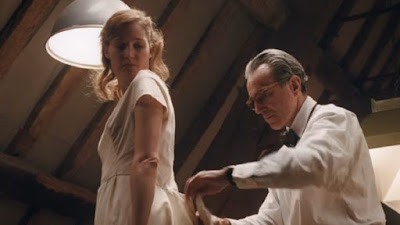
Alma becomes a part of his life, moving into the posh townhouse that is The House of Woodcock, with her own separate bedroom, becoming a part of his work and his life, which are one and the same. But, it soon becomes clear to Alma that though she is a part of his life, she is part of his fiefdom, and she struggles to find a way to be essential to it, when it has such a narrow focus and his boundaries are exact and not to be crossed. How do you negotiate something so intractable?

Although Cyril is intimidating to Alma, she also professes to Reynolds that she is "quite fond of" Alma—a revelation that is a bit startling—when he becomes piqued with Alma's completely innocent indiscretions into his habits and moods. And he has no compunction to withhold his dissatisfactions, whereas Cyril behaves like a complete cipher, unreadable even to her own brother. But, Alma does not want to be an adornment, a model, a help-mate; she wants to be essential, the fabric to his life that cannot be cut away when it proves to be extraneous. How do you become necessary and not just artifice?

If you're looking for clues about what it all means, look to the literature of the 19th century—Alma is a modern "Jane Eyre", or if you want to go to the previous century's equivalent, "Rebecca". She is a simple, humble woman thrust into a fairy-tale land that is both a dream and a nightmare. The environment is rife with ways in which she can be materially happy, but can wound her soul and her self-worth. She has it better than her predecessors—there are no forbidden wings or unmentionable scandals—but, those are merely plot-devices that obfuscate the real issue—is she deserving of this life that she has been hand-held into? Is she a part of it, or another adornment? Will she fall out of taste or fashion? How can she be equal to the man who controls things, when he does not accept an equal and has become absolutely calcified to his life and his ways of doing things.

Phantom Thread cuts right to the chase and the icy heart of the problem—the man is just unwieldy and his authority is unquestioned, and any woman who trespasses must realize that it is "his way or the highway." That is apparent enough with his clients, but she is not a client. But, what she cannot quite figure out is...what is she? And what must she become to survive in his world? How does she get to this man's heart?
That's where revealing anything must stop, because that's where Phantom Thread leaves the road paved by Bronte and DuMaurier and goes its own way, but not going too far astray from the sensibility of Rebecca's director, Hitchcock, who would chortle at Anderson's solution, even while mopping his own brow in worried identification. It might be a bit base, given the trappings of civility that Reynolds overrules, but it gets the job done, and, in a lovely bit of perverse thinking, makes the two lovers co-conspirators. All's fair...

I can't say I've ever been too terribly fond of Anderson's work. Oh, he works hard at it and you can certainly admire the effort of what he's done before. One is often left wondering what the point of it all is, though. But, Phantom Thread is my favorite of everything he's done in that he is so scrupulous, so refined, and so focused on what is important. It's amazing, and fits in very nicely with the surge of feminist-tinged movies that have hit theaters at just the right time. This one is both lovely to look at, and lovely to consider.


