Showing posts with label Bobby Cannavale. Show all posts

Friday, October 7, 2022

Blonde (2022)

Carrion, Marilyn ("What Business of Yours is My Life?")
or
"Isn't Love Always Based on Delusion?" 
 
The controversies surrounding Blonde, the new Netflix film about Marilyn Monroe*—with the "about" tending towards the "somewhat surrounding" meaning—have been many and manifold.
 
There's the casting of Ana de Armas, the Cuban born actress of Knives Out, Deep Water, and Balderunner 2049 as Norma Jeane Mortenson that generated many a plucked eyebrow to raise in a reverse of the usual "black-on-white" kvetch-mishegoss. And when the film was completed, it was smacked with an NC-17 rating, which promised some salacious material—to which those looking for it will be disappointed—that limited what venues could advertise the film. The fact that its subject is Monroe, one of the most recognizable (and marketable) icons to come out of Hollywood shouldn't slow down the anticipation or the rush to judgment that such a film would engender.
 
But, we already know the story. Or, at least, we think we know the story—as far as anything gleaned from the entertainment press can be informative. And that is of Norma Jeane, the poor waif from questionable circumstances, rising to fame to achieve ultimate Hollywood stardom—men want her, women want to be her—only to find that happiness in the stratospheric air up there is just as illusive to find as down among the mortals who crave it. But, it's also a story of Hollywood as meat-grinder. Of exploitation as a never-ending cycle. Of the predatory nature of the patriarchy. And of never being able to fight back against "The Wisdom of the Tribe."
Blonde
is based on Joyce Carol Oates' "fictionalization" (the author's word) of the accepted and/or whispered Monroe story. Which, in itself, is one more craven attempt to exploit the person. Oates took stories, legends, and gossip and created a creative narrative to make it neat and tidy. But, she was making things up as she went along, only hewing to the facts that have been seen in newsreels and in Cinemascope.
Dominick begins with the harsh glare of klieg lights and flash-bulbs, the one harsh and blinding and strong, the other fast, temporary, and with the aftermath of corruption; it is the scene of Marilyn Monroe filming the "subway grate" scene of The Seven Year Itch
and she pirouettes incandescently in slow motion in the glare. The main title pops on, the title filled with embers and waves. And we're in Los Angeles 1933, where 7 year old Norma Jeane (Lily Fisher) lives with her mother (Julianne Nicholson), a "studio employee" who blames the child for the absence of the child's father (another more well-known "studio employee') in her life. On Norma Jeane's birthday, her present is to be allowed to see a photograph of her father—a studio "head-shot"—but whether this is the father or not is a matter of question. Her mother will soon be diagnosed with paranoid schizophrenia to spend the rest of her days in an asylum, and Norma Jeane's in an orphanage.
"The press" has been saying that folks turn off Blonde after a few minutes, and one can see why, as these scenes are raw, deal with an unprettified version of mental illness, and involve child endangerment—there is much verbal abuse and when a wild-fire breaks out nearby, the mother is determined to escape to the absent father's house "in the hills" attempting to drive through the flames before being stopped by police. Returning to their boarding room, she kicks the child out, leaving her to fend on her own. Of course, people want to turn away at this point—this is tough stuff—the same way that they want to turn away from the homeless on the street. Why should they watch this to feel bad? Well, sadly, that's the story.
And it's not the story, either. The opening sets up a "Daddy Myth" for movie-Marilyn, that she will seek throughout the entire run-time of Dominik's film. The marriages—the ones portrayed, anyway (the first one's missing)—she constantly addresses her husbands as "Daddy." Is this true? I don't know, I wasn't there. But, Oates and Dominick use it as a through-line for Marilyn's entire life, in ways that she seeks father-figures (which could be true, but there may be something else to it?) and in a life-long hope that she might meet her actual father some day; letters from him are concocted to sustain that story arc, but it ultimately proves to be the cruelest part of this exercise. It is psychological speculation of the most specious, coming to conclusions from mere impressions and another example of "Fake News" from over-active imaginations.
The story then leaps from Norma Jeane's childhood to her career in modeling- seeking-acting-roles, and it is at this point that Ana de Armas enters the movie. Whatever one thinks of the movie itself, its best asset is de Armas. At 34, she still evokes the waif-like qualities that become the Marilyn persona, and her physical resemblance is uncanny enough to deflect "Monroe-memory," something extremely capable past performers have been unable to do. The voice-work is well-done without being a parody and even includes the variations between her "breathy" stage-voice and her still-vocal-coached but more natural tones.
De Armas also has a quality that helps—the camera loves her, which is that undefinable fairy-dust that shows an actor to their best advantage, but also allows the audience to read any emotional shift in their face—a quality she shares with Monroe. And Dominik has such faith in the actress and her resemblance—but, more importantly, her performance—that he risks the most brutal close-ups in emotional scenes. And they are frequent. De Armas is in such full command that she allows her face to crumple into ugliness at extreme moments—her humiliating exit from a an office meeting with a studio head (a "Mr. Z" because "lawyers"**) that is more of a pretense for rape, for example. It's one of the most brutal performances—while under scrutinized control—of any actress I've seen. De Armas has the best luck (prominent movies where she's singled out) but also the worst luck (being heavily cut out of movies) that, hopefully, casting types will see her amazing range.
If only it was in service to something better. Oates posits the newly re-christened Marilyn meeting up with fellow acting students, who also have a "Daddy" complex, but 180° opposed to hers, as they're only too well-associated with their fathers. They are Charles Chaplin Jr. (Xavier Samuel) and Edward G. Robinson Jr. (Evan Williams). The namesakes involve her in an extended ménage à trois in which they ply her with booze, sweet nothings of devotion, all the while sexually using her. They're the true villains of the piece, narcissistic, privileged Hollywood kids who can't be successful on their own but only by making a living parasitically. Later, the two will use nude pictures they've taken of her to blackmail "The Athlete" (Bobby Cannavale) who marries Monroe, and...as mentioned...have a direct correlation to Monroe's fatal overdose. Indications in the real world are that Monroe may have encountered them in her career, but whether there was a threesome relationship or that it resulted in a pregnancy (as the film depicts) is just conjecture. I don't know, I wasn't there. Neither was Oates, or Dominik.
At least, the director-screenwriter eliminated Oates' scenario that Monroe was killed by assassins at the order of the then-Attorney-General. As it is, they merely suggest an assignation with the President (
Caspar Phillipson)—that might have resulted in a pregnancy and a forced abortion which is played out like a "horrible dream." What he's replaced it with isn't much better, even if it hues closer to the actual autopsy report, although even then its casting for a reason for "why" centers on manipulation and cruelty, which seem to be the mainstays in this sensationalistic re-imagining of her life.
The pacing seems off as well. There is short-shrift given to her marriages to "The Ex-Athlete" (the issue seems to be she's too much a celebrity) and "The Playwright" (their attempt to create a simple life is hampered by her difficulties carrying a child to term and his writerly penchant to betray confidences) and her dependence on drugs and alcohol to maintain her schedule. It was probably more complicated than that. By this time, Monroe had her own production company and was wrangling creative control with her former bosses and potential new ones. Dominik has her throwing tantrums, but as far as being a tough businesswoman in a male-dominated town? Nothing.

Two opposing views: Monroe filming The Seven Year Itch
"The Ex-Athlete" witnessing in disgust.
Enough. The script, the attitude, the promiscuous, indiscriminate character assassination, the utter cruel tone of the entire project can be parsed for a week of posts. One could get sick of it. But, aside from de Armas' gutsy and (one would even go so far as to say) heroic performance, is there anything else to recommend even a casual glance at this?
Sure. Blonde is a marvel, visually. Dominik moves through formats, aspect ratios, gradations of color and and depths of black and white all to the service of making it look authentic to the period and our cultural memory, despite the lack of any matching veracity in the script. Complementing de Armas' "you'd-swear-it-was-reality" performance, the creative team endeavored (and you can compare their efforts to real pictures above***) to reproduce the appearances of one of the most photographed women from the Hollywood era. It's chilling, really, how much they get the visual right while the story has so much wrong. When the movie jack-knifes into surrealism towards the end, you're willing to believe it.
I will applaud the dedication to detail to recreate those touchstones that any schlub off the street would recognize. Poster images, movie recreations, photo recreations are done meticulously to pass muster. But, one could also see it as an attempt to give all the rampant speculation some legitimacy.
The ultimate tragedy of Marilyn Monroe is that, even after her death in 1962, people are still taking advantage of her, making a buck off her, and dragging her through the mud, just as much as they were doing while she was alive. Usually after a passing, there can be some perspective where one "never speaks ill of the dead", or a charitable view will become the one agreed upon. Not so with Marilyn, evidently. Her afterlife is one composed of the same exploitation foisted upon her while she was alive, a Hell of our own making...and marketing...for all eternity.
It all feels like dancing on her grave...if not outright pissing on it. That's a fate best served to mass-murderers, serial killers and autocrats.
 
But, what did she ever do to us, except entertain us?
Traditionally, movie reviews end with the ranking of stars—5 stars, 4 stars, whatever—and I usually don't do that. But, Blonde made me want to say three Hail Mary's and make a good Act of Contrition
 
And, maybe, light a candle.
* Up to a few weeks ago there was a www.marilynmonroe.com web-site that seems to have disappeared into the ether, and now re-directs to an Instagram account. Seems apt.
 
** The studio head is never named but given that Monroe's career was mostly for 20th Century Fox (run by Darryl F. Zanuck) the implication is clear without spelling it out. This "supposedly" didn't happen with Zanuck (according to the always trustworthy entertainment press) but Zanuck was known for having (what was once known as ) "proteges" who were usually beautiful young women, but also usually from Europe. Still, the production did have to get its clips (to reproduce) from 20th Century Fox, didn't they?
 
 *** Oh. The ones on the LEFT are the real Marilyn, while the ones on the right are from Blonde.

She's scary-good.

Thursday, March 19, 2020

The Irishman (I Heard You Paint Houses) (2019)

A Tragic Loyalty
or
Tales From the Last Man Standing ("It's What It Is...")

“Blind faith in your leaders, or in anything, will get you killed.”
Bruce Springsteen

“I don’t see them. I tried, you know? But that’s not cinema. Honestly, the closest I can think of them, as well-made as they are, with actors doing the best they can under the circumstances, is theme parks. It isn’t the cinema of human beings trying to convey emotional, psychological experiences to another human being.”
Martin Scorsese, Empire Magazine interview

Martin Scorsese and Francis Ford Coppola say (in their own ways) that Super-hero movies are not cinema and they are right to a certain extent, at least in how it creates a studio myopia on what gets made and what doesn't. Because unless the movie has people with emblems on their chest (and are seriously marketable as action figures), they're consigned to streaming services like Netflix, which, if you think about it, is one step up from premiering on the SYFY channel (which is one step up from direct-to-video..if such a thing still exists).
Nerd's eye opinion of Martin Scorsese.
We could go on about how tent-pole films dominate theater-schedules (when theaters have schedules again once we're past our pandemic focus) and even major film-makers are having trouble attracting studio interest, but that would just be kvetching ("All you kids get out of my theater!"). But, Scorsese did manage to get Netflix to buy into The Irishman, his long-in-the-works adaptation of Charles Brandt's book "I Heard You Paint Houses" when Robert De Niro first proposed it after its publication in 2004, and Scorsese's been working on it since 2007.
Better late than never. And without a Miramax (and Harvey Weinstein) breathing down his neck, one can see what a late-Scorsese film without studio badgering looks like. What we get is a 3 hour film told in nested-flashback of Sheeran's (one must say disputed) reminiscinces of his war experience, brief work as a trucker, and his being enfolded into the world of the Mafia and Teamsters politics as a hit-man and then as body-man for Teamsters president Jimmy Hoffa (played by Al Pacino).
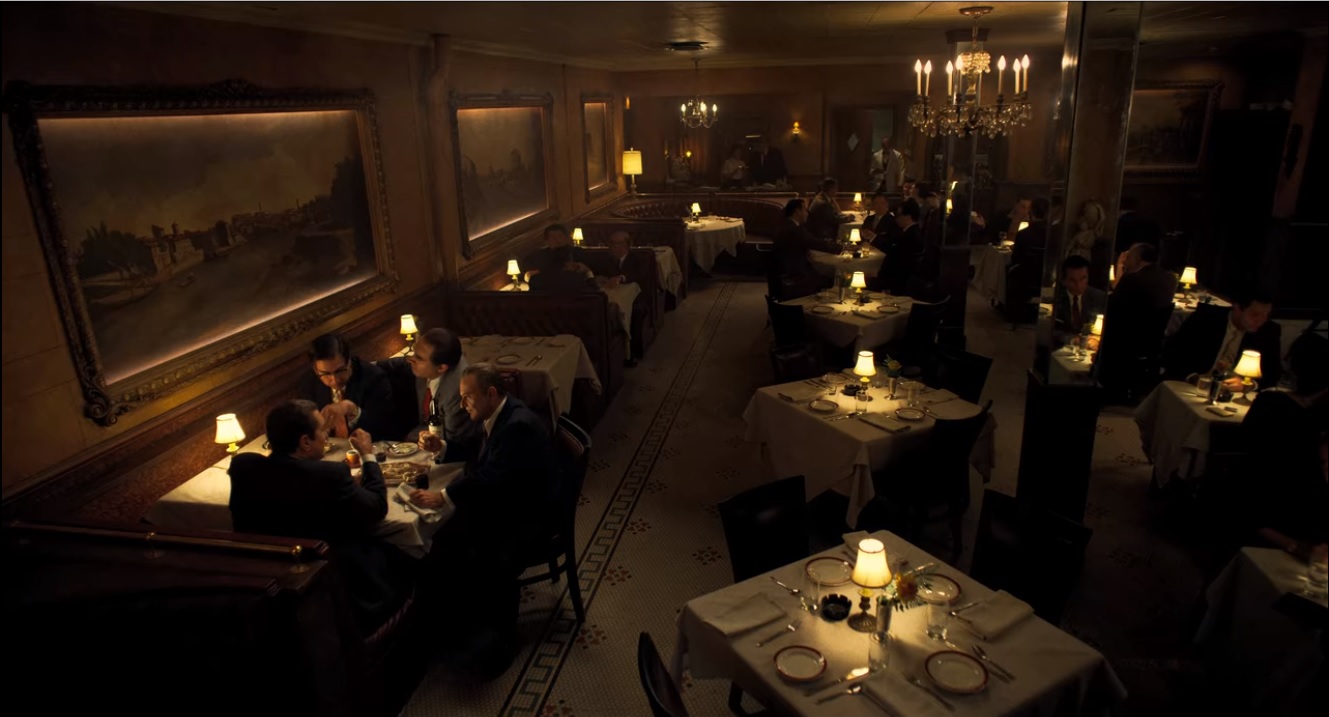
That "nested flashback" structure is interesting, as it's a bit more complex than, say, Once Upon a Time in America, where Sergio Leone has an elderly De Niro return to New York to investigate a past mystery, or Arthur Penn's Little Big Man where Dustin Hoffman's Jack Crabbe narrates his own fanciful take on History. Here, Sheeran resides in a nursing home and relates his history ("It's what is is..."), flashing back and forth between a fateful trip to the wedding of the daughter of lawyer Bill Bufalino (Ray Romano) in 1975, and the events that led up to that road trip.

It takes a bit of patience and a reliance on our memory of how people look—which is very risky as so much of that is dependent on CGI de-aging technology, particularly of De Niro, Pacino and Joe Pesci—who came out of retirement for this role (and who gives the best and most subtle performance of his career).*
That road-trip is given the most detail and the most dialing-down of information because of its implications in how it affects the rest of the world and in Sheeran's moral decline.
Sheeran briefly looks to us when backed into a corner on the road-trip ("It is what is is")
De Niro's Sheeran is a perpetual foot-soldier, following orders with the same mind-set instilled in him during WWII—you're given a job, you follow orders and you don't question them, but merely carry them out. Yes, he considers the consequences, but there is a moral disconnect of responsibility, whether in war-time, or in civilian duties, to the point where the escalating consequences only produce a larger amount of hesitation before accepting the job." "In for a penny, In for a pound." He carries out his role without a second thought, other than the means to the various ends. 
Sheeran understands his role. He also understands the consequences of not carrying it out, which is always done quickly, coldly and efficiently—the body disposed of (or not) and the weapons used, just one of a growing number tossed into the river. He understands the consequences very well; one of the neat touches that Scorsese tosses in, whenever a new character is introduced, is a short title identifying the person and the date and the means by which they died. You just met them and you already see their death sentence. The rule is: don't get attached. Relationships are short and fragile in that sphere of influence. 
And it is one of influence. The Irishman is one of Scorsese's quietest, more subdued pictures—there's not a lot of fancy camera moves, merely an angular movement done at a steady pace. And there are no acting fire-works...except from Pacino—who seems to have taken on the Pesci "wild card" role in this one—or some of the more volatile actors in the game. But, there is such—I hate to use the term "civility" among mobsters—but shrewd, measured calmness, that when someone does get volatile—or a little out of whack—they're going to get "whacked." It may just be a matter of time.
The Irishman is so measured that you take note of the silences and there are many, especially on the part of De Niro's Sheeran, as he digests what is expected of him, sometimes that takes a little understanding and realization. These aren't mobsters, who come right out and Cagney-like, say "I'm gonna kill ya"—that would be too obvious, especially in a world of wire-tape and undercover cops, and especially as so many are done is social gatherings. The words, when they come, are calm and proceeded by justification, an understanding and presentation of larger issues, arguments that make it difficult to say "no" (except by personal choice and then it's "on you") and that just seems impossible in Sheeran's case.
The final fate of Jimmy Hoffa
Nobody comes out and talks murder or assassination—too obvious and too traceable. The title of Brandt's book, based on Sheeran, "I Heard You Paint Houses"—which is also revealed by a separate title card as a continuation of the title of the film—refers to one's reputation as a killer or hit-man, as "painting houses" refers to blood spray-patterns. That abstract circumlocution is the manner in which things are conveyed—words best left unsaid, but woe if they are not done.
It's all done, so that there is no price to pay. But, there is. Being a Scorsese film, The Irishman does have a conscience, a cost, and for Sheeran, it is placed in his daughter Peggy (played first by Lucy Gallina as a child, and then by Anna Paquin), who early on, when she is pushed by a grocer, Dad goes over and throws the guy through his own glass door. When, Ed becomes involved with Russell Bufalino (Pesci), the older man tries to ingratiate himself—constantly—with the little girl, but she almost has an aversion to him, reverting to a stony silence at the presentation of a present. She does, however, appreciate Hoffa for his efforts to help "the common guy" in his Union, and when Hoffa disappears without a trace, she gets only evasions from her Teamster-father, which estrange him from her forever.
Scorsese has a daughter—she's the one who challenged her Dad to "make a movie people like" (which resulted in Hugo, which set no box office records, but it's certainly likable)—so, it's no surprise that she would be the cost for his lack of character, for his survival in a world of ultimate costs and truncated lives. It's ironic—what would a Scorsese film be without irony?—that his survival to old-age in a world of short-life expectancy should be lived along and apart and shuttered away from his family. That's the cost for long-life.
The Irishman is getting the best reviews of Scorsese's considerable career, and one can guess why: access. On wide-release, you get one or two chances to see and then the judgment gavel comes down. But Scorsese is subtle, even in excess. And having The Irishman immediately available for repeated consumption, one can see the touches, the intricacies in this, one of his most subtle films.

* An aside on this de-aging thing, especially in regarding The Irishman. Sure, you can erase wrinkles from a man's face, sharpen his nose, shave the jowls, and the loose skin. But you can not put bounce in a step, spryness in a gait, or unhunch the shoulders and the careful, gingerly pace of a 76 year old actor. That's the big betrayal of time. The only way you could conquer that is to replace the actor with a younger man...in which case, you wouldn't have De Niro. The made the best choice by compromising with time...as we all do.

Wednesday, December 4, 2019

Motherless Brooklyn

The Big "If"
or
Do You Have the First Inkling of How Power Works?

Listen. This won't do any good. You'll never understand me, but I'll try once and then give it up. When a man's partner is killed, he's supposed to do something. It makes no difference what you thought of him. He was your partner, and you're supposed to do something about it...and it happens we're in the detective business. Well, when one of your organization gets killed, it's...it's bad business to let the killer get away with it...bad all around, bad for every detective everywhere. 
Sam Spade, The Maltese Falcon


"Leave it alone or you'll make a mess." Gil Coney (Ethan Suplee) keeps telling his twitchy partner Lionel Essrog (Edward Norton) while they're waiting for a stake-out. They're providing back-up for the Chief Investigator for their detective agency, Frank Minna (Bruce Willis), and Lionel is starting to lose it. He keeps picking at his sweater and if he keeps doing it, it's going to unravel. He knows he shouldn't, he knows what will happen, and it's not that Lionel is dumb (which everybody thinks), it's just that he has Tourette's and unless he has a drink, or chews gum, or smokes dope, or has his mother rub his neck, he's kinda at the mercy of it. He's just a massive tic. And when he's waiting for something to go down, he's a mess. A blurting, shaking, quaking mess. Admittedly.
But, Minna trusts him. All the crew went through the war together, and it's Lionel that Minna trusts most. Because, yeah, he has Tourette's, but he's also a bit of a savant with a photographic memory. Lionel's good with details and when Minna goes over last minute instructions, he leaves with "Lionel's got it. Follow his lead." Of course, Lionel's got it; he's got it chapter and verse, and he'll be instrumental enough to listen in on the meeting, of which he knows nothing because Minna hasn't told anybody, but he will know everything by the end of it—he just won't understand why.
This being 1950's New York, Minna gives Lionel a phone booth to wait in and, once the older man's in place he calls Lionel and hides the phone in a drawer, so that Essrog can monitor the conversation in the room, and if Minna thinks something's going south, he'll make an innocuous "safe" remark for Lionel to hear in order to know where to take the next step—fight or flight.
It turns out to be a bit of both. Minna is taken by a couple of goons to another borough across one of New York's bridges—the goons in the car flash a badge and don't have to pay a toll—while Coney and Essrog struggle to keep them in sight. They catch up just in time to see the sight of Minna running to escape from his captors, but he can't outrun a bullet and he gets gunned down in an alleyway. It's a fast trip to an emergency room where Minna can only gasp out words with his last breath—"Brooklyn, she's in trouble now..."—before Essrog is escorted out...STAT.
Minna doesn't make it. And it shakes his detective agency to its core. There is a some business to take care of—tell the wife, re-arrange the org chart (if they had org charts)—but Essrog feels like they have to find out who killed Frank and to find that out, he wants to find out what he was working on. The others in the agency are all for it to a certain degree, but there's no money to be made finding out Frank's killing, so it's put on the back-burner, which means Essrog can handle it. All the other guys see Lionel as a handicap, but it was Minna who saw him as an asset.

And besides, Lionel has his hat now.
Edward Norton has wanted to make Motherless Brooklyn for a couple decades. Sure, he did. It's got a "tic-y" part, one of those ones that he excels at, even if he'd rather do something with less obvious "character." But, it's one of those detective stories that starts with a little thing, but mushrooms into the world of noir—even if so much of it is photographed in the clearest of New York daylight—where one realizes that the odds are stacked against because the fix is in and the fixers are too big and too powerful. You're lucky if you get out alive.
And where the evil is so big and so ever-present that you can only see it for the details and the anomalies. And Essrog is good at those. So, he picks at the threads of what Minna was doing, back-tracking and going forward which takes him from the highs and lows of New York, from gleaming City Hall Park to decaying Harlem and the strings that tie them together while tearing the city apart. "Leave it alone or you'll make a mess." But, Essrog can't leave it alone. He's wearing Minna's hat and his coat, and walking backwards in his footsteps, and slowly, but less than surely, he will be making them his own.
The original novel (by Jonathan Lethem) is set in contemporary times, but Norton, sets his screenplay in the 1950's and it's a good fit, taking advantage of the echoes in the detective movie boom, shadowed as it is with the era of film noir, the mainstream popularity of jazz as its soundtrack, amidst a back-drop of the post-war boom in building, an up-sweep in the economy, with the resulting gentrification and the fall-out of segregation inherent in it all. But, it's also in that valley between the increased presence of minorities in the war effort and the Civil Rights movement of the 1960's, where any progress their service might have engendered never materialized amid the same Jim Crow laws and racial covenants placed in the suddenly mushrooming suburbs.   
The time-shift fits the material like an old battered trench-coat and manages to keep it relevant even though relocating it to the past. It also manages to nestle comfortably in the distracted Eisenhower era, where social engineering could be accomplished over long periods of time in the name of progress where little attention would be payed to the changes, lest activists toss their wrenches into the gears.
If the movie reminds me of anything, it's the movie Chinatown, where the machinations of the powerful to manipulate society into protecting their plutocracy happens in broad daylight among the disenfranchised and the under-represented, and where subtle changes to infrastructure uproot lives and undermine neighborhoods and whole communities, turning urban planning into urban "plotting," designed to line pockets while society unravels. And that makes a mess—if not now then certainly for the future.
"The Future, Mr. "Gitts", the future!" Those are the words of Chinatown's Noah Cross (John Huston) when asked by Jake Gittes (Jack Nicholson) why it is that he does what he does, he being so rich and all. At least, he was thinking about the future. Motherless Brooklyn has its "big bad" just like Chinatown had its Noah Cross. It's in the character of a similarly biblically-named Moses Randolph (Alec Baldwin in a part that wasn't in the book, but is based on New York developer Robert Moses). Randolph is more of a short-time thinker, having a vision of his goal but myopic about the ultimate ramifications when it comes to human beings. His eye is on the ledger, the fiscal year, and the next election cycle and what can be done to cook the books. Where Cross wants a kind of immortality from his works, Randolph wants the power to do as he pleases in some Randian plutocracy, where he sees himself as the engine, rather than by the funds provided by people who actually fund it. They pay taxes. They have no power. And so, they can be dismissed. They don't matter. 
In fact, they're pests. "They're invisible. They don't exist." Not Government of the people by the people for the people. Government despite the people. And often, to spite the people.

"Do you have the first inkling of how power works? It means you can do anything." 
My, how that line resonates these days. It should resonate all the time, but people have short memories and the powerful depend on that to survive in a perpetual shell-game, playing the public like a cat-owner with a laser-pointer. And we chase the light, never suspecting we're being manipulated from on high, given new concerns, new enemies, new priorities that are turned on and off—like a laser pointer—when it suits the powerful.

If you think Randolph is a Trump stand-in (it's Alec Baldwin, right? "Duh!"), one should consider that his character builds bridges, not walls. But bridges are just as effective.

Motherless Brooklyn is a great meal of a movie, one of the kind that come out of left-field and is just so good that you wish it wouldn't end. I haven't mentioned 3/4 of the plot because it's one of those things you don't want to spoil, and that neglects great work by Willem Dafoe, Gugu Mbatha-Rawe, and Cherry Jones (as well as stellar production design by Beth Mickle and art direction by Michael Ahern). It's nearly perfect, with its only sin being it might be a bit "on the nose" when it reaches its resolution. But, it still manages to surprise, and gives Norton another one of those flashy performances he can sink his considerable acting chops into. That is has more than that with sub-texts both in the script and the imagery shows that he's come a long way as a director since his last film, 2000's Keeping the Faith.

Hope he doesn't wait so long to make another one.