The one-two punch of two Spielberg movies opening within a week of each is almost an embarrassment of riches, and in going from Tintin to War Horse it's a journey from the ridiculous to the sublime. We've seen what happens when Spielberg tries to make a Kubrick film (A.I.: Artificial Intelligence), a David Lean film (Empire of the Sun) or cut up like Hitchcock (Jaws), but what happens when he makes a John Ford film? The answer isWar Horse,based on the 1982 children's book by Michael Morpurgo, which was subsequently staged as a play adapted by Nick Stafford at London's National theater. Somewhere on this journey, Spielberg got wind of it, and the tale of World War I told from a horse's point of view became Spielberg's second Christmas release. Horse movies have all the sentimental elements of fables, which is why children love them, but the circumstances of this one have little to do with childhood concerns, but have more to do with kinship between man and beast in an unsentimental, often brutal world of adults.
It has all the elements of Ford: the Irish flavor as it begins in Devon, with the Narracott familyacquiring a noble, unbreakable horse for plowing their hard-scrabble field; the horse—named Joey—learning to trust its first master, young Albert (Jeremy Irvine); the family being threatened with eviction by an uncaring bank (personified by David Thewlis' examiner); the "it takes a village" atmosphere that Ford engendered in his films (and not necessarily to come together in a common purpose, so much as to comment and gossip on it); the low comedy relief of animals—Spielberg makes goofy use of a particularly belligerent farm-goose and Ford favored horses that acted against training and merely acted like horses. Even the town of Devon looks precisely like the 20th Century Fox back-lot recreation of the Welsh mining town in Ford'sHow Green Was My Valley.
But tough economics trumps sentimentality here and the horse is sold into service in WWI to keep the family going, and The Great War passes the horse from hand to surviving hand, some gentle, some harsh as the battles change the landscapes and fortunes of those in the European theater.
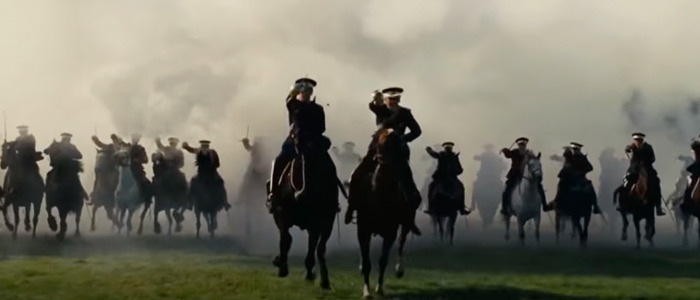
The war goes from planned charges to muddy trench warfare, Spielberg opens it up with a spirited run where, Joey, alone and ownerless for the first time in the film, makes a desperate gallop for freedom (something possibly learned by a former caretaker), through, over and past the soldiers huddled in the trenches and ironically ending his gallop in the middle of No Man's Land, where warring parties must watch and wonder at the sight between them that has nothing to do with the concerns of Man.
But, where War Horse most resembles Ford's work is pictorially—Spielberg sticks to close shots for moments of drama, but when he opens up, it calls to mind advice that the old Commander gave the young director when he was still dreaming of making movies (see video below). He's definitely paying attention to the horizon in this one, and the film, especially in its final moments, seems to come from a different era, one more rich in design and purpose.
In its color, both in sentiment and photographically, War Horse hearkens back to another period of cinema, one that was simpler and more direct, but it never betrays anything less than sophistication of subject matter and maturity of purpose, while still maintaining a high level of entertainment value. At this point in his career, Spielberg is presenting a master class in film-making, evoking the past when it suits him, but maintaining a personal growth that seems to never flag.
"Gertrude Stein Punched Me in the Mouth" or "L'époque est toujours plus belle de l'autre côté du pont Einstein-Rosen"
I first came to Chicago in the twenties, and that was to see a fight. Ernest Hemingway was with me and we both stayed at Jack Dempsey's training camp. Hemingway had just finished two short stories about prize fighting, and while Gertrude Stein and I both thought they were decent, we agreed they still needed much work. I kidded Hemingway about his forthcoming novel and we laughed a lot and had fun and then we put on some boxing gloves and he broke my nose.
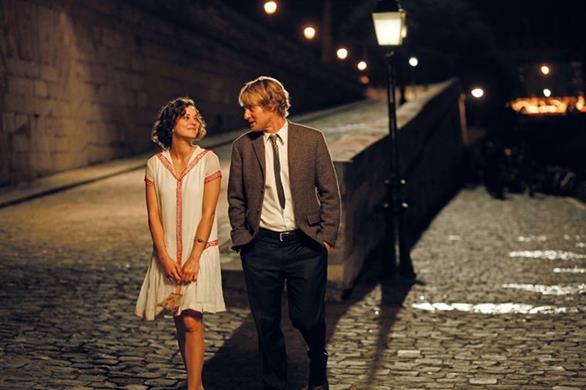
Based on a routine from his stand-up days,*which he later expanded for a piece in "The New Yorker" (see above),Midnight in Parisfollows Gil (Owen Wilson) a self-absorbed, neurotically anxious writer of Hollywood fluff ("Wonderful, but forgettable...sounds like something I wrote"), who is obsessed with death,**as he travels to Paris from Pasadena with fiancee Inez (Rachel McAdams, but it could just as well have been Elizabeth Banks) and her conservative family. Gil is working on a novel, long in the gestation, and is distracted by the vapid shallowness that he is about to marry into. Paris is shops, restaurants, museums and snootiness, and to escape the jejeune de vivre, he takes a late-night walk through the streets of Paris and is approached by a vintage taxi.
Entering the cab for Gil is a magical moment for him, on the same plane-breaking as when Tom Baxter (or is it Gil Shepherd) walks off the screen in The Purple Rose of Cairo. He is instantly transported to 1920's Paris and becomes lost in "The Lost Generation" (without the benefit of having survived World War I), meeting Cole Porter (Yves Heck), Ernest Hemingway (Corey Stoll), Zelda (Alison Pill) and Scott Fitzgerald (Tom Hiddleston), all the heroes of his favorite literary era and time, the 1920's. He's enchanted...and as his novel is about that period of time...inspired. He goes back to Inez, gob-smacked, unable to explain where he's been all night, but "alibi's" his adventures as a dream (as they are, certainly in the aspirational sense). He tries to bring Inez to the party, but the magic doesn't work—she's as unthrilled with Gil's stories as he is with her wine-tasting adventures with acquaintance Paul (Michael Sheen).
So, the two planes of existence for Gil are set up: his modern-day drudgery on the cusp of a marriage of inconvenience; and his fantasy past, where his dreams are reality and reality can make dreams. You know where this is going.
It doesn't matter, though. This is a "feel-good" Woody Allen picture—the kind people like—where the messages are still telegraphed the way they are in "obvious" Allen movies, the coincidences just a little too convenient, but so full of incident, grace and nuance (and quite a bit of humor) that it goes down well (as Allen groused throughout Stardust Memories, audiences "like his earlier, funnier [movies]"). That Gil is such a sunny presence in the past (and as played by Wilson, he has a guileless charm that doesn't sacrifice intelligence—he's the way you'd imagine Jimmy Stewart would play Woody Allen), even his kvetching is charming and not harsh. It doesn't matter that you be a history buff and "get" all the references,***(and we meet Luis Bunuel, Man Ray, Salvadore Dali [Adrien Brody], and on a side-trip, Toulouse Lautrec, Gaugin and Degas).
Of course, Gil is enchanted; he is an era when his heroes are still at the stage he is, becoming themselves, with their best work still ahead of them. His age of magic is their everyday life. The interesting lesson of the film (and what makes it special and wise) is that the knife cuts both ways. The "lesson" is both sour and sweet, but not hope-crushing—a little bit of salt in the creamy fluff.
And no, nobody punches Gil in the nose—but you can't help noticing that Wilson's is a little broken.
A Match Made in Heaven
or Early Man United, Playing with Feet of Clay
Earth is not in a good place. Timewise, it's in the Neo-pleistocene era as the title tells us. That covers a lot of ground, so they tell us (as the volcanos belch in the back-ground and homage is paid to the late Ray Harryhausen with our first sight of a stop motion Tyrannosaurus and Triceratops fighting in the background) that it is "Near Manchester." Helpful. Then, they zero in and say "Around lunch-time." Very good. That reassures us that it is not entirely accurate, scientifically, by showing us a lot of doughy bi-ped humans fighting over food at the same time than the dinosaurs are doing their cage-match. Biblically speaking, it's all good, because the people (and dinosaurs) are all made of clay—call it the "neo-plasticene" era, then. But, I say that Earth is not in a good place, because while both humans and dino's are chowing down, a pesky meteorite wants to be right where the Earth is and slams into it creating a mushroom cloud and destroying the dinosaurs. Say good-bye to the "flintstonian" era of co-existence, then, but "humankind" survives by being covered in dirt and digging themselves out. Peering into the voluminous crater the meteorite has produced, they see at its center the very culprit what made it in the first place, a rock-spheroid, glowing red. They clamber down and try to pick it up, but it's too hot to handle. They drop it. And kick it. And kick it again. And again.
And that, ladies and gentlemen, is how football was born (it is, after all, around Manchester).
I've loved the Aardman Animation Studio films (the folks responsible forEarly Man) since I first saw their Oscar-winning short "Creature Comforts"* in 1989. Since that first brilliant little short, they moved on to the Wallace and Gromit shorts, Chicken Run, the "Shaun the Sheep" series, shorts, and features and innumerable commercials featuring toothy-anthropomorphised...products. They have a distinctive feel, with a lovely combination of precise casting, meticulous animation, and a goofy "catch-as-catch-can" ability to use detail to create comedic possibilities that when they pave off makes you go "oh, that was a long time in planning."
The prep and story-sense is so good that they don''t have to do a lot of reaching or depend on short-shelf-life cultural references in order to garner laughs, which you see a lot of in animation these days. The humor of the Aardman staff is evergreen—it never falls out of fashion or relevancy (that's a real bonus for people who turn all lemony-puss at political references). They are classic comedians in the stripe of the silent clowns, vaudevillians and early television; they don't look at today's headlines, they know that there is more than enough material to mine out of the human condition and the absurdity of the everyday.
Even if you're a caveman. Advance in time "a few ages," and the species living in the crater hasn't advanced all that much. They subsist on rabbits (if they can catch them, but rabbits haven't made it this far by being caught all the time) and one of the cave-dwellers, Dug (voiced by Eddie Redmayne) thinks it might be better and more sustainable if they hunted mammoths instead (they're big, have more meat than a rabbit...) but the tribe chief (Timothy Spall) thinks that's a BAD idea (they're big...), but the other tribe members decide to give it a "go," and their maiden hunt is interrupted by an invasion from a tribe who's advanced to the bronze age looking for precious minerals. Led by Lord Nooth (Tom Hiddleston) with a singularly snide french accent), they repulse the defense of the cave-dwellers and push them off to the Bad-lands outside of the crater. For the caveman, this sucks. But there's nothing they can do, they are clearly outmatched and can't fight back.
Dug in Bronze-town (note the crosswalk)
During the melee, Dug finds himself knocked out and being carried to the advanced town, which is quite civilized by relative standards, and is very disorienting to a caveman. In attempting to escape, he is captured and, desperate, he makes a deal with Lord Nooth to a football match with Nooth's elite team; if they win, they get to return to the valley, and if they lose, they will be consigned to work in the Lord's mines for the rest of their natural lives. For Nooth, it's a win-win, for there is no way that the cavemen can learn the game and gain the skills to win, and he'll be able to charge a premium for the town's populace to see it.
Dug goes back to the Bad-Lands and informs the tribe that if they win the match, they'll be able to return to their homeland. Only one thing stands in the way—teaching them how to play football and actually win. If they don't, then their situation becomes much worse. How hard can it be?
A lot, actually. The trouble starts with all the rules in the rule-book, and their general lack of coordination. Then, their one and only soccer-ball...gets punctured. Along with their hopes. Dug (along with his pet Hognob) takes it upon himself to sneak into the Bronze-town and steal soccer balls to practice with. Initially, it does not go well...
But, with some difficulty, he manages to secure enough balls for the tribe to practice,, as well as an ally, Goona (Maisie Williams), who, because she's a girl, has no chance to realize her dream of becoming a champion footballer. Goona becomes their de facto coach, training the tribe the fine arts of footballing with the theory that if they work as a team they'll be able to defeat a team of elitist, selfish star-players. That's the theory, but will it come in practicw...or...after practice and they actually play?
There is a wealth of material here and director Nick Park and his co-writers Mark Burton and James Higginson, fill the film to near-bursting with jokes, both verbal and visual. So thick with incident is this film that how it turns out becomes obvious very early on in the proceedings. But, it doesn't matter, because it has so many surprises along the way that it all feels fresh and funny. That is something to cheer about.
And when you think that the primary way that this film is made is by meticulously creating it one frame at a time—there is some CGI in the backgrounds but that's it—you come away from Aardman films gob-smacked by the artistry and sheer British stiff-upper-lipped tenacity to produce a ninety minute feature at...such...a...steady...brilliant...pace. Do the math: let's assume 89 minutes at (let's say) the video rate of 30 frames a second and that's (click, click, click) 2,670 separate intricate pictures they had to make in order do the whole feature. Just imagine someone giving you that assignment with all the detail and personality that Nick Park puts into the story and the frame...
Exactly. Making a movie—any kind of movie—takes a lot of talent and something of a miracle. You try—I try, anyway—to keep that in mind every time stepping inside an auditorium to see a film. It gives you a little respect right off the bat and a little responsibility to keep the people-hours in mind and not just the budget and terabytes. Those are just statistics and hurdles of their own sorts. But, movie like Early Man shows you much work goes into something as doggedly silly as this movie. Something of a miracle in itself, actually.
Goblins and Garden Parties
or "Darling, You Have No Idea What is Possible"
The first couple of "Thor" films were extraordinarily dull things. It might have been because the first was directed by Kenneth Branagh, who wanted to make a Shakespearean myth rather than a comic book movie and art-designed the thing to a fair-thee-well and treated it SO seriously, that it wasn't until Joss Whedon's The Avengers that Chris Hemsworth's version of the character could display some personality besides being ontuse at the top of his lungs. Alan Taylor's Thor: The Dark World I can barely remember except for a lot of things going *thud* at the end—one of them being my patience. The Avengers showed that the God of Thunder could be more than just a guy with a hammer, increasing both the possibilities and the personalities of Thor and his half-brother, Loki (Tom Hiddleston). The whole Odin story-line could be dispensed with, but the fact that Thor was the only one of Marvel's heroes being utilized who was world and dimension-spanning gave the MCU some scope (even if they didn't know how to use it just yet) and set the paths for Guardians of the Galaxy and Dr. Strange. Thor: Ragnarokdoes a lot of things: there's a lot of cameos and guest-stars, brand new characters, and a minimum of returnees from the previous two films—Loki, Thor's father Odin (Anthony Hopkins), and Heimdall (Idris Elba); it introduces another family threat, who is primarily the focus of the story; once the film is finished, everything has changed and the elements that buttressed (and limited) the first two movies are gone and there is no "safe zone" anymore. "Significance" happens in Thor: Ragnarok, and it's a significance that can't be walked back in the next movie (of course, they could do that, but audiences would see it as a cheat and lazy film-making). And that's good; it certainly makes this "Thor" memorable...and that's a first in the trilogy.
We find Thor chained up in a prison in some cavernous expanse, suspended over a lava-bubbling landscape. How did he get there? Who cares? (although he does the requisite "Maverick" style "I suppose you're wondering..."). He is being held by the CGI beast Surtur (voiced by Clancy Brown--the other voice you hire if you can't get James Earl Jones), and it's an odd little back and forth except for the interruptions when Thor rotates at the end of his chain from looking directly at Surtur. "Oh! Wait a tick! Need to be facing you!" And they wait until Thor is in proper axis to look at Surtur while he simmers threateningly at him. That this little interruption happens is your first indication...other than the Marvel Studios logo sinking and melting into hot lava...that this one's going to be a little different; the filmmakers are not going to be hurtling pell-mell to the next ringing declaration or action set-piece. There are going to be Pythonesque "silly bits" when a situation gets a bit...absurd. Like being polite to a lava monster.
Anyway, that's the first bit. Then, Thor goes to his home in Asgard, finds out that Dad-Odin is missing and that Loki is behind it (really, there doesn't need to be much investigation), that Heimdall is not around and an Asgardian named Skurge (Karl Urban) is in his place on the Asgardian turn-stile letting people in. The guy isn't the best border-guard and would have Donald Trump tweeting out something ending in "sad." I won't spoil the details, but ultimately it's determined that Odin is exiled to Earth (Loki's fault...it's always Loki's fault),in the most demeaning of circumstances (he's treated like a human being).
Some such-and-such happens (with the help of Benedict Cumberbatch's Dr. Strange (thanks for stopping by and recycling the post-credits tag from your own movie, Doc)—and ultimately, there's a family dissemblation and a family reunion with the first child of Odin—Loki and Thor's half-sister Hela (Cate Blanchett—you may have seen Blanchett over-act before but you've never seen her relish in it, as she does here, reminding one a bit of Gloria Swanson in Sunset Boulevard) and before you know it, she's smashed Thor's hammer, Mjolnir (rest in pieces), and managed to make her way to Asgard, while kicking Loki and Thor out of the bifrost "rainbow connection" warp-tunnel that gets you there.
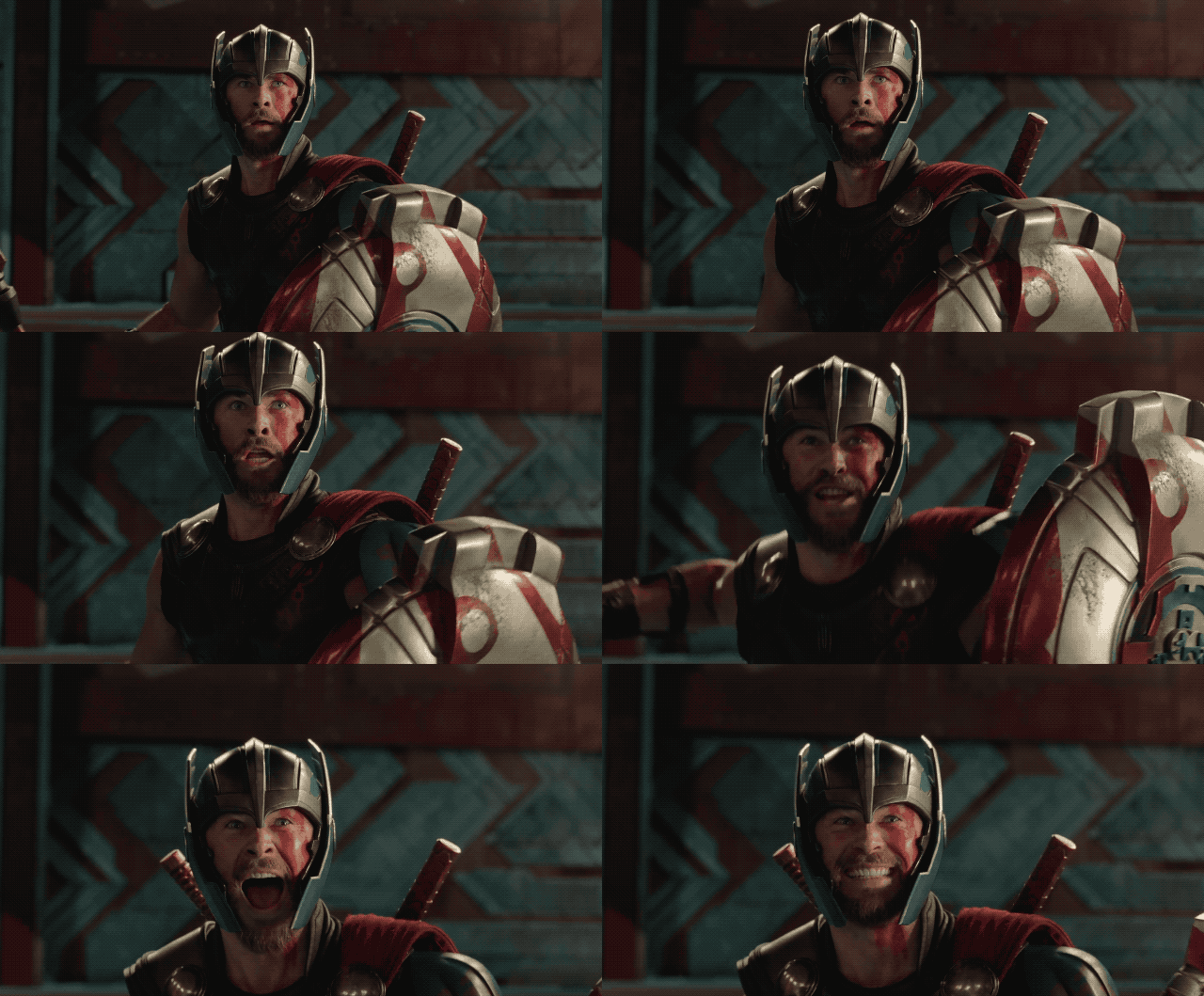
Loki we find out about later, but the hammer-less Thor ends up in a garbage planet (called Sakaar) and gets captured by Valkyrie (or Scrapper 142 as she's known—played by Tessa Thompson in a breakout role), where he's set up for gladiator duties by the planet's "Grand Master" (Jeff Goldblum, reminding you of why you like Jeff Goldblum) to fight the current champion of the gladiator games. Anyone who's seen even the first trailer knows who that turns out to be, and, frankly, it's a good move on Marvel's part to play with the animosity that was displayed between the two characters in a brief scene in The Avengers that lasted all of five seconds. To repeat:
There is much brief rejoicing, not only on Thor's part, but also the audience's. This isn't the "stuffy mythology" Thor that has been displayed in his own solo movies; this is the potential that could be done with Thor if anybody in the first two movies wasn't so afraid of failure at the box-office. The breath of fresh air comes from New Zealand director Taika Waititi, who helmed What We Do in the Shadows and last year's bright, shining Hunt for the Wilderpeople. Waititi has a kiwi sensibility ("yeess"), but his film language is strong and he has a wonderful way with presenting the logically absurd into his work. If he wasn't doing Thor, he'd be doing wondrous things with Marvel properties like Ant-Man and Guardians of the Galaxy—and they could certainly have used him in the Dr. Strange feature if his expansion of the End Credits "tag" of that film is any indication.
Waititi embraces the odd and that's a far cry from what other film-makers do with the four-color world of super-heroes, usually tamping down the comic nature of the things and replacing it with leather costumes and sturm-and-drang. But, when you're dealing with in-fighting Norse gods and ADHD-CGI Hulk's, it might be best to keep your sense of humor, especially once these characters have gotten over the "tragedy" of being displaced and "gifted." Waititi also has a nice visceral sense—subtlety is not his strength—and he's happy letting super-heroes be super-heroes in extremis. So, a completely gladiator battle between Thor and Hulk goes into giddy excess, even repeating a couple of Avengers jokes for good measure.
It's fun. A lot of fun. But, Waititi CAN get carried away with the in-jokes—for instance, an Easter-Egg for Marvel junkies has the Gladiator arena exterior*decorated with the busts of past champions, including Beta-Ray Bill (who took over the "Thor" title for awhile) and Man-Thing (what the hell?). In another instance, Thor is being wheeled into the Grandmaster's tournament hall, he is given an audio tour of the place, all accompanied by "Pure Imagination" from Willy Wonka and the Chocolate Factory. It got a laugh out of me, but...really? Willy Wonka wasn't a success when it was released here...it made it out to Sakaar?
It pads things out a bit—ultimately, the whole idea comes down to getting the Hela out of Asgard and finding a way to get there to do that (they find a way as Sakaar, being a dumping ground for the universe has all sorts of portals through which refuse falls through—and the portal to get them back is called "The Devil's Anus"...really). And, ultimately, Thor finds out that in order to accomplish what he must, embracing the worst thing that could happen might not be a bad thing. Change happens, and the shorn, hammerless Thor must learn that power comes from within...literally.
Odd. Frequently silly. But, ultimately, Thor: Ragnarok is the best film of the trilogy for its own ability to see what hasn't worked in the previous films and embrace its own change. That it causes some destruction of its own history along the way is all for the good.
Gorilla My Fever-Dreams or Monkey-See, Monkey-Poo It's hard to know whetherKong: Skull Islandis a monster movie or a comedy. The team that put together the new film version of Godzilla (minus Gareth Edwards, who moved on to the Star Wars franchise) have whipped together a reboot of King Kong—I have no idea how many Kongs this is now, but it rivals the number of kongs my dog went through in his life. That confusion might be due to the influence of writer Dan Gilroy (Nightcrawlers, The Bourne Legacy—the non-Damon one), who might have taken on this assignment to fund one of his own more personal projects...and didn't quite have the wherewithal to take it too seriously. Peter Jackson, who was obsessed with the original, did his own elephantine version of King Kong some years back (he suggested Guillermo del Toro direct the new one), but this version has little to nothing to do with that one. For one thing, the Kong in this one is monstrously huge, freakishly taller than Jackson's. And, as any re-boot will do, they start afresh, as if nothing before it had happened. Everything, that is, except Apocalypse Now.
After a prelude which sets up a character's back-story and feels a bit like John Boorman's Hell in the Pacific, we cut to the story's main time-line. It is 1973 and President Nixon has announced the end of the Vietnam war. Troops are headed home. But Nature apparently abhors a military vacuum. Driving into Washington D.C. is Bill Randa (John Goodman) and geologist Houston Brooks (Corey Hawkins) who are in town for a terse and not-too-welcome meeting with Senator Willis (Richard Jenkins) seeking a grant to explore a hither-to unknown piece of landscape, Skull Island. Randa badgers the Senator into getting the funds, but, before he leaves, one more thing...he'd like a military escort.
Cut to the Sky Devils Squadron, in the process of rotating stateside when a phone-call comes to Col. Preston Packard(Samuel L. Jackson) with a new assignment—chopper Randa and his crew to Skull Island. Randa and Brooks, meanwhile, are recruiting: they hire James Conrad (Tom Hiddleston)—Conrad (nyuk, nyuk*)—a former Captain of the British Air Services as a tracker; photographer Mason Weaver (Brie Larson); and Landsat employees, geologist San Lin (Tian Jing), Victor Nieves (John Ortiz) and Steve (Marc Evan Jackson)—you know that when a character doesn't have a last name, they're not going to have a lot of screen-time.
The odd mix of scientists and Air-Cav take a ship to Skull Island and launch a reccy with Huey's over the seemingly deserted island. But, sometimes, all it takes is one...."I-is that a monkey?" says one of the pilots. And then, all Hell breaks loose.
Usually, in a "King Kong" movie, they save the air-vehicle swatting for the finale, but, here, it's the opening act as Kong dispatches the Huey's like so many annoying mosquitoes. Machines get knocked out of the sky with extreme prejudice, or, in a phrase that will come up later, "no conscience." The surviving parties are scattered across the terrain, enough to create two sides: the military and the scientific. The scientific respond with an alarmed "what the Hell was that?" The military respond with an alarmed "whatever the Hell that was, let's kill it." Col. Packard is pissed that too many of his guys have bought it from the monkey-menace and he confronts Randa about what they're doing there.
"Monsters exist." says Randa. "No shit," says the unimpressed Packard.
Randa tells him that he has a history with a monster, but the world has considered him a crack-pot despite his being the only survivor of an encounter. This little sortie has had a purpose beyond geology—to provide proof for his group MONARCH, in the business of finding Massive Unidentified Terrestrial Organisms, or MUTO's. Where have we heard that term before? Godzilla. "This planet doesn't belong to us." says Randa. "Ancient species owned this Earth long before mankind, and if we keep our heads buried in the sand they will take it back."
Sounds like Packard is on the same page, but a few chapters behind. Randa thinks the Earth is hollow with all manner of unmannerly critters hidden inside and that we need a coordinated plan to deal with it all. Packard is not so forward-thinking. He's got men dead who should have been with their families instead of dealing with these monkey-shines, and he's going to take the primate down with whatever weaponry he can salvage from the downed choppers. But, as the movie has a ways to go, the Monarchs and the Sky Devils split up for a rendezvous point downriver where the scheduled pick-up is going to occur, giving the Monarch team to get into a bunch of mis-adventures and set-pieces.
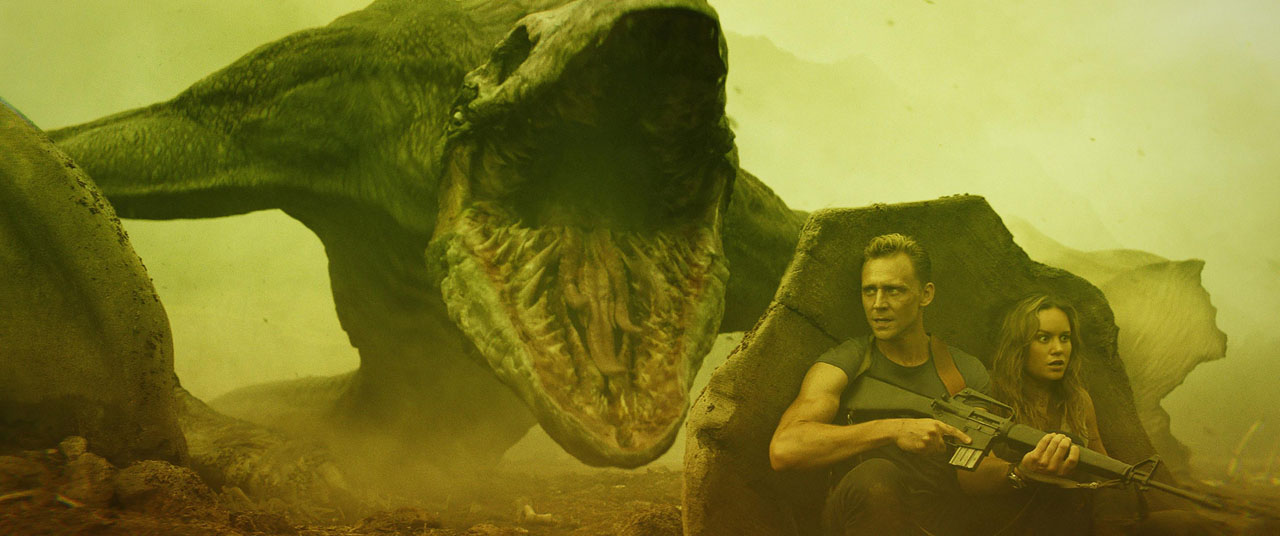
The best of these takes place in a smokey boneyard, where there is evidence of the carcasses of other Kong's and creatures littered across the landscape. The air is shrouded with a thick sickly-green mist...all the better for beasties to come lurching forward into sudden view in 3-D to make patrons jump out of their seats...as both are wont to do.
Skull Island has a bunch of weird creatures, odd enough you might see a Del Toro influence...either that, or the design staff kinda gave up. Sure, there's a skyscraper-tall spider (that's rather interesting), but there's also a thing called a Skull Crawler ("I never said that name out loud before, it sounds stupid now that I think about it. You call them whatever you want.") that's basically a big lizard that wears its bones on the outside. Then there's a monster that just appears nameless that resembles a walking tree-trunk. Okay, they saved some design-money there.
The puny humans do their best to hold things off, and then Kong stomps in and whups on them—that's the pattern for all the Kong movies since Merian C. Cooper directed the first one in 1933. But, again, the Del Toro influence is evident because a lot of the battle moves are straight out of Pacific Rim.
The director is one Jordan Vogt-Roberts, who has been mostly directing TV, but has one feature in his resume, 2013's The Kings of Summer, which is as far away from this as one could get. Vogt-Roberts has a rather straight-forward style, more dependent on art direction than direction, encourages comedy in the performance of the actors (except for his leads) and he has one odd quirk: he seems to be a techno-fetishist. No one can turn on a piece of equipment or flip a switch on anything electronic without it getting its own cutaway shot, a move that tends to halt the momentum of the story, and, after awhile, gets annoying. One wonders what the motivation for this is—it certainly isn't to enhance the story-telling.
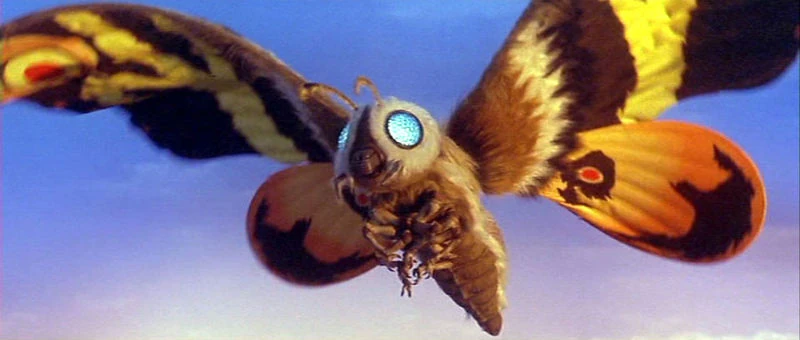
Entertaining, it is, if kinda dumb, and the Apocalypse connection is, simultaneously, inspired and derivative, exchanging Marlon Brando for a gorilla (at least the gorilla isn't babbling pretentiously). But, one quibbles at one's own risk when you face the fact that it's a movie about a flippin' giant monkey. One can't get too high-brow about this as the bar is so low. Instead, one should just be glad there's a spark of life in the thing—something you can't say about John Guillermin's 1976 version...or, most of them, for that matter. Previously, Kong movies were merely a showcase for technical FX advancements in the art of illusion. Now, in the CGI-verse, everything is on the same level pixelated playing field. We want more from our King. It will be interesting to see what they do with these things—a post-credit sequence promises a Godzilla/Kong mash-up (with hints of Mothra, Ghidrah (the three-headed monster), and Rodan). Thank God(zilla) they're not taking these things too seriously. That means I don't, either. Pass the banana-flavored popcorn.
"This is the end...."
* "Conrad" refers back to author Joseph Conrad, who wrote "Heart of Darkness" on which Apocalypse Now is based. Another character is named "Marlow" after the story's protagonist.
The producers promise a sequel of King Kong v. Godzilla.
 "The Lives That Pass Through a Horse"