Showing posts with label Richard Brooks. Show all posts

Thursday, October 27, 2022

In Cold Blood (1967)

In Cold Blood
(
Richard Brooks, 1967) The slaughter of the Clutter family of Holcomb, Kansas in 1959 by two random ex-cons was considered note-worthy—and shocking enough—that The New Yorker wanted to do a story about it. It was one of two story ideas offered to Truman Capote to write for the magazine. Capote's trip to Holcomb, accompanied by childhood friend Harper Lee, led to many interviews, 8,000 pages of notes and an escalating goal that Capote labored with until the publication of his book "In Cold Blood" seven years after the murders.* The publication became one of the best-selling books of the ghoulish genre and sparked debate over something that was called "New Journalism" where stories were written with the practices of fiction in mind, and what Capote, stoking his own embers, dubbed a "new art form, a nonfiction novel." Certainly it was different than a "just the facts, ma'am" account, but it was the first spurt in an increasingly lurid form of publication and presentation, where a moral center is replaced by an almost teasing glee for all the gory details. Just watch "Dateline" sometime ("Coming up, next...").
Richard Brooks, coming off the films Lord Jim and The Professionals, was reading drafts of Capote's novel, owing to their mutual friendship. Brooks bought the film rights for $400,000 and began the process of turning it into a film with an eye towards verisimilitude, noir theatrics, and, with the help of cinematographer
Conrad L. Hall, a look of neo-realism—as much as possible, the filmmakers tried to film in the actual locations, including the house where the multiple murders took place.
Perry Smith (
Robert Blake), newly released from prison, meets up with an old prison buddy Dick Hickox (Scott Wilson), who has word of "a big score" in Kansas, even though traveling there will break their paroles. Hickox has been told by another prisoner that $10,000 is being held in a safe by farmer Herbert Clutter, that prisoner's former employer. The film follows two parallel paths—of the day-to-day activities of the Clutters, and Smith and Hickox's travels up until the fateful night.
The next day, there's no answer at the Clutter household, but upon entering the house, a friend of one of the daughters' finds the family murdered. FBI Agents Alvin Dewey (
John Forsythe) and Roy Church (John Gallaudet) arrive at the scene, stunned that the murders took place, with no fingerprints and only bloody footprints at the scene. They reveal that Clutter never kept large sums of money at the house, only writing checks in his business.
The film then follows the investigation, while tracking the path of Hickox and Smith as they make their way to Mexico and then, running out of money, back to California and eventually to Kansas. As Dewey and Church follow leads, particularly one from Hickox's old prison pal, they are joined by a reporter Bill Jensen (Paul Stewart), as they talk to family members and try to follow disparate reports to try and track down the two ex-cons. Eventually, the two are arrested, stand trial and eventually executed.
The film, in wide-screen black and white, manages to fit into the genre of noir—the things Hall does with the monochrome textures is amazing, but even though the film strives for authenticity to the point of ghoulishness, there is still something just a little "off" in the way Brooks presents it. The angles are too showy, too precise, and except for a couple of shots, does not give you a "You Are There" quality ala neo-realism. It feels staged and artificial, rather than gritty and naturalistic.
The film is also a bit off-center morally, too. Although much time is spent with the Clutter family before the murders take place, and the investigators are shown as diligent and professional, where the most work on the film is in the depiction of the lives of Smith and Hickox. They're the ones given the most focus and I'm not going too far and saying that they're given the most sympathy, as well. No one tries to "explain" the Clutters. No one dives into the histories of the FBI men. But, the perpetrators, the murderers, are given long sequences showing their bad backgrounds and their dysfunctional parents. At least, Brooks rejected the original casting ideas for Smith and Hickox—Steve McQueen and Paul Newman. As it is, Brooks saw fit to cast the parts with two relatively unknown actors, who still managed to make the most of their roles.
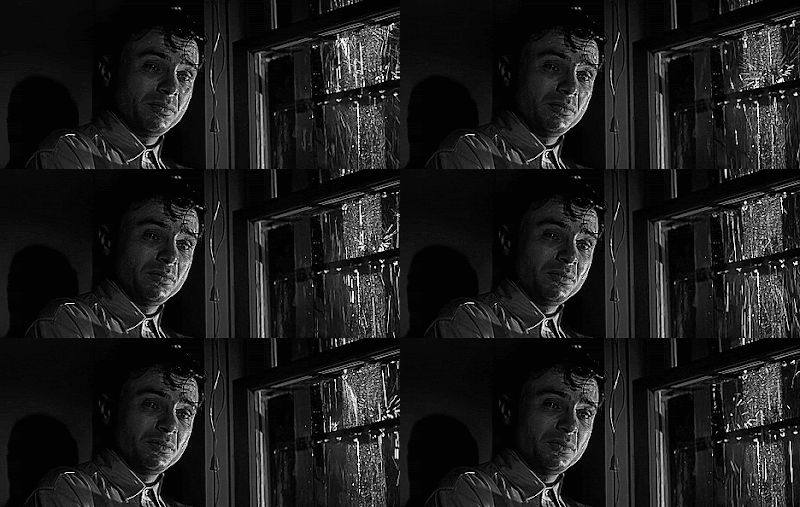
Conrad Hall's "lucky break" of the rain reflection.
 
Brooks saw the film as a damnation of capitol punishment, as it is. One cannot contemplate the title In Cold Blood without it reflecting both the killing of the Clutters and the state-sanctioned murders of those responsible. The death penalty's record of deterrence is only good for those that are killed, but looks mighty feeble when atrocities on the order of the ones by Hickox and Smith show up on the news every month when some wacko with a gun decides to make a name for himself (the choice of pronoun is deliberate—it's always a "him"). Bad guys should not be celebrities, no matter how low the bar for "celebrity" has sunk these days. And the justice system, built on politics, is so corrupt that one doesn't need "The Innocence Project" to speculate on how many innocent people have been killed in the name of justice. But, where's their justice? The system either works 100% of the time or we don't take actions that can't be taken back. Nobody is so infallible they can play God. That applies to good and bad alike.
 
In Cold Blood was voted into the National Film Registry in 2008.
Remembering the victims: the Clutter family

 * Two movies about Capote with the Holcomb murders serving as the centerpiece were made, as well. Capote and Infamous
.

Wednesday, April 28, 2021

Lord Jim (1965)

Lord Jim (Richard Brooks, 1965) Orson Welles wanted to make this Joseph Conrad story about a disgraced seaman out to prove his worth to himself and the world, and he wanted to do it with Charlton Heston—they'd talked about it while making Touch of Evil together and Welles was particularly taken with Heston's vouching for him during the turbulent making of that picture. That sort of loyalty is unusual in Hollywood and Welles must have thought Heston a good match...and good box-office. 

Conrad's novel had been adapted once before—by Victor Fleming in 1925—and Brooks optioned it in 1957. His clout with such classics as Cat on a Hot Tin Roof, Elmer Gantry, and Sweet Bird of Youth allowed him to make this one, which required extensive location shooting. Acquiring Peter O'Toole, hot after Lawrence of Arabia and Becket, allowed Brooks to acquire a $9 million budget, which ballooned the scope, and Lord Jim was designed as a "roadshow attraction," complete with Overture, Intermission, and Exit Music.
The story is narrated by Marlow (Jack Hawkins)—the same Marlow of Conrad's "Heart of Darkness"—as he relates the tale of young James Burke (Peter O'Toole) merchant seaman, young, enthusiastic, obedient, resourceful, who becomes Marlow's first officer before becoming injured and left to be treated in Java. 
His next assignment is less fortuitous: he's hired as first mate on board the rickety S.S. Patna, transporting—as the novel puts it—800 "pilgrims of an exacting belief," Muslims, to Mecca, when the ship hits a storm and has a collision on the Red Sea. Checking for damage, Jim sees that they're taking on water, and, telling the captain that they should get the passengers to the lifeboats, is surprised when the captain and other crewmen are more intent on saving themselves. The film makes it debatable whether Jim jumps in with them, or is washed onto the lifeboat is a squall, but the result is Jim is on the lifeboat, the Patna and its passengers, abandoned to their fate.
Making port, they find that the Patna, having survived the journey with the help of a French ship, has arrived before them. The Captain and the other crew disappear to escape the infamy for their actions, which, by now, has gotten around throughout the port, but Jim insists on a trial to atone for his abandoning ship, and he is roundly condemned, stripped of his sailing papers, the chief judge telling him that, instead of an inquiry, he should have just buried "himself 20 feet deep."
Jim does the next best thing, becoming a drifter from port to port, losing himself and running away from his shame in anonymity. An incident where he saves a skiff loaded with beer and gunpowder from exploding in the harbor attracts the attention of a Mr. Stein (Paul Lukas), who just happened to be receiving that gun-powder. It's destined to be shipped to Patusan where the people, led by Stein's friend Du-Ramin (Tatsuo Saitō) are trying to defend themselves from a warlord, "The General" (Eli Wallach), and Stein hires Jim to accompany the shipment to make sure it reaches its destination, there having been some sabotage in the past.

There are attempts made on the journey, as the weaselly Cornelius (Curt Jurgens)—who used to work for Stein as his representative before he was caught skimming supplies—now is aiding "The General" in his attempts to overthrow the natives. Jim hides the cargo, but is captured, and although tortured for the information, does not reveal where it's hidden.
Jim is rescued by "The Girl" (Daliah Lavi)—in the book, her name is Jewell, but the movie doesn't even give her character a name!—and Jim leads the Patusans to the supplies and launch an attack on The General, killing everyone but Cornelius. Jim is welcomed by his fellow combatants and given the title "tuan" by the Chief, which means "Lord."

Intermission.
If you want a happy ending that would be where you ended it. If you wanted a happy audience you might have ended it there, as well. Reportedly (and this may be apocryphal) it was at this point at the London premier that James Mason's parents were so bored by the picture, they left, completely missing their son's performance in Part II. Maybe a bit impatient, but one does get the impression that Lord Jim will never end, so elongated and detailed is the film, with sequences running a trifle indulgently, and every line of dialogue treated as if it were precious. This becomes readily apparent after the Intermission.
Jim stays in Patusan, beloved by the people and The Girl. Unbeknownst to him, Cornelius and Schomberg have brought in the cut-throat pirate "Gentleman" Duncan Brown (James Mason)—"he's given more business to Death than the Bubonic Plague"—to raid the village of its treasures, and although their attempts fail, Jim negotiates with the blackguards that they may leave if they never return again. The villagers and Du-Ramin argue for attacking the pirates, but Jim wants no conflict and vows to the chief that if anyone dies because of his mercy, that he will sacrifice his own life in forfeit.
So, Jim trusts the pirates to just go away, huh? He also sets up contingency plans that, should the pirates attack, the natives can fight them back. Meanwhile, Jim looks moony and talks about the position he is in, given his second chance: "I've been a so-called coward and a so-called hero and there's not the thickness of a sheet of paper between them. Maybe cowards and heroes are just ordinary men who, for a split second, do something out of the ordinary. That's all." But, there is a great deal of difference between a romantic idealist and a conscienceless pragmatist, and Jim frustratingly never finds a middle ground. If you wanted a happy ending, you should have taken a cue from James Mason's parents and left at intermission.
It is a long tedious slog to come to that conclusion and although some of the dialog in the second part crackles with cynical brio and Mason's performance is worth watching, one has to spend so much time with O'Toole's doubting Jim—trying ever-so-hard to bring some internal depth to this character that you get stymied by the dependence on the fragile blue eyes shining out of the screen without any of the nuance or creativity the actor brought to his previous performances—that, ultimately, you lose faith in Jim, O'Toole, and the movie.

Brooks is no help here. His staging is perfunctory, whether in Cambodia or Shepperton Studios in Surrey and the one interesting shot is in the beginning with a weirdly evocative shot of a "lost soul"—which Jim could have become—walking like a zombie along a Malaysian pier. One wishes that same sort of frisson could have shown up a bit more...or ever...but it's just a tantalizing moment in a film so confident in its ambitions that it never tries to achieve them.

Thursday, April 9, 2020

The Professionals

The Professionals (Richard Brooks, 1966) In this post-modern Western (post-A Fistful of Dollars and pre-The Wild Bunch), a ranching tycoon (Ralph Bellamy) hires three soldiers-of-fortune, late of the Mexican Revolution, to rescue his wife Maria (Claudia Cardinale), who has been kidnapped by a Mexican revolutionary-turned-bandit, Jesus Raza (Jack Palance), the ransom being $100,000. The wages are $10,000 per man for a 9 day job. The three are Henry "Rico" Fardan (Lee Marvin), Jake Sharp (Woody Strode) and Hans Ehrengard (Robert Ryan), all with different skill-sets and temperaments, for a job that will require stealth, intricate planning, and an assault on an extremely well-guarded encampment deep in Mexico.

Fardan is a weapons expert, Sharp, a former Apache scout and expert with a bow, silent and precise, while Ehrengard is a horse wrangler, with a regard for his charges, more than he does for human beings. 

There's just one man missing: Bill Dolworth (Burt Lancaster), explosives expert. Fardan wants him for that expertise, but also because he and Dolworth rode with Pancho Villa during the Revolution, alongside Raza. But, sentimentality aside, they've been hired for a job and will ride against their former band-mate, and their history with him may prove valuable in the task. It's a job, pure and simple. It won't remain either.
The four start tracking Raza's gang to get a sense of tactics and escape routes. Dolworth sets up explosives in a particularly tight cliff-pass for their end-game, that can be abetted by a train route, the government transport which they spy Raza's men commandeering, while slaughtering all of the Mexican troops on-board. The small troop of professionals don't interfere and Ehrengard is aghast, but Dolworth explains that those troops were dangerous cut-throats who had been responsible for the destruction of a village, killing Fardan's wife in the process.
But, the train will making a handy means of escape to the mountains after the attack on Raza's encampment, so the four take on Raza's men and take it over. Now, they have a quick way to retreat. But now, the tough part begins: an assault on Raza's stronghold under cover of darkness and try to take Maria back. Ehrengard stays behind with the train while Fardan, Dolworth and Sharp continue the rest of the way, three men against a well-armed fortress.
Raza's place is scouted, the sentries timed, dynamite placed, the two biggest targets being a water tower and a machine-gun placement. For Fardan and Dolworth, it's set and forget, giving them an opportunity to get to the area where Maria is being kept, while Sharp—with arrows tricked up with dynamite—provides cover and distraction. Dolworth has the explosives on timed fuses, so there will be ample explosions to send Raza's men scurrying, with Sharp given the opportunity to improvise.
But, when professionals plan, God laughs. There's always got to be a surprise and The Professionals turns on a single phrase: "We've been had, amigo..." Their mission turns out out to be made on a false premise, and it's then that the four have to make decisions of conscience, for which the time in the revolution has provided ample experience. "Maybe there's only one revolution since the beginning: the good guys versus the bad guys. Trouble is, who are the good guys?" And can good guys do inherently good, even when their job is bad...
Oh, and since they have the woman, they have to find a way to get her back...and stay alive while doing so. It won't be made any easier by the fact that the train they have in waiting has been taken back by Garza's men, who have taken Ehrengard hostage...and they're not interested in any ransom—but maybe a trade will do. Maybe.
Brooks' film (based on Frank O'Rourke's "A Mule for the Marquesa") is a nifty little variation on John Ford's The Searchers, but has nothing to do with that film's underlying motivation of family cohesion and race hatred or hysteria. Here, it's all business that sets the search in motion, not family, and in the course of the film, it happens to turn that film's premise on its ear. Things are done for convenience, things are done for commerce, things are done for compromise. There's no passion here, it's a transaction. But, passion wins out in the end.
It's another of those macho films with a woman at the center of it, and its focus—even when Cardinale's Maria isn't on the screen, the characters are always pondering "What makes a woman worth $100,000?" It finally succumbs to a rough-hided romanticism, as if any of the characters would admit to it (which they wouldn't as their credo is usually demonstrated by actions and not words) that might be revolutionary echoes or merely respect. The dialog does get a little too philosophical in intent, but it does have one heck of a clever come-back at the end. And it's an entertaining ride.


There'll be another of the Western genre's "Searchers spin-off's" next week.

Thursday, July 6, 2017

Battle Circus

Battle Circus (Richard Brooks, 1953) You don't get very far along in Battle Circus before you realize that it is actually, basically M*A*S*H (the 1970 movie, the novel it was based on, and, ultimately, the television series based on it), but without the 1960's counter-culture sensibility of the Robert Altman film. As the P.A. announcements would say "Follow the exploits of some zany Mobile Army Surgeons, cutting up and cutting loose, laughing and loving their way through Korea, dodging bombs and commitments, while passing the penicillin and morphine, but not the 'Mary-Jane.' That is all" (and that last part would be "Bogarting"). 
 
There's even a little flaunting of authority to go along the way, what with Humphrey Bogart as a less-than-regular-Army surgeon, who takes a lot of pride in his meatball-surgery but not a lot of guff from the higher-in-rank. You could almost imagine Richard Hooker, Ring Lardner, jr. and Larry Gelbart writing this stuff, if not, in fact, being inspired from it. It's like there's a pool of Korean War Army hospital stories that everybody is drawing from.
But, Battle Circus came first, and was in production while the war was still going on. Focusing on the arrival of Nurse Lt. Ruth McGara (June Allyson) to the MASH 8666 unit near the front lines, she has to learn her way through the no-better-than-camping conditions, the closeness of the battles, the harrowing work on wounded soldiers on a seemingly endless supply being choppered in, and the "bailing-wire-and-spit" resourcefulness of the unit in tending to the wounded but also the Korean villages caught in the cross-fire.

Then, there's the relations in the camp. Nerves are frayed, but the only way to cure those are to drown them in alcohol. Chief among those patients is Chief Surgeon Maj. Jed Webbe (Bogart), meticulous in the OR but erratic anywhere else. Warned of his tendency to think of breaking hearts as minor surgery, McGara keeps him at scalpel's length. But Webbe, being a brilliant surgeon, has a way of getting under your skin.
When one of the village children is in need of a delicate open heart surgery, she entreats the Camp Commander, Lt. Col. Hilary Walters (Robert Keith) who refuses, due to the man-hours and supplies such a procedure would drain on the already strapped base. But, Webbe knows his way around a heart and goes against the rules and performs the surgery anyway, despite the consequences, winning McGara's regard...and her own heart.
Webbe has a way of going against the grain. When blood supplies are needed at a nearby outpost, he convinces their chief helicopter pilot (William Campbell) to risk taking him there during a bad storm, barely making it, and when they return, going on a bender that Walters tells him it may be the last straw, threatening his career in the Army and probably stateside unless he sobers up. Good thing he stays, because at some point, the colonel takes a bullet, and Webbe has to take command, in a particularly hazardous re-deployment to another site (with some pretty tricky jeep maneuvers down precipitous hills that are done for real, no dummies, and the slipperiest of brakes).
So, who's "Radar?" That would be Keenan Wynn's Sgt. Orvill Statt (nice name in a hospital), loyal, unquestioning, and extraordinarily gifted in the "mother-of-inventions" department. He makes the camp work, seemingly by himself, and if you need a jeep repaired, a route planned, a supply filled, or an orderly on stand-by, he's your man.
Nurse McGara has a tough time adjusting to the craziness, but when a North Korean prisoner is being operated on and pulls a grenade (I think that was on the TV series at least twice), she's able to be disarming, earning the company's respect...and a scar...for her efforts. She wins her stripes in the community, if not from the Army. And it makes the flirtatious banter between Allyson (who's quite good, although I've always found a bit creepy) and Bogart (never one for too light a touch, but who acquits himself well) turn more serious as ties bind and wounds heal.
Richard Brooks wrote and directed Battle Circus from a story by Allen Rivkin and Laura Kerr and Bogart was attracted to the mixture of drama, action, romance and comedy. But, he wasn't entirely happy with the result, falling out with the director with whom he made Deadline-U.S.A. Perhaps it's because Brooks has mostly been a very deliberate, even heavy-handed, director, who, when he sets out to make a joke, does so without much subtlety, and was always more successful when it was sub-text rather than front and center. His subject matter could be controversial and boundary-pushing, but his approach to it rarely was. He was good at action (as movies like The Professionals and Bite the Bullet proved), but seemed to think little of it, aspiring to bigger (and big "I" important) themes that he pushed all too leadenly. Richard Brooks could be quite good, but rarely great. It's why Battle Circus is largely forgotten, while M*A*S*H stole the play-book, and lingers on.

Saturday, May 16, 2015

The Last Hunt

The Last Hunt (Richard Brooks, 1956) Writer-director Brooks followed up his urban drama Blackboard Jungle with this film far afield of JD's and ghetto schools, out into the wide open spaces. But people are still being buffaloed.

Stewart Granger plays Sandy McKenzie, a hunter sick of killing and looking to get out and do something else. He's approached by Charlie Gilson (Robert Taylor) with a business proposition—going into the buffalo pelt business. It's too tempting for the expert marksman (he has a sight on his rifle) to pass up. The beasts are a renewable resource, after all, and their hides bring in a sizable profit from the trading companies, guaranteeing that Sandy can retire. And they're so plentiful on the plains, the volume of them will make a quick killing in greenbacks, and they'll make a fine trading material for the natives to provide food, horses and supplies. There's no down-side. The two set out with the company of leathery skinner Woodfoot (Lloyd Nolan, given a chance to play something beyond his dependable world-weary professional) and half-native apprentice Jimmy O'Brien (Russ Tamblyn, whiter than white) to the wilds of what-will-soon-be South Dakota to make a considerable killing. 
Things go well for awhile.  It becomes a competition between the two hunters over who can drop the most beasts. And Gilson isn't content until he has wiped out entire herds. The movie encapsulates the wholesale slaughter of what used to constitute rivers of beef across the plains—an example of the profilgate short-sightedness of the western expansion, of the desire to make a fast buck, even while littering the landscape with corpses.
But the competitiveness turns to needling, more than knives get under skins, and the two hunters begin bickering, Gilson riding McKenzie and the other keeping his own simmering counsel. It's clear their motivations are incompatible. Things come to a head when Gilson's personal ambitions run afoul of anybody but himself to an increasing degree, first irritating Gilson by killing a local hunting party—he doesn't like the competition—and taking possession of the surviving woman (Debra Paget, whiter than white) and her son, and then horrifying the local natives by taking down and skinning a white buffalo, sacred to the tribe. 
Granger is properly (and typically, for his roles) stalwart, but Taylor gets the rare opportunity to play a genuine asshole, a portrayal he seems to relish as it's done with more energy than he exhibited in his more heroic roles in such films as Quo Vadis?, Ivanhoe, and Knights of the Round Table. He certainly doesn't try to hedge his character's avarice by trying to make him in any way sympathetic. It's also good to see Lloyd Nolan in a character part of some distance from his crusty, trusty Irishman (at least he's not cast as Native). It's Brooks at his best (despite the casting compromises), bringing a subtle message underneath the black and white morality on the surface.
Debra Paget's "Native Girl" doesn't even have a name.