Showing posts with label Will Geer. Show all posts

Thursday, October 27, 2022

In Cold Blood (1967)

In Cold Blood
(
Richard Brooks, 1967) The slaughter of the Clutter family of Holcomb, Kansas in 1959 by two random ex-cons was considered note-worthy—and shocking enough—that The New Yorker wanted to do a story about it. It was one of two story ideas offered to Truman Capote to write for the magazine. Capote's trip to Holcomb, accompanied by childhood friend Harper Lee, led to many interviews, 8,000 pages of notes and an escalating goal that Capote labored with until the publication of his book "In Cold Blood" seven years after the murders.* The publication became one of the best-selling books of the ghoulish genre and sparked debate over something that was called "New Journalism" where stories were written with the practices of fiction in mind, and what Capote, stoking his own embers, dubbed a "new art form, a nonfiction novel." Certainly it was different than a "just the facts, ma'am" account, but it was the first spurt in an increasingly lurid form of publication and presentation, where a moral center is replaced by an almost teasing glee for all the gory details. Just watch "Dateline" sometime ("Coming up, next...").
Richard Brooks, coming off the films Lord Jim and The Professionals, was reading drafts of Capote's novel, owing to their mutual friendship. Brooks bought the film rights for $400,000 and began the process of turning it into a film with an eye towards verisimilitude, noir theatrics, and, with the help of cinematographer
Conrad L. Hall, a look of neo-realism—as much as possible, the filmmakers tried to film in the actual locations, including the house where the multiple murders took place.
Perry Smith (
Robert Blake), newly released from prison, meets up with an old prison buddy Dick Hickox (Scott Wilson), who has word of "a big score" in Kansas, even though traveling there will break their paroles. Hickox has been told by another prisoner that $10,000 is being held in a safe by farmer Herbert Clutter, that prisoner's former employer. The film follows two parallel paths—of the day-to-day activities of the Clutters, and Smith and Hickox's travels up until the fateful night.
The next day, there's no answer at the Clutter household, but upon entering the house, a friend of one of the daughters' finds the family murdered. FBI Agents Alvin Dewey (
John Forsythe) and Roy Church (John Gallaudet) arrive at the scene, stunned that the murders took place, with no fingerprints and only bloody footprints at the scene. They reveal that Clutter never kept large sums of money at the house, only writing checks in his business.
The film then follows the investigation, while tracking the path of Hickox and Smith as they make their way to Mexico and then, running out of money, back to California and eventually to Kansas. As Dewey and Church follow leads, particularly one from Hickox's old prison pal, they are joined by a reporter Bill Jensen (Paul Stewart), as they talk to family members and try to follow disparate reports to try and track down the two ex-cons. Eventually, the two are arrested, stand trial and eventually executed.
The film, in wide-screen black and white, manages to fit into the genre of noir—the things Hall does with the monochrome textures is amazing, but even though the film strives for authenticity to the point of ghoulishness, there is still something just a little "off" in the way Brooks presents it. The angles are too showy, too precise, and except for a couple of shots, does not give you a "You Are There" quality ala neo-realism. It feels staged and artificial, rather than gritty and naturalistic.
The film is also a bit off-center morally, too. Although much time is spent with the Clutter family before the murders take place, and the investigators are shown as diligent and professional, where the most work on the film is in the depiction of the lives of Smith and Hickox. They're the ones given the most focus and I'm not going too far and saying that they're given the most sympathy, as well. No one tries to "explain" the Clutters. No one dives into the histories of the FBI men. But, the perpetrators, the murderers, are given long sequences showing their bad backgrounds and their dysfunctional parents. At least, Brooks rejected the original casting ideas for Smith and Hickox—Steve McQueen and Paul Newman. As it is, Brooks saw fit to cast the parts with two relatively unknown actors, who still managed to make the most of their roles.
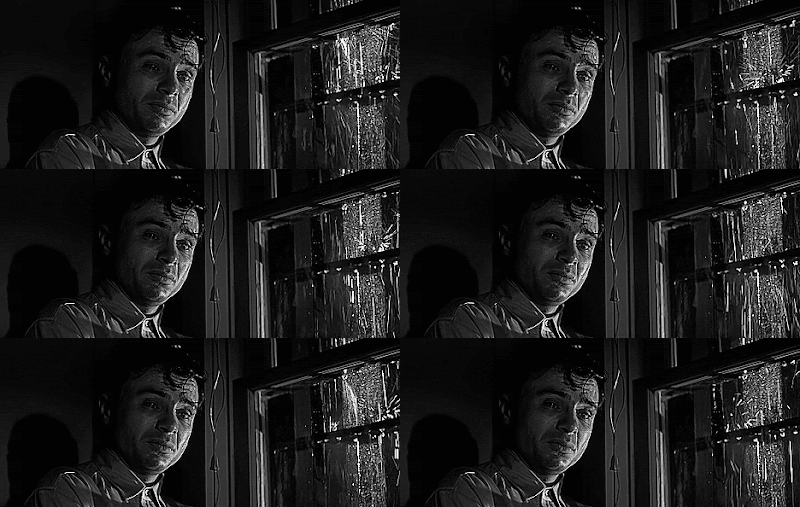
Conrad Hall's "lucky break" of the rain reflection.
 
Brooks saw the film as a damnation of capitol punishment, as it is. One cannot contemplate the title In Cold Blood without it reflecting both the killing of the Clutters and the state-sanctioned murders of those responsible. The death penalty's record of deterrence is only good for those that are killed, but looks mighty feeble when atrocities on the order of the ones by Hickox and Smith show up on the news every month when some wacko with a gun decides to make a name for himself (the choice of pronoun is deliberate—it's always a "him"). Bad guys should not be celebrities, no matter how low the bar for "celebrity" has sunk these days. And the justice system, built on politics, is so corrupt that one doesn't need "The Innocence Project" to speculate on how many innocent people have been killed in the name of justice. But, where's their justice? The system either works 100% of the time or we don't take actions that can't be taken back. Nobody is so infallible they can play God. That applies to good and bad alike.
 
In Cold Blood was voted into the National Film Registry in 2008.
Remembering the victims: the Clutter family

 * Two movies about Capote with the Holcomb murders serving as the centerpiece were made, as well. Capote and Infamous
.

Saturday, July 11, 2020

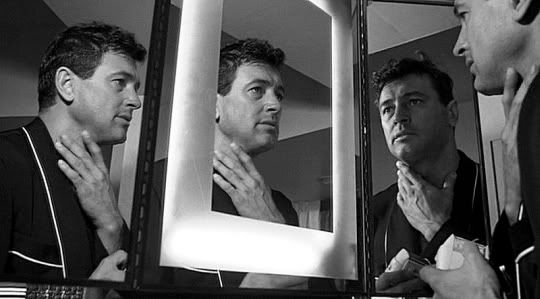
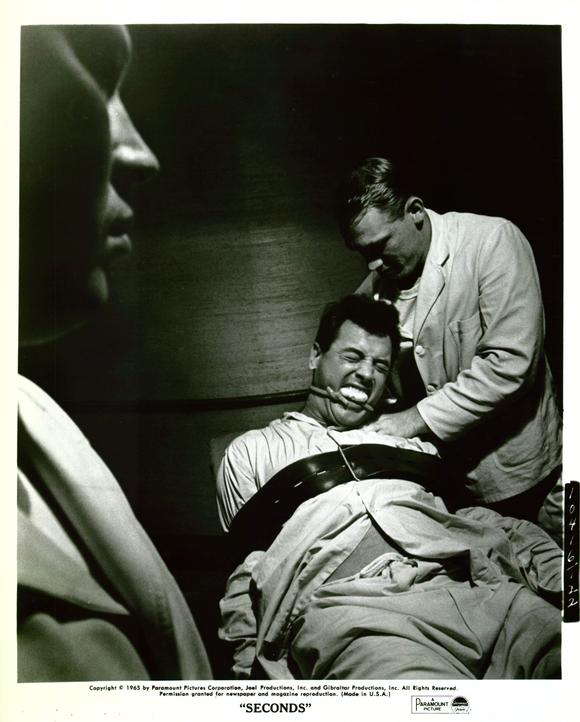
Seconds

Seconds (John Frankenheimer, 1966) Post "Star Wars," science fiction films have been pretty cookie-cutter—fleet-ships, a Hero with a Thousand Names, odd plasticized bi-ped creatures in supporting roles and quests that somehow or other usually get around to revenge. Even the "new" can become old hat.

Science Fiction used to be about concepts, and technology was just an aspect of futurism. For all the newly-conceptualized metal and plastic and wires and blinking lights, it is the organic that has to contend with the changes and evolution just can't keep up with the advancement of tools (especially when they're eventually turned into weapons). Who or what is being served? How does one adjust...if one adjusts? That's why to see Seconds is still a thrilling experience, as it calls to mind a feature-length, subtler "Twilight Zone" episode, that takes an idea and turns it around in its hand, exploring the angles...and the consequences.*
Bank executive Arthur Hamilton (John Randolph) is receiving mysterious phone-calls from someone who claims to be an old friend but doesn't sound like him. A note is slipped into his hand as he enters the subway, and upon further exploration (and prompting) learns that he is being offered a second chance in life. The anonymous corporation will transform him with plastic surgery (even replacing his finger-prints) and an exercise regimen, while setting up a planned "accident" with an unrecognizable "similar body-type" to explain his absence. To the world, he will die, but he'll be resurrected as a new man, with a new life, in a new community—everything re-arranged neatly and clinically. From the ashes of Arthur Hamilton will emerge Hamilton 2.0, Antiochus Wilson (Rock Hudson), bohemian painter. "Wilson" makes a go of his second chance, but he's still the man he used to be inside, and he struggles internally with his new choices...and the ones he left behind. Changing his mind becomes the greatest challenge.
Filmed in black and white—this film would have been over-powering and kinda ugly in color—by the master cinematographer James Wong Howe (with assistance by John A. Alonzo), Seconds is filmed in disorienting tight close-ups, and with unnerving wide-angle lenses that contort, bend and mold the right-angles of life into constricting prisons. The helter-skelter editing of David Newhouse and Ferris Webster keeps the viewer from becoming complacent, and Jerry Goldsmith's bizarre discomfiting score only adds to the unease. This is Hudson's best role—if you're like me and aren't into rom-com's—and his best movie. But it's contradictorily a one-sided performance—there's not an awful lot of joy (I think that may be the point), and he's unsure, disoriented or drunk throughout most of it. And, as Frankenheimer says in his commentary, he really worked hard in this role...especially towards the end.
One should also be aware that in one scene in the corporation's stark "briefing room," the cast is comprised of Randolph, Will Geer (he's especially creepy in this role, while being his most benevolent) and Jeff Corey—all "brethren" in the secret society of blacklisted actors.
This version of Seconds is not the one released in the States in 1966. A disorienting wine-making festival sequence with pre-hippie free-thinkers orgiastically stomping grapes in the buff was deemed too risque for its release (and Hudson wasn't comfortable with the sequence, as is evident in his performance), but it has been restored for the DVD release.

It's still an affecting film, even now, over 40 years later, a cautionary time-capsule of that era when the concerns of the speculative writer was society and not space-ships. Sometimes, fantasies have a nasty habit of becoming nightmares.

Saul Bass' disorienting Title Sequence gets you in the mood.
* Director Frankenheimer worked in the Golden Age of Live Television and worked with Rod Serling, pre-TZ, and post-TZ—Serling wrote the script for Frankenheimer's Seven Days in May.

Wednesday, May 10, 2017

Winchester '73

Winchester '73 (Anthony Mann, 1950) One in a thousand. That's how many perfect Winchester rifles were produced. One in a thousand so perfect of bore and rifling that a man using it need not compensate for anything except that thrown at him by God. Men would fight for one. Men would kill for one. And the Winchester '73 that Lin McAdam (James Stewart) wins in a marksman's contest probably ends up a little less than perfect as it goes from hand to hand, and is even used as a shield and a club in the long circuitous route of the movie. But, as the repeating rifle has become the difference between life and death in the heady days after Little Big-Horn, the Winchester is the weapon of advantage in skirmishes on the plains.

The first of five westerns Stewart made with Anthony Mann in the 1950's that deepened and darkened the Stewart persona from the "aw, shucks" townie to a complex, psychologically challenged character who could be pushed to undisciplined anarchy, Winchester '73 has more going on in it than most of the other Stewart-Mann films, which had more straight-forward story-telling through lines. This one is practically episodic, as McAdam and fellow-traveler "High-Spade" (the terrific Millard Mitchell*) start in Dodge City with run-ins with Wyatt Earp (Will Geer, before the blacklist got him), Bat Masterson and a stranger-in-town named Dutch Henry Brown (Stephen McNally) before winning the perfect Winchester in a shooting match.

He doesn't have it for long as the stranger beats McAdam up and steals it from him. From there, it falls into the hands of an unscrupulous Indian trader (John McIntire), a Sioux warrior (Rock Hudson--you read that right), briefly in the hands of horse-soldiers Jay C. Flippen and Anthony—soon to be Tony—Curtis), then to an untrustworthy homesteader (Charles Drake) and finally, the possession of desperado Dan Duryea. Quite the cast (where's Harry Morgan?), and add in Shelley Winters as the saloon-girl trying to make good, and even if you didn't have Mann's steady hand with action, you'd have a movie full of good character parts.
Duryea is at his hipster best, playing an outlaw determined to out-laugh all of his opponents, McIntire is nicely droll as the Indian giver/trader, and Shelley Winters gives off an "I'll deal" vibe that endears you to her immediately. In one of the little authentic touches Mann inserts to show how rough the West really was, Winters nearly bounces off a buck-board dangerously careening through the desert, and when McAdam hesitates when giving her a gun to defend herself during a Native attack, she gives him a toothy grin and says, "I understand what the last one's for..." I want that girl on my side.
It is capped with a mountain shoot-out between old-antagonists-with-a-past McAdam and Brown that is a primer for any action director to clue an audience to the strategies and complications that a fight for advantage in the mountains can entail. Add to that Mann's experiments with light in landscape that were far outside and past the urban noir settings he had bathed in shadow and slivers of light in the post-war 40's.
But in the same year as Stewart and Delmer Daves dared make a western that showed the First Peoples' side of things (Broken Arrow), Mann and Stewart** (and Stewart and other directors) began a decade-long exploration of the cracks in Western civilization's veneer that showed the fragility of the individual—how, in a so-called "decent" society, there's only an angel's breath of morality distinguishing a maverick and a psychopath. Everyone can be pushed over the edge. And the only advantage is how many rounds you can fire off before the other guy feels the first one. The repeating fire-arm was the great leveler when it came to fighting. But it was also what prevented letting cooler heads prevail. Cooler heads don't have a chance against hot lead fired by a cold heart. It's how the West was taken...and still is. The chances of surviving it to build something decent?

Probably one in a thousand.


* Mitchell has a great stoved-in character face and a likable self-deprecating manner that are also on display in one of his other prominent movie roles-in Singin' in the Rain. He died in 1952.

** One of the joys of the current DVD version of Winchester '73 is a rare commentary track by the elderly Stewart who goes into detail about the filming and his working relationship with Mann and the other actors. It's done without the "Stewart persona"--he's just watching the film and answering questions--but at the end, you can't help but smile when he blurts "Ya know, I'm just really impressed with this laser-thing."

Tuesday, October 6, 2015

It's a Small World (1950)

It's a Small World (William Castle, 1950) Having nothing to do with Disney or animatronic children, this is, instead, an exploitation film directed by William Castle, who, a few years later, would be directing exploitative horror films that would be presented with outrageous in-theater gimmicks.

The gimmick here is the star, Paul Dale (real name: Dale Paullin from Iowa and still alive, thanks), who was, in the old politically-incorrect parlance, a midget, but is now called (in the phrase I still see as demeaning) "a little person."* It is (as the poster tag puts it) "the amazing story of a man forced to live in a child's world." Well, not in a child's world per se. But, in an adult world perceiving him as a child and all that that entails, in ways both exploitative and marginalizing. And in an ironic way, the movie shows that his world isn't small, but people's perceptions of him (in their own small minds) are.
When most kids are going through "growth spurts," Harry Musk is left behind. He keeps anticipating when he's going to catch up to everybody else but it never happens. His father (Will Geer) is a simple farmer and shelters Harry from the vagaries of the "normal" world that entails the kids at school beating him up for being a "shrimp," his own sister outpacing him in the growth department (and bitching that she can't bring friends around because Harry's such a freak). The one friend Harry has is Janie who becomes his friend at 8, and grows up and out of his life. Harry is crushed.
Because of the sister thing and because Harry isn't much help around the farm, when he turns 21, he decides to go out and make his way in the world by offering his services as a "little person" to a promoter. The guy wants him for carnies and things like that and for Harry it's a chance to be useful and... somebody wants him. But when the guy turns out to be an exploitative creep, Harry runs away. He makes his way to a nearby town, where a gal appears interested in him...but ultimately not in that way. Then, he starts working as a shoeshine boy, and for awhile he seems content.
Perhaps the best term to use for Harry Musk is "disenfranchised." Nobody sees him for who he is, but for what he is...and what most see is how they can con him or make a buck from him. It's only in the film's third act that he finds a full measure of happiness and that is in a segregated community of "outsiders."

This one showed up on the cusp of the '50's, where folks were still reeling from a devastating war and pushing hard to return to "normal." But, "normal" is not the same to everybody. The decade roiled with a fallback to earlier prejudices and tribal suspicions. Now that we didn't have to pull together, it was safe splinter back into groups of "us" and "them." In its own weird way It's a Small World is a plea for tolerance, knowing that the world will come up short and that the only recourse is to fall back into the familiar tribe. The larger world can be a despicable place, but there are pockets of comfort...no matter how small.


*"Heighth-challenged" is another one that is "politically correct" but feels very wrong and makes me shudder, accentuating a negative and pointing out what is "wrong" in comparison to "the normal." Well, what's normal? My version would be to use (if I had to) the merchandising term—"fun-size." Or how about "compact?" Better yet...don't mention it at all.