Showing posts with label James Stewart. Show all posts

Wednesday, January 22, 2025

The Philadelphia Story

The Philadelphia Story
(George Cukor, 1940) "The prettiest sight in this fine pretty world is the privileged class enjoying its privileges
."
 
So says Macauley "Mike" Connor (James Stewart), cynical reporter with romantic notions about nobody but himself, as he and photographer "Liz" Imbrie (Ruth Hussey) are given the enviable task of reporting on the biggest marriage event of the season—or should we say "re-marriage season"—the Lord-Kittridge affair, she of the Philadelphia Lords, Tracy Samantha Lord (Katharine Hepburn), to be precise—formerly married to one C.K. Dexter Haven (Cary Grant), an upper class yacht designer—and for her second go-'round, she is marrying George Kittridge (John Howard), a "man of the people" who raised himself from the lower classes to achieve parity (without the legacy or provenance, mind you) of the Main Line of Philadelphia. Newsies Mike and Liz are given permission to "witness" the impending nuptials for a gossip rag (under the subterfuge that they're "distant relatives"), as an arrangement that said tabloid won't be publishing lurid stories about Tracy's father (John Halliday) having an affair with a dancer (of all people). This tit-for-tat has been arranged by a former runner for the mag, that personage being one...C.K. Dexter Haven, the ex (if you'll recall) of the bride-that-was and is to-be. How gauche it all is. How lurid. How delightfully sordid.
The Lord's are trying to manage this hullabaloo without much ballyhoo, thus their agreeing to the limited press coverage. But, they're not going to make it easy for them, no sir. Tracy is determined—with the help of precocious sister Dinah (Virginia Weidler)—to put up a discouraging wall of "airs", acting all hoity-toity...which is just what reporter Connor expects them to be. Tracy sees through their subterfuge just as easily as photographer Liz sees though theirs—just as she also sees through Connor's contempt for them (he protests a bit too much). As a photog' she seems to "read" people better than Connor, which is why she's biding her time with her colleague. She's in love with him, not that he'd ever stop concentrating on himself and his deathless prose to notice.
C.K. is also inserting himself into the affair, much to the delight of the Lords and to the dismay of his ex, Tracy. Their marriage broke up a couple years previously because, as an alcoholic, he did not measure up to her high standards. Tracy is a bit judgey as a rule, and decisively so, which led to tossing Dexter out ("She's generous to a fault" he says, "except for other people's faults") as well as the ostracism of her father from the family (His opinion of her: "You have everything it takes to make a lovely woman except the one essential: an understanding heart. And without that, you might just as well be made of bronze." That one hurts).
Tracy is all too aware of the criticism ("
Oh, we're going to talk about me again, are we? Goody."), but she is absolutely sure of her paragoness—reflecting well on the parents as it may have begun, but it has rigored into an expectation that anyone in her orbit should be beholden to the same courtesy. Her stubbornness is so ram-rod straight that it has appeared to reach her spine, as evidenced by her switch-blade dives into pools or even—in the oft-replayed silent opening sequence—when she's face-palmed back into her own home after kicking out Grant's Dexter Haven. It's amazing that she can be so stiff while performing the herculean task of having one's head up their ass.
She may have grown up, but she's still her parents' child—not that that's their fault. She's just stuck in her dutiful child-role despite long having passed its maturity date. Now, even her parents are annoyed with it (by contrast, youngest daughter Dinah—played by the incomparable
Weidler—seems to have skipped her childhood to become Thelma Ritter) and wish that "the phase she's going through" was over.
But, it's unlikely, even on the eve of the second of her how-many-future-marriages. The first one didn't work out because from her lofty perch, the faults, owing to his drinking, were all on him. This second has a much-better-manufactured future husband so she glides in with confidence, secure that Kittridge is just as stalwart and inflexible as her own reflection of herself—she's found her spine-mate.
Tracy emerges from a drunken night into the light of a new day
—and reacts to it like a vampire.
But, after a night of pre-wedding jitters—no doubt brought on by her being unable to cope with the intricate machinations of "everything is going according to plan" while confronting the failures of others in her past (like Dexter Haven and her prodigal father, who both have the temerity to judge her ("I'm going crazy. I'm standing here solidly on my own two hands and going crazy!")—she ends up drunk and with the appearance of being in a compromising position and in the vulnerable position of seeing herself being judged rather than judging. 
And despite rapt descriptions of her as a "marvelous distant queen" or "the golden girl," this paragon of taste, breeding and virtue who could walk into any room and do so with style can never manage to do it with "grace"
, and when her weak night of drinking has her stumbling through what feels like a "perp walk" under scrutiny, she learns a little of what she's been dishing out...and doesn't like the taste of it. But, you can't have a hangover without some shame in the mix. And despite the bleery eyes, she starts to see things more clearly.
This was Hepburn's project—she'd been labeled "box-office poison" after films like Mary of Scotland and Bringing Up Baby and Holiday bombed (despite the last two eventually gaining reputations of being cinema classics for decades) and helped writer Philip Barry to create it and make it a hit on Broadway. Then, as she owned the rights to it, she personally took it to M-G-M and its head, Louis B. Mayer, to have it made with the director of her choosing (Cukor) and maybe with Spencer Tracy and Clark Gable as the leads. Mayer substituted Grant and Stewart who were more readily available and the deal was made. The movie was her first box-office hit in a couple years. But, there was a little bit of a price to pay for its success.
 
It was the first of Hepburn's movies where she had to have a serious  "comeuppance" moment. Oh, her Jo March in Little Women had to suffer loss and rejection before she achieved any path-way to true happiness, and in her breakout film-role in Stage Door she had to suffer another character-changing tragedy in order to make her "complete" and deserving of success, but here the knives are out for Hepburn's 
"tall poppy" to be "dead-headed" and reduced from imperious competence to crumbling vulnerability.

And that's apparently what audiences liked. Katherine Hepburn seemed to always have to be "taken down a peg" for the customers, even in her many movies with Spencer Tracy (their first pairing, Woman of the Year, had its ending changed and re-shot to end with a humiliating kitchen scene due to the negative remarks on preview cards by female audience members). She wasn't allowed to maintain her dignity, or achieve some sort of parity with her male co-star, but, to insure commercial success, she had to have her characters' weaknesses and failures made manifest and her dependence on male supremacy made apparent despite any evidence that was shown before that she could act independently from her own efforts. Katherine Hepburn, the actress, having already been shown the consequences of bad box-office reputation, conceded the point that emancipation wasn't "a thing" in the make-believe world of the movies and "played the game." Sometimes (like in Woman of the Year) it was grating and and embarrassing. In The Philadelphia Story (which, remember, she helped develop), it's a little easier to digest and becomes the crux of the movie.
It's not a bad lesson to learn, either. Everybody in the movie (unless they've been humbled in some way) is a little "judgey" and before things play out, minds are changed instead of made up and calcified into permanent prejudice. Everybody bends a little bit without the fear of snapping holding them back. Things become malleable, negotiable...why, it almost becomes the euphemism of "polite society". It's why the use of the term "yar" in the film is so apt. "Yar" (in sailboats or yachts) means "easily maneuverable" but it can also be
"agile, quick, nimble"—something C.K. Dexter Haven always aspires to. The mast must be sturdy and strong, sure, but it's the sail that gets you anywhere. You just have to bend with the wind.


Wednesday, January 10, 2024

Wife vs. Secretary

Well, gosh, here's an oddity: One of those reviews where I can pinpoint right where and when I wrote it. 

I was living on Whidbey Island, which—at the time—had very little cable/internet service (I lived smack-dab in the middle of the island and "intermittent-net" only got to those residences on the North and South parts of the island closest to the mainland). I relied on a Hughes satellite dish system for the internet (and my first forays into the blogosphere), and I think the TV might have depended on rabbit-ears. But, I missed those old movies; I started a habit of renting DVD's from the library. But, here, I got to luxuriate in a cable experience.

Wife vs. Secretary (Clarence Brown, 1936) One of those forays off "The Rock" allowed me an evening of cable TV, and when I have a choice I head straight for Turner Classic Movies-easily the best channel for watching movies on the television dial. 

TCM treats the movies they show with respect--without commercial interruption, and in the proper theatrical aspect (widescreen if its a widescreen movie). They also show rare films, silent films, foreign films, things that any other channel with "movie" in its name wouldn't dare show in their efforts to cram as many commercials into each film as possible (Hello, AMC, you whore!)*

So, that night I had the chance to catch a movie I'd never heard of, called Wife vs. Secretary, which starred Clark Gable, Myrna Loy (as the "Wife") and Jean Harlow (as the "Secretary").
It was an M-G-M programmer, designed to exploit three of its biggest stars, and particularly Gable—the man is given so many loving close-ups, you actually begin to think he was being shot through gauze. Anyway, his V.S. Stanhope is a publishing tycoon, seeking to expand his properties—he's aggressive, a "man's man," and keeps terrible office-hours, seeing his loving, trusting wife only for an early breakfast and a late formal dinner party. 
His "Girl Friday" is Helen "Whitey" Wilson, a career-girl who keeps pace with Stanhope for the sheer exhilaration of seeing how fast the company can grow. That leaves her boy-friend a bit mopey, and considering he's played by a proto-
Jimmy Stewart, that's saying quite a bit. An extended business trip to Cuba that leaves the Stanhope and Wilson drunk and in the same hotel room almost sparks a romance, but both of them are just sober enough to think it's a dumb idea. But that doesn't keep the wife and boyfriend from suspecting the worse. It's interesting to see a pretty standard melodrama done with such snap—the timing of the stars crackles.
Now, I said this was a programmer,
Gable had been in three previous films with Loy and four with Harlow, so they were all old veterans, and the movie sails by with quick dialog, impossibly rich surroundings (it's M-G-M), quite a few sophisticated laughs, and a very old school lesson in morality and suspicions gone awry. But it all turns out right in the end, as long as the career-girl gives up her job and "settles down," that is. Retro-chauvinism aside, though, it's a fascinating look at a typical night at the movies from 1936, cranked out like an automobile, but with obvious care, a nice sheen, and only the best parts.
* My! Where did THAT come from? Well, a little history is in order for those of you showed up late. AMC started life—on October 1, 1984—as American Movie Classics, which had the innovative idea of running old movies commercial-free and unedited, and even (by the time I got around to it) in letter-boxed format for widescreen films (rather than using the widely available "pan-and-scan" versions that filled up a television screen but cut the amount of the movie's picture-image. When I first got addicted to AMC the host was broadcaster Nick Clooney, brother of Rosemary and father of George. But—and I did not know this at the time I wrote this—they faced severe competition when Ted Turner bought the M-G-M/Warner Brothers film library (AMC were showing quite a few of those movies, but not exclusively). By the time Turner Classic Movies started up, AMC was feeling the heat and, facing competition from TCM—as well as legal issues with TCM—the channel began taking commercials, first between films, and then interrupting their movies for them. By 2007, with the acquisition of the series "Mad Men," AmC started moving away from old movies and started pursuing original programming...where it stands today.
 
If you're wondering why Scorsese and Spielberg and being so vocal about TCM not changing under the aegis of Warner Brothers Discovery, it's because they've seen it happen before...with AMC.

Tuesday, November 14, 2023

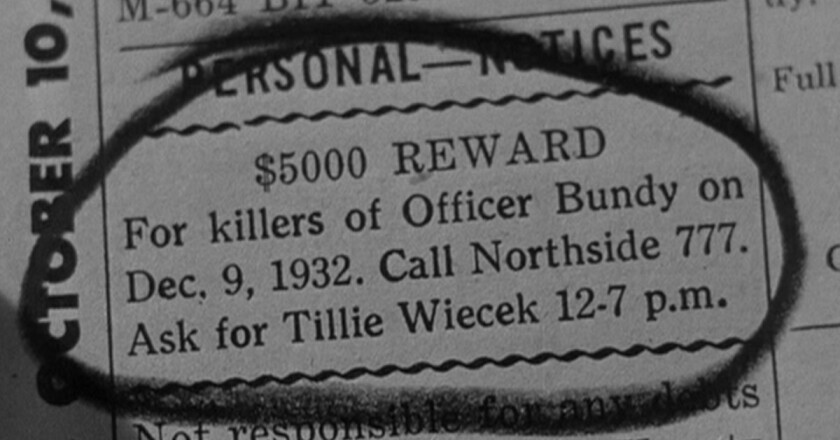
Call Northside 777

Call Northside 777 (Henry Hathaway, 1948) There was a brief period in American films where Hollywood embraced the neo-realist school coming out of Italy—where stories were filmed out in the streets, not in the rarefied atmosphere of a film-studio (It started in Italy because their huge studio, Cinecittá, was being used to house refugees), and it dove-tailed (if one can use so plumy a word) with the gritty post-war world of film-noir and crime-thrillers. Elia Kazan made one, even Hitchcock did.

But the most well-remembered of them was
Call Northside 777 with James Stewart as blasé "Chicago Times" reporter Jim McLane, who, upon taking an assignment he doesn't want, turns it into a cause celebre and his own obsession to see Justice done.
This was one of the first movies
Stewart did after his Air Force service, as he was beginning to challenge and even destroy his callow image audiences were used to at the beginning of his career. Now, with an added maturity he could actually pull off the cynical journalist role he wasn't too convincing as in The Philadelphia Story (which won him a "sympathy" Oscar after losing the previous year for Mr. Smith Goes to Washington the year before) He returned from the war determined to play characters with a darker edge.
Henry Hathaway
directed with a subtle eye, finding interesting deep-focus shots in lackluster surroundings. McLane's first encounter with a scrub-woman washing the stairs of a cathedraled office building carries the visual weight of years of work needed to raise the reward-money to help spring her imprisoned son (Richard Conte). The jailhouse of the visitation scenes IS the jailhouse, and the arrest of Conte's character looks and feels like actual newsreel footage. Finally, you get to go back in time and watch vital clues produced by the old technology of wire-photo transfer. It's another instance where the straight-laced neo-noir style goes a long way in selling the truth of a story, however implausible it might seem.

Tuesday, September 26, 2023

Anatomy of a Murder

Anatomy of a Murder
(
Otto Preminger, 1959) The novel of "Anatomy of a Murder" (by judge John D. Voelker and based on a 1952 murder case where he was the defense attorney) was a number one best-seller in 1958—and on the New York Times Best-Seller List for 62 weeks!—so it was fast-tracked to the movies with a tight script and un-fussy but frame-filling direction by Otto Preminger. The German producer-director shot it in one mere month and had it edited and scored ready for previewing 21 days after that. That could be the reason why the film is a whopping 161 minutes long, or it could just be that the film is so full of good stuff there wasn't anything to cut out.
 
But, "that stuff" was enough to make it controversial—and even banned in a couple places—in the U.S. of the 1950's. Preminger always enjoyed thumbing his nose at the Hays Code, and Anatomy of a Murder's constant harping on rape, torn panties, spermatogenesis, penetration, contraception and the terms "climax," "bitch" and "slut" were enough to draw people away from their televisions—where married couples couldn't sleep in the same bed—and into theaters (although star  James Stewart's own father considered it "a dirty picture").
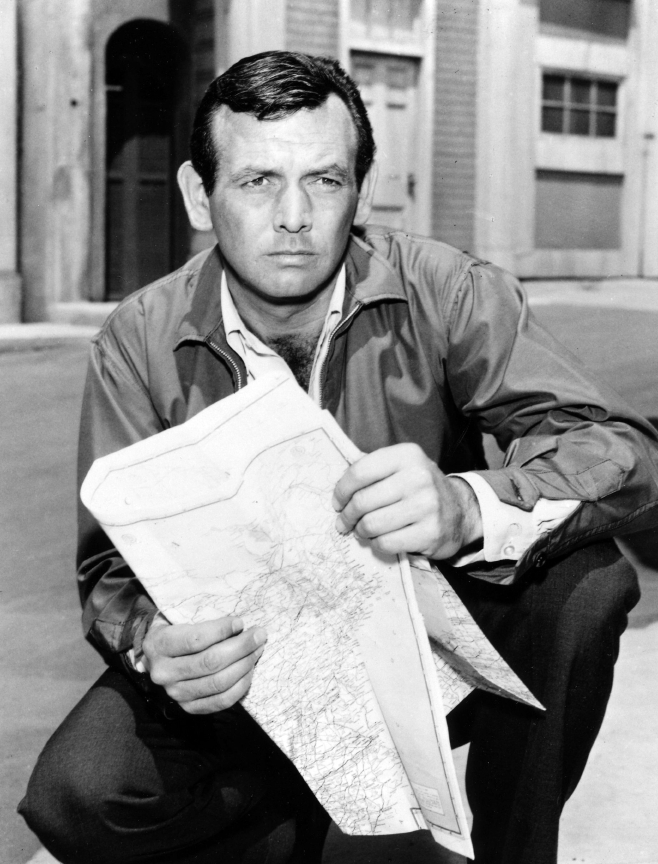
Stewart plays, well, basically author-judge Voelker, loving the law and fishing. Retired D.A. Paul Biegler (Stewart) is enjoying a happy retirement—forced on him by being voted out of his district attorney position—of fishing and free jazz when he's approached by Laura Manion (
Lee Remick) to defend her Army Lieutenant husband, Fred (Ben Gazzara), who has been arrested for murder in nearby Thunder Bay, Michigan. The victim was a local innkeeper named Barney Quill. Meeting Mannion in prison, Biegler finds him admitting to the murder, but defends it saying that Quill raped his wife. He also claims that he has no memory of killing Quill, just the sort of detail Biegler can hook his defense on.
With his secretary sardonic Maida Rutledge (
Eve Arden) and alcoholic colleague Parnell McCarthy (Arthur O'Connell), the small consortium start doing research in the law stacks and strategizing their defense of Manion, which will entail a little manipulation of the facts...or at least some creative presentation. For instance, Manion's lack of recall lends itself to a defense precedent for temporary insanity based on "irresistible impulse"—that'll mean expert witnesses whose theories might lead to debunking by cross-examination.
Then, there's the matter of  Laura Manion, who is (shall we say?) a little "loose"—not only in her manner, but also with the facts— andcould be smeared at trial for "provoking" her attacker—the usual "tarnish the victim" strategy. So, she is coached, given a make-over, and presented in such a way at trial to be as unprovocative as possible. But, the facts of the case and Quill's attack can't be denied, try as the prosecuting team—local D.A. Mitch Lodwick (Brooks West) and stringer, big-city prosecutor April Dancer (George C. Scott, in one of his early highly acidic roles)—might, so they go after the tenuous "irresistible impulse" defense and the Manion's volatile married life. This creates a highly charged trial with Dancer's vicious cobra-like questioning and Biegler's "courtroom theatrics" thundering back and forth. One would swear 50% of the dialog consists of "Objection!" Pity the poor judge (played by Joseph N. Welch, he was made famous by the Army-McCarthy hearingsand had no shame to exploit it!).
Anatomy of a Murder is different than most of the trial depictions that 1959 audiences were used to. Saturated with previous courtroom dramas and the weekly trials of "Perry Mason" on television, viewers were seeing these things as mystery stories, with the investigating going on in real time only to have the solution revealed at the end. This one, however, already has the "whodunnit" sorted out before the first swing of the gavel. The emphasis is on debate, advocacy, counter-arguments, presentation, theatrics, and, frankly, scoring points with the jury. It's more like a real trial process is, but with better lines and better actors.
And...it's a hell of lot less boring. But, then, the law SHOULD be boring. Theatrics only muddy the head-waters to the truth. And to justice.
Scott goes in for the kill: "Barney Quill was WHAT, Miss Pilant?!"
But, it's also a movie on the cusp of change, especially with the actors, a mix of old Hollywood, young Turks, and The Method, the clashing styles all giving off friction-sparks in the proceedings. It is a genuine thrill to watch aging pro Stewart at full volume going after the intensely malevolent Scott and more than holding his own, or watch him back off and scrutinize the inscrutable performance of Gazzara. Stewart always makes it look easy, but he was a student of the acting form with a vast array of tricks in his kit-bag. He navigates the styles and generations of actors like a well-tuned sports car, constantly and smoothly shifting.
It's always a pleasure to sit back and judge Anatomy of a Murder. It sure beats jury-duty.

Wednesday, March 15, 2023

Directed By John Ford

One of the delightful things about Steven Spielberg's film The Fabelmans is the late inclusion of maverick director David Lynch portraying maverick director John Ford in the recreation of the young Spielberg's meeting with him. Lynch "got" it exactly right—the irascibility, the bluntness, the crotchedly pugnaciousnes,...and the simplicity of the lesson being taught. He tells Spielberg something he knows, but not everything he knows. Just a tid-bit, that has served Spielberg well ever since (his film War Horse is a shining example of the lesson that Ford taught him that day). 

That's just a preamble for this expanded documentary that Peter Bogdanovich revised years after his death—the original was made in 1971 while Ford was still alive. One of these days (how often I say that!) I'll get back on track with the "History of John Ford" series I was doing. It's not complete yet, but the many John Ford entries I've run across while compiling an Index for this site tells me there's still a lot of work to do. 
 
For one thing, I can't believe I've never brought this over from my old movie blog. But, here it is:
 
Directed by John Ford (Peter Bogdanovich, 1971, 2006) Bogdanovich's essential primer is a "viewer's digest" of some big things that that made John Ford such a powerful director not only in individual films, but also across a career of experience. Generous clips from throughout his life's work illustrate points, punctuated by talking head clips from the '71 version including Ford himself (who is not very helpful, to say the least—by saying the least*—and is deliberately dismissive of doing the whole "critical analysis" thing, much like a comedian hates to explain a joke, or a magician a trick), as well as actors he worked with like John Wayne, Henry Fonda, and James Stewart
 
The 2006 update folds in Harry Carey, Jr., Maureen O'Hara, and analysis from Clint Eastwood, Martin Scorsese, Walter Hill, and Steven Spielberg, as well as Bogdanovich (you couldn't keep him out of one of his own documentaries, even if it's about another subject).
The update has everything from the original re-jiggered to add more points, but there's more of a "legacy" feel to the thing, now, as the casts of regulars Ford depended on have dwindled—Ford was still alive during the first version—and so the next generation who grew up and learned their craft sitting in the theater watching Ford's images talk about "what John Ford means to me." Also, as the man is gone now, there's a bit more psychological analysis and more delving into the man's irascible personality, already on full display in his interview.
But there is one troubling aspect to this "new" version, something that stuck in my craw when I saw it (and no doubt would result in Ford caning Bogdanovich if he got wind of it). There is a brief (very brief) examination of Mary of Scotland, Ford's only film directing Katherine Hepburn, and the subject of much speculation over what their relationship was. A sound clip is played of Hepburn's visit to Ford days before his death. The tape was allowed to run continuously, and their parting words to each other are played, words that they had no way of knowing were being recorded, and words that might not have been said if known they'd been overheard (Ford specifically asks her "Are they gone?"). It's nothing scandalous or huge. Ford merely says "I love you," and Hepburn says "it's mutual." But it feels like a violation of the departed by the parties that recorded it and who have re-presented it. And far too much is made of it (Really?  It was the inspiration for the names of O'Hara's and Wayne's characters in The Quiet Man?) in a gossipy, speculative fashion.
These were, after all, words from two people who must have known they'd never see each other again, and it's nice and it's lovely. But it's beneath the film, beneath Bogdanovich, and undercuts whatever scholarly impact the film might otherwise enjoy to make anything more of than the sweet parting gesture it is. The worst part is...there's no one to rebut, no one to protest, no one to defend...or even better yet, to correct the speculation. Even Ford's maxim of "When the legend becomes fact, print the legend" doesn't cover this
.
That aside (and it's my quibble, really), it's an invaluable first toe-dip into the films of Ford, and enriches the experience and appreciation of every film of his seen afterwards. One thing Bogdanovich did right (besides getting Turner Classic Movies to bank-roll it, so more people would see it, as the various clips from many studio sources would be very expensive) is he kept the original's essential narration by Orson Welles, Ford fan and student. The voices and faces and memories out of the past have as much weight and bearing as the films do, reverberating throughout history and time, feeling immortal and universal.
*


Saturday, March 26, 2022

The Greatest Show on Earth

Saturday is traditionally "Take Out the Trash" Day. What's different about this one is it ivolves Oscar's "Best Picture" category.

The Greatest Show On Earth
(Cecil B. DeMille, 1952) 
 
Insufferable.

In every way, insufferable. 

Let's leave out winning the 1952 Best Picture Oscar (over High Noon and The Quiet Man*), as obvious Hollywood Industry pandering during the McCarthy Era anti-communist witch-hunt to the Grand Wizard of that cause, Cecil B. DeMille.
 
Let's just take that out of the equation and take the film for what it is.
 
The Greatest Show On Earth is an extended commercial/documentary/drama for The Ringling Brothers and Barnum and Bailey Circus. Filmed in eye-popping Technicolor (which is where the film, showing off the bright colors in many hues, truly is spectacular), that begins with the Director sepulchrally narrating a series of work-a-day location footage of the circus being prepped for its yearly run. The pompous tone that he sets is akin to a war film, the army metaphors stacked up thick and deep like a chain of marching elephants, with all the accompanying lack of grace and subtlety. Leave it to DeMille to take the fun out of a circus and turn it into something resembling boot-camp.
We transition (roughly, as DeMille's favorite transition is a quick right to left scene wipe, making it all seem like a moving slide-show) to the stars of the film acting roles that the folks who are told to stay out of their way actually do.
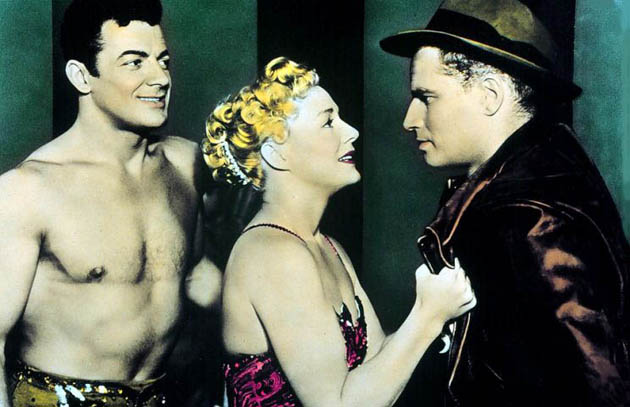
Charlton Heston is the circus "boss"—the show-runner, if you will—who, in order to guarantee a "full season" (the complete city tour) has brought a marquee name, "The Great Sebastian" (Cornel Wilde, cheerily smarmy) to take the center ring, displacing his aerialist sweetie, the plucky but vain Holly, played by Betty Hutton.
This top-billed character is particularly annoying. Hutton could play dumb well (with a vocal range from A to A-), but here's she's a schizo in need of a pair of padded tongs and a generator, with a change of motivation and character for every change of scene. Buffed up to do her own trapeze stunts (smattering of applause for that), her character is so insecure that she's a harpie spinning like a Tasmanian Devil: "I HATE the Great Sebastian!" "I'm JEALOUS of the Great Sebastian!" "I LOVE the Great Sebastian," "No, now I HATE the Great Sebastian!" "I LOVE you, Sebastian!" "I feel GUILTY about Sebastian" "I'm going to forsake my Ca-REER for Sebastian!") 
I pity Sebastian, myself. As well as Heston,
the guy you see rubbing his neck from whip-lash
. See, she's in love with his character, although she's annoyed with the fact that he spends all his time trying to keep the Circus going, thus letting her keep the only job she's capable of, besides waving on floats. Hutton's Holly not only wears her heart on her sleeve, but also her ankle, around her pretty little neck as a broach, as a hat, anything but a symbol of commitment. She accuses Heston's Brad Braden** of having "sawdust in his veins"—at least he's got something in his. I wanted her capped in the head with her own trapeze twenty minutes in. Probably sawdust in that, too. 
No such luck. Before one can turn their attention to what Holly would look like in the tiger-cage and quicker than one can shout "Sebastian! No! Don't do it without the net!!,"
tragedy does befall the circus leading to broken bones and souls, angst and recrimination and another case of Holly-pong in desperate need of a net...held by men in white coats. 
The movie sets up a dull pattern: stentorian documentary section narrated by DeMille on "Circus as War Machine"/slide wipe to melodrama/slide-wipe to an extended sequence of abbreviated cir-cussedness that manages to make you feel slighted while still feeling interminable each time. Along the way, much of the subjects' opportunities are squandered, if not down-right sabotaged. For a scene of DeMille's heavies planning badness, DeMille stages the two Runyon-esque hoods
*** (without the quaint patois) in front of a process shot simulating the outdoors. Halfway, DeMille cuts to a tighter shot of the two, but behind them the projection-screen image doesn't move, making it look like they've quantum-jumped closer to the camera. It's an amateurish give-away of a process shot.
And there's a cynical, rather crude attitude towards the circus audience—pandering to the audience while bashing them at the same time by endlessly showing giddy parents consuming ice-cream cones while their bored children look like they to want to erp up their cotton candy. But as the originator of this particular circus so famously said: "There's a sucker born every minute!" DeMille knew that lesson well.
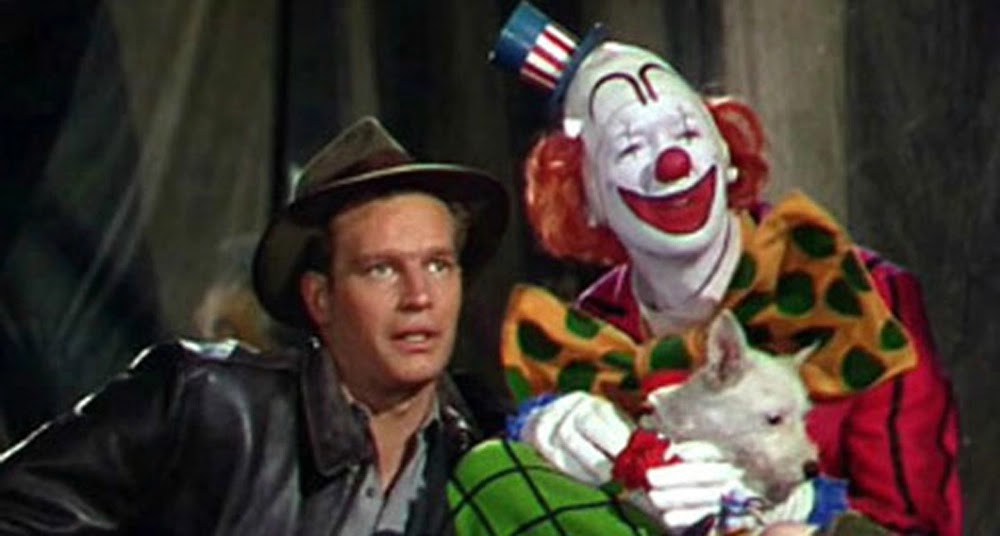
Another lesson is the one of justice, where kindly Dr. Buttons (
James Stewart in perpetual clown make-up...Richard Kimble never used that trick!), a surgeon on the lam for murder, unselfishly sacrifices himself by helping injured people on a train-wreck, exposing his true identity and is rewarded by getting cuffed and hauled off to the iron bar hotel. It was the '50's, after all—he could have been lynched. That would have to wait for prison, I guess. Thanks, doc! Take him away, boys.
 
Another little game of the movie is a sporadic "Spot the Stars." There's
Hopalong Cassidy! There's...somebody? Is that dewey debutante Jeanne Crain or a DeMille "ingenue?" And Bob Hope and Bing Crosby show up during Dorothy Lamour's number because its a Cyclical Universe on the Paramount Lot, with very tight gravitational rules; you could almost make a case for Creationism.
"Hey, is that Roddy McDowell?"
 
At some point during this megalith, you begin to realize with butt-numbing certainty, that if DeMille had cut out any of his "Circuses aren't some pink clown-show, they're American Hard Work" lectures, or maybe cut a "Tribute" sequence or parade or two, or one of the forgettable songs (or allowed Holly one less seizure) that the movie wouldn't have had to clock in at 2 1/2 hours in length.
2 1/2 hours is a longish book, with...ya know...subtleties, not a circus movie. But DeMille must have seemed unable to strip whole sequences, however redundant, away. Like Spielberg wanting to over-stuff 1941**** with beloved-by-none-but him-gut-and-budget-busting sequences, DeMille super-saturates the screen until the Technicolor fairly bleeds. And he couldn't bear, or didn't know enough, to cut any of it.
The only thing never mentioned in the many of DeMille's "Bozo Marches On!" narrations, is the requisite shoveling of the tons of manure. Why bother? The evidence is all there on the screen.
In a brilliant "meta" move, DeMille stages a train-wreck in a train-wreck.
 
* ...and the not-even-nominated Singin' in the Rain
.
 
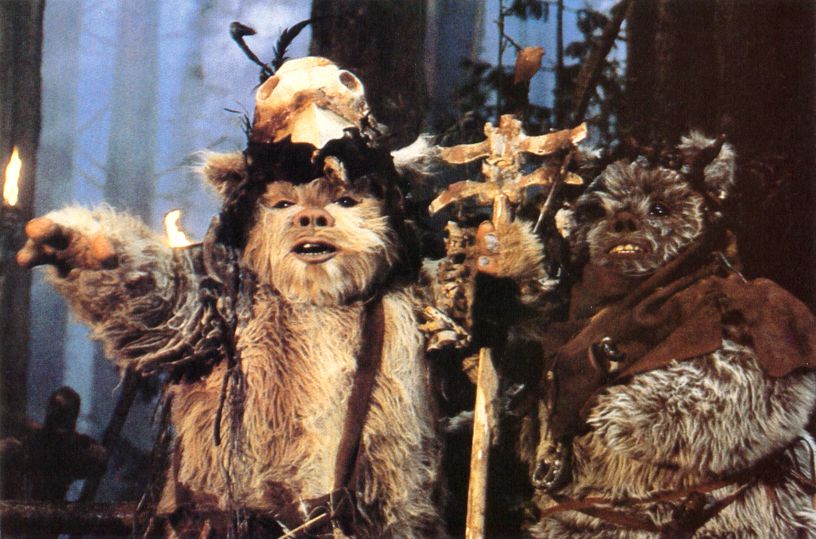
** ?...Brad Braden...of the "we-couldn't-come-up-with-a-better-last-name" Bradens? I think he became an "Ewok" trainer in later life.

*** One of them being Hollywood bad boy/guy Lawrence Tierney. He and Heston have a seething scene of clashing testosterone blasts.  

**** It was this very movie that inspired the Spiel-boy-g to pursue a career directing films. Spielberg learned his lessons concerning movie elephantiasis in his 20's. DeMille was in his 60's.

Friday, May 21, 2021

Anytime Movies #6: Mr. Smith Goes to Washington

While I catch up on the reviews still in "Draft" phase here, I'll re-run a feature I ran when I first started this blog seven years ago,* when it was suggested I do a "Top Ten" List.

I don't like those: they're rather arbitrary; they pit films against each other, and there's always one or two that should be on the list that aren't because something better shoved it down the trash-bin.

So, I came up with this: "Anytime" Movies.


Anytime Movies are the movies I can watch anytime, anywhere. If I see a second of it, I can identify it. If it shows up on television, my attention is focused on it until the conclusion. Sometimes it’s the direction, sometimes it’s the writing, sometimes it’s the acting, sometimes it’s just the idea behind it, but these are the movies I can watch again and again (and again!) and never tire of them. There are ten (kinda). They're not in any particular order, but the #1 movie IS the #1 movie. 

I’m very suspicious of patriotism (I always recall the "last resort of a scoundrel" remark), yet nothing moves me so much like a movie extolling the virtues of America. The promise "to form a more perfect Union," as it was outlined in The Constitution, as opposed to lining people's pockets, or to lionize the undeserving, or to maintain the status quo because it's comfortable.

Anybody who's fought for this country knows it's not comfortable (and if they did, they were promoted too soon!)

It wasn’t until I was voting on the
Emmy’s that I sat down and watched TV's “The West Wing.” I figured it was going to be a vapid “America-Love It or Leave It” tract (starring Rob Lowe), even if it did have Martin Sheen playing the President, in which case, I could leave it. But TWW was a serious look at government work—its glories and  disappointments, the combination of ego and sacrifice. It could criticize individuals and “ideology for ideology’s sake,” but one thing it never ever criticized was the idea of Public Service, no matter what side of the aisle it was on. At the same time the country is being run by crooks specializing in an institutionalized form of bribery and graft, there is an infrastructure of people for whom government service is a sacred trust (well, there’s gotta be ONE!) “The West Wing” paid tribute to that corps of people wherever they might be, week after week, and it made for refreshingly positive TV. It also made for a refreshing look at our nation as it stands.

And so, too, does
Mr. Smith Goes to Washington. Made in 1939, it plays like it was written yesterday. When I saw it for the first time—right after “Watergate”—I found it amazingly prescient. But, no, it was talking about its own times. The problems just keep re-occurring again and again. And again. Whoever doesn’t know history is doomed to repeat it, and with every fresh crop of people governing, they’ll keep making the same mistakes. Maybe they think they’re unique. Maybe they just don’t know history. They say that if you keep making the same mistake over and over, it’s a sign of insanity. Well, psychology never factored in term limits.

Mr. Smith… is the story of a local youth leader who is appointed to the Senate after the incumbent suddenly dies. This runs afoul of the state’s political machine that ran that late senator as well as the state's senior Senator, Paine (Claude Rains)—who just happens to be an idol of the new senator’s. But, "The Machine" lets it happen, as Smith is a yokel, and their boy, Paine, will be able to keep him in line.
It wouldn’t work if director Frank Capra didn’t have tall awkward Jimmy Stewart—not James, Jimmy—whose every stammered syllable bespoke humility. But get him talking about America or Liberty of The Capitol Dome and the stutter disappears in a fervent stage whisper that trails off in awe. Mr. Smith isn’t sure of himself, but he’s sure sure of the Country.
And Washington, D.C. is just the place to shake him up with a few lashes of the Beltway. Stewart could be frustratingly folksy, but for Capra (and for Hitchcock and Anthony Mann) he could be unnervingly vulnerable and, at the other end of the bi-pole, dramatically unhinged. The last act of Mr. Smith…—the filibuster against false charges of graft—features Stewart in both phases. At one point, he's knee-deep in political hate-mail, clutching it in his hands and looking skyward like Jesus at Gethsemane. Then a few short paragraphs about “lost causes” later, he’s at his most defiant. “You think I’m licked! You ALL think I’m licked!!” That was his Oscar-winning performance, not the next year’s The Philadelphia Story where the “cynical reporter” bit just didn’t wash with someone who looked so homespun. The filibuster scene always brings a lump to my throat, and it’s not sympathy pains for Stewart’s frayed larynx.
Now, I’ve read the original screenplay to “Mr. Smith Goes to Washington.” It ends with a big parade honoring the completely vindicated Smith, surrounded by his boy-rangers, supported by the woman-he-loves (Jean Arthur, again, who manages to make her extraordinarily jaded Senate Aide adorable, even when she’s at her worst—and she has a great drunk scene with Thomas Mitchell. Hmmm, Thomas Mitchell, again). Why, even the disgraced Senator Paine is being lionized in the sequence. Oh, it’s just so sweet, your eyes could roll back in their sockets and jam and stick that way. As Arthur’s Miss Saunders tipsily says in the film, “Nah, I can’t think of anything more shappy!” “Capra-corn” is what the very self-aware director called it.
So, he cut it. Orson Welles has said: "If you want a happy ending that depends, of course, on where you stop your story." Capra leaves his story’s ending ambiguous. Oh, you could call the riotous goings-on at the end a Happy Ending—but all of Paine’s Senate pals are trying to calm him down, telling him it’s okay…everything’s all right, we're still on your side. The only solace Jefferson Smith is granted is in the sympathetic smile from the Vice-President (played by John Ford’s silent cowboy film-star Harry Carey) before he collapses in a heap of his enemy’s mass-generated letters. The movie "celebration" has all the weight of an Al Gore victory celebration on Election Day 2000--a case of premature exaltation. But nothing's been solved. No one's been cleared. Nothing has been decided. There is just misunderstanding and confusion. Carey leans back and has a chaw while the chaos of Democracy continues unabated. It may not be a "happy" ending, considering the sequence that was shelved. It may not even be a dramatically satisfying ending. But it is representative of the loud, messy process that turns the gears of Democracy. 

However slow-moving, however off-course, they still turn.

Jeferson Smith (Jimmy Stewart) looks for guidance.

Anytime Movies:
Chinatown
American Graffiti
To Kill a Mockingbird
Goldfinger

Bonus: Edge of Darkness

Washington turns out for the Mr. Smith premier—they weren't happy.
From Wikipedia:  "Alben W. Barkley, a Democrat and the Senate Majority Leader, called the film 'silly and stupid', and said it 'makes the Senate look like a bunch of crooks'."

* And, on Sunday, we'll put up a "Don't Make a Scene" feature from each week's film.