Showing posts with label Katherine Hepburn. Show all posts

Wednesday, January 22, 2025

The Philadelphia Story

The Philadelphia Story
(George Cukor, 1940) "The prettiest sight in this fine pretty world is the privileged class enjoying its privileges
."
 
So says Macauley "Mike" Connor (James Stewart), cynical reporter with romantic notions about nobody but himself, as he and photographer "Liz" Imbrie (Ruth Hussey) are given the enviable task of reporting on the biggest marriage event of the season—or should we say "re-marriage season"—the Lord-Kittridge affair, she of the Philadelphia Lords, Tracy Samantha Lord (Katharine Hepburn), to be precise—formerly married to one C.K. Dexter Haven (Cary Grant), an upper class yacht designer—and for her second go-'round, she is marrying George Kittridge (John Howard), a "man of the people" who raised himself from the lower classes to achieve parity (without the legacy or provenance, mind you) of the Main Line of Philadelphia. Newsies Mike and Liz are given permission to "witness" the impending nuptials for a gossip rag (under the subterfuge that they're "distant relatives"), as an arrangement that said tabloid won't be publishing lurid stories about Tracy's father (John Halliday) having an affair with a dancer (of all people). This tit-for-tat has been arranged by a former runner for the mag, that personage being one...C.K. Dexter Haven, the ex (if you'll recall) of the bride-that-was and is to-be. How gauche it all is. How lurid. How delightfully sordid.
The Lord's are trying to manage this hullabaloo without much ballyhoo, thus their agreeing to the limited press coverage. But, they're not going to make it easy for them, no sir. Tracy is determined—with the help of precocious sister Dinah (Virginia Weidler)—to put up a discouraging wall of "airs", acting all hoity-toity...which is just what reporter Connor expects them to be. Tracy sees through their subterfuge just as easily as photographer Liz sees though theirs—just as she also sees through Connor's contempt for them (he protests a bit too much). As a photog' she seems to "read" people better than Connor, which is why she's biding her time with her colleague. She's in love with him, not that he'd ever stop concentrating on himself and his deathless prose to notice.
C.K. is also inserting himself into the affair, much to the delight of the Lords and to the dismay of his ex, Tracy. Their marriage broke up a couple years previously because, as an alcoholic, he did not measure up to her high standards. Tracy is a bit judgey as a rule, and decisively so, which led to tossing Dexter out ("She's generous to a fault" he says, "except for other people's faults") as well as the ostracism of her father from the family (His opinion of her: "You have everything it takes to make a lovely woman except the one essential: an understanding heart. And without that, you might just as well be made of bronze." That one hurts).
Tracy is all too aware of the criticism ("
Oh, we're going to talk about me again, are we? Goody."), but she is absolutely sure of her paragoness—reflecting well on the parents as it may have begun, but it has rigored into an expectation that anyone in her orbit should be beholden to the same courtesy. Her stubbornness is so ram-rod straight that it has appeared to reach her spine, as evidenced by her switch-blade dives into pools or even—in the oft-replayed silent opening sequence—when she's face-palmed back into her own home after kicking out Grant's Dexter Haven. It's amazing that she can be so stiff while performing the herculean task of having one's head up their ass.
She may have grown up, but she's still her parents' child—not that that's their fault. She's just stuck in her dutiful child-role despite long having passed its maturity date. Now, even her parents are annoyed with it (by contrast, youngest daughter Dinah—played by the incomparable
Weidler—seems to have skipped her childhood to become Thelma Ritter) and wish that "the phase she's going through" was over.
But, it's unlikely, even on the eve of the second of her how-many-future-marriages. The first one didn't work out because from her lofty perch, the faults, owing to his drinking, were all on him. This second has a much-better-manufactured future husband so she glides in with confidence, secure that Kittridge is just as stalwart and inflexible as her own reflection of herself—she's found her spine-mate.
Tracy emerges from a drunken night into the light of a new day
—and reacts to it like a vampire.
But, after a night of pre-wedding jitters—no doubt brought on by her being unable to cope with the intricate machinations of "everything is going according to plan" while confronting the failures of others in her past (like Dexter Haven and her prodigal father, who both have the temerity to judge her ("I'm going crazy. I'm standing here solidly on my own two hands and going crazy!")—she ends up drunk and with the appearance of being in a compromising position and in the vulnerable position of seeing herself being judged rather than judging. 
And despite rapt descriptions of her as a "marvelous distant queen" or "the golden girl," this paragon of taste, breeding and virtue who could walk into any room and do so with style can never manage to do it with "grace"
, and when her weak night of drinking has her stumbling through what feels like a "perp walk" under scrutiny, she learns a little of what she's been dishing out...and doesn't like the taste of it. But, you can't have a hangover without some shame in the mix. And despite the bleery eyes, she starts to see things more clearly.
This was Hepburn's project—she'd been labeled "box-office poison" after films like Mary of Scotland and Bringing Up Baby and Holiday bombed (despite the last two eventually gaining reputations of being cinema classics for decades) and helped writer Philip Barry to create it and make it a hit on Broadway. Then, as she owned the rights to it, she personally took it to M-G-M and its head, Louis B. Mayer, to have it made with the director of her choosing (Cukor) and maybe with Spencer Tracy and Clark Gable as the leads. Mayer substituted Grant and Stewart who were more readily available and the deal was made. The movie was her first box-office hit in a couple years. But, there was a little bit of a price to pay for its success.
 
It was the first of Hepburn's movies where she had to have a serious  "comeuppance" moment. Oh, her Jo March in Little Women had to suffer loss and rejection before she achieved any path-way to true happiness, and in her breakout film-role in Stage Door she had to suffer another character-changing tragedy in order to make her "complete" and deserving of success, but here the knives are out for Hepburn's 
"tall poppy" to be "dead-headed" and reduced from imperious competence to crumbling vulnerability.

And that's apparently what audiences liked. Katherine Hepburn seemed to always have to be "taken down a peg" for the customers, even in her many movies with Spencer Tracy (their first pairing, Woman of the Year, had its ending changed and re-shot to end with a humiliating kitchen scene due to the negative remarks on preview cards by female audience members). She wasn't allowed to maintain her dignity, or achieve some sort of parity with her male co-star, but, to insure commercial success, she had to have her characters' weaknesses and failures made manifest and her dependence on male supremacy made apparent despite any evidence that was shown before that she could act independently from her own efforts. Katherine Hepburn, the actress, having already been shown the consequences of bad box-office reputation, conceded the point that emancipation wasn't "a thing" in the make-believe world of the movies and "played the game." Sometimes (like in Woman of the Year) it was grating and and embarrassing. In The Philadelphia Story (which, remember, she helped develop), it's a little easier to digest and becomes the crux of the movie.
It's not a bad lesson to learn, either. Everybody in the movie (unless they've been humbled in some way) is a little "judgey" and before things play out, minds are changed instead of made up and calcified into permanent prejudice. Everybody bends a little bit without the fear of snapping holding them back. Things become malleable, negotiable...why, it almost becomes the euphemism of "polite society". It's why the use of the term "yar" in the film is so apt. "Yar" (in sailboats or yachts) means "easily maneuverable" but it can also be
"agile, quick, nimble"—something C.K. Dexter Haven always aspires to. The mast must be sturdy and strong, sure, but it's the sail that gets you anywhere. You just have to bend with the wind.


Wednesday, March 15, 2023

Directed By John Ford

One of the delightful things about Steven Spielberg's film The Fabelmans is the late inclusion of maverick director David Lynch portraying maverick director John Ford in the recreation of the young Spielberg's meeting with him. Lynch "got" it exactly right—the irascibility, the bluntness, the crotchedly pugnaciousnes,...and the simplicity of the lesson being taught. He tells Spielberg something he knows, but not everything he knows. Just a tid-bit, that has served Spielberg well ever since (his film War Horse is a shining example of the lesson that Ford taught him that day). 

That's just a preamble for this expanded documentary that Peter Bogdanovich revised years after his death—the original was made in 1971 while Ford was still alive. One of these days (how often I say that!) I'll get back on track with the "History of John Ford" series I was doing. It's not complete yet, but the many John Ford entries I've run across while compiling an Index for this site tells me there's still a lot of work to do. 
 
For one thing, I can't believe I've never brought this over from my old movie blog. But, here it is:
 
Directed by John Ford (Peter Bogdanovich, 1971, 2006) Bogdanovich's essential primer is a "viewer's digest" of some big things that that made John Ford such a powerful director not only in individual films, but also across a career of experience. Generous clips from throughout his life's work illustrate points, punctuated by talking head clips from the '71 version including Ford himself (who is not very helpful, to say the least—by saying the least*—and is deliberately dismissive of doing the whole "critical analysis" thing, much like a comedian hates to explain a joke, or a magician a trick), as well as actors he worked with like John Wayne, Henry Fonda, and James Stewart. 
 
The 2006 update folds in Harry Carey, Jr., Maureen O'Hara, and analysis from Clint Eastwood, Martin Scorsese, Walter Hill, and Steven Spielberg, as well as Bogdanovich (you couldn't keep him out of one of his own documentaries, even if it's about another subject).
The update has everything from the original re-jiggered to add more points, but there's more of a "legacy" feel to the thing, now, as the casts of regulars Ford depended on have dwindled—Ford was still alive during the first version—and so the next generation who grew up and learned their craft sitting in the theater watching Ford's images talk about "what John Ford means to me." Also, as the man is gone now, there's a bit more psychological analysis and more delving into the man's irascible personality, already on full display in his interview.
But there is one troubling aspect to this "new" version, something that stuck in my craw when I saw it (and no doubt would result in Ford caning Bogdanovich if he got wind of it). There is a brief (very brief) examination of Mary of Scotland, Ford's only film directing Katherine Hepburn, and the subject of much speculation over what their relationship was. A sound clip is played of Hepburn's visit to Ford days before his death. The tape was allowed to run continuously, and their parting words to each other are played, words that they had no way of knowing were being recorded, and words that might not have been said if known they'd been overheard (Ford specifically asks her "Are they gone?"). It's nothing scandalous or huge. Ford merely says "I love you," and Hepburn says "it's mutual." But it feels like a violation of the departed by the parties that recorded it and who have re-presented it. And far too much is made of it (Really?  It was the inspiration for the names of O'Hara's and Wayne's characters in The Quiet Man?) in a gossipy, speculative fashion.
These were, after all, words from two people who must have known they'd never see each other again, and it's nice and it's lovely. But it's beneath the film, beneath Bogdanovich, and undercuts whatever scholarly impact the film might otherwise enjoy to make anything more of than the sweet parting gesture it is. The worst part is...there's no one to rebut, no one to protest, no one to defend...or even better yet, to correct the speculation. Even Ford's maxim of "When the legend becomes fact, print the legend" doesn't cover this
.
That aside (and it's my quibble, really), it's an invaluable first toe-dip into the films of Ford, and enriches the experience and appreciation of every film of his seen afterwards. One thing Bogdanovich did right (besides getting Turner Classic Movies to bank-roll it, so more people would see it, as the various clips from many studio sources would be very expensive) is he kept the original's essential narration by Orson Welles, Ford fan and student. The voices and faces and memories out of the past have as much weight and bearing as the films do, reverberating throughout history and time, feeling immortal and universal.
*


Friday, May 6, 2022

Little Women (1933)

Little Women
(George Cukor, 1933) Pre-code version of Louisa May Allcott's much-beloved novel of the March family struggling with life in mid-Civil War America. "Pre-code," but we're talking Louisa May Allcott here, so don't expect anything surprising eyebrow raising, other than director Cukor's penchant for laying the iron on stuffed shirts and exposing society's pretensions and hypocrisies.
 
No, this is Little Women, so there is warm homespunnery, with an encouragement towards spunkiness of the actresses—much too old for the parts (but, jeez, Katharine Hepburn and Joan Bennett, who's going to complain?)—playing the March sisters, consigned to different fates for womanhood in the 19th century: home and hearth, marrying rich, seeking a risky independence (for awhile, anyway) or early death. The story is multi-faceted with the emphasis on self-improvement, charity towards others, positive attitudes in times of strife, and the spark of imagination.
 
Oh, and family values. Ambition is good, but when kept in small orbits...like, within horse-cart distance. Family is all.
Cukor directing Kate Hepburn directing
 
Cukor wanted to work less on the star-crossing and budding relationships and concentrate on the charity, selflessness and bonding in what would become the blueprint for all subsequent versions of Allcott's Women (there had been two previous silent versions), and although times and tastes have changed, one can't quibble too much with the acting, everything is done with such brio and conviction that, even if something questionable does come up, there will be something that punches you in the gut within a minute. Hepburn, of course, shines, but everyone else is good, too, particularly Henry Stephenson as the somewhat reticent Mr. Laurence.
And now, something a little personal: while watching the film, a flash of memory happened as one of the March sisters admonishes the others for quarreling. "Birds in their little nests agree" in a lilting sing-song. I remember as a child (3? 4?) my grandmother saying the exact same words with just the same inflection. The source of the phrase is from "Divine and Moral Songs for Children"* published in 1715 by Isaac Watts. Now, Watts was a prolific hymn-writer, but he was a Protestant (where my family was traditionally Catholic), so I'm not sure where my grandmother picked it up, but it probably was this version of Little Women. 

At the time of its release, RKO's version of Little Women was seen as wholesome entertainment (back in Hollywood's salacious "pre-code era") with an emphasis on "making do" and charity for the less fortunate. 1933 was, after all, deep into The Great Depression and that lilt and those circumstances make me certain my grandmother saw it. My mother certainly did at the age of 22. She was always an admirer of Katherine Hepburn and when the star toured Seattle in 1981 with "The West Side Waltz" (at the 5th Avenue Theater), I made sure to get tickets for her. And me, too.

It's funny how movies can reach back in time and space and link generations together over a shared memory. Small orbits...
 
* Song 17 goes like this:

1. Whatever brawls disturb the street,
There should be peace at home;
Where sisters dwell, and brothers meet,
Quarrels should never come.

2. Birds in their little nests agree;
And ’tis a shameful sight,
When children of one family
Fall out, and chide, and fight.

3. Hard names at first, and threatening
They are but noisy breath,
May grow to clubs and naked swords,
To murder and to death.

4. The devil tempts one mother’s son,
To rage against another;
So wicked Cain was hurried on
‘Till he had kill’d his brother.

5. The wise will let their anger cool,
At least before ’tis night;
But in the bosom of a fool,
It burns till morning light.

6. Pardon, O Lord, our childish rage,
Our little brawls remove;
That, as we grow of riper age,
Our hearts may all be love.


Tuesday, February 22, 2022

The Sea of Grass

The Sea of Grass (Elia Kazan, 1943) It's Kazan's third feature as a director, playing in Louis B. Mayer's sandbox (literally—the film is shot in-studio at M-G-M, making use of stock-footage of rolling fields already in the can, with some location back-projection), and the founding member of The Actor's Studio has a cast of anybody but—Spencer Tracy and Katherine Hepburn (in their third film together), Melvyn Douglas, Harry Carey Sr. and Edgar Buchanan, all pro movie actors who'd already figured out the best way to project on film, without having to rely on sense-memory for it.
 
Kazan hated this film and discouraged anybody who'd listen from seeing it. But, despite its soap-ish tendencies as a romance, it has an underlying ecological message. Colonel Jim Brewton (Tracy) is a very well-landed cattle baron and resists any efforts by the "guv'mint" towards granting homesteading rights or development on the open range. For him, its a matter of keeping it unspoiled. "God's work," as he calls it. That's his purpose, but he's a might surly, mulish and uncommunicative. Along comes city-girl Lutie (Hepburn) into his life, and he bends slightly, like the trees she insists be planted at the entrance to their estate, as they sway in the harsh prairie winds. He'll bend with a "wait-and-see" attitude, as in "Wait—you'll see." He yields to Lutie on her friends's homesteading near his property. But, a clash is inevitable. "Fences are a curse word in these parts, he informs her.
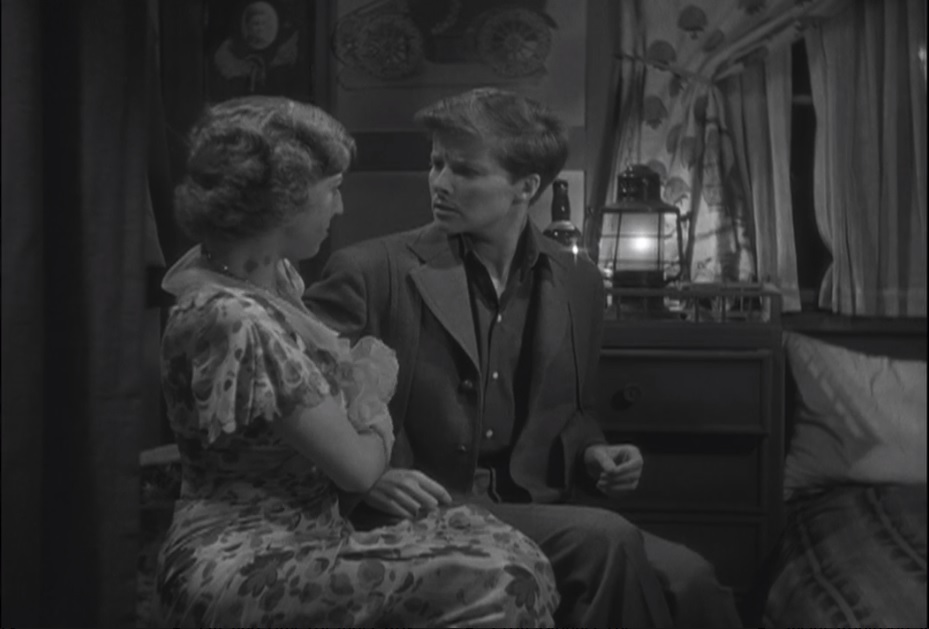
There are other complications. She's a city girl on the prairie and distances between people are daunting. Then, there's the town lawyer, Chamberlain (Douglas) who has two strikes against him in Brewton's suspicious eyes—he wants the land open to homesteading, and he has his own eyes for Lutie, waiting to pounce whenever there's a crack in the Brewton marriage, which is inevitable.  What his motivations are in both areas are suspect—Brewton Chamberlain are bitter enemies, politically and socially. Chamberlain just might be making the fight personal and can't help himself. With both the open fields and Lutie, he can't leave well enough alone.
The rise in Chamberlain's political career (becoming a judge in the district) dooms Brewton's ecological dreams, and soon the prairie becomes home to sod-busters, dependent on weather for their success, and when the rains stop, the crops fail and the farmers leave, the countryside becoming a barren dust-bowl.  It's a hollow, dry victory for Brewton—he's proven right (which no one will admit) and the land goes to waste.  And, in the meantime, Lutie has left, leaving Brewton and cook Jeff (Buchanan) to raise the kids: loyal but neglected Sara Beth (Phyllis Thaxter), and black sheep son Brock (Robert Walker), who it is more than suggested may be Chambelain's child.

One can see why Kazan, Tracy and Hepburn were attracted to the material. The ecology theme (even if espoused by a bull-headed "protect-what's-mine" cattle rancher) should have been close to the sod of anybody who'd come out of the depression, and the "unbranded scarlet letter" theme must have been attractive to Hepburn who enjoyed tilting at societal windmills. At this point, Tracy and Hepburn knew each other's tricks on-set. And it's interesting to see that their personal back-and-forth's in this film are much the same as they are in Guess Who's Coming to Dinner decades later. She's adoringly passive with a steel spine, and he's remote until his face collapses with emotion. Kazan would come out of this film feeling compromised—and, indeed, this film about the vastness of open land and the prairie feels like it was filmed inside a glass ball—and would explore other ways to make movies, as opposed to being stuck on the sound-stage. He'd start insisting on location work and even filming with a documentarian's eye. His search for authenticity in artifice could not be held behind stage-doors and artificial light.
 

Tuesday, September 7, 2021

Mary of Scotland

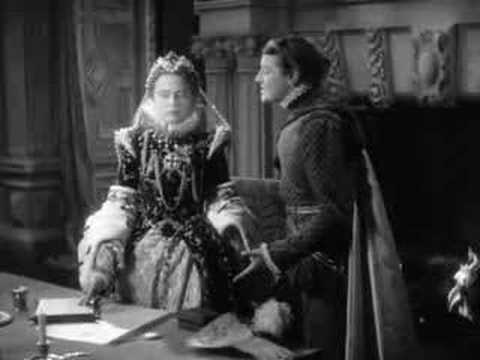
Mary of Scotland (John Ford, 1936) The film, written by Dudley Nichols from Maxwell Anderson's play, begins with an odd preamble, giving an overview of the whole Mary, Queen of Scots/Elizabeth R situation, and ending with the hopeful suggestion that they are "all equal now," buried close to each other in Westminster Abbey. Cheery thought, and, despite what the play and movie say, the only time that Elizabeth and Mary were in the same room together.*

It's a problematic film. betraying its stage roots (the speeches are very formal, stylized, and performed theatrically, with no overlap and AT THE TOP OF EVERYBODY'S LUNGS, as if trying to reach the last row of the balcony) although Ford works overtime to find interesting angles to shoot from. So much Hollywood gossip swirls around this film**—part of Hepburn's "box-office poison" cycle (she'd just bombed with Sylvia Scarlett and more were on the way)—that one is hesitant to bring it up as sources for the film's problems, which are many. 

But the main fault lies with Anderson's play, which lionizes Mary (Katherine Hepburn) while demonizing Elizabeth, and the production goes right along with it—Mary's first lines are a prayer to God for returning safely to Scottish shores, while Elizabeth's is ordering people around and played (by Florence Eldridge) as if she were Edward G. Robinson. It would have been nice if this subject were a little more nuanced, as it involves two strong women in positions of power with men as being subjective, if constant irritants. One wishes that the two could have gotten together and agreed that all the men surrounding them were jerks and done something about that, rather than engaging in power plays for England's throne.
But, that's not how history went, and the play plays fast and loose enough with the facts as it is. And this is Mary's movie, to the point where Hepburn is the only cast member with close-ups—jarring close-ups that have the feel of insert shots as the lighting changes dramatically from the establishing shots—Elizabeth is only seen in full shots that emphasize costume over performance.
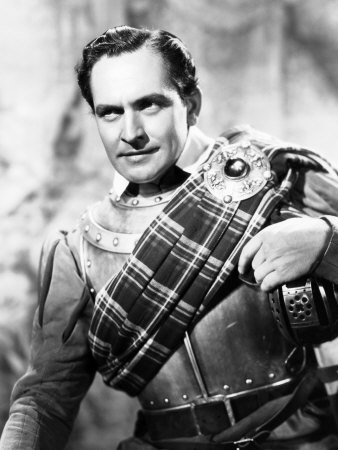
There are joys to be had, though. Ford's penchant to use unruly horses is much in evidence, and the animals are particularly out of control on the sound-stages that dominate the film. And Frederic March is something of a revelation, boisterous and accented, his is the best performance in the film. And Ford's presentation is never less than spectacular, as has been mentioned, giving the film a scope that it wouldn't have had in other's hands.
 
 
A not-altogether successful film, but interesting to see.


* This is a problem with most of the films dealing with Mary, Queen of Scots—historically, they never did appear (that we know—something Lucy Worsley might some day let us in on it) in the same room, although there were letters sent back and forth. It might have something to do with studio politics and ginning up the drama. Traditionally, the two have been played by stars (Vanessa Redgrave and Glenda Jackson in 1971's Mary Queen of Scots, and more recently Saoirse Ronan and Margot Robbie in 2018's Mary Queen of Scots) and so there must be some re-writing of history in order to get Acting Queens to spar off each other, even if the real Queens did not.
 
** Ford was unhappy making it, and—as he occasionally did—walked off the film in the midst of shooting on day. I can't be sure, but when I read Hepburn's autobiography, I seem to recall her saying that she directed for the rest of the day and seemed to think nothing of it. And...take a look at this scene on YouTube. There is a portion where Mary addresses James Stuart, Earl of Mowbray, where the conversation is at cinematically clashing angles, perhaps to favor a flattering angle...well, let's face it, of both actors. It's an odd choice by Ford if he, indeed, did make it.

Tuesday, August 17, 2021

The Iron Petticoat

The Iron Petticoat (Ralph Thomas, 1956) There are many reasons a film can be withdrawn from circulation. In some cases, like Frank Sinatra's withdrawal of Suddenly and The Manchurian Candidate, it is the fear that the influence of the film might have had on current events, in much the same way as Stanley Kubrick withdrew A Clockwork Orange for many years in England, due to what seemed to be several copycat crimes related to it.

Bob "I probably should have done this with Phyllis Diller" Hope and his estate kept The Iron Petticoat out of America after its initial release until...November, 2012...when TCM showed it for the first time in this country since its release, (with the exceptions of a couple of private screenings). It's been available in Europe and throughout the rest of the world, but not in the States, owing to a disagreement between Hope and the film's original author, the esteemed Ben Hecht, who wrote the thing for Katherine Hepburn, with an eye toward re-teaming her with Cary Grant. But, Grant was still on his on-again-off-again retirement at the time and passed, Hope sashayed in, and proceeded to hand it to his gag-writers who refashioned the script more to Hope's style than Hepburn's...or Hecht's. To be fair, stars do this all the time, re-writing scripts to their liking and their strengths, but Hecht took the issue public in the Hollywood press, leading to a Hope-ful response. For whatever reasons, Hope, who had the distribution rights in the U.S., kept it out of circulation after its initial run, making it a curiosity.
Would that the unearthing of this film, with the unlikely match-up of Hope and Hepburn, the first movie producing credit of Bond producer Harry Saltzman, be anything more than that.  But, like Schrödinger's cat, once seen, there is certainty, and in this timeline, it ain't good. The story of a Russian aviatrix (Hepburn) who defects to Europe and is squired by an American Air Force Major (Hope) under orders to keep her on our side is a few notches shy of Ninotchka, and is almost entirely charmless. No one's at the top of their game here, with the exception of some of the character actors (Robert Helpmann, James Robertson Justice). Hope seems to have that hapless "I'm bombing here" look on his face without the curl to his lip that inspired confidence. And Hepburn? There's a distinctive overabundance of iron, as if she were trying to be her own Berlin Wall to hold her own in the project. And where Garbo played Ninotchka with a stiff world-wary calm ("like a Vulcan" I compared it to), Hepburn is loud and forceful, projecting her words to the top of "the house" (more like a Klingon). And if Melvin Douglas' ardent suitor in the earlier Lubitsch film softens his Moscovite's demeanor, Hope's stand-offishness—keeping her at golf-club's length—does nothing towards making this one either romantic or comedic.
No film should be locked away in a vault, but for this one, the only joy in it is  its seeing the light of day again. It is only when it sees the light of the projector that the disappointment starts.

Tuesday, February 2, 2021

Olde Review: Stage Door

The following was part of a series reviewing the ASUW film series at the University of Washington that were broadcast on KCMU-FM in 1976--I found the old scripts and thought it might be interesting to post them here--with no editorial alteration or comment. I have no doubt that my attitude to some of these films has changed over the years--ageing does that--but to just erase my opinions from back then and tack on my new-found objections would do a disservice to the reviewer who was just a "stinky kid" back then. It'd be like making Greedo shoot first.

Stage Door (Gregory LaCava, 1937) It's hard to say what I like best about Stage Door--not the story, it's pretty much the "tough-road-on-the-way-to-success" trope. But the dialogue is original--snappy and delivered at a break-neck pace, sometimes overlapping (and you don't see that very often in modern movies)* It all tends to make watching old-time movies invigorating.

Maybe it's the acting, delivered by an all-star cast headed by Ginger Rogers (again), Gail Patrick as a primary sufferer, Lucille Ball as a wicked-tongued Seattle-ite (but don't hold it against me), (and) Eve Arden as an aspiring actress who is permanently attached to a cat. All live together in various stages of animosity when Katherine Hepburn makes another of her grand entrances and proceeds to steal the movie as easily as candy from a bunch of talented babies. Her role is somewhat autobiographical--rich society girl trying to make it into acting because it's a thrill and it's different. To see newcomer Hepburn--a small strap of a girl squaring off against a star-since-silent-days Adolphe Menjou and run acting rings around him is a certifiable thrill. It's Hepburn that is best about this movie, but then Hepburn has always been one of the best things about the movies.
----------------------------------------------------------------------------------------------


* Well, you did if you saw any Robert Altman movies at the time, and I'm sure I did--at least Nashville and California Split and M*A*S*H and The Long Goodbye! But the last movie I saw where the movie was seriously over-lapping and going at this pace was Clooney's Leatherheads (and I think I was the only one...)

I notice I neglected to mention such stars of the future as Ann Miller and Jack Carson (one of my favorites). Well, these things could only be two minutes long...and it should be noted that this is the film where the Hepburn trademark line "The calla lilies are in bloom a-gain!" came from. Any actress or comedian who wanted to do a quick impression of Katherine Hepburn (in the days before Martin Short) would just say that line and people would immediately get the connection.

One interesting little piece of trivia:  Gail Patrick was the long-time executive producer of the "Perry Mason" TV-series.

Wednesday, February 19, 2020

Sylvia Scarlett

Sylvia Scarlett (George Cukor, 1935) This one can't be considered a movie of the libertine, free-and-wheelin' "Pre-Code" era of movie-making, but it takes mild chances (if only teasingly), but hardly enough to account for its reputation as one of the most financially disastrous movies on the 1930's despite a good script, solid direction by George Cukor and the pairing of Cary Grant and Katherine Hepburn (though it being their first—Hepburn had met Grant at Paramount and recommended him to Cukor—no one could anticipate their subsequent chemistry). The film's lack of success labeled Hepburn as "box-office poison" and she didn't become bankable again until she bought herself the rights to "The Philadelphia Story" and revived her career with it...also with Grant in the movie version.

But, it looks tame today, even quaint. And it wouldn't so much as cause a pursed lip among the blue-haired old ladies who went to see Victor, Victoria or Shakespeare in Love. It was just before its time, although Cukor—who was euphemistically esteemed throughout his career as "a woman's director"—enjoyed depicting the sexes in sometimes challenging ways, often as satire, often as comedy. Sylvia Scarlett is a light-hearted drama (until it turns dark) and a comedy of manners (if those manners only tease but don't commit, and Judith Martin would certainly not call that "manners"). It's a little bit of everything, but more soufleé than stew. 
In Marseilles, when the seamstress wife of Henry Scarlett (Edmund Gwenn) dies, he becomes desperate to flee the country from French officials. He's been embezzling funds from the lace factory where he was employed as a bookkeeper, and lost all the funds to gambling. With some lace that he has stolen, he decides to head back to England to start anew, but tells his daughter Sylvia (Hepburn) that he will go alone and send for her later. She will have none of that, and so cuts off her hair and tells him that if she travels with him as a boy, the police will be confounded in their search for a man and his daughter.
While ferrying across the channel, they make the acquaintance of one Jimmy Monkley (Grant), a charming Cockney con artist and grifter, who uses his acquaintance with the Scarlett's to throw suspicion off himself when they go through customs (he rats out Henry's lace so as to distract from the diamonds he's smuggling in his shoe). Despite the seeming betrayal (and the £100 Monkley gives the Scarlett's for their trouble), the three decide to hook up as con artists using Monkley's contacts in London. The living arrangements are a bit problematic, as Monkley can't seem to figure out while "Sylvester"—the name Sylvia goes by in her disguise—is nervous about sharing a room with him, and gets downright agitated about dressing down for the night. What is wrong with the boy?
The first scam attempt involves Maudie Tilt (Dennie Moore), a lady's maid whom Monkley tries to seduce to steal her lady's expensive pearl necklace. The escapade doesn't pan out but it does manage to hook Maudie up with the band, partially because she's attracted to "Sylvester" which worries Sylvia, but not as much as when her father starts to fall for Maudie. Sylvia/Sylvester, having a crisis of conscience, insists they give up the dangerous grifter life, and instead become travelling show-people, "The Pink Pierrots," a cavorting harlequin troupe caravaning from small town to small town entertaining the villagers.
In one town, they meet bohemian artist Michael Fane (Brian Aherne), who is enchanted by the group, but, curiously, most by Sylvester—who, in turn, is attracted to him—prompting Fane to gasp the most famous line to pass the censors: "I say, I know what it is that gives me a queer feeling when I look at you..."
pause for effect
"...There's something in you to be painted!" 

Of course. That must be it. Artistic inspiration. While Sylvia Scarlett (the movie) flirts and teases with the gay mystique, there is nothing beyond girl-on-girl pecking (mistaken or otherwise) that produces something akin to horror in Hepburn's character. Even Aherne's outburst is provincially couched in Sylvia's subterfuge—he's attracted to her because she's a woman, though dressed as a man. Safe enough. And when "Sylvester", smitten with Fane, borrows ladies' gear to appear all flowery and girly, he is charmed but ultimately dismissive once learning the truth of Sylvia, going back to his un-British—in fact, Russian-European—mistress.
The sexual politics is flummery—just a tease—because once things settle—and people settle—things are safely hetero, but, at least, they take one chance: the pairings are not based on Hollywood archetypes of who should be with whom (we've all seen disastrously mis-paired types in many a final fade-out), but rather in personality types; the romantics are together and the churlishly cynical are as well, being matches of the soul, rather than the romantic heart.
At least that is a bit different; the couples deserve each other, for good or ill. It's not much of a revolution, certainly not enough to inspire a reprisal at the box-office. In fact, it's merely common sense, but that's something rarely found in romantic films.

Or in romance, for all that.