Showing posts with label Edna May Oliver. Show all posts

Friday, May 6, 2022

Little Women (1933)

Little Women
(George Cukor, 1933) Pre-code version of Louisa May Allcott's much-beloved novel of the March family struggling with life in mid-Civil War America. "Pre-code," but we're talking Louisa May Allcott here, so don't expect anything surprising eyebrow raising, other than director Cukor's penchant for laying the iron on stuffed shirts and exposing society's pretensions and hypocrisies.
 
No, this is Little Women, so there is warm homespunnery, with an encouragement towards spunkiness of the actresses—much too old for the parts (but, jeez, Katharine Hepburn and Joan Bennett, who's going to complain?)—playing the March sisters, consigned to different fates for womanhood in the 19th century: home and hearth, marrying rich, seeking a risky independence (for awhile, anyway) or early death. The story is multi-faceted with the emphasis on self-improvement, charity towards others, positive attitudes in times of strife, and the spark of imagination.
 
Oh, and family values. Ambition is good, but when kept in small orbits...like, within horse-cart distance. Family is all.
Cukor directing Kate Hepburn directing
 
Cukor wanted to work less on the star-crossing and budding relationships and concentrate on the charity, selflessness and bonding in what would become the blueprint for all subsequent versions of Allcott's Women (there had been two previous silent versions), and although times and tastes have changed, one can't quibble too much with the acting, everything is done with such brio and conviction that, even if something questionable does come up, there will be something that punches you in the gut within a minute. Hepburn, of course, shines, but everyone else is good, too, particularly Henry Stephenson as the somewhat reticent Mr. Laurence.
And now, something a little personal: while watching the film, a flash of memory happened as one of the March sisters admonishes the others for quarreling. "Birds in their little nests agree" in a lilting sing-song. I remember as a child (3? 4?) my grandmother saying the exact same words with just the same inflection. The source of the phrase is from "Divine and Moral Songs for Children"* published in 1715 by Isaac Watts. Now, Watts was a prolific hymn-writer, but he was a Protestant (where my family was traditionally Catholic), so I'm not sure where my grandmother picked it up, but it probably was this version of Little Women

At the time of its release, RKO's version of Little Women was seen as wholesome entertainment (back in Hollywood's salacious "pre-code era") with an emphasis on "making do" and charity for the less fortunate. 1933 was, after all, deep into The Great Depression and that lilt and those circumstances make me certain my grandmother saw it. My mother certainly did at the age of 22. She was always an admirer of Katherine Hepburn and when the star toured Seattle in 1981 with "The West Side Waltz" (at the 5th Avenue Theater), I made sure to get tickets for her. And me, too.

It's funny how movies can reach back in time and space and link generations together over a shared memory. Small orbits...
 
* Song 17 goes like this:

1. Whatever brawls disturb the street,
There should be peace at home;
Where sisters dwell, and brothers meet,
Quarrels should never come.

2. Birds in their little nests agree;
And ’tis a shameful sight,
When children of one family
Fall out, and chide, and fight.

3. Hard names at first, and threatening
They are but noisy breath,
May grow to clubs and naked swords,
To murder and to death.

4. The devil tempts one mother’s son,
To rage against another;
So wicked Cain was hurried on
‘Till he had kill’d his brother.

5. The wise will let their anger cool,
At least before ’tis night;
But in the bosom of a fool,
It burns till morning light.

6. Pardon, O Lord, our childish rage,
Our little brawls remove;
That, as we grow of riper age,
Our hearts may all be love.


Tuesday, March 3, 2015

The History of John Ford: Drums Along the Mohawk

When Orson Welles was asked what movies he studied before embarking on directing Citizen Kane he replied, "I studied the Old Masters, by which I mean John Ford, John Ford, and John Ford." 

Running parallel with our series about Akira Kurosawa ("Walking Kurosawa's Road"), we're running a series of pieces about the closest thing America has to Kurosawa in artistry—director John Ford. Ford rarely made films set in the present day, but (usually) made them about the past...and about America's past, specifically (when he wasn't fulfilling a passion for his Irish roots). In "The History of John Ford" we'll be gazing fondly at the work of this American Master, who started in the Silent Era, learning his craft, refining his director's eye, and continuing to work deep into the 1960's (and his 70's) to produce the greatest body of work of any American "picture-maker," America's storied film-maker, the irascible, painterly, domineering, sentimental puzzle that was John Ford, John Ford, and John Ford.

Drums Along the Mohawk (John Ford, 1939) "Every generation must make its own way—in one place or another"—so director Ford caps the start of his career-long history of the United States...with a wedding, for this earliest episode in that timeline. The year is 1776, but instead of the politicians haggling over language in Philadelphia meeting rooms, he's—again—on the frontier, a couple day's ride from Albany, New York. Gil Martin (Henry Fonda) and his new wife Lana (Claudette Colbert) are embarking on a mission, just as the newly formed states are, "to form a more perfect union."  

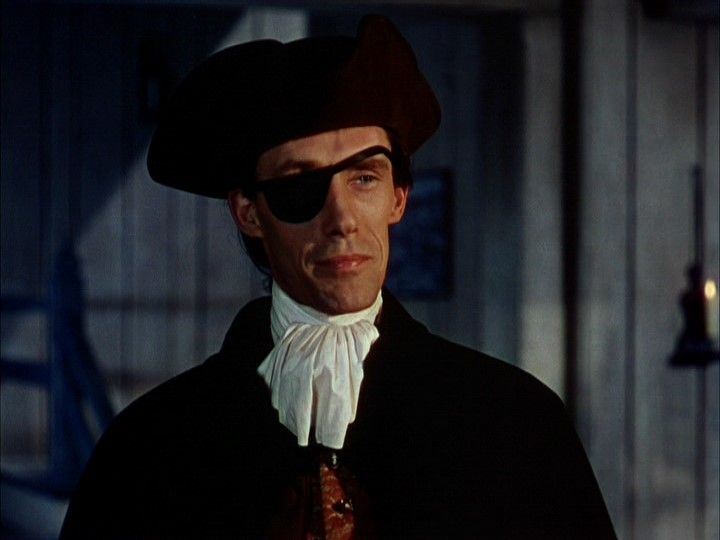
It won't be easy for either organization, with threats, both internal and external. There are attacks by Natives against the encroaching settlers (but, even here, Ford has them blameless—if brutally opportunistic—as the Iroquois are taking their orders from a Tory agent, played by an eye-patched John Carradine, who is paying the tribe for their berserker destruction of the homesteads, burning everything—buildings, crops and possessions—down to the bare Earth, leaving nothing, not even anything the tribe could steal or profit by), internal strife among the villagers, and the hard-scrabble existence that tests the fiber of the town-folk.
Before long, the citizens are driven to the local fort housing the militia, always at the ready for a call to arms from General Washington. In the meantime are the struggles to maintain a family, order, and petty grievances that threaten to disrupt the community from within. But, a shared sense of purpose—community-building reflecting the larger picture of nation-building, pulls the majority of them through.

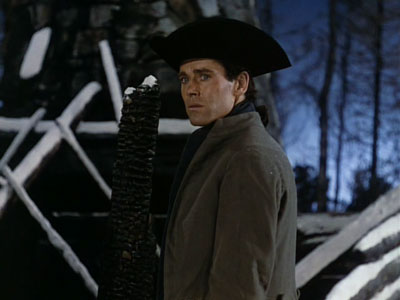
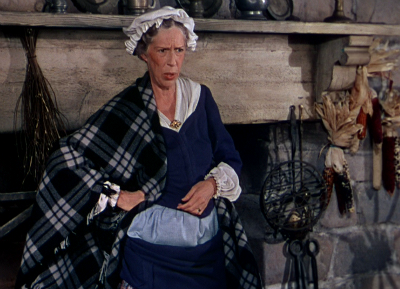
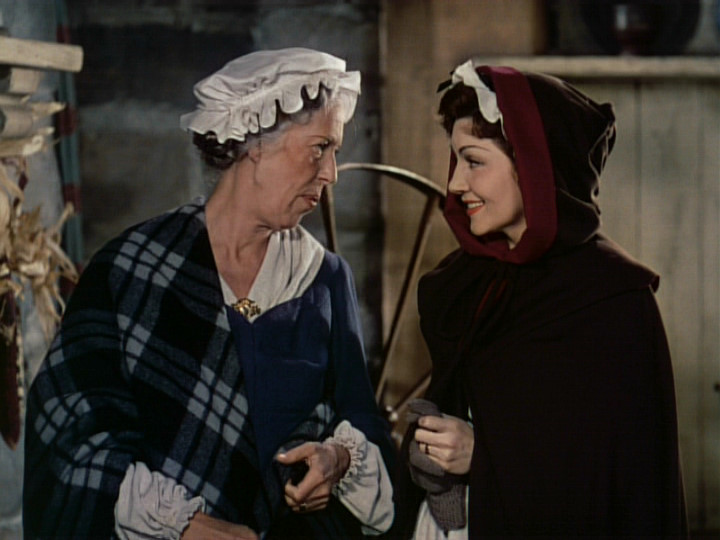
Early on, Gil and Lana are burned out of their humble cabin-home, built by Gil. They take up lodgings with the widow McKlennar (Edna May Oliver) as workers and soon, are back on their feet, on a par with everyone who has suffered hardships.
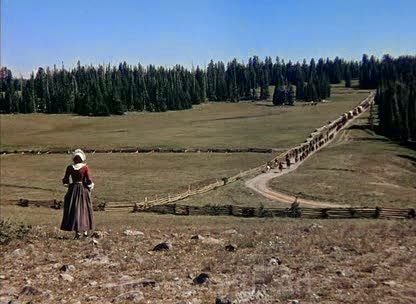
This is Ford's first film in color, and it's eye-popping Technicolor, and the director, who was discriminating in his choice of which format to use—his last two were in monochrome—fills the screen with detailed color; the very first shot, after the needle-pointed credits, is a pull-out from the bouquet that Lana is holding at her wedding, and there are fiery sunsets and sunrises framed in the same Ford-fashion, with just the right amount of horizon for contrast. The greens are the most verdant, and fire seems to play an important part of the scheme of things, the flaming colors unnatural against a pastoral backdrop.
Fire figures in a violent double-whammy that strikes one unexpectedly towards the end of the film, as a scout (played by Francis Ford, the director's brother) is wheeled out in front of the fort in a wagon of straw, which is then set alight by torches and flaming arrows.* Just when that scene is set in the mind, one of the settlers (played by Ford stock-player Ward Bond) is shot in the shoulder with a flaming arrow. A flaming arrow. Okay, sure, the arrow is a special effect on a wire, but the fire is real and Bond and his clothing are just as flammable as the next guy and his clothing. The level of violence is turned up just a notch from what one might expect, and one is taken aback by it.
Ford could do that—make you feel all-complacent and tear the Navajo-rug out from under you.

But it's a great movie. Action-oriented, with the only difference being that the significant events—the bigger picture—is all happening off-screen, rather than being part of the tapestry of events. Ford would be doing that in the future (both in his career and the events that shaped the country), but this is a very fine beginning.
Ford's first film in color—and Technicolor, at that—does not disappoint.


* It works just as dramatically here as it did in 1987, when Kubrick used something similar in Full Metal Jacket.