Showing posts with label Peter O'Toole. Show all posts

Thursday, July 4, 2024

Becket (1964)

 
"In the year 1066, William the Conqueror crossed from France with his Norman army and conquered the Saxons of Britain at the Battle of Hastings. Henry II, his great grandson, continued to rule over the oppressed Saxon peasants, backed by the swords of his Barons and by the power of his imported Norman clergy."

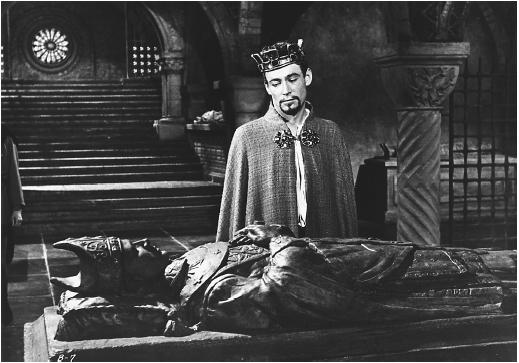
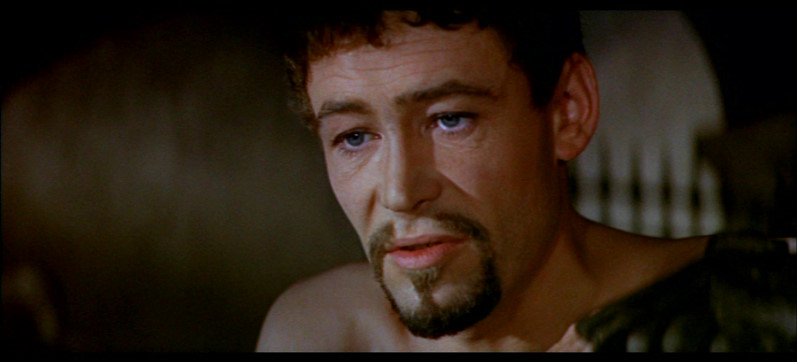
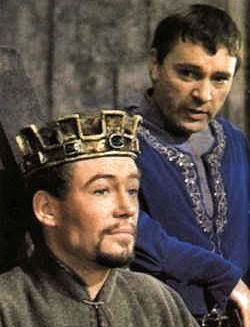
Why bother about religion when there's so much wenching to be done? Wenching and bellowing at the TOP of your lungs while you're at it! King Henry II (Peter O'Toole, who would play the role again a few years later in The Lion In Winter) is having a bit of trouble with his Archbishop of Canterbury—who objects to his lands being taxed. So when the elderly Archbishop dies ("He'll be much more use to God than he ever was to me"), Henry appoints as his replacement his old friend, fellow debaucher, and new chancellor Thomas Becket (Richard Burton)—"He's read books, you know, it's amazing. He's drunk and wenched his way through London but he's thinking all the time." A cozy and advantageous arrangement for both parties. What could possibly go wrong with that?

Well, Becket, actually. And it's a matter of going right. Thomas, being a Saxon—actually, he was Norman, the original playwright Jean Anoulih got it wrong—causes some grief to Henry's Court, when he should be winning his people over to the King's side. And then Becket finds religion as archbishop and gets all self-righteous on Henry, taking the Church's stance on conflicts with the King.
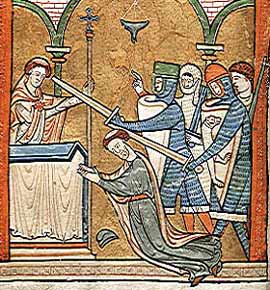
This turn of events—and character—does not sit well with the "perennially adolescent" first Plantagenet King, and in a drunken rage shouts, "Can no one rid me of this meddlesome priest?" and he has
barons who are perfectly willing to take on the job. Becket, in death, becomes a folk-hero to the Saxons, and Henry, in his remorse, and for political expediency, has himself flogged and petitions for Becket's sainthood. 
Am I giving anything away? The story's only 800 years old
! O'Toole and Burton have a fine time playing "Can you top this?" with each other in scene after scene, Burton controlled and stentorian and O'Toole indulgent and capering. Add John Gielgud as the King of France and you have some of the best British actors doing top-notch work rolling around some very rich dialogue abetted by some glorious cinematography by Geoffrey Unsworth. Yes, it's talky (in the best way), but with this cast, it sure is entertaining conversation.
These days, one can't help but be reminded of the stark contrast between the story of Becket and the far-in-the-future States in that Kings have the prerogative of "offing" their opponents and it is only Henry's largese and his own self-loathing that makes him accept a punishment for his actions, narcissist though he may be. Oh, those were the good old days.


Friday, May 10, 2024

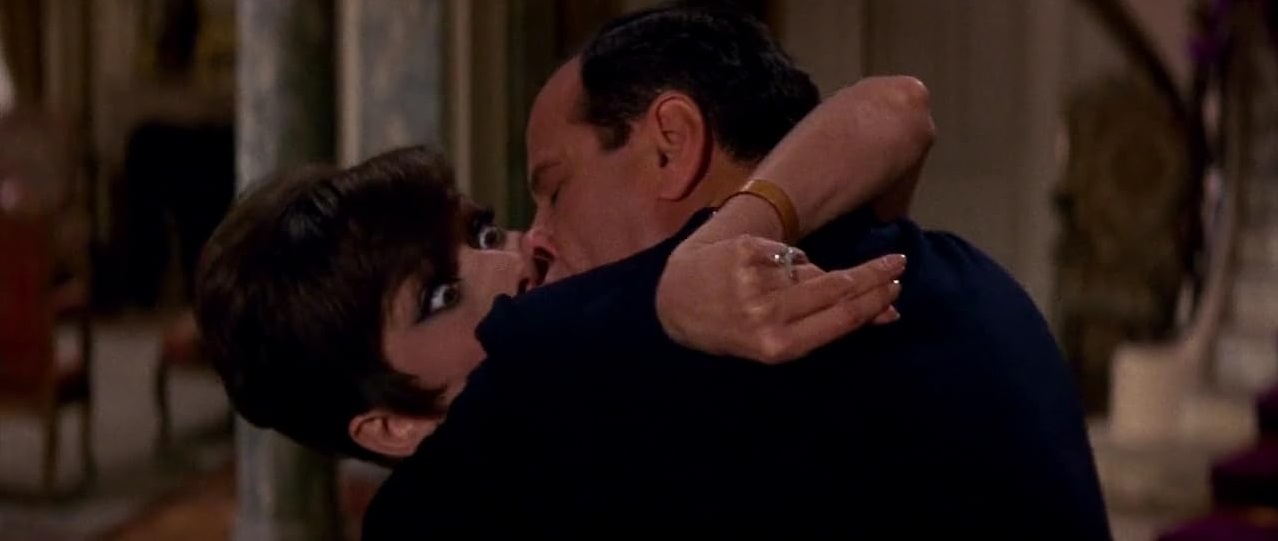
How to Steal a Million

How to Steal a Million (William Wyler, 1966) Writer Harry Kurnitz (who the story for Hatari!, the novel for A Shot in the Dark, and the screenwriter for Witness for the Prosecution and a couple entries of the "Thin Man" series) could be counted on to deliver a solid story that never really amounted to what it promised...that is, other than to entertain and entertain mightily. Especially if all the elements were in place—good photography, cracker-jack actors, an ornate location or two. He didn't write important pictures. He wrote fluff. Good fluff. That would satisfy audiences, and make critics suspicious that they were being conned.

The story goes that director William Wyler, after directing Audrey Hepburn to an Oscar for Roman Holiday, wanted to re-team her with co-star Gregory Peck for another rompish movie, this time set in Paris. In the forseeable future, however, Hepburn and Wyler worked on The Children's Hour together, Wyler had directed a little film called Ben-Hur, and Peck had won his Oscar for To Kill a Mockingbird. Somehow, the elements wouldn't gel until Wyler put together Hepburn and Peter O'Toole—who was toiling in an endless stream of drama parts, and was probably attracted to the idea of something lighter for a change.
What the fuss is all about...
The story concerns one Charles Bonnet (Hugh Griffith), whose French estate contains some of the world's most renowned art treasures, and who, also, maybe coincidentally, is also one of the world's most unknown art forgers. His daughter Nicole (Hepburn, all Givenchy'd up and no place to go—O'Toole's character makes a crack about it later in the movie) is constantly worried that Dad is going to go too far some day and the Paris gendarmes will come knocking at their door and the family's wealth and reputation will be as worthless as one of Daddy's forgeries.
Wyler, exploiting the film's wide-screen presentation,
must really love that staircase.
So, imagine her dismay when guards, police and armored cars come to the drive-way. Charles assures her that he is merely lending one of his collection, "The Cellini Venus", to the Kléber-Lafayette Museum* for display and the heavy armory is for safe passage. Except for one tiny detail—that "Cellini Venus" is a forgery, too, sculpted by Charles' father and the model for it being his mother. What's more, it is probably more susceptible to being realized as a forgery than one of the family's many paintings. Her father is not worried, and the small Venus is whisked away for display. Nicole is not so reassured.
It doesn't help that while father Charles attends a celebratory soiree at the museum, Nicole** must confront a burglar, one Simon Dermott (O'Toole), caught in the act of examining one of the Bonnet Van Gogh's. In a tuxedo, he's exceptionally well-dressed for burgling, a move no doubt inspired by Charles' absence for the night. But, he's charming enough to be able to disarm the situation, although she does manage to ruin the line of sight by accidentally shooting him in the arm. "Oh, it's just a flesh wound" Nicole scolds. "But it's MY flesh!" he retorts.
Nicole should be worried. Dermott is something of a fraud himself. Plus, the Bonnet household is being circled by art dealer DeSolnay (Charles Boyer), who has decided to look into the Bonnet provenance and have it investigated. And a rather eccentrically driven American wheeler-dealer (Eli Wallach) wants to obtain the "Venus" by any means necessary—including marrying Nicole. 
And then, there's the major complication: insurance. Charles Bonnet is not worried about the Venus being determined a forgery, as he is merely loaning it out and it need not be examined for authenticity. He thought. But, as the museum has to insure the statue from theft, it must go through the formality of a "technical examination, which will expose the fakery. Bonnet has already signed the papers, inadvertently giving the Museum permission to its study, so surely that will expose the family.
Nicole then decides—mad-cap that she is—to hire Demott (the only burglar she knows) to steal the statue before it can be found out. It takes about an hour of cute dialogue, spry encounters, several costume changes and that nearly lethal incident of "meet-cute" before we get there. The rest of the movie documents the long, drawn-out robbery which relies on false alarms—and we see all of them.
There is magnetism involved among the principal actors—Hepburn pirouettes in her own spotlight, and O'Toole observes, amused. Wyler, on the other hand, is content to make sure we see how expansive the sets are, like he was still filming Ben-Hur. Those sets, however, never seem more than nattily-dressed cavernous sound-stages (his next film would be the equally ornate Funny Girl). How to Steal a Million is a trifle, with all the consistency of just-applied meringue, and with as much confectioner's sugar.
One interesting thing to ponder is what might have been. For the role Wallach eventually played, Walter Mathau (who was in Hepburn's Charade and starred on Broadway in Kurnitz's "A Shot in the Dark" was approached but wanted too much money. Cast instead was George C. Scott, who, unfortunately, turned up late for his first day of shooting...like, after lunch. Wyler, who was already worried that O'Toole and Griffith, two notorious drinkers, were in danger of derailing the project, would not abide such behavior in a third, and promptly fired Scott, which, apparently, greatly upset Hepburn.
 
One can only imagine...
Face it. Whatever the plot, this is what audiences wanted to see.
 
* It's fictional, but then so is The Cellini Venus...

** Interestingly, she is again caught in her bed reading a book involving Alfred Hitchcock (as was also the case in Roman Holiday). I don't know if this was a nod to his fellow director by Wyler, or if Hepburn was attempting to court Hitch to appear in one of his films (although the film Charade is considered the next best thing), but the two never collaborated. Maybe because Hepburn would not have let Hitchcock decide what she wore.

Wednesday, May 18, 2022

Venus

Roger Michell died last year at the age of 65, before his latest film The Duke was released. It is out now and I recommend seeing it, especially in a theater, where it will do the most good. Michell's most popular film is probably Notting Hill, but he also made The Mother and Enduring Love (for you Daniel Craig fans), Hyde Park on Hudson (with Bill Murray as Franklin Roosevelt), and Morning Glory (with Rachel McAdams, Harrison Ford and Diane Keaton)—which we'll be looking at tomorrow. To sum up, he made movies that are usually placed in "art-houses" where films of a limited budget and less than frivolus subject matter, unsullied by hyperbolic press and saturation campaigns go to die...and merit consideration during Awards Season, where sometimes their fortunes are favored, but mostly forgotten. And he was darned good at it. 
 
Here's a look at one of his films—featuring another amazing performance of Peter O'Toole. It was also the feature film debut of Jodie Whitaker, who made history as the 13th Doctor Who. This was written at the time of the film's release on DVD.
 
Venus (Roger Michell, 2006) Peter O'Toole, in an interview in the special features section of the Venus" DVD sums it up as a story between "a dirty old man and a slutty young woman." Exactly, and if it had been sold like that it would have made much more money at the box-office. As it is, the film has to stand on its own merits, which are considerable. Hanif Kureishi's script is literate but low-down, full of humanity in all its frailties, both young and old, well-played by a stellar cast. And that's where the elements of specialness occur:
1) O'Toole--he plays an elderly thespian who, these days, "specializies in corpses," who has lived an impulsive romantic life, and in the winter of his discontent, still does. O'Toole makes the most of the words, but, more than any other actor, knows what to do between the lines. O'Toole is frail, but not THIS frail, and his tremulousness is a stunning act of craft over pride. He's not alone.
2) Playing the ex-wife he abandoned with three kids ("under six," she reminds him) is Vanessa Redgrave, the greatest actress extant, who does the part sans make-up, unglamourously and brilliantly. To see O'Toole and Redgrave play a scene together for the first time is a great event, and should be required viewing for all aspiring actors. These two actors, once coltish and prancing, now old and playing broken down is heart-breaking, but exciting (I'm starting to sound like bloody James Lipton!)
3)
Jodie Whittaker, in a seemingly artless way, matches them. That is not an insignificant thing. Picked, no doubt, because she resembles the young Vanessa Redgrave, one waits for the scene where the two meet. The viewer is not disappointed.

4) A scene where O'Toole, humiliated, goes for a walk and finds himself at a small, humble proscenium--the benches covered and strewn with leaves and garbage, as the soundtrack becomes awash with O'Toole's voice from past performances of different eras and different fidelities that's as fine as any piece of film I've ever seen
5) A waitress at the old actor's favorite eating hole sees a picture of the young actor in the paper. "Gawd, he was GO-geous, wasn't he?" Someone should make another starrer for O'Toole and call it "Give The Man The Friggin' Oscar He So Richly Deserves, Already" and be done with it.
2022 Update: Peter O'Toole was nominated for 8 Best Actor Performances and received an "Honorary Award" in 2003.

Thursday, April 29, 2021

My Favorite Year

I felt so bad about trashing the Peter O'Toole movie Lord Jim—I think O'Toole is "the finest man who ever breathed"—that I went scouring for an old review of another of his movies, and I found the one where he played a fictional version of Errol Flynn (featured Tuesday). Ya know, you watch a lot of movies and coincidences just happen...

My Favorite Year
 (Richard Benjamin, 1982) Surely one of the best jobs during the early 1950's was being a writer for "Your Show of Shows,"* broadcast live Saturday nights on NBC. Starring Sid Caesar, Imogene Coca, Carl Reiner and Howard Morris, the writing staff contained such wits as Reiner, Mel Tolkin, Larry Gelbart, Danny Simon, his odd couple brother Neil Simon, Lucille Kallen, and Mel Brooks.** The work environment was so fondly remembered it has consistently been used as comedic inspiration. First, Reiner used it as the work environment for "The Dick Van Dyke Show." Neil Simon wrote the stage-play "Laughter on the 23rd Floor."*** And Brooks took the kernel of a script by Dennis Palumbo about a going-to-seed celebrity and his "minder" and morphed it into his remembrance of "Your Show of Shows," My Favorite Year.**** Brooks served as neither writer, nor director, but as Executive Producer, he completely re-imagined the film as this sunny, hilarious remembrance, dripping with nostalgia, of being a cocky kid in New York in the '50's working for a hit comedy show. 
"King" Kaiser (Joseph Bologna) is the high-strung, neurotic star of a network variety show, and one week it falls to writer's assistant Benjy Stone (Mark Linn-Baker) to "manage" movie star Alan Swann (Peter O'Toole) through the rehearsals and broadcast. Two problems: Swann's a perennial lush, and he's never acted before a "live" audience. Fortunately, Benjy is Swann's biggest fan and forgives a lot of bad behavior, but Swann's "bad boy" behavior, insecurities and inebriation keep throwing up barriers.
O'Toole was initially hesitant to take on the role of the Errol Flynn-like Swann (he was convinced by an odd coincidence--the date of Swann's death inscribed on a tombstone--in a scene cut from the film--was also O'Toole's birthday. He was, again, nominated for a Best Actor Oscar for his performance. Richard Benjamin solidified his transition from actor to director with this film, which also featured Jessica Harper as the apple of Benjy's eye, Bill Macy, Anne De Salvo and Basil Hoffman as the show's writers, legendary composer Adolph Green as a producer, Lainie Kazan as Benjy's mother, Cameron Mitchell as a mobster unhappy with his portrayal on the show, and even former "Show of Shows" performer Selma Diamond in a small role. 
But the highlight is O'Toole's swashbuckling star. Looking gaunt and rheumy-eyed even when he's not plowed, Swann benefits from O'Toole's charm, crack timing and physical comedy—O'Toole can do a prat-fall and make it look deadly—but the actor makes the drama work as well. Swann's freak-out at being told he's performing "live" ("I'm not an actor! I'm a movie star!!") is both comic and tragic. And he plays off well with a sharp cluster of East Coast character actors. 
The all-pervasive air of nostalgia begins immediately with the opening of Nat King Cole's "Stardust" over animated credits, and continues to the last frame with a joyous semi-sadness. My Favorite Year works on so many levels--as a drama as well as a comedy, as a fond remembrance as well as a fond farewell. And any movie that has a decent role for O'Toole to show how good he is, dramatically or comedically deserves a place on any list of 'favorites." 

* To give you a glimpse of "Your Show of Shows" here's Carl Reiner, Sid Caesar, Howie Morris and Louis Nye performing a sketch called "This Is Your Story." 


And here's Errol Flynn guesting on TV's "The Colgate Comedy Hour" with Abbott and Costello

** And Woody Allen became a writer for the 60 minute version of the show, "Caesar's Hour." 

*** Coincidentally, when "Laughter on the 23rd Floor" was video-taped for PBS, it was directed by "My Favorite Year" director Richard Benjamin, and featured its star, Mark-Linn Baker. 

**** The original screenplay took place in the early 1900's, and Wyatt Earp was the personage to be "minded."

Wednesday, April 28, 2021

Lord Jim (1965)

Lord Jim (Richard Brooks, 1965) Orson Welles wanted to make this Joseph Conrad story about a disgraced seaman out to prove his worth to himself and the world, and he wanted to do it with Charlton Heston—they'd talked about it while making Touch of Evil together and Welles was particularly taken with Heston's vouching for him during the turbulent making of that picture. That sort of loyalty is unusual in Hollywood and Welles must have thought Heston a good match...and good box-office. 

Conrad's novel had been adapted once before—by Victor Fleming in 1925—and Brooks optioned it in 1957. His clout with such classics as Cat on a Hot Tin Roof, Elmer Gantry, and Sweet Bird of Youth allowed him to make this one, which required extensive location shooting. Acquiring Peter O'Toole, hot after Lawrence of Arabia and Becket, allowed Brooks to acquire a $9 million budget, which ballooned the scope, and Lord Jim was designed as a "roadshow attraction," complete with Overture, Intermission, and Exit Music.
The story is narrated by Marlow (Jack Hawkins)—the same Marlow of Conrad's "Heart of Darkness"—as he relates the tale of young James Burke (Peter O'Toole) merchant seaman, young, enthusiastic, obedient, resourceful, who becomes Marlow's first officer before becoming injured and left to be treated in Java. 
His next assignment is less fortuitous: he's hired as first mate on board the rickety S.S. Patna, transporting—as the novel puts it—800 "pilgrims of an exacting belief," Muslims, to Mecca, when the ship hits a storm and has a collision on the Red Sea. Checking for damage, Jim sees that they're taking on water, and, telling the captain that they should get the passengers to the lifeboats, is surprised when the captain and other crewmen are more intent on saving themselves. The film makes it debatable whether Jim jumps in with them, or is washed onto the lifeboat is a squall, but the result is Jim is on the lifeboat, the Patna and its passengers, abandoned to their fate.
Making port, they find that the Patna, having survived the journey with the help of a French ship, has arrived before them. The Captain and the other crew disappear to escape the infamy for their actions, which, by now, has gotten around throughout the port, but Jim insists on a trial to atone for his abandoning ship, and he is roundly condemned, stripped of his sailing papers, the chief judge telling him that, instead of an inquiry, he should have just buried "himself 20 feet deep."
Jim does the next best thing, becoming a drifter from port to port, losing himself and running away from his shame in anonymity. An incident where he saves a skiff loaded with beer and gunpowder from exploding in the harbor attracts the attention of a Mr. Stein (Paul Lukas), who just happened to be receiving that gun-powder. It's destined to be shipped to Patusan where the people, led by Stein's friend Du-Ramin (Tatsuo Saitō) are trying to defend themselves from a warlord, "The General" (Eli Wallach), and Stein hires Jim to accompany the shipment to make sure it reaches its destination, there having been some sabotage in the past.

There are attempts made on the journey, as the weaselly Cornelius (Curt Jurgens)—who used to work for Stein as his representative before he was caught skimming supplies—now is aiding "The General" in his attempts to overthrow the natives. Jim hides the cargo, but is captured, and although tortured for the information, does not reveal where it's hidden.
Jim is rescued by "The Girl" (Daliah Lavi)—in the book, her name is Jewell, but the movie doesn't even give her character a name!—and Jim leads the Patusans to the supplies and launch an attack on The General, killing everyone but Cornelius. Jim is welcomed by his fellow combatants and given the title "tuan" by the Chief, which means "Lord."

Intermission.
If you want a happy ending that would be where you ended it. If you wanted a happy audience you might have ended it there, as well. Reportedly (and this may be apocryphal) it was at this point at the London premier that James Mason's parents were so bored by the picture, they left, completely missing their son's performance in Part II. Maybe a bit impatient, but one does get the impression that Lord Jim will never end, so elongated and detailed is the film, with sequences running a trifle indulgently, and every line of dialogue treated as if it were precious. This becomes readily apparent after the Intermission.
Jim stays in Patusan, beloved by the people and The Girl. Unbeknownst to him, Cornelius and Schomberg have brought in the cut-throat pirate "Gentleman" Duncan Brown (James Mason)—"he's given more business to Death than the Bubonic Plague"—to raid the village of its treasures, and although their attempts fail, Jim negotiates with the blackguards that they may leave if they never return again. The villagers and Du-Ramin argue for attacking the pirates, but Jim wants no conflict and vows to the chief that if anyone dies because of his mercy, that he will sacrifice his own life in forfeit.
So, Jim trusts the pirates to just go away, huh? He also sets up contingency plans that, should the pirates attack, the natives can fight them back. Meanwhile, Jim looks moony and talks about the position he is in, given his second chance: "I've been a so-called coward and a so-called hero and there's not the thickness of a sheet of paper between them. Maybe cowards and heroes are just ordinary men who, for a split second, do something out of the ordinary. That's all." But, there is a great deal of difference between a romantic idealist and a conscienceless pragmatist, and Jim frustratingly never finds a middle ground. If you wanted a happy ending, you should have taken a cue from James Mason's parents and left at intermission.
It is a long tedious slog to come to that conclusion and although some of the dialog in the second part crackles with cynical brio and Mason's performance is worth watching, one has to spend so much time with O'Toole's doubting Jim—trying ever-so-hard to bring some internal depth to this character that you get stymied by the dependence on the fragile blue eyes shining out of the screen without any of the nuance or creativity the actor brought to his previous performances—that, ultimately, you lose faith in Jim, O'Toole, and the movie.

Brooks is no help here. His staging is perfunctory, whether in Cambodia or Shepperton Studios in Surrey and the one interesting shot is in the beginning with a weirdly evocative shot of a "lost soul"—which Jim could have become—walking like a zombie along a Malaysian pier. One wishes that same sort of frisson could have shown up a bit more...or ever...but it's just a tantalizing moment in a film so confident in its ambitions that it never tries to achieve them.

Thursday, July 2, 2020

Stardust (2007)

Written at the time of the film's release...

"Getting killed by pirates...heart eaten by a witch...meet Victoria--I can't seem to decide which is worse!"

Matthew Vaughn's film of Stardust is so far removed from his last film, Layer Cake, that it would take a Babylon Candle to bridge the two (Don't know what a "Babylon Candle" is? Then you'll have to see the film. You should anyway). 

Layer Cake (an updated aside—it's the film where, suddenly, Daniel Craig, managed to emerge from behind the furniture into a eye-catching starring performance) was a whooping, swooping kitchen-sink-and-Porsche's story of drug-dealing in contemporary London. And while some of the stylistic touches are the same for Stardust, the story couldn't be more different. For instead of modern-day Britain, he is spinning his camera through Neil Gaiman's Faerie-Land.
Gaiman's reach is all things mythical, from the twee to the atrocious--across the stars, underground, beyond the pale and underneath your fingernails. He borrows from all sources, and puts them through his own personal salad-shooter and spits them out with his own dressing. In his work you'll find echoes of Shakespeare, Marlowe and Milton, G.K. Chesterton and Jorge Luis Borges and the Brothers Grimm, Greek mythology and Roman gods, History and Urban Legend, The Arabian Nights and the Book of the Dead, The Bible and the DC/Marvel Multiverses. 
I've been reading Gaiman with delight (no pun intended) for years, starting with his "Sandman" saga, which dragged on for maybe a dozen more issues than necessary because he had so many stories he wanted to get to, but I also love his "Violent Cases," and much of his book-work. It is with some trepidation that one watches his forays into film--Jon Peters owns the film-rights to "Sandman," for instance, and Gaiman wrote the English translation for Princess Mononoke, and worked on "Mirrormask," and there's talk of filming "Good Omens," the book he co-wrote with Terry Pratchett.* That's scary talk. For what it's done to the works of Alan Moore, Hollywood looks like a gold-plated abortion clinic, and one wonders if they could do any justice to Gaiman's work. Even to attempt to film his "Signal to Noise" would be to destroy it.
Stardust makes the transition fairly well, though it eliminates the faeries and sprites that populate Gaiman's world like smoke, dust and flotsam do in Ridley Scott's (they also serve as little "Rosencrantzes" and "Guildensterns"). They throw in a sock-o finale, and the film has none of the delicacy of Charles Vess' illustrations from the graphic novel that Gaiman expanded to book-length. In fact, it has the sensibility several refinements up from Monty Python-design. But it does retain Gaiman's special form of "myth-busting," the wink-and-a-nod to the "real" world that suffused The Princess Bride, but without the Borcht Belt cinched around its waist.
What's interesting is how Paramount is selling it...or not selling it, as the case may be. Looking at the poster, you'd think it was one of the endless string of pre-teen or teen fantasy novels adaptations that are filling the Previews, or as reverent as Chronicles of Narnia, when nothing could be further from the truth, (but there are enough spinning helicopter shots of big landscapes to reassure the Suits that it has a "Lord of the Rings" quality). It's frequently hilarious in surprising and snarky ways, especially in the casting. 
Michelle Pfeiffer may not be the best at holding an accent, but her comic timing, and willingness to play against her looks is delightful. Robert DeNiro makes an entrance and you worry that he's been put in the wrong movie, but then he comes through with flying colors. Peter O'Toole does wonders with his limited screen-time as the Lion-King of a family of blue-bloods, and Rupert Everett shows up long enough to tweak his image hilariously. It's a fun, fine, un-gooey fairy tale that charms and delights. It's not doing well at the theaters, so do yourself a favor and go. Don't wait for Paramount to get their act together to convince you.


* "Good Omens" was made into a TV Mini-series in 2019 on Amazon Prime.