Showing posts with label Ralph Meeker. Show all posts

Tuesday, June 18, 2024

The Detective (1968)

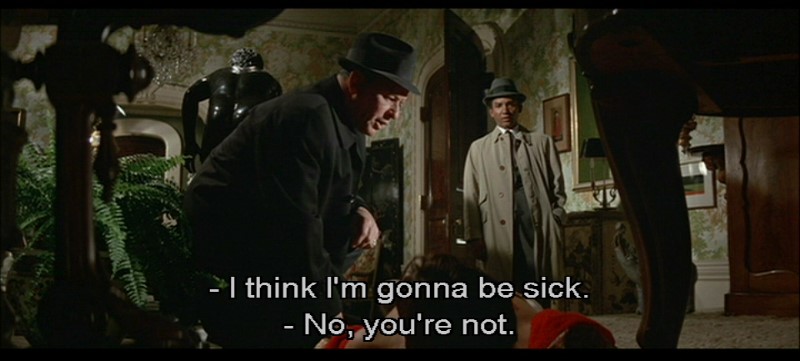
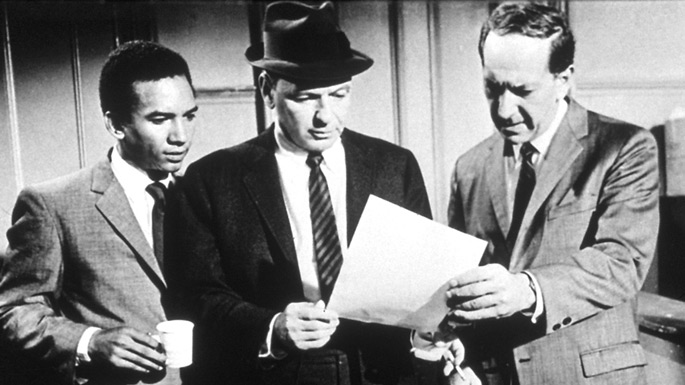
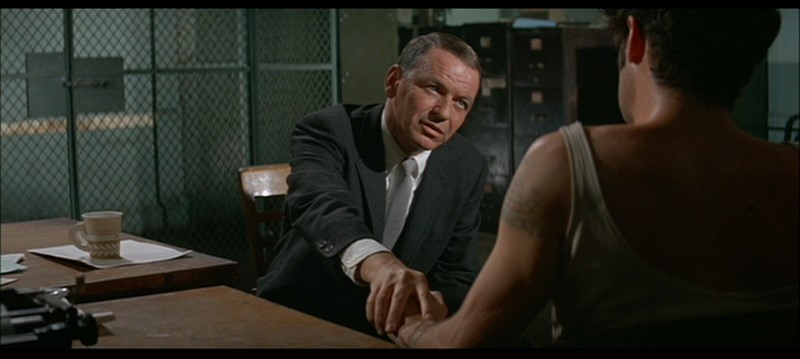
The Detective (Gordon Douglas, 1968) You spend a lot of time looking into the wearily dead blue eyes of Frank Sinatra in this one, as he tries to come to grips with a world he no longer understands, driving in the rain, looking for the clue to where it all went wrong.

There are some notable behind-the-scenes things that merit a footnote in Sinatra's career and in movies. For one thing, the film rights to the novel were bought by a guy named Robert Evans, a former actor associated with the Evan-Picone fashion line, and he got the ball rolling on the film for 20th Century Fox. But, before any film started rolling, he was offered the title of head of production by Paramount Studios (where he would oversee Paramount's glory days shepherding such films as True Grit, Love Story, and The Godfather, among others). Once at Paramount, he concentrated on their planned film of Rosemary's Baby, which starred an actress who'd become popular on television, but was also the then-current wife of Frank Sinatra, Mia Farrow. Sinatra was adamant that his wife appear with him in The Detective. She refused, convinced by Evans that she'd win an Oscar for her work in Rosemary (a tactic he used quite often, ironically, to persuade cast and crew to do his bidding). Farrow stuck with Rosemary's Baby and Sinatra served her divorce papers on its set. Jacqueline Bisset was cast, instead, sporting a wig of short hair that was reminiscent of Farrow's chopped hair-style.
The Detective hasn't aged well. What was daring and "adult" at the time of the film's release (the forced underground homosexual culture, along with nymphomania) now seems dated and "quaint," even. More compelling, and ground-breaking is the police procedural in the foreground—a murder investigation that has a ritual aspect to it. The victim's house-mate (Tony Musante) is noticeably absent, and Sinatra's Det. Joe Leland leads the investigation to track the man down, leading to his arrest, trial and execution. Textbook, it's thought. 
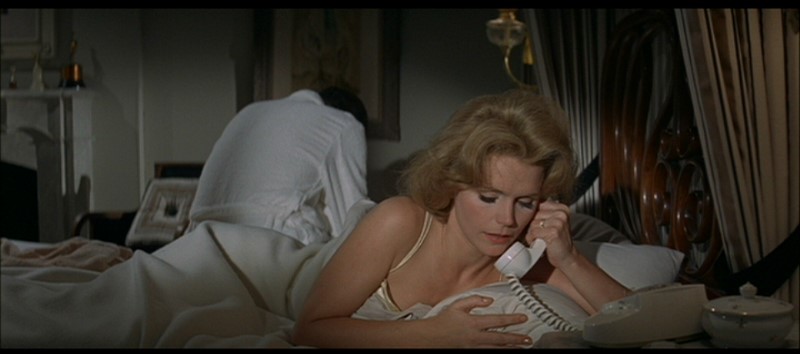
But, later, he's approached by Norma McIver (Jacqueline Bisset) the wife of a prominent suicide (William Windom), who committed the act very publicly, and Leland's investigation leads him to question his earlier actions and those of his authorities. All this, while reconciling his difficulties with his wife (Lee Remick). The fallibility of the cops to follow their prejudices, and pressure from corrupt superiors was something new to the genre. These cops had flat-feet of clay.
Director Douglas—not one for subtlety—overlays the execution
scene rather than just letting the character's grief tell the story.
The director, Gordon Douglas, was a favorite of star Sinatra, shooting quickly and efficiently, letting Sinatra do his set-up's in the minimal number of takes that he preferred. The cast also has prominent roles for Ralph Meeker, Jack Klugman, Al Freeman Jr. and Robert Duvall as other detectives in Leland's squad.
If the film has passed into the discount bin of film history, it does have one more tangential link to claim some significance beyond itself.
There were other novels in the "Leland" series by author Roderick Thorp, including one, "Nothing Lasts Forever," in which The Detective tries to save his family from terrorists in a high-rise professional building. 
 
That's right, it's the book on which Die Hard was based. Per his contract, Sinatra had first refusal reprising the character and as he would be the age of 73 at the time of filming, he passed. Now, just imagine if John McLaine had said "Dooby-dooby-doo" instead of "Yippie-Kye-yay..."

Thursday, September 30, 2021

The Anderson Tapes

The Anderson Tapes
(Sidney Lumet, 1971) The second of the five films that Sean Connery would ultimately make with Sidney Lumet, an unlikely pairing of the Scots actor and the New York director, but the two obviously enjoyed working together, as Connery's next project with him 
(The Offence) was one of the "vanity" projects he was allowed to make for returning to the role of James Bond in Diamonds Are Forever, and Lumet was Connery-picked to direct, no doubt in loyalty to the director, as their first project, The Hill, allowed the world to see that the star of the "007" films had a range that extended outside the spy field.
 
The Anderson Tapes, however, was a different creature, entirely. An extended heist film, in which Connery, Martin Balsam, and (introducing) Christopher Walken participate in what must be the slowest caper in history, the casing of a luxury apartment building in New York City. Connery plays Duke Anderson, a con just released from a ten year stretch in prison, who can't wait to do another score. The inspiration is his girlfriend Ingrid (Dyan Cannon), a high-end call-girl, who has been set up in a luxury apartment by another man.
But, things have changed in the ten years since Anderson was free. Unbeknownst to him, he is under constant surveillance by three different agencies: Ingrid's apartment is bugged by a private detective hired by her "keeper;" the FBI is tracking Black activists, whose headquarters is at a flop where the thieves meet; the IRS is phone-tapping the Mafia Boss (Alan King), who is funding the heist; and the Bureau of Narcotics is keeping tabs on one of the group's members. 
All of these groups are keeping a running record of the planning of the break-in...but none of them are coordinated or sharing information, 
 and the surveillance work is so concentrated on their individual subjects, that nothing is put together to prevent it from happening.  
 
It's hard to determine exactly what is being decried here—that our privacies are being invaded to such an extent, or that this intelligence isn't being cross-referenced to prevent actual crimes and thus is working to cross-purposes and is...dumb. One gets the impression that there is no stance being taken, rather that it's to present A Big Irony, that undercuts how events play out, eventually. 
But, that was Lumet's specialty—he frequently spaced his flat-out movie drama assignments with "Ironies," (as opposed to "Comedies") that, their point having been made half-way through the movie, wear out their welcome by the often dissatisfying end of the tale. Everybody looks a little stupid here: the agencies, for their tunnel-vision, the crooks for their own utter lack of surveillance as the crime goes about, and the NYPD, whose very elaborate storming of the apartment complex is literally over-the-top.
Lumet was not the best director for comedy as he had a tendency to sledge-hammer things—like Martin Balsam's mincing interior decorator/antiques smuggler (yeah, yeah, "it was the times," I suppose—prejudice always has "a time"), but there are some joys to be had, besides Connery doing something different and Walken's debut: appearances by Max Showalter, Margaret Hamilton (her last role), and "crazy old lady"(their own form of prejudice) Judith Lowry, as well as Ralph Meeker and SNL pioneer Garrett Morris as Gotham police.

Lumet would hit his stride later in the decade (with the sure editorial hand of Dede Allen), but this one is only moderately successful.
 

Saturday, June 17, 2017

The Naked Spur

The Naked Spur (Anthony Mann, 1953) Five desperate people in the Rocky Mountains. That's what Anthony Mann's 
The Naked Spur sears down to. Each one is flawed, if not down-right evil, and the twisted dynamics of their connections with each other are complicated and web-like. Isolated in the mountains, there is no Society or Civilization to get in their separate but intertwined ways or to pass judgement...or provide judgement. It's as if they're the last people on Earth, and (as the saying goes) it's not big enough for all of them.

Howard Kemp (James Stewart) is stalking prey in the mountains of Colorado. He runs into an old prospector, Jesse Tate (Millard Mitchell, one of my favorite character actors) and tells him he's tracking a man, Ben Vandergroat (Robert Ryan), for the murder of a sheriff in Abilene. He offers Tate $20 to help find Vandergroat and Tate takes him up on it, thinking that he's a sheriff, himself. I mean, he has the "wanted" poster.


Kemp and Tate find Vandergroat "treed" (as it were) on the high peak of a cliff. Attempts to get up there are met with sudden and dangerous man-made rock-slides. Tate is too old to make the attempt, and although Kemp is desperate to get up there, he gets injured in the attempt, the first of many injuries he will sustain in the film. The two back-track to see if they can find a back-route to surprise Vandergroat.


Aid comes in the form of former Union Lieutenant of the 6th Cavalry Roy Anderson (Ralph Meeker) who is heading east after serving. Anderson is taking the more precarious route to avoid entanglements with the Blackfeet tribe, as it seems they're tracking him after he compromised the virtue of the chief's daughter. Naturally suspicious, Kemp grills him about his service and when he demands to see Anderson's release papers sees he's been dishonorably discharged for being "morally unstable." 
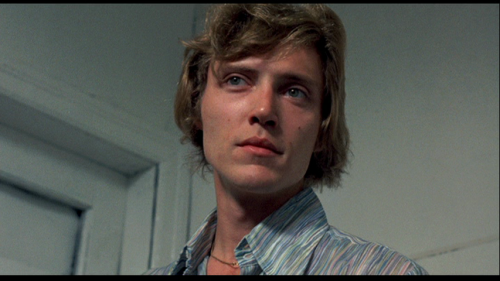
In this movie, he'll fit right in.

Anderson scales the cliff and gets the drop on Vandergroat (Ryan is creepily brilliant in the role, a standout among great performances). But, Vandergroat is not alone. Anderson is attacked by Lina Patch (Janet Leigh, all of 26 at the time of filming, it was already her 19th film), daughter of Vandergroat's bank-robbing buddy and the desperado takes advantage of the distraction to attack Anderson—one of Ryan's effective little touches is to laugh while he's engaged in a death-struggle with his opponent, which is unique and unnerving. Tate and Kemp manage to show up on time to keep Anderson from being killed, but once Kemp has Vandergroat captured, he begins to lose control of the situation.


"Now, ain't that the way? A man gets set-up for trouble head-on
and it sneaks up behind him every time!"
For one thing, Vandergroat makes it known that he's known Kemp a long time and has no respect for him, calling him "Howie." He also lets Tate and Anderson know that Kemp is no sheriff, he's just a bounty-hunter who wants the $5,000 reward for his capture so he can buy his land back, which he lost during his time in the Civil War. For Tate and Donovan, this immediately changes their view of Kemp and they start making noises about splitting the $5000 reward, something Kemp wants no part of, wanting the entire reward for himself.

Kemp's duplicity, Tate's greed, Anderson's "unstable" morality are all fertile ground for Vandergroat to work: he uses Lina as a pawn for the affections of both Anderson and Kemp, fills Tate's head with tales of striking it rich prospecting, and preys on Lina's loyalty for being the only man who's ever treated her right. By playing on each person's weak spots, he knows that eventually he'll get himself freed from capture and away from the hangman's noose.

And for Kemp, he's fighting other demons besides Vandergroat.  Before the War, he was just a farmer, but the War made him lose everything—his farm, his girl, his trust, his money...he's a desperate man whose only a few belt-notches away from being a gang-lander just like his quarry. He's just trying to get back to the place he was before the war, and if hunting a murderer for reward will get him that much closer, then hunt he will.

But, Vandergroat is as conniving as Kemp is distrustful and not so easily played as Tate and Donovan. It will come down to a battle of wits between the two men and any advantage Vandergroat can use against him is played—Lina's affections, Anderson's jealousy, Tate's pliable loyalty. There's also a psychological advantage; Vandergroat's extremely confident and Kemp is doubting, it's not a case of good winning out over evil, but of strength versus weakness, and Vandergroat takes advantage of every injury, accidental or deliberate to try and kill Kemp...by any means...or any ally...necessary.

The Naked Spur was the third of the five westerns Mann and Stewart would collaborate on during the 1950's, that period when Stewart was experimenting with material and directors like Hitchcock and Mann who would use his Americana persona as a counter-point to stories of obsession and neurosis that show that decency is just a raw nerve away from being exposed as fragile and undependable.

The isolation is key here. In previous Mann-Stewart westerns, there was a back-drop of civilization early on, rough-hewn and hard-scrabble as it may be. Here, in the mountains, there's nothing but the law that is made up on the spot. And it's jungle law. Survival of the fittest. Nature plays a hand in who will survive—both Nature in the wild and the nature of man. The terrain may be wild, but it follows rules of moderation and any excess is dealt with.  By the end of The Naked Spur, the environment is back in balance, with no chance of spinning out of control. Fires are tempered, and the Earth is replenished.

Anthony Mann had a lot of experience dealing with the nature of humans. He started his career in the dark and stormy nights of film-noir, where the worst instinct of people are on display and desperation is just a symptom. But, as this presents, darkness can be found in the light of the sun and the clean, unpolluted vistas of mountaintops. Light doesn't penetrate the darkness than can be found in souls.

For folks newer to film who might not relate, The Naked Spur is sort of like The Hateful Eight...only created by folks who are actually artistically creative...some 62 years earlier. 

The Naked Spur was added to the National Film Registry in 1997.


Tuesday, March 17, 2015

Kiss Me Deadly: The Brightest Noir, or The Anti-Life Equation

Kiss Me Deadly (Robert Aldrich, 1955) Kiss Me Deadly might be the greatest film noir film of all time. You know the genre—"When the streets are dark with something more than night"—implying that the lack of light goes far beyond foot-candles and is radiated by a void in the soul...or the permeating Evil in the World. Oh, there'd always been detective movies—but, they were usually played in a cocktail party environment, gussied up and prettified for the ladies...and there always had to be a pet. But, in the late 30's, with Hitler bringing real evil to our headlines and minds, that world changed, became darker, the booze cheaper, and the dames less dependable. After the war, we'd lost our innocence enough that the tarnished golden age of noir happened, its authors became legit, movie deals followed, and the resulting films rougher, because we could take it. Combined with what Hollywood saw coming out of the European neo-realist movement, things got grittier, less polished and the gangsters came out of the dark cracks of the wood-work to walk amongst us and make the lives of decent folk miserable, while in the mind's eye loomed the existence of mushroom clouds that could turn all of us, any of us, into ash and dust. By the time the 50's sneaked up on us, promising a better life (if we followed the rules), paranoia walked the streets, the board-rooms, and halls of government, setting the stage for Robert Aldrich's über-noir. 

Mickey Spillane, author of "Kiss Me Deadly" in all its popular crudeness, didn't like the film version. It slapped his book around for its tough-guy attitude that puffed up its chest in the face of truly nihilistic forces that could wipe the sneer off its mug and dared to question the sexist-macho attitude of its protagonist. The script is by one of the better novelist-scriptwriter vagabonds, A.I. Bezzerides (whose novels were turned into the films They Drive By Night and Thieves' Highway). "I was having fun!" Bezzerides said of his adaptation of Kiss Me Deadly, and, indeed, it is a lot of fun in a savage, even cruel way, that has no truck with the merits of its source-book, and boils it down into a Maltese Falcon-ish quest of thugs for a "great whats-it," that (as is ultimately revealed) is not riches, but power—at the time, the most dangerous form of power extant.

Our savior—the point-man walking down these mean streets—is a private dick in all senses of the term, the not-subtly named Mike Hammer (Ralph Meeker), the bluntest of instruments, and where that other tool of the trade, Sam Spade, beat up bad-guys and gunsels, Hammer makes no character distinctions, he's as indiscriminate as a force of Nature, turning people, places and prized possessions into disaster areas so he can sort through the rubble.
The caper doesn't start very subtley—it doesn't come to him, knocking politely on the door of his offices—he nearly runs it over on the highway. A damsel in distress (Cloris Leachman—yes, her—in her film debut) is running down the street in a panic and only a trench-coat.  She might have escaped from a mental institution, but Hammer, at her request, tries to take her to the nearest bus stop.  

"Get me to that bus stop and forget you ever saw me. If we don't make that bus stop…"  "We will," says Hammer dismissively, confidently.  "If we don’t," she pointedly says, "Remember me."

They never make it. 
Details aside, Hammer wakes up in a hospital bed, remembering—the girl is dead, tortured, and he has two motivations: revenge and to find the people who tried to kill him and succeeded with her. Hammer strikes out, becoming the bull with Los Angeles as his personal china shop, getting closer to the responsible parties but not many answers. A detective without a clue, things usually have to be spelled out for him with a constant litany of "you just don't get it, do you's." His informants and victims dance around the answers, talking circumspectly, while Hammer just scowls, wondering if there's a way to beat the answers out of them.
It's the way things have to be, because almost everyone is corrupt, no matter what their position on the intelligence scale, and that includes the guy behind the whole operation, Dr. G.E. Soberin (Albert Dekker), the type of character Sydney Greenstreet might play in earlier mysteries: brilliant, erudite, but not smart enough not to be brought down by baser instincts than his own. And, once he's gone, any hope of containing the evil about to be unleashed goes with him.
There are two endings to the film: in the first, Hammer and his sexy secretary Velda (Maxine Cooper) manage to escape from the traditionally burning building (burning quite non-traditionally) and seek refuge in the surf. But, somewhere along the way, the film was streamlined, so their fate is undecided and, indeed, the film screams "The End" in the middle of a growing apocalyptic nuclear conflagration. Does it ever end, or does Los Angeles go up with it, the match being struck by the sociopath who sold her soul for power.

It's the ending I first saw when I encountered the film and it's the ending I prefer: Kiss Me Deadly presents a world so far down the jungle path that even a thug like Mike Hammer can be considered a hero. Man has de-evolved so far but still managed to harness the power of God, that the inevitable happens. The film asks nihilistically, given how bad the world is, why not let the whole rotten system crash (sound familiar?). The quest for power has gone nuclear. Let 'em get what they deserve.
The opening of "The Great 'Whats-it:" a "Pandora's Box" that would "inspire"
filmmakers Alex Cox, Steven Spielberg and Quentin Tarantino.
Given the view of the film Kiss Me Deadly, if the world is so corrupt, maybe the justice should be dealt in an uncontained fusion, where the shadows are permanently burned into the landscape. And so the world ends—not with a bang, not with a whimper, but with a high keening shriek, echoing the many screams that have occurred throughout the film.

Even in the glare of a nuclear light, you can't get more dark than that.

Thursday, September 18, 2014

The Dirty Dozen

The Dirty Dozen (Robert Aldrich, 1967) Another one of those films I've had (uh..) dozens of opportunities to see, but never bothered is this, Aldrich's off-set war-genre film, combining the heroics of The Guns of Navarone with the nihilism of The Magnificent 7.  

The Army chooses a loose cannon, Maj. John Reisman (Lee Marvin) to train and command a squad of brig-rats on a suicide mission behind enemy lines before D-Day. The inmates are a motley crew of renegades, degenerates and non-com's (as in non-conformists), who need no training to be bad to the enemy. If they survive, their jail sentences (and for some, death sentences) will be commuted. If they don't, well, war is Hell.

But it's not a cell. And these guys have nothing left to lose, and given the situation, they're American kamikaze's, who might just make it to freedom, like any other soldier...if they make it through.

The movie is top-heavy with male character actors.  Besides Marvin, there's Robert Ryan, Ernest Borgnine, George Kennedy, Robert Webber, Richard Jaeckel, and Aldrich's Mike Hammer, Ralph Meeker. Those are the good guys. The cons include Charles Bronson, Clint Walker, Telly Savalas, Jim Brown, John Cassavettes, Donald Sutherland, and Trini Lopez (hey, where's Don Rickles and Bobby Darren?)
Bronson gets a promotion in this one, becoming the Steve McQueen to Marvin's Yul Brynner, Cassavettes has the biggest character arc and the showiest performance (despite underplaying his death scene) winning a Best Supporting Actor nomination, Savalas has the most colorful role as a Bible-spouting psycho, and Jim Brown has the moment everybody remembers—sprinting across a courtyard throwing grenades down air vents, moving so fast the camera crew can barely keep him in the view-finder.
Aldrich—never one to be very conventional no matter what genre he was tackling—manages to make his anti-war, anti-authority statements in the story set-up; these guys have little choice but to hang it all out in combat, and, ironically, they're the best-suited to do all the dirty work, even if nobody is shooting at them in the initial stages. At the time of its release, the film got all sorts of flack for its violence, which Aldrich manages to get away with by merely suggesting things with quick cut-aways, but it looks extraordinarily tame today (and, in fact, would look tame two years after its own release when The Wild Bunch would take movie violence to a whole new level). It might even get by with a light PG rating today.
But despite the dirt-dog-grubbiness of the whole thing, the director still manages to throw in some testosterone-laced sentimentality into it, then pulls back during the big action sequence as more and more men fall in battle and the director only affords them quick shots in death. Pretty soon, you lose track of who made it and who didn't, and a pre-End-Credits roll-call of the dead is the only verification—not everybody gets their death scene, further undercutting any sense of heroics, despite the war-time setting. And let's face it, most of the deaths occur by trapping the victims (party-guests mostly) in a cellar and burning them alive by drenching them in gasoline, and setting them alight with grenades. It's never made clear why this might help the Normandy Invasion effort, but one shouldn't look too closely at the movie for any sort of authenticity.