Showing posts with label Gordon Douglas. Show all posts

Tuesday, June 18, 2024

The Detective (1968)

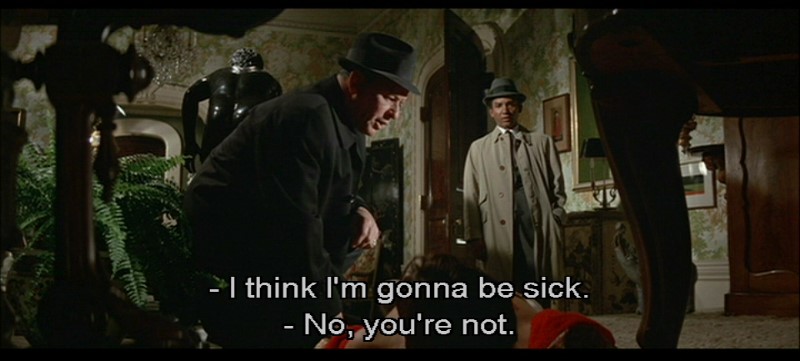
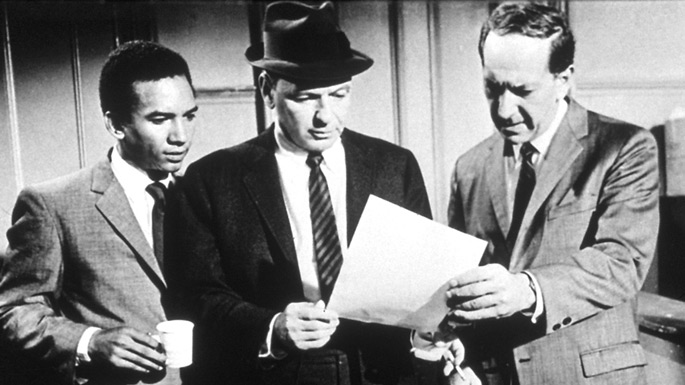
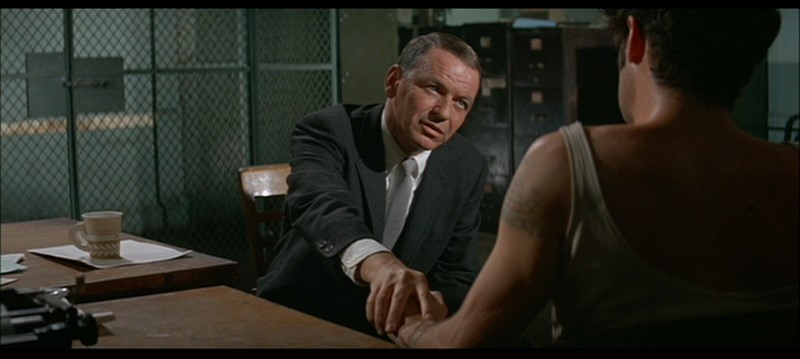
The Detective (Gordon Douglas, 1968) You spend a lot of time looking into the wearily dead blue eyes of Frank Sinatra in this one, as he tries to come to grips with a world he no longer understands, driving in the rain, looking for the clue to where it all went wrong.

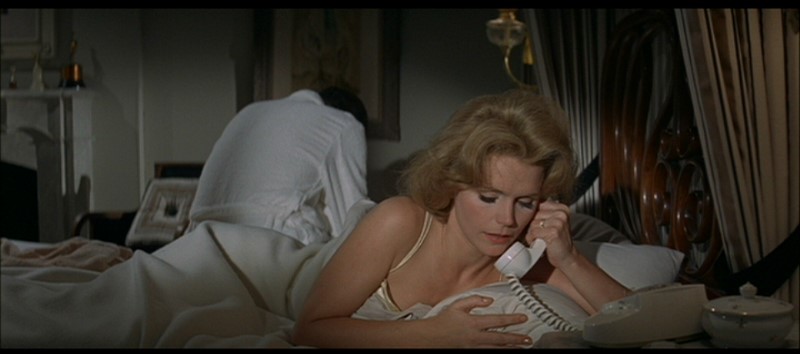
There are some notable behind-the-scenes things that merit a footnote in Sinatra's career and in movies. For one thing, the film rights to the novel were bought by a guy named Robert Evans, a former actor associated with the Evan-Picone fashion line, and he got the ball rolling on the film for 20th Century Fox. But, before any film started rolling, he was offered the title of head of production by Paramount Studios (where he would oversee Paramount's glory days shepherding such films as True Grit, Love Story, and The Godfather, among others). Once at Paramount, he concentrated on their planned film of Rosemary's Baby, which starred an actress who'd become popular on television, but was also the then-current wife of Frank Sinatra, Mia Farrow. Sinatra was adamant that his wife appear with him in The Detective. She refused, convinced by Evans that she'd win an Oscar for her work in Rosemary (a tactic he used quite often, ironically, to persuade cast and crew to do his bidding). Farrow stuck with Rosemary's Baby and Sinatra served her divorce papers on its set. Jacqueline Bisset was cast, instead, sporting a wig of short hair that was reminiscent of Farrow's chopped hair-style.
The Detective hasn't aged well. What was daring and "adult" at the time of the film's release (the forced underground homosexual culture, along with nymphomania) now seems dated and "quaint," even. More compelling, and ground-breaking is the police procedural in the foreground—a murder investigation that has a ritual aspect to it. The victim's house-mate (Tony Musante) is noticeably absent, and Sinatra's Det. Joe Leland leads the investigation to track the man down, leading to his arrest, trial and execution. Textbook, it's thought. 
But, later, he's approached by Norma McIver (Jacqueline Bisset) the wife of a prominent suicide (William Windom), who committed the act very publicly, and Leland's investigation leads him to question his earlier actions and those of his authorities. All this, while reconciling his difficulties with his wife (Lee Remick). The fallibility of the cops to follow their prejudices, and pressure from corrupt superiors was something new to the genre. These cops had flat-feet of clay.
Director Douglas—not one for subtlety—overlays the execution
scene rather than just letting the character's grief tell the story.
The director, Gordon Douglas, was a favorite of star Sinatra, shooting quickly and efficiently, letting Sinatra do his set-up's in the minimal number of takes that he preferred. The cast also has prominent roles for Ralph Meeker, Jack Klugman, Al Freeman Jr. and Robert Duvall as other detectives in Leland's squad.
If the film has passed into the discount bin of film history, it does have one more tangential link to claim some significance beyond itself.
There were other novels in the "Leland" series by author Roderick Thorp, including one, "Nothing Lasts Forever," in which The Detective tries to save his family from terrorists in a high-rise professional building. 
 
That's right, it's the book on which Die Hard was based. Per his contract, Sinatra had first refusal reprising the character and as he would be the age of 73 at the time of filming, he passed. Now, just imagine if John McLaine had said "Dooby-dooby-doo" instead of "Yippie-Kye-yay..."

Saturday, May 7, 2022

I Was a Communist for the F.B.I.

I Was a Communist for the F.B.I.
(Gordon Douglas, 1951) In one of those instances of Oscar head-scratching that involves rules (rather than taste...or lack thereof) this drama based on a Saturday Evening Post series, was nominated for an Academy Award...for Best Documentary Feature. Okay, there's some stock footage used for a couple of minutes, but the rest of it is a noir-shaded (with not a damn hint of red!) B-movie with not a hint of a real person, but only D-list actors that no one would recognize...unless you saw The Sound of Fury.
 
But, then it was the 1950's. Hollywood was doing a lot of back-bending in order to prove to right-wing government-types that they weren't being infiltrated by Communists in the same way that the State Department, the Truman Administration, and the U.S. Army weren't being infiltrated by Communists.
 
Hey, it must have worked! By the mid-50's, there were just 5000 registered communists in the country—1500 of them were F.B.I. informants.
Much like Matt Cvetic (
Frank Lovejoy, who—I gotta say—looks a lot like then anti-commie Senator Richard Nixon). For ten years, Pittsburgh steel factory supervisor Cvetic has served two masters—the FBI and the Communist Party. He's worked his way up in the Party ranks to become chief party organizer for Pittsburgh, where he uses his influence to promote party members to higher positions and recruit new Party members. It seems a natural fit as it's no different than being a Union organizer or the even more common Old White Boys Network...or The Elks. The only difference being that after recruiting or promoting, you don't find the nearest pay-phone (it's the 1950's, youngsters!) and alert the FBI.

Or do you?

Anyway, his case-runner at the local Fibby branch is Ken Crowley (Richard Webb) who lets him know that a big Communist mucky-muck Gerhardt Eisler (Konstantin Shayne) is coming to The Burgh and he really should attend. Cvetic says, sure, give him a call when the old boy shows up—he's gotta go see his Mom. 
The reception is chilly. Oh, Mom is happy to see her good boy...but the rest of the family? Well, they know that Matt is a "dirty red" and treat him with contempt...even his son, Dick (Ron Hagerthy) is conflicted—he's getting harassed about it at his private school. Lips are curled when Cvetic is called to the Party meeting, where Eisler is greeted in a grand hotel suite with champagne and caviar. Some are more equal than others, eh comrade? "Better get used to it—it's the way we're all gonna live once we take the country over..." "The workers, too?" "The workers will always be the workers. The trouble with you is you're a fanatic."
At the meeting, the strategies are formed based on the old "Divide and Conquer" rule. Set people against each other by exposing weaknesses in the system, recruit minorities and key positions—like teachers—to the Party line. Then, sit back and do a little fomenting, cackling all the way about the "useful idiots" who advance the cause. Disparaging those very minorities with racial slurs—"You mean "negroes", doncha, Jim?" "Only when I'm trying to sell 'em the party-line"—hoping for tension that they can exploit for fund-raising ("The Pittsburgh branch needs dough. We're always in the red." <chuckle>). Lest, the irony is lost on the audience, Cvetic is always there to clarify the dichotomy ("In other word, Jim, your speech tonight had a double purpose...?"). "Duh!"
But, nobody points out the obvious that we're watching two sides of the same red cent. There are good guys (The F.B.I.) and the bad guys (The Commies), but, curiously they employ the same techniques. Yeah, it's bad the Communist Party is infiltrating Unions and schools, but the F.B.I. is infiltrating the Party—a couple of moments of thought exposes I Was a Communist for the F.B.I. as the same moral quagmire exhibited in The Departed (and its inspiration Infernal Affairs). If the good guys become partners with the bad guys, don't they become bad guys? Yeah, it's bad that the Communists are micro-phoning their meeting places to use as blackmail, but the Feds are tapping those same systems...to use as evidence. 
But, nobody stands up and says "Golly, Lieutenant, aren't we doing the same things the Communists are? I mean, I LOVE my country, but I'd like it a lot less if it was a country of spies and snitches! What sort of freedom are we protecting, anyway?"
No one says it because then the F.B.I. employee would be fired and possibly investigated and there wouldn't be a movie. Actually, there would be...but not one that looks at the country unquestioningly.

Thursday, October 10, 2019

Them!

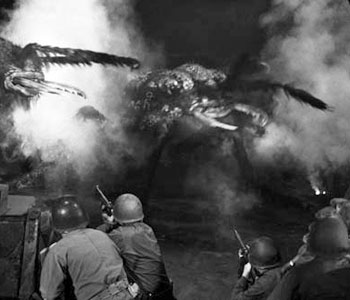
Them! (Gordon Douglas, 1954) "When Man entered the atomic age, he opened a door into a new world. What we'll eventually find in that new world, nobody can predict." What no one could predict is that giant atomic-mutated ants would spoil The Big Picnic. Somehow, one expected the splitting of the atom to have more profound effects.

But nature abhors a vacuum or tampering with things on the atomic level, and, apparently, so did the world-wide movie industry, because, by 1953, two films that displayed horrific effects from atomic testing exploded on (appropriately, I guess) American and Japanese theater screens: The Beast from 20,000 Fathoms (Eugène Lourié) and Gojira (Ishirô Honda). Neither film exactly bombed.

And as The Bomb (and a popular 1952 re-release of King Kong) begat The Beast..., so did that Warners film beget Them! (which became Warner Brothers' box-office champ in 1954)*, inspiring a subsequent fallout of atomic themed films featuring Incredible Shrinking and 50 ft. metamorphoses that have had a half-life of (going on) 60 years. Them! may not be the glowingly cheesiest of them all—some of the writing's not bad, and despite the subject matter, some of the performances are surprisingly good—but, then, what can you expect with such an early entry in the genre, everybody was trying hard, and the writers managed to throw in some scientific fact mixed in with the hokum. But, it does have an exclamation mark in the title, which immediately makes it suspect.
And it has a good intro: a little girl (Sandy Descher) is found by police wandering in the desert, mute, in shock. Tracing her back to the family trailer (!), they find it split open—but from the inside. Hmmm. Mystery abounds, and at one point Sherlock Holmes is invoked (appropriately, as he once had to do battle with The Giant Rat of Sumatra, "a story for which the world is not yet prepared").  
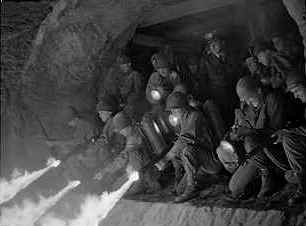
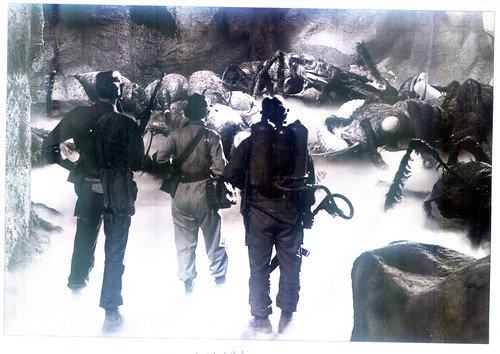
But, you can't hide a gargantuan ant for very long, not even in the desert, and soon the local constabulary and the army (with the help of a couple of myrmecologists (you know, "ant-thropologists") take on the formidable formicidae with all manner of WWII surplus—flame-throwers, bazookas (that look really cool!), cyanide gas cannisters, and rocket-propelled grenades—one wishes for the huge Monty Python foot to appear, or a monstrous can of Raid...better yet, turn New Mexico into a giant ant-farm! 

There is no trying to "negotiate" with the ants (it was the 1950's, after all, at least they weren't hauled up before the House Un-American Activities Committee), and even one of the scientists—the cute female one (Joan Weldon), after making her observations, documenting them, and taking her corroborative pictures,** turns to her companions with the flame-throwers and says, "Burn it. Burn EVERYTHING!" O-kay...
This one was directed by Gordon Douglas,*** who worked his way up from "Our Gang" comedies to Laurel and Hardy and became to go-to director for 20th Century Fox when they needed a fast turn-around on a sequel or a Frank Sinatra movie, and sports all sorts of good actors trying to take it all seriously: Edmund Gwenn, James Whitmore, James Arness, Fess Parker (in an odd role as a man driven lunatic by the sight of giant ants), and look for glimpses of Richard Deacon (reporter), William Schallert (doctor) and Leonard Nimoy**** (fleetingly) as a soldier with some interesting information, and with no less than four employments of the giddily hysterical "Wilhelm" scream (performed by Sheb Wooley) shrieking throughout.  "The Wilhelm" was recorded for the 1952 film Distant Drums and became part of the Warner Brothers stock sound effects library under the title "man being eaten by alligator." 
And giant ants. Lots of giant ants. Zillions of them. Although, for budgetary reasons, we only see three at a time.
"The Wilhelm," however, probably wouldn't be classified as one of those "profound effects" previously mentioned.
"Look...it was a paycheck, okay?"

* Interestingly, though, no Academy Award nominations....

** Dialogue that came to mind: "I need to get one of you officers close to one, so I can get some perspective. Would you...?" "Lady!  You nuts??!!

*** And, you can tell that it was SUPPOSED to be shot in 3-D, with some shots hurtling at you...and evidently in color (only the title is), but someone in Warners accounting wisely decided not to "splurge" on a giant ant movie.

****