Showing posts with label Natalie Portman. Show all posts

Wednesday, June 12, 2024

No Strings Attached

Written at the time of the film's release...

"Turning Natalie Portman Into a Girl"
or
"That 'Flippy' Thing You Did?  Good Call."

"SUCH a chick-flick!" said one of the young women sitting in front of me at the conclusion of No Strings Attached, the new rom-com with Natalie Portman (who exec-produced, as if you didn't have ENOUGH reasons to hate her) and Ashton Kutcher.  This one might be the most negligible film in the 12 month span which will see her in five new movies (based on previews, I think Thor might actually be the weakest link), having a kid, getting married, and probably winning an Oscar (Geez, Nat,' over-achieving much?).

And, yeah, total chick-flick, but one with a tiny spin to it, although it still falls into the "happily-ever-after" formula they've followed since the days when we innocently worried that Doris Day might lose her chastity to Rock Hudson. No such worries here. There's a lot of hay-rolling in this one, body-double or no, although we see more of Kutcher's tush than hers (for a change). Virtue is not the issue here, but "true love,"* now permanently split, I guess, from sex (not that they really got along).
But, and this is the "neat twist," it is Portman's Emma Kurtzman, who has commitment issues, not, as is typical, the male of the species. "I'm not really an affectionate person," she blandly tells her camp-buddy Adam (they keep "meeting-cute" throughout their lives, which in movie terms means they're destined to be together (Hell, they're in a romantic comedy—of course, they're destined to be together!). But, when both are "available," they have a brief encounter (clocked at 45 seconds), that puts Emma in mind that, rather than suffering through that whole "relationship thing" that they become "friends with benefits," casual sex partners available at the drop of a text message.
Then,
in a Hawksian role-reversal, which, as in His Girl Friday, makes the original premise snap into focus a little better, it is Kutcher's TV-assistant director who wants something more, as in commitment, from which Portman's Emma wrinkles her nose, rolls her eyes and turns on her heel. It gets complicated. It gets messy. It gets resolved.

This sounds like a dreadful premise
, but for all the "R"-rated language and suggestiveness (though never veering into "bro-mance" crudeness), and the seemingly-required "safe" arc of the storyline,
** it is a clever and funny movie in the particulars, thanks in no small part to Elizabeth Meriwether's clever screenplay, a less-leaden-than-usual direction by Ivan Reitman, and a splendid ensemble above and below the title. Incidents and details seem fresh and buoy you up, disguising the fact that there may be some clockwork mechanism behind the face, and the cast makes the most of these moments, making it all play fast and a little loose (with the exception of Kevin Kline, who is just a little practiced and arch as Kutcher's never-grown-up father, but that could be explained away as he's an actor). Portman manages to make her "stick-in-the mud" Emma stiff and likeable simultaneously, and is only too happy to sacrifice her dignity in scenes (she has a great drunken wobble-walk in high-heels that's priceless), and Kutcher—who gets a lot of stick for just being Ashton Kutcher—doesn't take himself so seriously that he avoids turning winsomeness into weakness. Both's comic timing makes for a good chemistry, despite the obstacles their characters regularly throw between each other.  In the end, it is two people's trip to normalcy in a chaotic world that seems to want to either crush them or ignore them, and only by narrowing their focus to each other can they achieve the specialness they think they deserve.

* ...and, coincidentally, Cary Elwes, Westley from The Princess Bride, is in this, although discretely disguised behind a nerdlinger beard, so he doesn't pose a realistic threat to Kutcher.

** One of these days I have to finish that post on Judd Apatow.

Friday, May 17, 2024

Star Wars, Episode 1: The Phantom Menace in 3-D

Episode I: The Phantom Menace is back in theaters for a 25th Anniversary (Really? That long ago?) and it's doing really well at the box-office, beating out NEW movies. And I've been hearing "buzz"...like an NPR report on "All Things Considered Weekend" that damned with faint praise (hardly the "reconsideration it promised).

But, it did raise some issues, that led to some actual...thoughts. So, I'm re-running my review of The Phantom Menace when I viewed it in its 3-D version.


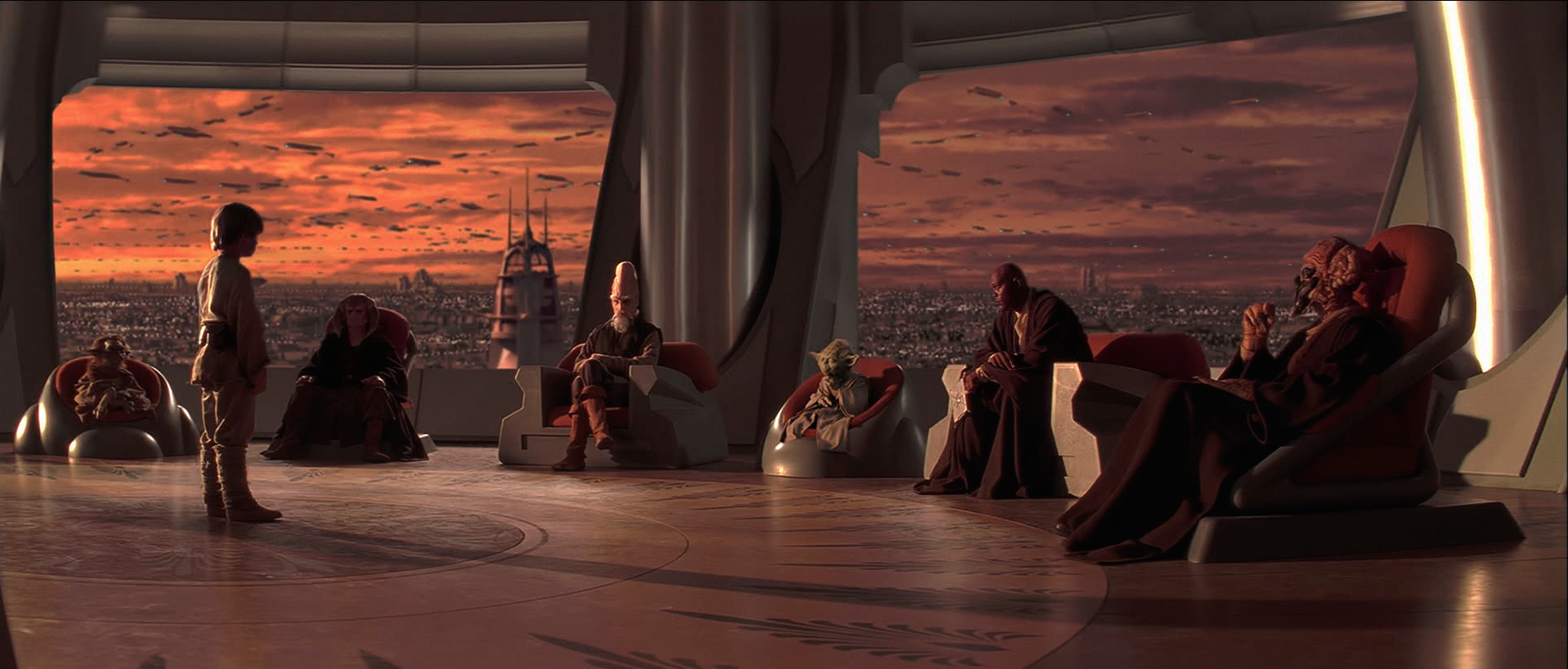
Star Wars, Episode 1: The Phantom Menace (in 3-D) (George Lucas, 1999/2012/in perpetuity) "Star Wars" is the one series I was curious to see in 3-D—the clean, simple lines of force (pardon the pun) from the first immersion into those films (a long, long time ago in 1976) was along a line that extended from behind our heads to points close to the center of the screen: the opening titles that flashed, then crept into a distant infinity; hyperspace travel that zipped into that same bulls-eye quadrant; the cavernous, warehouse spaces of the Empirical HQ's; the approaching death-spirals of various death-stars; slaloms through asteroids and skimming over ice-fields. The movies already seemed yearning to stretch 2-D images into three-dimensional spaces, and although Lucas' spacial sense and action lines became increasingly complicated, and precise cutting more extreme, he always kept that sense of background/foreground busyness that leant itself to three-dimensions without (literally) rubbing our noses in it...or poking our eyes with it.
Naturally, they'd start with Episode 1 this time. After all of Lucas' tinkering over the years, 3-D seems like a natural place to go, especially for the reasons already listed, and there's been enough time out of theaters to make projected images seem unique (plus, there's a ready-made audience already grown up on all six films, who may actually prefer the prequels to their predecessors...despite the sneering of their fathers--"Shut UP, Dad!").

But, whatever the design sense going into the films, they were still SHOT flat.  Yes, there's a lot of post-production digital imagery that can be manipulated, but the actors—the live ones, anyway—are still forever tied to the backgrounds on location, and any cutting/pasting/shifting is going to make those portions look as fake as those late-model View-master pix that weren't taken with stereo-cameras on location, and looked instead like cardboard standees in front of a shifted background.

Not sure how they did it—I suspect it's the adding of shaped shadows to facial features and bodies—but, the 3-D effects are convincing and seamless, and although the picture loses some luster due to the lower light-levels (and those damn glasses), they're the same minor annoyances one finds in any 3-D presentation-it goes with the depth-of-territory.  And, as most of the SW films, pains had already been made to make things multi-planed enough to justify the conversion. Some of the speedier foreground elements tend to go rather unmenacingly phantom-like, but those are on rare occasions. 


Some random thoughts:
—The big vista shots, especially with the Naboo city-scapes, tend to look a bit more miniaturish in 3-D—although the sky-scraping Coruscant scenes play very well.
—I also got the impression that some shots which resisted conversion were just replaced with closer shots—the main ones being
Qui-Gon Jinn (Liam Neeson, who seems to have made the best choice in underplaying his radical Jedi ideologue, although it tends to undermine the character's importance) clucking a Tatooine beast-of-burden into motion, which I was under the impression was done in a fuller shot than the close-up this has, and Obi-Wan Kenobi (Ewan McGregor, who had the best acting arc of all the actors in the prequels) doing a spinning lightsaber move seems to have been moved a bit closer than the original.
—I don't remember The Phantom Menace moving as fast as this viewing seemed to. It's still pretty amazing to see how precise the editing is, and yet manage to get all the visual information necessary to follow what's going on, something not helped by the sound mix, which tends to prefer effects impression over clarity.

—Interesting how
Keira Knightley blends in the role of Queen Amidala's decoy/hand-maiden with Portman's more formal Queen acting (although, considering Knightley is probably a full foot taller than the miniaturish Portman, shouldn't the instinctual Jedi have noticed the subterfuge a little earlier?).

—The last 20 minutes work like gang-busters with the cross-cutting Battle for Naboo on four fronts—
the Gungan invasion by battle-droids, the Padme-led attack on the palace, the attack on the droid-command ship, and the three-sided lightsaber duel, and it's helped immeasurably by John Williams' "Duel of the Fates," which after consisting of a subdued omnipresent sonic wallpaper for most of the film, kicks things into high-gear. 

—Haters are still going to hate it—and, indeed, the fan-boy line has been staunchly adhered to in 3-D reviews—but, the Trade Federation plot resonates a bit more after the NAFTA kerfluffle and the bank meltdowns, and I still like the midi-chlorian idea making Anakin a "virgin birth"—leading me to the thought at the time "what if Jesus Christ turned out to be an asshole?"—even if it was all revealed to be a bio-engineering project by Palpatine in Revenge of the Sith.

No, it ain't perfect—it's a little stiff, with shots of smiles for smiles' sake, and the dialogue clunks along, even if some vital bits of information are slipped in under the radar, along the way. But, as one friend remarked after seeing a student-remixed version of Episode IV, "God, I forgot it was such a cheese-fest." It is. The thing is based on old "
Flash Gordon" serials and embraces the sensibilities of that style of ham-fisted major-key film-making. It's a fantasy film, not a Guide For Living, and subtlety was never in the blue-print. It is a small, quaint little conceit-film-series made Epic by the adoration of its fans. 
Yet, for some reason, George Lucas is to blame for the pushing of "product" (I haven't read any of the 3-D reviews, but the word "greed" keeps popping up in them), when it's the marketplace that drives these things. If people stopped buying this stuff, he wouldn't keep tossing it out there, revamping, tinkering, and attempting to make the films transition across the decades and technologies. We have met the Sith, and they are Us. And, boy, are we dumb!

2024 "Reconsideration"

As Roger Ebert said in his review of The Phantom Menace, "If it were the first 'Star Wars' movie, 'The Phantom Menace' would be hailed as a visionary breakthrough. But this is the fourth movie of the famous series, and we think we know the territory."

Just so. 
But, there were a couple things that Lucas hadn't really addressed in his Universe filled with exotic creatures and wondrous sights.
One of them was fashion, not only in apparel, but also in architecture. The previous films the former was dominated by uniforms and casual wear, and for the latter—other than the cloud-city of Bespin and the militaristic gloss of the Death Stars—everything else was supposed to suggest an improvised environment cobbled together with wire and spit.
Now, there had to be vast functioning cities of well-engineered design with an established history. And the clothes, for the higher end of dignitaries and royalty, had to have an air of regality and authority, where no one was allowed to dress like a scruffy nerf-herder. Nobody really complained about that.
The other was ethnicity. In a bio-diverse Uni-sphere, it was a little improbable that everybody would sound either American of British (the only exception being Millennium Falcon co-pilot Nien Nunb, who spoke in Kenyan). And so, for the sake of diversity, understand, accents were provided for the Gungans, the Trade Federation, and for Watto, the junk dealer on Tatooine. Character accents (that is, the way they speak)—eschewing the very recognizable French, German, and Italian kind—were treated as if they were racial slurs (they are considered offensive, still, in that NPR "reconsideration" above). But, the binary Yank/Brit accents are a bit limiting for such a Universe, don't you think? Shouldn't it be a bit more diverse? To American audiences, apparently not. It's not in our comfort zone. As I said at the end of the piece above, boy, are we dumb.
But, hey, it's just a movie. It's not like anybody treats it like a religion or anything.
Right?

That's right. "We think we know the territory."
 
What we don't know is how damn sensitive we are.

Wednesday, January 3, 2024

May December

Watching Me Watching You
or
Persona Non Grata
 
It's a little bit of an invasion, really. The actress (Natalie Portman) "doing personal research" on your life. Seems there's going to be an "independent" film about the notorious past of you, Gracie Atherton-Yoo (Julianne Moore), and the notorious affair with a 13 year old friend of her son's, got pregnant, was tried very publicly for child-rape, was convicted and sent to prison where she delivered their child, and, when released, married her now "of age" lover, Joe (Charles Melton). They've tried to live a normal life, but it's practically impossible, with the tabloids, the photographers, the neighbors. And with those who'd rather not forget. 
 
Now, 20 years later, "this film" is being made (an earlier, exploitative TV Movie was made years ago without their participation or consent), and the Atherton-Yoo family is co-operating with this one in the desperate hope that it might make the film more sympathetic...or at least do no harm.
 
Do no further harm.
So, the family has welcomed this woman, this actress Elizabeth Berry (Portman) to their home, and at a busy time: "the twins" (
Gabriel Chung, Elizabeth Yu) are graduating high school, and that will leave Gracie and Joe, for the first time, empty-nesters. Their first daughter—you know, that one—(Piper Curda) is coming home from school for the first time since she left for school. For family. Special occasion. And...she's there. The actress.
But, the actress is just clueless enough that when she arrives at their doorstep for a meet-and-greet dinner that she (helpfully, of course) brings in a package she found left at the door-step of the house. That package is just another poop-a-gram from a harassing neighbor (or maybe it's not even a neighbor—they get them every week). She'll learn. It's her job to. Still, it's not a good start.
And Elizabeth is good at first. She hangs back, observing, talks to the sympathetic friends, makes notes, preliminary research. She witnesses son Charlie at dinner get a little belligerent and leave the table. Things are kind of tense. Elizabeth is sensitive to this and worries about her presence and reassures them that she is doing the research because she wants to portray them honestly and make it a "human story" (what else would it be?). She asks Gracie how they met, and when dinner's over, gets Joe's side of it and asks if she can visit him at his work. Then she starts to do some digging.
She interviews Gracie's ex-husband, the one she cheated on. She goes to the pet shop where Joe and Gracie were working and talks to the manager there, asking if she can go into the back-room where the two were caught, and when the manager goes back out front to check on a customer, Elizabeth tries to re-enact the scene where it happened. She goes to the lawyer who represented Gracie, and meets, by accident, the son who was friends with Joe (but is no longer) and he has issues.
But, he's not the only one, apparently. Elizabeth goes to visit Joe at work and she's deliberately provocative, almost like she's re-enacting what might have led up to the affair at the pet shop. She speaks at daughter Mary's drama club and (of course) the first question from the students is about filming sex scenes and Elizabeth's answer makes Mary more than uncomfortable. Then, she asks Gracie to show her how she does her make-up.
It's one of two sequences that director Todd Haynes sets up in front of a bathroom mirror. But, there's no mirror. Elizabeth and Gracie stand side-by-side playing as if a mirror was before them, but they're facing forward on screen, with us sitting in the place of the mirror. It's as if one isn't necessary because at this point, the two women are becoming reflections of each other. 
We've already seen Elizabeth going through old tabloids, studying pictures of Gracie and imitating her poses, the way she folds her hands, the way she holds her mouth. Gracie acts differently around Elizabeth and is more capable of holding things together because that's the image she wants to give Elizabeth—it's how she wants to be portrayed. But, it's a tough act to pull off. In private with Joe, she is more flinty and breaks down often. But, with Elizabeth, she's thoughtful, calm, and nurturing.
And, at the same time Elizabeth is learning to "play" Gracie, she is "playing" Gracie, complimenting her, ingratiating, trying to get on her good side (even while not knowing that that is precisely the side Gracie is giving her). The two women start to meld into each other's psyches, becoming a third person, the "best" Gracie each can achieve. Both are acting "towards" that version, it's "the job," one for the family, one for the film.
There's an amusing story in the "Trivia" section of imdb's listing for May December that "
Julianne Moore (Gracie) did not notice Natalie Portman (Elizabeth) was improvising by mimicking her mannerisms in some scenes until later into filming." That's amusing if it's true, but Portman is doing it so subtly—even while her character is doing it more blatantly in the film—that Moore probably caught on when she was looking. Portman usually saves the mimicry for when Moore is out of eye-line and it's slightly spooky. But, then Portman's actress is "spooky," doing things for verisimilitude that most actors (I hope) wouldn't do.
It's one of Haynes' most subtle films about the act of watching and being watched and how scrutiny changes things and not in an altogether good way. Layers and layers of scrutiny abound until the whole thing feels like it's under a microscope, at a time when we are all voyeurs, while simultaneously wanting our 15 minutes of fame...until we get it.

Saturday, March 25, 2023

Your Highness

Saturday is traditionally "Take Out the Trash" Day. And I remember this one distinctly because it's one of those comedies that didn't make me laugh much, but, instead, only filled with me a great resentment for whatever hack studio executive green-lit this mess. I'm usually charitable to movies because they are the work and coordination of many people and only some can achieve some sort of magic greatness. But, I can't even be charitable about this one. This crap-fest was a waste of everyone's time...but evidently not their talent.

Written at the time of the film's regrettable release.
 
"Du-uh..."
 or   
"Natalie Portman's Post-Oscar Slump, Part 1"

I've needed a laugh lately. I've been second-and third-guessing myself, not sure which way to go on all sorts of matters. And after seeing two movies, good and bad, in which anyone can be tread upon by the Government (The Conspirator and this Saturday's "Take Out the Trash" entry*), I needed something light, something frothy, something not Hanna or The Lincoln Lawyer.
 
I needed a comedy, dammit! After playing pin-ball in my head for a week and a half, I wanted a new thought to tilt me out of my doldrums. It would be appropriate, too, as every scene we've looked at Sundays of this April Fools Month has been a comedy (this week will be no exception), so a comedy might be just the thing to kick my torpor in the ass, or at least make it slip on a banana peel. 
 
Wish I'd found one, because this isn't it.
Your Highness, in fact, makes me wish I was living in a different era—not the one depicted in the film, of course, but also not in a time when such a movie, with big stars (every Briton who isn't in the "Harry Potter" series, like Charles Dance and Damian Lewis), sumptuous locales and elaborate costuming can be so sloppily put-together that one gets the impression that at every stage the film-makers said "Eh...good enough" and moved on. 
I noticed myself laughing exactly twice, and longing for something—anything—to be half-way clever or even half-way executed.
* I like my comedy to have a brain in its head, and something to say besides what could shock your grandmother. Despite the cast, this one has so little going for it, you start to worry that at least the cast were well compensated. Because it couldn't have been for love.
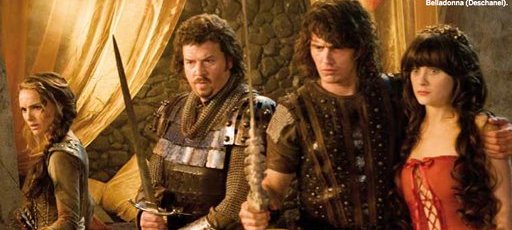
I'm a fan of James Franco, Natalie Portman and Zooey Deschanel, but why they should play second-fiddle to Danny McBride (who's usually lousy...Land of the Lost...and who barely registered as the reluctant groom in Up in the Air) is beyond me. Sure, Franco probably owes director David Gordon Green for his role in Pineapple Express (which I haven't seen, but have heard good things about), but he seems a bit lost in this, although gamely appearing cluelessly cheery throughout.
Borrowing heavily from every fantasy-adventure movie from the last 20 years (and liberally from Star Wars—their take on Yoda is particularly nasty, and they have
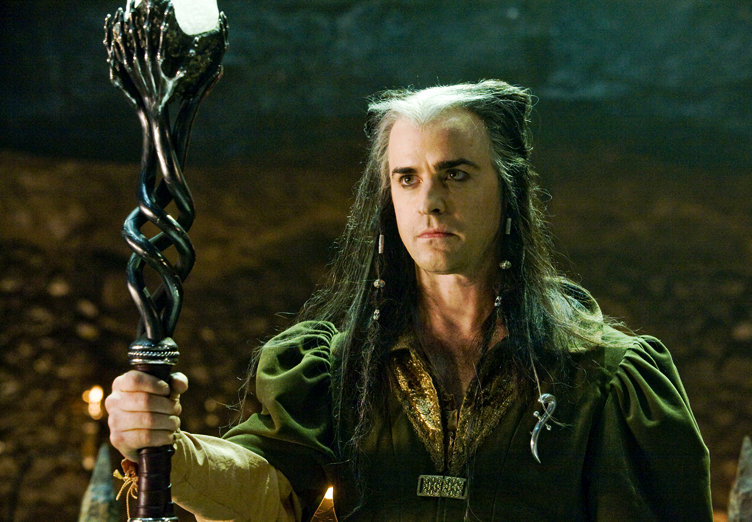
a clockwork bird-familiar after the original Clash of the Titans), Highness tells the story of the sons of King Tallious (Dance) and his two sons—the heir to the throne, Fabious (Franco), and the ne'er-do-well younger Thadeous (McBride) who would appear to be "Your Lowness." Fabious' bride Belladonna (Deschanel) is kidnapped by the evil sorcerer Leezar (Justin Theroux, who co-wrote Tropic Thunder, another high-concept low-result comedy) for his own nefarious plans. Fabious recruits Thadeous to go on the search for Lezar, despite the fact that the younger Prince can't fight, doesn't travel well, and is in all things incompetent. Plus, he's the "troop griper/whiner." Good planning. Dick jokes ensue.
Between the puerile humor
there are some action sequences, but Green has a hard time deciding whether he's playing them for laughs or for jolts. Not that it matters, as they succeed in neither, not even in the way that competent directors can achieve both or even one. And, although things are accomplished, nobody really learns anything so character arcs are as flat as a crushed pixie (the only clever idea I saw in the whole thing).

But, one thing Your Highness did accomplish: I had no second thoughts about it.


Maybe Hanna would have had more laughs.***
"I just won an an Oscar. You want me to what?"

* A complete execution...of me...was what I wanted after seeing this movie!  One thing that is mentioned in all the write-ups I've seen is that the crew went into production with  only a story and everything was ad-libbed on-set.  Really, they shouldn't be boasting about that. Oh...and the film I hinted at for the Saturday "Take Out the Trash" candidate that week was the latest version of Atlas Shrugged (Part 1).

 ** Okay, okay. I dump on Danny McBride—or Danny R. McBride, as he's calling himself these days—a lot. Because I don't see the talent. I don't find him funny, and mostly find him a little desperate. But...he was okay in Up in the Air. And he was superb in Alien: Covenant. When the man is firing on all thrusters—as he had to do in the "Alien" movie—he can be really good. (Here's what I wrote about him then—"I have to confess: while one shouldn't walk into movies with prior expectations, I was really looking forward to a scene where Danny McBride gets offed by one of the xenomorphs—I rarely have seen McBride in anything where I found him with an ounce of talent or charm, he's one of those few actors I actively don't like. But, here, he's terrific, taking an under-written part and bringing a lot of good choices and subtle nuances to the role. I'm now a fan.")

*** It didn't.


Tuesday, July 12, 2022

Thor: Love and Thunder

Another Classic Thor Adventure
or
Maybe It's 1 Out of 4  (Are You Not Underwhelmed?!)

Taika Waititi performed something of a miracle with Thor: Ragnarok, taking the moribund Marvel "Thor" series and injecting it with some of the humor that Joss Whedon injected into the character for the Avengers series. One wonders why it was taken so seriously in the first place as Thor was always the twee-est of the Marvel super-heroes, usually sticking out like a sore thumb in group adventures, but serving a purpose as that publisher's "Superman" with powers and abilities far above those of the mortal men (and women) in their "Avengers" line-up. Thor wasn't a king, wasn't a scientist, wasn't even rich...he was an other-dimensional God, who you wondered why he spent so much time hanging around in New York, when there were bigger cosmic fish to fry with the lightning of the Gods.
 
In Thor: Love and Thunder (again directed by Waititi), we find Thor (Chris Hemsworth), post-Infinity War, has gone through a lot of changes—and not just in his ability to quip. Asgard has been destroyed, he has lost both his Father and Mother and his adopted brother Loki. His people have been scattered, but localized to a sanctuary on Earth under the governorship of ally Valkyrie (Tessa Thompson, who comes into her own as a comic actress), and he's been hanging out with the Guardians of the Galaxy (Chris Pratt, Dave Bautista, Karen Gillan—she has one line and gets a laugh out of it—Pom Klementieff, Sean Gunn, and Groot and Rocket all make cameo appearances for a very short time, Zoe Saldana out busy Avatar-ing) and getting back in shape after his "Fat Thor" Endgame depression.
That should make Hemsworth-bod fans happy, but Thor is not. He's doing a lot of meditating, getting his hero-mojo back, but still not himself balance-wise. Oh, he's still bloviating ("What a classic Thor adventure! Hurrah!" he says after a battle) and acting like the Big Asgardian on Campus, but he's overcompensating, treating the Guardians as if they were Minions, and being a few coulombs short of a full lightning blast. Oh, he's great at knocking down enemies like ten-pins, but there's usually some collateral damage.
Thor's disturbing lack of faith is reflected in his latest enemy, Gorr (
Christian Bale), who, after, the last remnants of his family dies on his barren planet—despite his pleas to his deity—finds said deity in an oasis, oblivious to his pain, and Gorr kills him with the Necrosword and vows to kill all gods. He targets New Asgard and the warrior Sif (Jaimie Alexander is back! Yay!) warns Thor of the attack and he and Korg (Taika Waititi) travel there with two screaming goats (don't ask) and the Bifrost-inducing Stormbreaker he's now carrying. They team up with Valkyrie to defeat Gorr and his shadow-creatures, but find they have a new ally. 
It's Jane Foster (
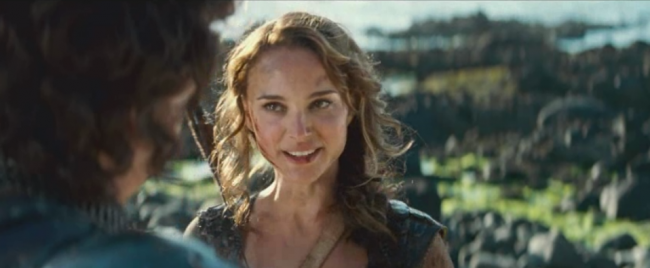
Natalie Portman), Thor's ex, who has assumed the role of Thor because...well, long story—and flashback—short...she has Mjolnir, Thor's old broken hammer, which is no longer broken (because Thor asked it to protect her—presumably when he wasn't using it) and it's power is keeping her alive despite her having Stage 4 cancer (we find all this out in a flashback that also involves Kat Dennings and Stellan SkarsgÃ¥rd, despite them not showing up in the IMDB cast list!). They are able to defeat Gorr, but his dementors (sorry, wrong franchise, but same idea!) steal all the kids from New Asgard, leaving nothing but Old Asgardians to fret about the children at school-board meetings.
The two Thor's, Val and Korg decide to go to the home of the Gods, Omnipotence City—this is said with a straight face—to warn the Gods and try to recruit them to battle Gorr, and petition Zeus (
Russell Crowe, who is clearly having a great time and using a florid Greek accent) to help in the cause. But, as any philosophy student will tell you, Gods don't listen very good. Zeus knows all about the Necrosword and how powerful it is, but he totally dismisses any danger...he's Zeus, what's gonna happen to him?...but, does drop the plot-point that Gorr has to reach the special effect of Eternity before he can accomplish his goal. But, that'll never happen, so what's the big deal. Zeus clearly never read Chekhov.*
Because at the end, Gorr very easily does the impossible and finds his way to the special effect of Eternity where, seeing the sacrificial way that love can display itself, decides...to change his mind (in another example of so many times in this movie, where they should have thought of this first—but then, there wouldn't be a movie). There's not an awful lot of story here, just a lot of strategies and actions that don't work before a resolution is found...and found very conveniently.
It's hard to take it all seriously, when so much of it is spent being done with so much jocularity. It reminded me of (of all things) Star Trek V: The Final Frontier, which spent so much time trying to recreate the "funny" of Star Trek IV that characters were no longer acting like themselves in order to get the most transient of laughs. Laughs come out of character, rather going out of character to make them. As a result, despite the call-backs and fan-service and getting "the old gang back together" everybody recognizable is no longer acting recognizably. Not that the grave way everybody was acting in the first two "Thor" movies is desirable—it certainly wasn't to me!—but to go as far as this movie does to prod a laugh out of every conceivable situation, is just reaching too far.
And as much as I love what Taika Waititi does with movies, he should be discouraged from making sequels. His movies should take stale material and make them fresh, rather than repeat them and just make them stale again.
* "Remove everything that has no relevance to the story. If you say in the first chapter that there is a rifle hanging on the wall, in the second or third chapter it absolutely must go off. If it's not going to be fired, it shouldn't be hanging there."