Showing posts with label Todd Haynes. Show all posts

Wednesday, January 3, 2024

May December

Watching Me Watching You
or
Persona Non Grata
 
It's a little bit of an invasion, really. The actress (Natalie Portman) "doing personal research" on your life. Seems there's going to be an "independent" film about the notorious past of you, Gracie Atherton-Yoo (Julianne Moore), and the notorious affair with a 13 year old friend of her son's, got pregnant, was tried very publicly for child-rape, was convicted and sent to prison where she delivered their child, and, when released, married her now "of age" lover, Joe (Charles Melton). They've tried to live a normal life, but it's practically impossible, with the tabloids, the photographers, the neighbors. And with those who'd rather not forget. 
 
Now, 20 years later, "this film" is being made (an earlier, exploitative TV Movie was made years ago without their participation or consent), and the Atherton-Yoo family is co-operating with this one in the desperate hope that it might make the film more sympathetic...or at least do no harm.
 
Do no further harm.
So, the family has welcomed this woman, this actress Elizabeth Berry (Portman) to their home, and at a busy time: "the twins" (
Gabriel Chung, Elizabeth Yu) are graduating high school, and that will leave Gracie and Joe, for the first time, empty-nesters. Their first daughter—you know, that one—(Piper Curda) is coming home from school for the first time since she left for school. For family. Special occasion. And...she's there. The actress.
But, the actress is just clueless enough that when she arrives at their doorstep for a meet-and-greet dinner that she (helpfully, of course) brings in a package she found left at the door-step of the house. That package is just another poop-a-gram from a harassing neighbor (or maybe it's not even a neighbor—they get them every week). She'll learn. It's her job to. Still, it's not a good start.
And Elizabeth is good at first. She hangs back, observing, talks to the sympathetic friends, makes notes, preliminary research. She witnesses son Charlie at dinner get a little belligerent and leave the table. Things are kind of tense. Elizabeth is sensitive to this and worries about her presence and reassures them that she is doing the research because she wants to portray them honestly and make it a "human story" (what else would it be?). She asks Gracie how they met, and when dinner's over, gets Joe's side of it and asks if she can visit him at his work. Then she starts to do some digging.
She interviews Gracie's ex-husband, the one she cheated on. She goes to the pet shop where Joe and Gracie were working and talks to the manager there, asking if she can go into the back-room where the two were caught, and when the manager goes back out front to check on a customer, Elizabeth tries to re-enact the scene where it happened. She goes to the lawyer who represented Gracie, and meets, by accident, the son who was friends with Joe (but is no longer) and he has issues.
But, he's not the only one, apparently. Elizabeth goes to visit Joe at work and she's deliberately provocative, almost like she's re-enacting what might have led up to the affair at the pet shop. She speaks at daughter Mary's drama club and (of course) the first question from the students is about filming sex scenes and Elizabeth's answer makes Mary more than uncomfortable. Then, she asks Gracie to show her how she does her make-up.
It's one of two sequences that director Todd Haynes sets up in front of a bathroom mirror. But, there's no mirror. Elizabeth and Gracie stand side-by-side playing as if a mirror was before them, but they're facing forward on screen, with us sitting in the place of the mirror. It's as if one isn't necessary because at this point, the two women are becoming reflections of each other. 
We've already seen Elizabeth going through old tabloids, studying pictures of Gracie and imitating her poses, the way she folds her hands, the way she holds her mouth. Gracie acts differently around Elizabeth and is more capable of holding things together because that's the image she wants to give Elizabeth—it's how she wants to be portrayed. But, it's a tough act to pull off. In private with Joe, she is more flinty and breaks down often. But, with Elizabeth, she's thoughtful, calm, and nurturing.
And, at the same time Elizabeth is learning to "play" Gracie, she is "playing" Gracie, complimenting her, ingratiating, trying to get on her good side (even while not knowing that that is precisely the side Gracie is giving her). The two women start to meld into each other's psyches, becoming a third person, the "best" Gracie each can achieve. Both are acting "towards" that version, it's "the job," one for the family, one for the film.
There's an amusing story in the "Trivia" section of imdb's listing for May December that "
Julianne Moore (Gracie) did not notice Natalie Portman (Elizabeth) was improvising by mimicking her mannerisms in some scenes until later into filming." That's amusing if it's true, but Portman is doing it so subtly—even while her character is doing it more blatantly in the film—that Moore probably caught on when she was looking. Portman usually saves the mimicry for when Moore is out of eye-line and it's slightly spooky. But, then Portman's actress is "spooky," doing things for verisimilitude that most actors (I hope) wouldn't do.
It's one of Haynes' most subtle films about the act of watching and being watched and how scrutiny changes things and not in an altogether good way. Layers and layers of scrutiny abound until the whole thing feels like it's under a microscope, at a time when we are all voyeurs, while simultaneously wanting our 15 minutes of fame...until we get it.

Tuesday, March 20, 2018

I'm Not There

Relatively 4th Street 

If Robert Zimmerman did not exist, we would have had to invent him. And then we'd have to invent Bob Dylan like he did. Then we'd have to re-invent him. And re-invent him again. And again. And that would only cover his public persona--not the myths and misinterpretations and the thousand unnatural transferences imposed on him by a public trying to possess the unpossessable (He famously said "Just because you like my stuff doesn't mean I owe you anything."). 

F. Scott Fitzgerald said that there are no second acts in American lives. Well, Dylan is somewhere in the dozens now (and we won't even count the Victoria's Secret ads!) in his quest for a place in the American song-book. Todd Haynes has tried to capture some of the sides and asides of early Dylan in the kaleidoscopic and appropriately named I'm Not There (although it could have just have easily been named "It Ain't Me, Babe")
In an attempt to capture Dylan at the creation, Haynes has made the movie episodic, with a collection of stories with a handful of actors playing stages and aspects of Dylan, none of them forming a complete picture, but making a collage of impressions of the artist in his first 15 years in the limelight.

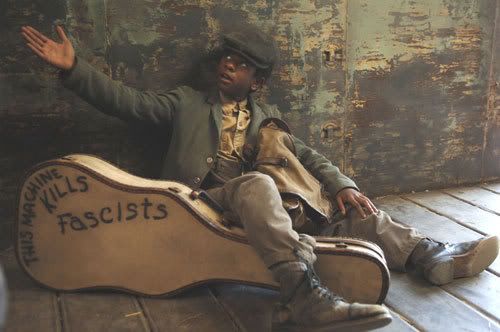
They are: 1) Woody Guthrie--an 11 year old black kid (Marcus Carl Franklin) who rides the rails escaping from a bad situation with just his guitar and his wits to keep him going. He eventually ends up making a pilgrimage to the New Jersey Hospital where the real Woodie Guthrie is dying of TB (Guthrie died in 1967).

2) Jack Rollins--Christian Bale plays the young activist folk singer who ardently sings "finger-pointing songs" and when he finds himself used by political groups, rebels, turns away from them and towards Christian Evangelicism.
3) Robert Clark--Heath Ledger plays an actor who played Jack Rollins in a film, and must deal with the effects of fame, notoriety and their demands on his ideals, private life, and marriage.

4) Arthur Rimbaud--Ben Whishaw plays Dylan the poet, answering straightforward questions at a police booking with wistful asides that aren't really answers (but will do in a pinch). Whishaw has the least to do, and like the next aspect of Dylan gets the lion's share of the best lines.*
5) Jude Quinn--the most hyped stunt-casting of the movie has Cate Blanchett playing Dylan on tour in London, where he is famously heckled by audiences for abandoning folk music for electric rock and challenged by the press trying to understand or categorize this strange creature from the States. This segment is shot in black and white (looking remarkably like the Dylan documentary "Don't Look Back") and heavily influenced by the style of Fellini. Quinn is perpetually bedeviled by esoteric questions that he either dismisses or vaguely answers and rails against the needling inquisition of one reporter (Bruce Greenwood) for whom Quinn writes "Ballad of a Thin Man" in one of the few instances where Dylan's music is used as fore-ground comment.

6) Billy the Kid--Richard Gere plays a Dylan aspect, alone and hiding out in isolation in a freak-filled town called Riddle, Missouri, where he lives under different identities and speaks up for the town when it is threatened by domineering Commissioner Pat Garrett (Bruce Greenwood, again). It's done in the style of Sam Peckinpah in a fever dream with a slow-tracking camera and a wandering editing style, and a narration by Kris Kristofferson (who played Billy in Peckinpah's Pat Garrett and Billy the Kid, of which Bob Dylan was an integral part.*
And the bizarre thing is, the bloody thing works. It helps to be hip on Dylan or you'll miss some of the in-jokes.** But it's enough Dylan and just enough kinda Dylan that one can't be too anal-retentive about getting the facts right. The film is more about the myth, and the persona and mystique (and expectations) of the artist than the real thing, and the use of Dylan songs edge along and suggest deeper meanings than, say, a cultural mis-fire like Across the Universe (which used its Beatles covers to tell you that A = A). Dylan's songs—some the traditional recordings, some enthusiastic "live" versions, some covers (there's a wonderful segment of Richie Havens and Franklin doing his "Tombstone Blues") form a suggestive background soundtrack, as his music did for us, that merely suggest, but doesn't hit us over the head, with the exception of that "Ballad of a Thin Man" segment.

Does it succeed in explaining Dylan? Nah. Some aspects of him are presented, and the acknowledgement that there ARE aspects puts this head and shoulders above the standard Hollywood "CliffsNotes" bio-pic (Ali, anyone?). And the film is filled with references and reverberations enough to fill several movies and a few lives, and that is an artistic victory in itself. And the tackling of the splintering of the artist for changing his art and himself—the holding of the mirror up to the flightiness and provinciality of audiences is a brave act, indeed. I came away not knowing Dylan any more than I did, but glad for the journey and reflected on three quotations on the way out.

"I don't think any one word can sum up a man's life" (Citizen Kane)

"He was a man. What does it matter what you say about people?" (Touch of Evil)

"No decent career was ever founded on a public." F. Scott Fitzgerald


-------------------------------------------------------------------------
* Including these seven Dylan Rules of Thumb:"Seven simple rules of going into hiding: one, never trust a cop in a raincoat. Two, beware of enthusiasm and of love, both are temporary and quick to sway. Three, if asked if you care about the world's problems, look deep into the eyes of he who asks, he will never ask you again. Four, never give your real name. Five, if ever asked to look at yourself, don't. Six, never do anything the person standing in front of you cannot understand. And finally, seven, never create anything--it will be misinterpreted, it will chain you and follow you for the rest of your life."

And, of course, he doesn't follow any of them.

** Dylan played "Alias," a member of Billy's gang, and also created the film's blue-grass score, which included his song "Knockin' on Heaven's Door."

*** My favorites--at a party Quinn is assaulted by the Tommy Boyce-Bobby Hart "I'm Not Your Steppin' Stone" a faux-Dylan piece of silliness performed by the Monkees, and Brian Jones is introduced as belonging to "a really good cover band."

Tuesday, February 9, 2016

Carol (2015)

Riding in Cars (With Boys)
or
The Talented Ms. Highsmith

A lot of movies have stuck with me over time this year—mostly because so many of what I saw were templated run-of-the-studio-mill disappointments—but the one that has stayed with me the longest and with the most vibrancy is Todd Haynes' adaptation of Patricia Highsmith's "The Price of Salt." 

At the time of its publication (1952 and under the pseudonym Claire Morgan), it caused a bit of a sensation. Highsmith had one published novel "Strangers on a Train" to her credit (after years of writing comic books) and her publisher, Harper and Bros., refused "Salt" as too risqué for a major publisher. Coward-McCann published it in hardback in '52 and a Bantam pulp paperback released in 1953. It sold over a million units. That's a lot of traffic for a "Novel of a Love Society Forbids" (as the Bantam blurb read). 

But, "The Price of Salt" was different. In her writings, Highsmith's characters live on the fringe of "polite" Society's morés (her most popular creation, "The Talented Mr. Ripley," was a sociopath for whom murder was merely an inconvenience), and "The Price of Salt" (or the simpler, more on-target title "Carol" it received when it was re-published in 1990—this time with Highsmith's name on it) is no different—it tells the story of a lesbian love-affair in the Eisenhower 1950's. 

That subject matter was not without precedent. But it was the first where the women did not suffer some punishment (rumored to be a requirement for publication), such as shaming, madness, or suicide, for "straying" from their expected roles and in fact, giving them, if not a happy ending, at least a hopeful one, a welcome relief to closeted readers who had enough of that in real life, thank you.
Haynes' Carol (with a screenplay by Highsmith acquaintance Phyllis Nagy) is extraordinary. Filmed in 16mm, giving it a nice, pulpy "period" feel, it follows the story of Therese Belivet (Rooney Mara), working a seasonal job at a Macy's toy counter while trying to establish herself in a career in photography, who encounters Carol Aird (Cate Blanchett), who is shopping for her daughter, without a clue what to get her. Her mind may be preoccupied, given how her marriage to husband Harge (Kyle Chandler, who's extraordinary here) is on the rocks, and the present might be some leverage in who she gets to spend Christmas with. The two take interest in each other and when carol leaves her gloves on the counter, Therese takes special pains to make sure that they are returned to her in the mails.
A thank-you phone call turns into lunch, and lunch turns into a visit, and the visit turns into a crisis where Carol must spend Christmas alone. And on the spur of the moment, she asks Therese if she wants to get out of town. And things get complicated, leaving one party conflicted and having to make a painful choice and the other abandoned and pained. Did I say a happy ending? Well, it's complicated. Love is like that.
A seemingly insignificant touch of the hand changes meaning in the film.
The story is told in flash-back, with just the hint of mystery to it. Carol and Therese meet at a restaurant and talk, but are interrupted by one of Therese's friends who invites her to a party. His presence makes Carol uncomfortable and begs off to allow Therese her night out with friends. On the way, Therese remembers, establishing a motif that Haynes will use again and again (but not to obviousness and not to annoyance). 
From that point on, the movie is rarely without barriers—in fact, Therese remembers the story seen through a rain-fogged window of the car she's being spirited away in. So much of the film will take place in cars, on the road, or from a distanced perspective where things simply get in the way, making we, the audience, work a little harder and maybe identify with the characters as they view the world surreptitiously, and (although this may be stretching things a bit) get a sense of the restrictions they might be feeling in a world where feelings can't be "open."
I've made mention of Kyle Chandler—he has a scene where he has to act like a fussing child that is quite amazing—but the movie hinges on and is blessed by the performances of Cate Blanchett and Rooney Mara. Mara has been an interesting actress to watch—she has the "otherness" look of a space alien, but her acting is so mercurial that she has always been memorable—that was the point of her tiny role in The Social Network (where she was first "noticed")—she had to be memorable. Ever since, she has been playing characters that exploit that "otherness" vibe, but here, she is as normal as can be, in a story where norms are not always an advantage (and are frequently dis-advantageous, if not threatening). For the first time in my memory, she is not playing a character entirely in control of herself and fully formed. There's a yearning Hepburn (Audrey category) ingenue quality to her that is poignant and hitherto unseen.
And Blanchett is a wonder. She's always had a steel-edged directness to her, but in Carol (the movie is named for her character, as if as an object of obsession), she is circumspect, a bit unknowable, looking at the world slightly askance. Observing her, as if in Therese's place, she seems not quite trustworthy, not altogether obvious, a bit of a mystery, as an affectionate object is at the beginning of a relationship. What brings the two together is also a mystery, other than mutual need—Carol's marriage to Harge is a disaster, one supervised and chaperoned by his disapproving dragon of a mother. And Therese is feeling pressure to get married to Richard (Jake Lacy)—by Richard. She's not in a hurry, but he is, and she knows that one's she's locked into marriage, any aspirations of her own life and independence are over.
In a way, both women have a desire to be free at a time when women can't. So, a road-trip at Christmas, the holiday of obligations, seems like a wish-fulfillment fantasy. But, freedom isn't free (as we're constantly reminded by bumper-stickers) and despite their lack of tinselly entanglements, they can't entirely escape them, either. Maybe you can't go home again, but home doesn't ever leave your mind or consciousness, either.
There is a lovely shot in Carol, that is evocative and simple. Time has passed since that Christmas. Therese has moved on. Things have "settled." After the events that have served as bookends for the flashback of their story, Therese emerges from another New York party, not really connecting with anyone. Haynes has a simple shot—Therese, post-party on the street, in the dark, with a single solitary street-light hovering over her. It's a cliche image, but not the way Haynes shoots it. It informs that shot for what comes next and does it without words, as an evocative projection that the best of cinema can offer—code that touches a nerve deep in our alligator-brains that can be universally perceived, understood and felt. That it's beautiful, too, is just frosting.
Carol stayed with me a long time, long after more recent film screenings dissolved like cotton candy. If it is not my favorite film of the year, it is in the top three of a very eclectic mix. Well worth seeing and being haunted by.