Showing posts with label Ian McDiarmid. Show all posts

Friday, May 17, 2024

Star Wars, Episode 1: The Phantom Menace in 3-D

Episode I: The Phantom Menace is back in theaters for a 25th Anniversary (Really? That long ago?) and it's doing really well at the box-office, beating out NEW movies. And I've been hearing "buzz"...like an NPR report on "All Things Considered Weekend" that damned with faint praise (hardly the "reconsideration it promised).

But, it did raise some issues, that led to some actual...thoughts. So, I'm re-running my review of The Phantom Menace when I viewed it in its 3-D version.


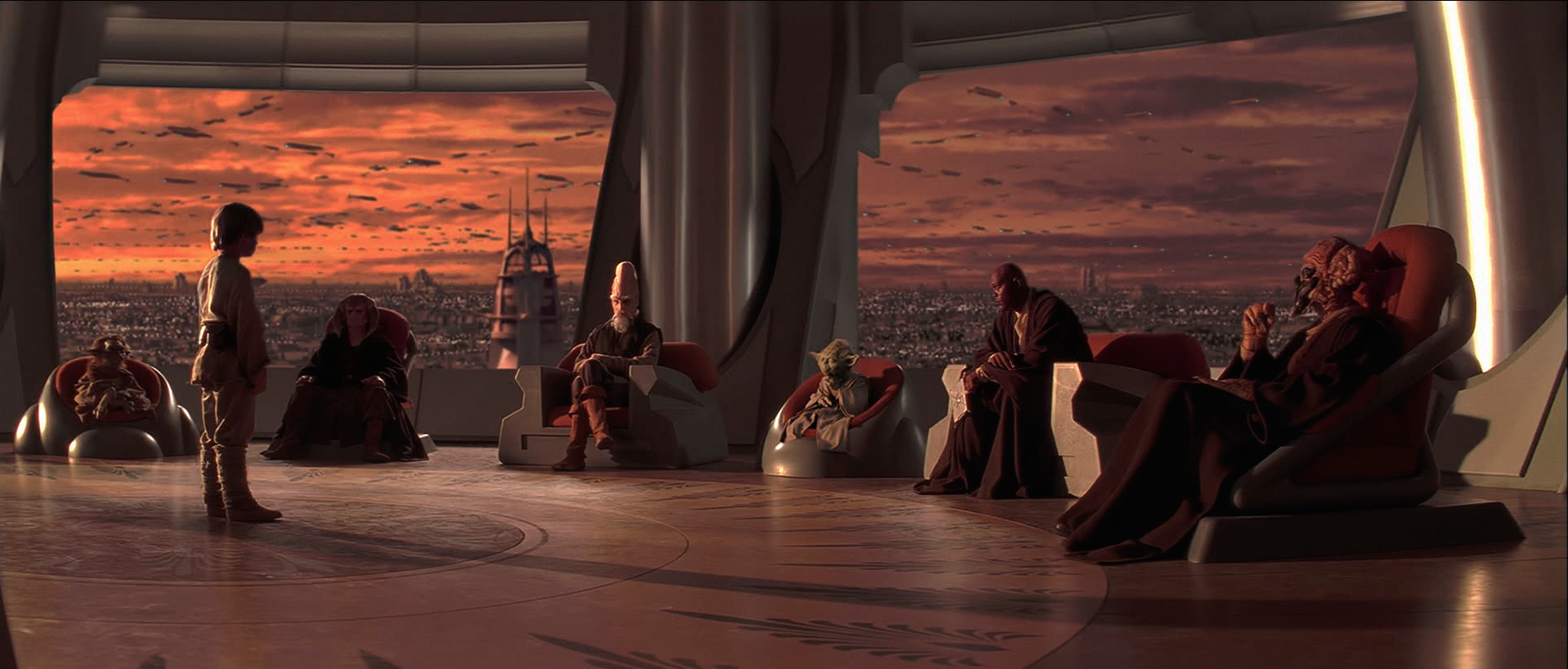
Star Wars, Episode 1: The Phantom Menace (in 3-D) (George Lucas, 1999/2012/in perpetuity) "Star Wars" is the one series I was curious to see in 3-D—the clean, simple lines of force (pardon the pun) from the first immersion into those films (a long, long time ago in 1976) was along a line that extended from behind our heads to points close to the center of the screen: the opening titles that flashed, then crept into a distant infinity; hyperspace travel that zipped into that same bulls-eye quadrant; the cavernous, warehouse spaces of the Empirical HQ's; the approaching death-spirals of various death-stars; slaloms through asteroids and skimming over ice-fields. The movies already seemed yearning to stretch 2-D images into three-dimensional spaces, and although Lucas' spacial sense and action lines became increasingly complicated, and precise cutting more extreme, he always kept that sense of background/foreground busyness that leant itself to three-dimensions without (literally) rubbing our noses in it...or poking our eyes with it.
Naturally, they'd start with Episode 1 this time. After all of Lucas' tinkering over the years, 3-D seems like a natural place to go, especially for the reasons already listed, and there's been enough time out of theaters to make projected images seem unique (plus, there's a ready-made audience already grown up on all six films, who may actually prefer the prequels to their predecessors...despite the sneering of their fathers--"Shut UP, Dad!").

But, whatever the design sense going into the films, they were still SHOT flat.  Yes, there's a lot of post-production digital imagery that can be manipulated, but the actors—the live ones, anyway—are still forever tied to the backgrounds on location, and any cutting/pasting/shifting is going to make those portions look as fake as those late-model View-master pix that weren't taken with stereo-cameras on location, and looked instead like cardboard standees in front of a shifted background.

Not sure how they did it—I suspect it's the adding of shaped shadows to facial features and bodies—but, the 3-D effects are convincing and seamless, and although the picture loses some luster due to the lower light-levels (and those damn glasses), they're the same minor annoyances one finds in any 3-D presentation-it goes with the depth-of-territory.  And, as most of the SW films, pains had already been made to make things multi-planed enough to justify the conversion. Some of the speedier foreground elements tend to go rather unmenacingly phantom-like, but those are on rare occasions. 


Some random thoughts:
—The big vista shots, especially with the Naboo city-scapes, tend to look a bit more miniaturish in 3-D—although the sky-scraping Coruscant scenes play very well.
—I also got the impression that some shots which resisted conversion were just replaced with closer shots—the main ones being
Qui-Gon Jinn (Liam Neeson, who seems to have made the best choice in underplaying his radical Jedi ideologue, although it tends to undermine the character's importance) clucking a Tatooine beast-of-burden into motion, which I was under the impression was done in a fuller shot than the close-up this has, and Obi-Wan Kenobi (Ewan McGregor, who had the best acting arc of all the actors in the prequels) doing a spinning lightsaber move seems to have been moved a bit closer than the original.
—I don't remember The Phantom Menace moving as fast as this viewing seemed to. It's still pretty amazing to see how precise the editing is, and yet manage to get all the visual information necessary to follow what's going on, something not helped by the sound mix, which tends to prefer effects impression over clarity.

—Interesting how
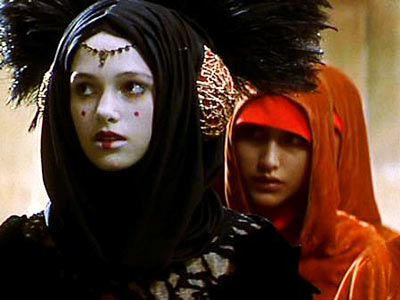
Keira Knightley blends in the role of Queen Amidala's decoy/hand-maiden with Portman's more formal Queen acting (although, considering Knightley is probably a full foot taller than the miniaturish Portman, shouldn't the instinctual Jedi have noticed the subterfuge a little earlier?).
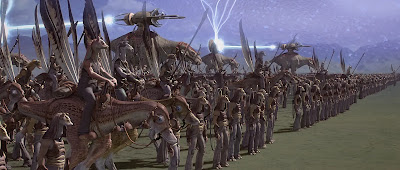
—The last 20 minutes work like gang-busters with the cross-cutting Battle for Naboo on four fronts—
the Gungan invasion by battle-droids, the Padme-led attack on the palace, the attack on the droid-command ship, and the three-sided lightsaber duel, and it's helped immeasurably by John Williams' "Duel of the Fates," which after consisting of a subdued omnipresent sonic wallpaper for most of the film, kicks things into high-gear. 

—Haters are still going to hate it—and, indeed, the fan-boy line has been staunchly adhered to in 3-D reviews—but, the Trade Federation plot resonates a bit more after the NAFTA kerfluffle and the bank meltdowns, and I still like the midi-chlorian idea making Anakin a "virgin birth"—leading me to the thought at the time "what if Jesus Christ turned out to be an asshole?"—even if it was all revealed to be a bio-engineering project by Palpatine in Revenge of the Sith.

No, it ain't perfect—it's a little stiff, with shots of smiles for smiles' sake, and the dialogue clunks along, even if some vital bits of information are slipped in under the radar, along the way. But, as one friend remarked after seeing a student-remixed version of Episode IV, "God, I forgot it was such a cheese-fest." It is. The thing is based on old "
Flash Gordon" serials and embraces the sensibilities of that style of ham-fisted major-key film-making. It's a fantasy film, not a Guide For Living, and subtlety was never in the blue-print. It is a small, quaint little conceit-film-series made Epic by the adoration of its fans. 
Yet, for some reason, George Lucas is to blame for the pushing of "product" (I haven't read any of the 3-D reviews, but the word "greed" keeps popping up in them), when it's the marketplace that drives these things. If people stopped buying this stuff, he wouldn't keep tossing it out there, revamping, tinkering, and attempting to make the films transition across the decades and technologies. We have met the Sith, and they are Us. And, boy, are we dumb!

2024 "Reconsideration"

As Roger Ebert said in his review of The Phantom Menace, "If it were the first 'Star Wars' movie, 'The Phantom Menace' would be hailed as a visionary breakthrough. But this is the fourth movie of the famous series, and we think we know the territory."

Just so. 
But, there were a couple things that Lucas hadn't really addressed in his Universe filled with exotic creatures and wondrous sights.
One of them was fashion, not only in apparel, but also in architecture. The previous films the former was dominated by uniforms and casual wear, and for the latter—other than the cloud-city of Bespin and the militaristic gloss of the Death Stars—everything else was supposed to suggest an improvised environment cobbled together with wire and spit.
Now, there had to be vast functioning cities of well-engineered design with an established history. And the clothes, for the higher end of dignitaries and royalty, had to have an air of regality and authority, where no one was allowed to dress like a scruffy nerf-herder. Nobody really complained about that.
The other was ethnicity. In a bio-diverse Uni-sphere, it was a little improbable that everybody would sound either American of British (the only exception being Millennium Falcon co-pilot Nien Nunb, who spoke in Kenyan). And so, for the sake of diversity, understand, accents were provided for the Gungans, the Trade Federation, and for Watto, the junk dealer on Tatooine. Character accents (that is, the way they speak)—eschewing the very recognizable French, German, and Italian kind—were treated as if they were racial slurs (they are considered offensive, still, in that NPR "reconsideration" above). But, the binary Yank/Brit accents are a bit limiting for such a Universe, don't you think? Shouldn't it be a bit more diverse? To American audiences, apparently not. It's not in our comfort zone. As I said at the end of the piece above, boy, are we dumb.
But, hey, it's just a movie. It's not like anybody treats it like a religion or anything.
Right?

That's right. "We think we know the territory."
 
What we don't know is how damn sensitive we are.

Tuesday, December 24, 2019

Star Wars, Episode IX: The Rise of Skywalker

"Long Have I Waited" (Yeah, Yeah, You're Not Special)
or
"Excellent Job, Sir." ("Terrible Job, Sir")

There is no way that Star Wars: The Rise of Skywalker could live up to expectations. The expectations are parsecs high and one could not/should not think every characters' stories to be satisfactorily tied up to every fan's hopes and dreams. 

Plus, this one has to make up for a lot of dissension with Rian Johnson's Episode VIII: The Last Jedi—which I quite liked—and so rather than have things unfolding in this one, it has to fold-back, providing nostalgia while not exactly advancing things...the way that J. J. Abrams did with The Force Awakens. 

We've been teased—"Dark Rey", Kylo and Rey teaming up (again) and dueling (again), C-3PO "dying," re-purposed Carrie Fisher footage, and the Return of  Emperor Palpatine (Thank badness Ian McDiarmid has good genes), who was killed off six films (or three by regular timeline) ago, and thus negating the triumphal moment of the first (or middle) trilogy.

So, is it "The Skywalker Saga" or "The Emperor Saga"—one was hoping for the former rather than the latter.

One should at least be happy there's no new Death Star—they're happy to re-purpose an old one.


Now, it is going to be very dicey doing a summary of the film so as not to spoil the surprises—and there are jolts throughout, even though the film plays out in what one would think is a logical progression that feels organic enough that one could conclude that this was the intent from the original plot-line devised for The Force Awakens.* 
I am still not used to not hearing the 20th Century Fox Fanfare heralding the film's opening, but then I've seen the new trilogy a lot less than I've seen the old ones. It shouldn't be since the Disney take-over, but it is. But, the first words of the opening crawl does give a certain unease: "The Dead Speak!" With the passing of Carrie Fisher, those words resonate a bit more. Fisher is top-lined (for the first time in the series) and that is entirely appropriate, despite the use of discarded scenes making up the entirety of her performance—reverse shots and stand-in's make the transition a bit more organic. But, there is still a slight disconnect with her scenes, especially in dialog with other actors. Fisher's Leia spouts aphorisms and exposes just how generic lines from "Star Wars" can be.
The film starts out with Kylo Ren, nee Ben Solo (Adam Driver—jeez, he's great in this!) on the hunt for the Emperor, seeing the old Sith as a threat to his status as Supreme Commander of The First Order. First, he has to track down some googah to help him find his location on the planet of Exegol (sounds like a pharmaceutical planet), and once he does, Palpatine makes him an offer he can't refuse—kill Rey (Daisy Ridley—jeez, she's good in this), the waif Source prodigy and become Commander of The Final Order's massive Star Destroyer fleet.
(The logician in me said that 1) it's a bad deal as guys in power don't like to give up their power and 2) where the Hell did they get all those ships?! Who built them, as it would take a Sith-load of supplicants to build them...but then, this is "Star Wars" where there is sound in space, X-wings can make turns and swoop around in space, there can be such a thing as a space-ship that's a bomber, and there are things like light-speed and The Force...you gotta get rid of science in these things, which is why I see this as more in the Fantasy/Fairy Tale genre than as science-fiction).
So, where's Rey? Jedi-training with General Leia (Fisher) where she's starting to get a "bad feeling about this"—her "Force-bond" with Kylo interferes with her training, like getting phone-calls from your too-ardent boyfriend who keeps interrupting your homework with calls asking "What are you doin'?" Speaking of ardent boyfriends Finn (John Boyega—jeez, he's good in this), Poe Dameron (Oscar Isaac—jeez, he's....ditto) and Chewbacca (always good, but he tugs at heart-strings a couple times here) are returning from a spy-mission that has confirmed the Emperor is still alive and his threat is real—they have to do some fancy flying to avoid First Order ships in order to get the information back to Leia (they couldn't have just hidden the information in a droid?).
So, the story revolves around Kylo trying to subvert Rey to the Dark Side, rather than kill her in order to defeat the Emperor (Golly, he really IS his grandfather's kid!), while Rey and the boys try to find a duplicate googah—it's a Sith "wayfinder" that hones in on Sith energy or something—so that the Resistance can find the Emperor and defeat the Phantom Menace (to coin a phrase).
So, that's the plot—which is basically the plot of Episodes IV-VI, one generation once-removed—with the customary serial-formula of a fight or a chase every ten minutes. The first half-hour is editorially compressed into a short-hand of highlights, so that the film-makers can squeeze enough story-line into the movie and keep it under 3 hours, but one has to say that gripes and plot-holes don't appear like a force-ghost in your head until after the movie is over. That means the movie is doing it's job. It's "Star Wars", after all, the thing is supposed to be a crowd-pleaser.
Many of the established characters are given short-shrift—as if serving as convenient plot-points in earlier movies had exhausted their possibilities—except for the ones mentioned. And there are new characters, including a sort-of love-interest for Poe in Zorii Bliss (Keri Russell—jeez, I can't tell if she's good or not!) and a new disposable General for the First Order named Pryde (Richard E. Grant, sneering appropriately), who you just know is going to goeth before The Fall. There is quite an amazing array of others in the movie that you'll hear, but not see, that—for me—was kind of a thrill. C-3PO (Anthony Daniels) is given a beefier part and, for once, he has a good reason to be annoying.
The special effects are quite amazing, if cluttered, and there are a variety of planets in various eco-systems, that you might as well just forget because nobody spends much time on them for very long.
And Lando's back. Big plus. Billy Dee Williams is older than Methuselah now, but he has lost none of his charm.

But, then, all the actors are on their "A-game" here—as I've been making a joke of. Everybody does a good job, but some of the interactions between actors are the best-timed I've seen in the series, zipping along like in a Howard Hawks screwball comedy. This is their last shot at this and everybody in front of the camera gives it their all, especially in scenes that must have been conceptually hard to play. Brava!
So, yes, take the "fan-service" talk with a grain of salt—there has always been a bit of it where "Star Wars" is concerned, starting with The Empire Strikes Back. It's a bit like criticizing a duck because it floats. You can...but why? I would've liked to have see a little more about the democratizing of The Force (ala The Last Jedi), although there's a variant of it here (that might have been convenient in earlier episodes...!), but it gets the writers out of several jams, so...amazing thing, that "Force," midi-chlorians or no.
So "fan-service," yeah. But, with this closer, it does bring to mind what Lucas envisioned for the last trilogy, where the victorious Rebels lose their way allowing for a new Empire to spring up in a circular variation of the Episode I -III trilogy. And as in the line attributed to Mark Twain "history doesn't repeat itself, but it rhymes." That rhyming becomes more than apparent in The Rise of Skywalker, paralleling what has come before in a manner of playing out.
That feels real. And is sure as the setting of twin suns.

* One could think that, but the fact is they were making it up as they went along—Ben Kenobi wasn't supposed to die in A New Hope (that was revised during shooting), most of Return of the Jedi was recycled from original New Hope treatments. These are stories, not reality. People make them up.

Thursday, June 1, 2017

The Lost City of Z

In Memory Yet Green
or
"What's a Heaven For?"

James Gray's new film, The Lost City of Z (I prefer to call it The Lost City of Zed, as it is articulated in the film), is not just "Based on a True Story (that cliche tag-line of so many movies these days), but "Based on the Incredible True Story." And it's about bloody time. Its protagonist, Col. Percival Fawcett (played quite effectively, if opaquely by Charlie Hunnam*) has been fictionalized enough times, being the inspiration for Challenger of A. Conan Doyle's "The Lost World," Quatermain of H. R. Haggard's "King Solomon's Mines," and their modern descendant of antiquities, Jones of Indiana. The original should get his due, because his story truly is incredible, filled with hardships and danger, both foreign and domestic, and proved a challenge to the complacent way of thinking about what makes a civilization among the class-conscious societies of England at the time. Fawcett was a forward thinker who became lost in the past. 

But it wasn't always so. When we first encounter Fawcett, he is long trek from legendary. A "lifer" in the British Army at the turn of the century, he has been passed over for promotion on numerous occasions—not through any dereliction of duty, not because he is untalented, he is, in fact, one of the best and boldest of his company. He overhears the reason after bagging the stag in an elk hunt held for the Archduke Ferdinand*—"He's been rather unfortunate in his choice of ancestors," as one of the stuffy dignitaries puts it. Dad was a bit of a drunk in his military career, so the sins of the father are visited upon the son. Class, and the lack of it, are married in one unfortunate summation. Geez, no wonder there's an America.
Skilled, he may be, and respectable, he certainly is, his career nevertheless is stalled, and so he accepts an assignment he's recommended for with the Royal Geographical Society (headed by former "Star Wars" Emperor Ian McDiarmid)—to map unexplored borders of the Amazon rain-forest and maybe, just maybe, find its source.
It is hazardous duty to be sure, from flora, fauna, disease, and natives, who have never advanced past the tribal stage (but, then, has anybody?) and might not take kindly to strangers. The Army offers him nothing and so he agrees, knowing full well it will be a journey of years; his wife Nina (Sienna Miller) knows the frustration of her husband and, rather reluctantly, agrees. Fawcett bids farewll to wife and child (with one on the way), taking with him Colonel Henry Costin (Robert Pattinson, unrecognizable and good enough to forgive anything he's done in the past), whose knowledge of the rain-forest proves essential, as well as a native guide Tadjui (Pedro Coello), picked up after a visit to a rubber plantation, run by the Baron De Gondoriz (Franco Nero), who warns him of the exploration parties that have not returned, but Fawcett forges ahead, determined to prove his mettle in the "uncivilized" world, a land without prejudice.
Tadjui tells him of an ancient city in the Amazonian jungle, a golden city with a large population, a city that Fawcett begins to call "Zed," and on his first mission, he finds pieces of pottery and figurines, artifacts that prove to him that, though there may not be a city of gold, there is one with a civilization that does more than hunt with spears, but is capable of art and practical tools. He finds the source of the river, but in their excitement at their find, Tadjui makes his escape.
Fawcett is welcomed back to England a hero and his accomplishments are lauded, but his theories about "the lost city of Zed" and that the natives of what he calls "Amazonia" are far more advanced than had been previously thought are controversial and met with scoffs and derision. It isn't long before he is enticed to go back to prove his contentions that the native populations have a sophistication and civilized organization that threatens the British imperialist image of savages.
There is also some controversy at home. His son Jack resents his time away, and his "equal wife" quickly realizes how far that goes when she wants to accompany him on his next trip—she has found an artifact in public records that alludes to a fabulous city somewhere in the Amazon. He tells her she is just not capable of it and steadfastly refuses to take her.
But, he does allow a renowned biologist James Murray (Angus McFadyen), late of Shackleton's Nimrod expedition and wants to reclaim his past glories on this latest endeavour that has so impressed the world. He should have taken his wife, instead, as Murray is quite ill-prepared to handle the tropics.

In a scene straight out of Apocalypse Now, the boatload of explorers sees another boat aground precariously on shore. by the time they notice a man aboard and that he's dead, the air becomes lethal with arrows and spears, too suddenly for some on the boat to avoid being killed. But Fawcett is determined to find the source of the attack and wades ashore, arms outstretched. One last arrow pierces his notebook and he stares at it in wonder, not just in that he was spared, but at the precision it took to hit and not go all the way through to kill him.
Fawcett walks up the bank. Soon, one warrior appears amidst the brush (which director Gray, like so many directors before him, treats as not merely a backdrop, but as one of the characters), then, another shows as back-up, then another. Soon, a half-dozen natives have emerged, and one goes back to report what has happened, while the others maintain eye contact. And with that, Fawcett achieves acceptance and discovers the tribe has a sophisticated defense mechanism to maintain its security. Despite his party's casualties, his trust is rewarded in kind.
A good thing, too, as the members of the tribe turns out to be cannibals, something that thoroughly repulses the biologist Murray. Fawcett and the veterans of the previous party know enough to keep quiet, lest they go from being the guests for dinner to being the main course. But, Murray, who has slowed the party down, and has been known to steal rations from others in the group. A knee wound leaves him raving and in need of medical attention, so the Fawcett thinks it best for all concerned if they send Murray packing to seek attention from the last known encampment on their journey as they go their own way. This will come back to haunt them when they return to England after they've found finished their expedition.
But, they've found no Zed—evidence of sophisticated farming and medicine, yes. But no golden city.

And, then World War I happens, even if doesn't turn out to be The War to End All Expeditions.
It is an "incredible true story." And all parties involved in The Lost City of Z do right by it. Filming in the jungle—the genuine jungle—is a logistical nightmare for a filming crew, but Gray is a fastidious director, but not so much so that he doesn't provide the telling grace note that moves the story from mere communication to the poetic. Because you cannot tell a story like Fawcett's without exploring how the quest becomes more than the goal, but about the journey itself, not only of the landscape, but also of the mind. Because the trek can have a profound effect on the traveler...as it did with T.E. Lawrence or Meriwether Lewis. What began for Fawcett as a way to gain acceptance transcended it beyond class, beyond family, beyond self...to the point where he became a man apart...unto himself. It is only appropriate...if unfortunate...that his last trip to find the lost city—one he took with his son—he never returned from...as if he disappeared into his own dream.
An incredible story, yes. A true story, as far as we have knowledge of.
But one could also say legendary, if it weren't for the mystery of the man at the center who lets life and love go by for a dream, thus making the story more..."proverbial." More cautionary. More universal. Do not lose your way. Do not lose your soul.

And in the end, the man and his goal became one. Fawcett's body was never found, nor has his lost city.
Fawcett in the jungle c. 1908


* Hunnam is much more appropriate for the role than the two who dropped out: Brad Pitt (whose Plan B Productions is behind the film) and Benedict Cumberbatch, who dropped out due to conflicts filming Dr. Strange) 

** I hear your arched eyebrows raise, history-buffs....