Showing posts with label Chris Pratt. Show all posts

Friday, May 12, 2023

Guardians of the Galaxy Vol. 3

"The (10th) Greatest Marvel Film Since Avengers: Endgame!"
or
"The Ballad of Rocket Raccoon"
 
I notice an up-tick in the number of people who looked at my review of Guardians of the Galaxy Vol. 2. I've long since stopped trying to figure out the patterns of what people are looking at, but I suppose it had something to do withe the release of Guardians of the Galaxy Volume 3—the movie that James Gunn was working on when he got hired as the High Evolutionary of the DC Movie Universe.

But, there was no incentive to see it. I haven't watched the last couple of Marvel movies, as they've been sputtering as far as quality, depending on call-backs, cameos, or with no clear sense of where things are going—other than contracts need to be fulfilled, promises made must be delivered on, and a general running-in-place while Kevin Feige tries to come up with a follow-up to the colossal success that was the first batch of Marvel movies. It seemed like, at those times, they were taking chances, swinging for the fences, and hitting home-tuns. Now, it seems they're just counting the receipts, waiting for the Next Big Thing to happen.
 
Trouble is the fan-base is lying in wait. Disappointments among the "TrueFans" may collapse the enterprise like a stack of back-issues no one's bothered to box.
 
Still, folks DID look at the review. I made a point to see it. 
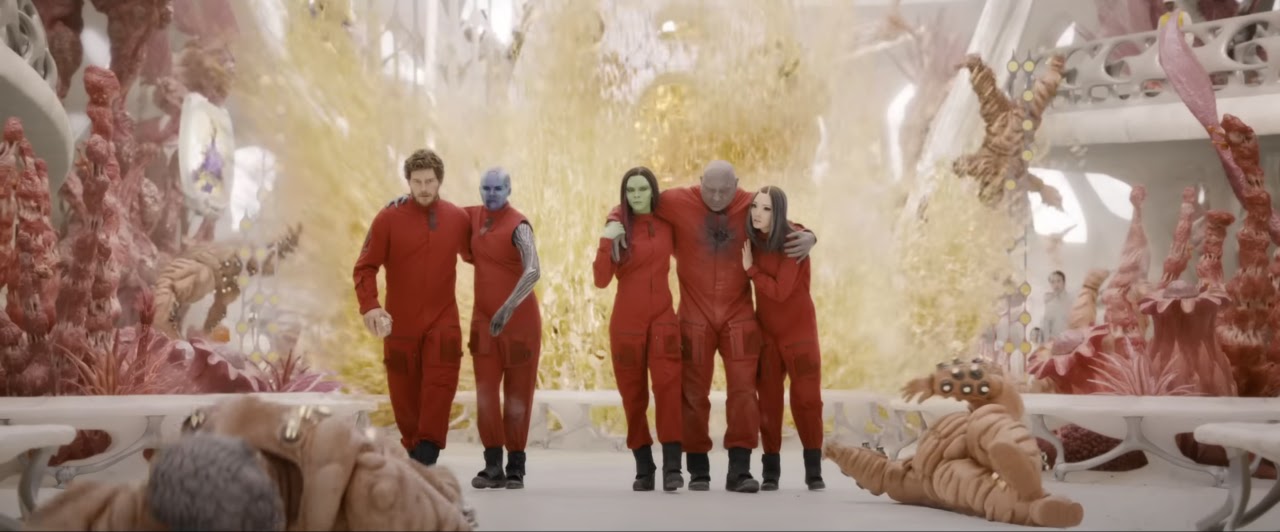
How is it? A pretty good send-off, actually, while being something different. It's an origin story of sorts—of how Rocket the Raccoon (voiced again by Bradley Cooper) came to be a wise-cracking, take-no-prisoners, but still fuzzy-funny animal came to be, mostly told in flash-back, after he is left near-death after an attack on Guardians of the Galaxy HQ (Planet Knowhere) by Adam Warlock (Will Poulter). The super-powered Warlock is on a mission to steal the mercurial mammal for his mother, Queen Ayesha (Elizabeth Debicki) of the Sovereigns at the behest of The High Evolutionary (Chukwudi Iwuji), a sort of gene-split Dr. Mengele/Dr. Moreau of Space, who's on a mission to create the perfect utopia based on his manipulating evolutionary traits.
Yeah, that trick NEVER works, but His Highness (Evolutionarily) wants Rocket—or as he designates him, Test Subject "89P13"—back, as the little varmint was the only test subject of his that displayed original thought, and may be the key to achieving his perfect utopia. Too bad that the way to get him back puts him in a coma.
The Guardians band together to try to save Rocket's life, but discover that he has an implanted kill-switch on his heart that will explode him if they trying any extraordinary efforts to save him. But, Peter "The Star-Lord" Quill (Chris Pratt), still nursing a broken heart after losing his lost love Gamora (Zoe Saldana) during the events of "The Blip"—then getting back an earlier version of her that can't stand him—determines that he's going to find the code to disable the kill-switch and save his little bandit-buddy, even if he has to travel the Galaxy, kill a bunch of multi-legged creatures and even *gulp* face his ex-girl-friend to do it.
And so, they do, over 2½ hours (which feels it, probably due to some rocky transitions that director Gunn has trouble with), meeting new friends and old friends of Gunn's in new roles (Nathan Fillion, anyone?), squeezing in Sylvester Stallone (the guy cannot handle tech-talk), Liz Debicki, and even an appearance by Howard the Duck (voiced by Seth Green, nice), and actually providing "I'm worth-being-here" arcs to Mantis (Pom Klementief) and Kraglin (Sean Gunn). Plus, we get another example of why Karen Gillan may be the most unsung-acting hero in the MCU and a "giving it 100%" performance by Pratt. Throw in a talking space-dog (voiced by Maria Bakalova—"He just called me 'a BAD DOG!'") and you have a vast cornucopia of cutesiness mixed in with Gunn's "ick" factor. Call it "Anthropro-Marvel"—the place where the studio can really get silly (even by comic-book standards).*
Take, for example, the look of the High Evolutionary's Orgosphere—an organic planet made out of meat—which is pure 20th Century Fox sci-fi tacky, ala Fantastic Voyage or Barbarella. It has the look of spareness, but the detail of something well-considered, rather than what the budget could spare. And one just knows, going along that one is missing a gazillion references stuffed into the thing with minor characters and such, but, frankly, there's enough for the non-Marvel Zombie to appreciate.
At the same time, there's a nice little message about universality and worth, where one's lab-rat could just be worth saving if only they were noticed. It's an extension of the original GotG movie, where everyone was, basically, a cast-off, but were worth more than the sum of their parts put together. Here, no one's a loser, except for the one's who never would have suspected they were in the first place. And, once again, it shows that although Gunn will always make films that feel tough-as-nails-cynical, they still have a core of sentimentality to them that puts them a notch above the usual super-hero fare.
 
It's a good movie for the series to go out on (if, indeed, it ends).

* Although judging by the Marvels trailer, they're not going to stop there.

Tuesday, July 12, 2022

Thor: Love and Thunder

Another Classic Thor Adventure
or
Maybe It's 1 Out of 4  (Are You Not Underwhelmed?!)

Taika Waititi performed something of a miracle with Thor: Ragnarok, taking the moribund Marvel "Thor" series and injecting it with some of the humor that Joss Whedon injected into the character for the Avengers series. One wonders why it was taken so seriously in the first place as Thor was always the twee-est of the Marvel super-heroes, usually sticking out like a sore thumb in group adventures, but serving a purpose as that publisher's "Superman" with powers and abilities far above those of the mortal men (and women) in their "Avengers" line-up. Thor wasn't a king, wasn't a scientist, wasn't even rich...he was an other-dimensional God, who you wondered why he spent so much time hanging around in New York, when there were bigger cosmic fish to fry with the lightning of the Gods.
 
In Thor: Love and Thunder (again directed by Waititi), we find Thor (Chris Hemsworth), post-Infinity War, has gone through a lot of changes—and not just in his ability to quip. Asgard has been destroyed, he has lost both his Father and Mother and his adopted brother Loki. His people have been scattered, but localized to a sanctuary on Earth under the governorship of ally Valkyrie (Tessa Thompson, who comes into her own as a comic actress), and he's been hanging out with the Guardians of the Galaxy (Chris Pratt, Dave Bautista, Karen Gillan—she has one line and gets a laugh out of it—Pom Klementieff, Sean Gunn, and Groot and Rocket all make cameo appearances for a very short time, Zoe Saldana out busy Avatar-ing) and getting back in shape after his "Fat Thor" Endgame depression.
That should make Hemsworth-bod fans happy, but Thor is not. He's doing a lot of meditating, getting his hero-mojo back, but still not himself balance-wise. Oh, he's still bloviating ("What a classic Thor adventure! Hurrah!" he says after a battle) and acting like the Big Asgardian on Campus, but he's overcompensating, treating the Guardians as if they were Minions, and being a few coulombs short of a full lightning blast. Oh, he's great at knocking down enemies like ten-pins, but there's usually some collateral damage.
Thor's disturbing lack of faith is reflected in his latest enemy, Gorr (
Christian Bale), who, after, the last remnants of his family dies on his barren planet—despite his pleas to his deity—finds said deity in an oasis, oblivious to his pain, and Gorr kills him with the Necrosword and vows to kill all gods. He targets New Asgard and the warrior Sif (Jaimie Alexander is back! Yay!) warns Thor of the attack and he and Korg (Taika Waititi) travel there with two screaming goats (don't ask) and the Bifrost-inducing Stormbreaker he's now carrying. They team up with Valkyrie to defeat Gorr and his shadow-creatures, but find they have a new ally. 
It's Jane Foster (
Natalie Portman), Thor's ex, who has assumed the role of Thor because...well, long story—and flashback—short...she has Mjolnir, Thor's old broken hammer, which is no longer broken (because Thor asked it to protect her—presumably when he wasn't using it) and it's power is keeping her alive despite her having Stage 4 cancer (we find all this out in a flashback that also involves Kat Dennings and Stellan SkarsgÃ¥rd, despite them not showing up in the IMDB cast list!). They are able to defeat Gorr, but his dementors (sorry, wrong franchise, but same idea!) steal all the kids from New Asgard, leaving nothing but Old Asgardians to fret about the children at school-board meetings.
The two Thor's, Val and Korg decide to go to the home of the Gods, Omnipotence City—this is said with a straight face—to warn the Gods and try to recruit them to battle Gorr, and petition Zeus (
Russell Crowe, who is clearly having a great time and using a florid Greek accent) to help in the cause. But, as any philosophy student will tell you, Gods don't listen very good. Zeus knows all about the Necrosword and how powerful it is, but he totally dismisses any danger...he's Zeus, what's gonna happen to him?...but, does drop the plot-point that Gorr has to reach the special effect of Eternity before he can accomplish his goal. But, that'll never happen, so what's the big deal. Zeus clearly never read Chekhov.*
Because at the end, Gorr very easily does the impossible and finds his way to the special effect of Eternity where, seeing the sacrificial way that love can display itself, decides...to change his mind (in another example of so many times in this movie, where they should have thought of this first—but then, there wouldn't be a movie). There's not an awful lot of story here, just a lot of strategies and actions that don't work before a resolution is found...and found very conveniently.
It's hard to take it all seriously, when so much of it is spent being done with so much jocularity. It reminded me of (of all things) Star Trek V: The Final Frontier, which spent so much time trying to recreate the "funny" of Star Trek IV that characters were no longer acting like themselves in order to get the most transient of laughs. Laughs come out of character, rather going out of character to make them. As a result, despite the call-backs and fan-service and getting "the old gang back together" everybody recognizable is no longer acting recognizably. Not that the grave way everybody was acting in the first two "Thor" movies is desirable—it certainly wasn't to me!—but to go as far as this movie does to prod a laugh out of every conceivable situation, is just reaching too far.
And as much as I love what Taika Waititi does with movies, he should be discouraged from making sequels. His movies should take stale material and make them fresh, rather than repeat them and just make them stale again.
* "Remove everything that has no relevance to the story. If you say in the first chapter that there is a rifle hanging on the wall, in the second or third chapter it absolutely must go off. If it's not going to be fired, it shouldn't be hanging there."

Thursday, June 16, 2022

Jurassic World: Dominion

It Comes Down to Animating Old Fossils
or
"It's Always Darkest Just Before Eternal Nothingness..."
 
Oh, they have been hyping Jurassic World: Dominion to the point where one doesn't have to see the movie to feel harassed by dinosaurs. There's a glut of advertising tie-ins, a "look-back" television special (which I admit I watched), and I'm sure there's a breakfast cereal ready to hit shelves ("T-Chex!").
 
If there is, I'm sure it will be rather stale.
 
This is the sixth "Jurassic Park" film in the franchise, the third in the "Jurassic World" sub-set, which, when written and published by Michael Crichton, seemed like the flimsiest of his high concept novels. The whole thing started as a 1983 screenplay about a lone geneticist creating a dinosaur with disastrous Frankensteinian results. But, Crichton couldn't crack the reason "why" a geneticist would do such a thing. He decided that the only reason to do it would be for entertainment purposes, so he spliced Americans' fascination with theme parks* with kids' fascination with dinosaurs, and (of course!) the thing was a massive best-seller. 
 
And a hit movie; Universal Pictures only agreed to Steven Spielberg's passion project Schindler's List (which they "knew" would not make money) if he first agreed to make Jurassic Park (which they knew would), and both films garnered the studio tons of money and awards. Spielberg even waived his own rule to not make sequels when he directed The Lost World years later. He is an Executive Producer on all the films.
But, that's all pre-history. What's this one about? Well, it's all about ecological catastrophe. The filmmakers have brought back the character of Lewis Dodgson (now played by
Campbell Scott), head of the rival genetics company BioSyn who has hired geneticist Dr. Wu (BD Wong again), who has engineered a super locust that decimate crops that are not grown with BioSyn seeds, thus cornering the market on food production and threatening a world shortage unless his products are not used. The Jurassic Park island of Isla Nublar was destroyed due to volcanic eruptions, but Lost World's Isla Sorna (or "Site B"), where the engineering work was done is still a preserve for some of the creatures. Dinosaurs are now migrating throughout the Earth, which would seem like a big deal. Raptor whisperer Owen Grady (Chris Pratt) and Claire Dearing (Bryce Dallas Howard) live in the Sierra Nevada Mountains, carrying for Maisie Lockwood (Isabella Sermon), the cloned daughter of an InGen executive. The surviving member of three trained raptors, Blue, is also living in the Sierra Nevadas.
 
Got all that?
BioSyn has been very busy, not just planning a world food crisis, but also trying to track Maisie and Blue's child Beta (wait, I didn't say that Blue reproduced?) to bring back to their Alpian HQ for study. Meanwhile, there seems to be a black market for capturing the animals—something that Dearing is involved in trying to stop. That's when Ellie Sattler (Laura Dern) starts to become interested in those locusts and their ties with BioSyn. She recruits Alan Grant (Sam Neill), who is always glad to see her, for a little tour of the BioSyn plant to see what's going on. And guess who's working for BioSyn now: chaos theorist Ian Malcolm (Jeff Goldblum)!
Meanwhile, back at the ranch, Grady and Dearing discover that Maisie and Beta have been clone-napped by BioSyn and they set off to get them back, using contacts from the CIA. They track them to Malta—where there is evidently a big black-market—and meet up with a pilot Kayla Watts (
DeWanda Wise), who had seen Maisie being transferred to a flight to Italy. So...everybody's going to the same place!
So...everybody's going to the same place and there will be dinosaurs there. You can guess the rest of the movie. Dinosaurs and humans do not mix unless it's in a dinosaurs stomach, so there's going to be a lot of threatened mastication going on. And a lot of running and hiding, and even more distracting dinosaurs with flares. In fact, there are so many of those, they could have just done it in one instance with a single J.J. Abrams movie
But, except for running around and hiding from dinosaurs, that's the rest of movie. The entire set-up has been explained and there's really nothing left to do. The trouble is the movie is set up like a bad Bond movie with a minimum of plot that merely threads action sequences. And, unfortunately, the stunt coordinator and second unit director is Dan Bradley (he's not listed in the movie on IMDB but his name is in the credits), who scurries through action sequences with quick shots that they barely register.
How's the cast? Well, Dern, Howard, and Goldblum do the best work—they also have the best lines—and Wise does some nicely laconic work as an Indiana Jones type. But, Pratt seems slightly disengaged as if he was thinking about the next project he's doing. And Neill is always a welcome presence, but his character has relatively little to do, so he goes in for that Harrison Ford-style mugging that was done in Return of the Jedi, just so he's got something to do.
But, the main attraction for the movie is usually the dinosaurs—and with the characters going by the numbers in this one, they have to be—and even there, this movie isn't all that impressive. Oh, the CGI wizardry has advanced so far from its origins in the original that you can practically see a brontosaurus' uvula for all the detail they put into it now. But, the CGI versions have less credibility than the puppets and animatronics—although a couple of triceratops babies look a little dodgy, too. There is no sense of wonder anymore, or sense of awe, especially as the 'saurs are moving so fast that they have less sense of mass...or threat.
As a result,
Michael Giacchino's score has very few places for John Williams' celebratory, awe-filled theme for Jurassic Park—just a couple of snippets here and there—and that tells you all you need to know about the movie: fast and transitory, not pausing enough to take anything in, or dwell on it. The ideas have all been mined, so it just jumps from danger sequence to danger sequence.
Perhaps it's time to take a break, not make any of these for awhile, and, in the meantime, take some of Michael Crichton's DNA and recreate him, just so we can get some new ideas. 


A sequence that was supposed to open Jurassic Park: Dominion but was cut for time.
Do you think anybody would be interested in a Director's Cut?
 
* Crichton had used the same theme of parks in his directorial debut, Westworld

Wednesday, October 20, 2021

Jennifer's Body

Written at the time of the film's release...

"Cluster-Fox"
 
The critical drubbing that horror film/High School satire Jennifer's Body has endured belies its talent behind the camera. After all, it was critics who first pointed out the particular tenor of Diablo Cody's writing in Juno and championed it through its short Film Festival run into theaters (Jason Reitman's previous film Thank You for Smoking, although a nice piece of film-making with a brain in its head, didn't do well at the box office.) Director Karyn Kusama isn't too shabby a director, although Æon Flux was an MTV-ginzu'd nightmare. I was surprised that 2oth Century Fox advertised it as a straight horror movie starring Megan Fox (aiming at—and only at—teenage boys), rather than including girls in the mix. As a result the film "opened soft" (as they say), and the film received decidedly mixed reviews depending on how serious they took it....even serial contrarian Armond White sided with the majority.
But horror films aren't just horror films—they say something about our fears, and more broadly, the "Holy Shite"-geist of society. The proverbially "good" horror movie touches our souls with a chilly finger and reminds us we're all mortal, but whether it's our relationship with God (in Frankenstein) or our relationship with sex and guilt (Halloween), horror films find our soft underbellies and either tickle us or stab up to the third knuckle. 
Jennifer's Body
tells the story of Jennifer Check (Megan Fox) and Anita "Needy" Lisnicki (Amanda Seyfried), girl-hood friends in the small town of Devil's Kettle, who've stayed close despite a Mutt and Jeff relationship in high school. Jennifer is a cheerleader, drop-dead gorgeous and just as likely to tell you...to drop-dead, that is. Needy, by contrast is blond, bespectacled, and Jennifer's beard, of sorts, her "Biff" in "Diablo-Code," able to rein her in if she gets too out of control in their adventures. Unfortunately, one night when the pair go off to a local dive to see an up-and-coming indie band, the place goes up in flames and Jennifer's entranced enough with the lead singer (Adam Brody) to go off in the band's van, leaving Needy behind, in a state of shock.
When Needy gets home,
she finds Jennifer waiting for her, pale, crazy-eyed, smiling through bleeding gums, and vomiting a noxious black bile: she's turned into a succubus from Hell, and where in the past she used to merely chew out aggressive boys, now she chews them out (quite literally) and consumes them, leaving behind what one schoolmate describes as "lasagna with teeth." It's up to Needy to keep her Best Friend Forever from being discovered for the fiend she is, while simultaneously protecting her class-matesa task if she was any good at would effectively kill the movie.
It sounds like very rich material with which to go over the societal strata of High School, if the territory didn't have so many skid-marks running through it already.* One could see it as a revenge flick for
all those sosh's who've terrorized the commoners, but Jennifer is as much a victim as anyone, and is an equal opportunity disembowler. And Needy's loyalties are so divided that you begin to wonder just whose side she's on. Stacked like bodies on top of that, the "males as victims of the woman" angle would seem fresh...if it was done 20 years ago.** Ultimately, the message aspect to it is weak and anemic, so ham-strung is the script by its own cross-messages. 
Good direction would divert your attention from them, but even there, everything comes up short. However cob-webbed the old cliche's, Kusama's rhythm for them is off, with loud bumps in the night that land with a dull thud. Opportunities lurk around every steadi-cammed corner and go un-sprung. Then when something happens, Kusama won't cut away until the carnage becomes so much spewing corn-syrup. In trying to do something different and avoid the standard horror tropes, Kusama can't even deliver any chills.
And, despite what you've heard, Megan Fox isn't half-bad, showing far more depth and humor than, say, other sex-bomb's like Raquel Welch, have in the past. Fox isn't afraid to not look beautiful, and does so frequently, even if it's just with an "I'm Sooo-C'ra-zy" glint in her eyes, but she also has the easier part. Seyfried has to play the "normal" girl, who can be both the ugly duckling and beautiful swan when the circumstances call for it. It shows how weak the material is when J.K. Simmons and Amy Sedaris can't find much inspiration in their parts. There was potential here, but it isn't satirical enough, funny enough, or scary enough to provoke any reaction other indifference. And that's the worst death in a horror film.
The View from 2021: 
But...but...Jennifer's Body was saying something a little different—something about objectification and the male capacity to exploit, rather than a female's capacity to trap using attractiveness (which, I think most critics glommed onto). But, more importantly, it's about BFF's and their power in the lives of young women—that iffy support system that feels like it will never die—and in the case of Jennifer's Body, it doesn't. I mean, it really doesn't.
 
One could blame the marketing by 20th Century Fox—it was promoted as a sexy horror comedy. The trouble with that is, it wasn't. The only characters that matter are Jennifer and "Needy" and the rest of the cast doesn't matter—especially the "gents". It's a revenge fantasy—the  story of a woman sacrificed on the altar of male-bonding (almost literally) and through a misreading of the fine-print of Ritual 101, Jennifer is allowed to come back to life without the burden of a victim mentality, but, instead, with the urge to avenge herself, combined with a supernatural ability to carry it out. And how, objectively, it might look like the wrong thing to do, empathy makes it subjective and contagious. Think Promising Young Woman with "besties" and fangs.
 
And in that context, with the POV of the sacrificed making her an outsider from Society and its natural enemy, it really is a horror film. But, which side is the monster? 
 

* Carrie, Halloween, Alien, Scream, Species, "Buffy the Vampire Slayer" have all staked out the same territory and potential that Jennifer's Body squanders, usually more pointedly and more entertainingly. 

** 50 years if you want to cross-categorize with "film noir."

Friday, September 11, 2020

Zero Dark Thirty

Written at the time of the film's release.

"You Know That Thing We Talked About"
or
How Are Things in Tora Bora?

Writer Mark Boal and director Katheryn Bigelow have made the two most important dramatic films about The War on Terror: the 2009 Best Picture Oscar Winner The Hurt Locker and now, Zero Dark Thirty, which covers the behind the scenes investigations to track down Usama bin Laden and the subsequent Operation Neptune Spear in Abottabad, Pakistan.

The film originally started as a feature about the carpet bombing of Tora Bora, and the field work leading to the decision and was scheduled to begin filming when the raid occurred. Immediately, the other film was shelved, and Boal began writing this, incorporating his research from the previous work which dovetailed with the earlier effort. It's a fascinating, troubling story of human beings waging war on an intimate level, trying to secure threads of information on a specific target, while also trying to keep track of new terror acts that might occur any time, any where.

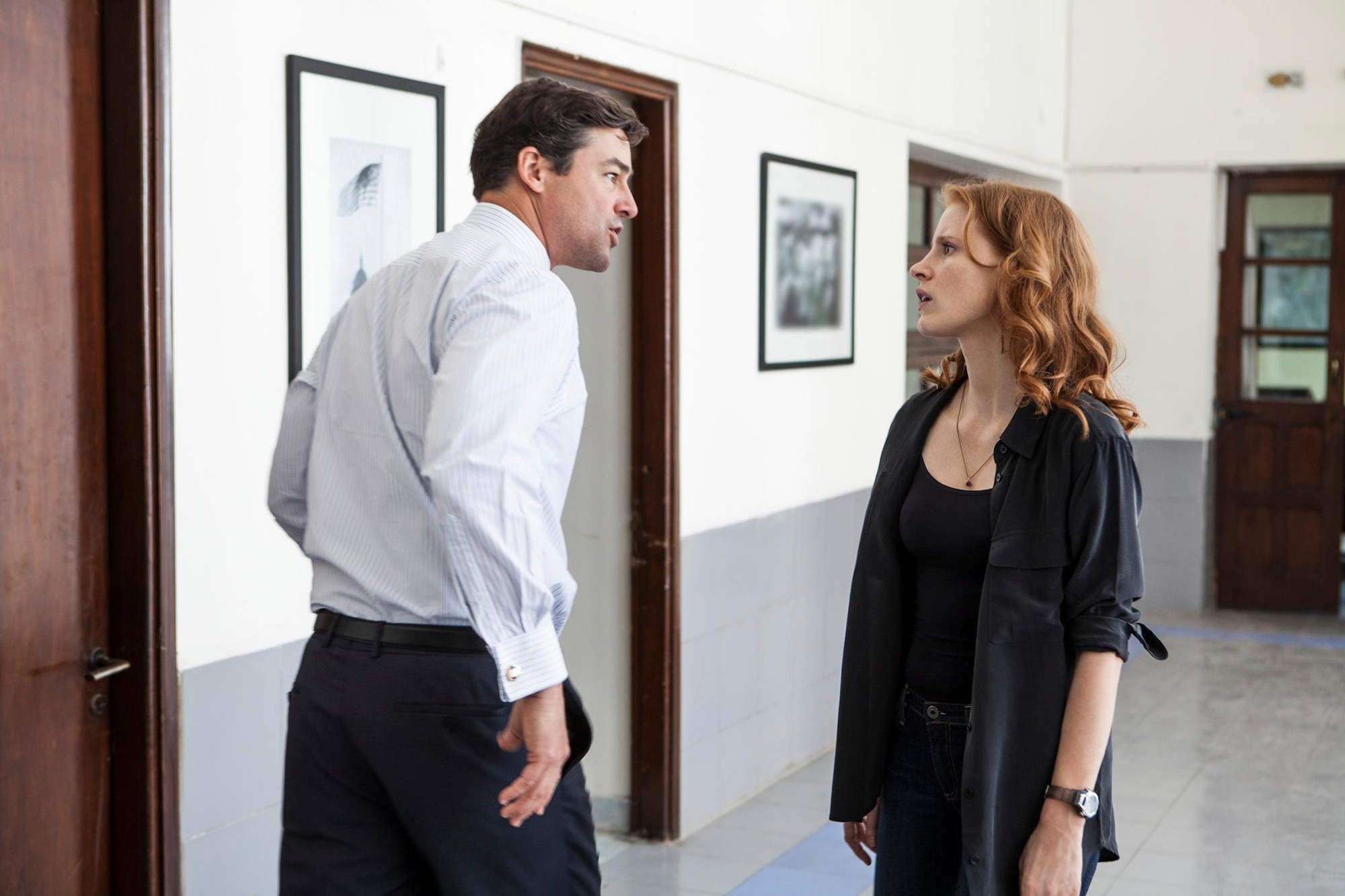
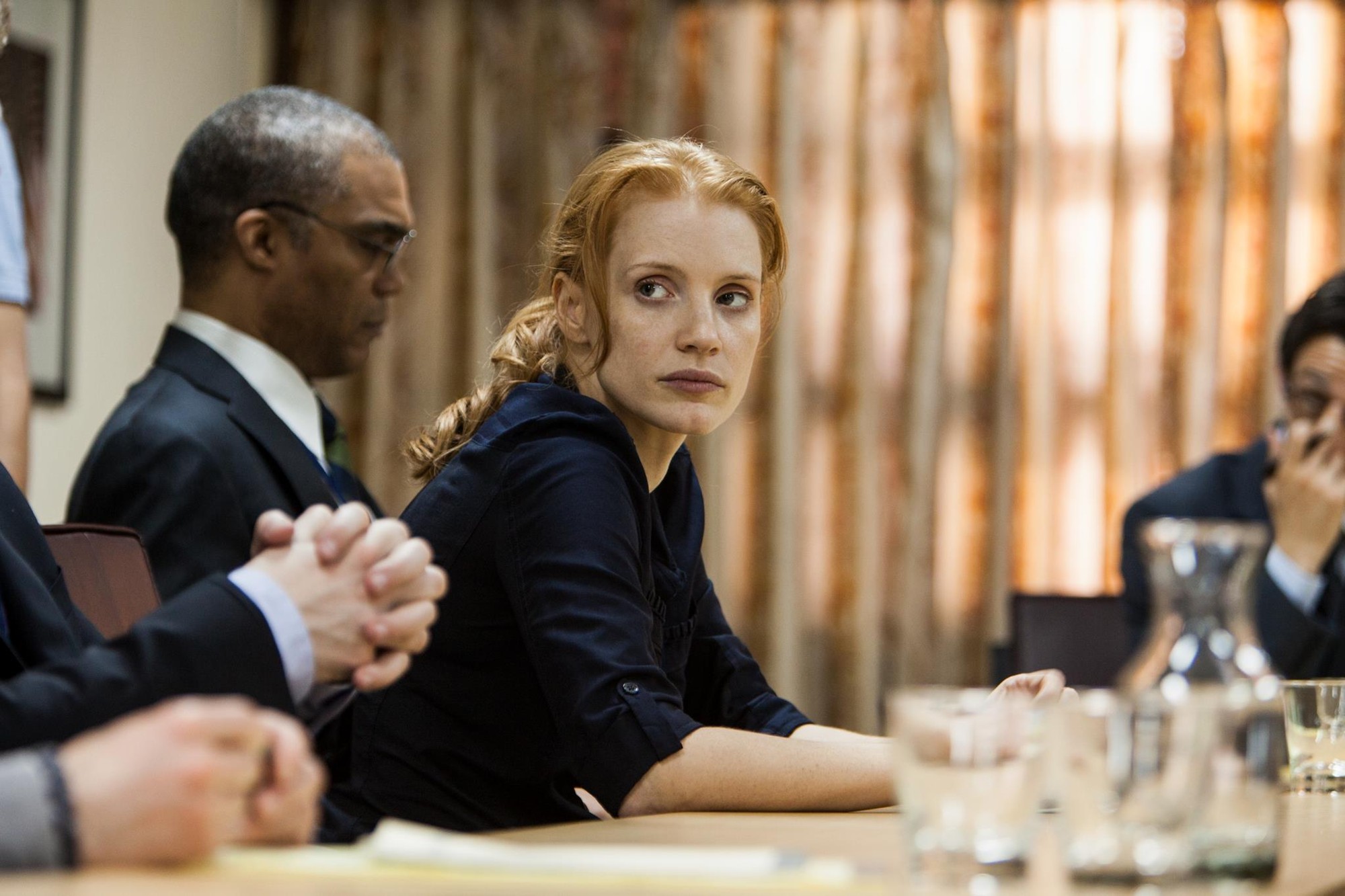
It focuses on one woman, a CIA analyst named Maya (played by Jessica Chastain)—her IM handle is "Maya173", but "Mark Owen," the nom de plume of one of the Navy Seals participating in the raid, refers to her in his book "No Easy Day," as "Jen." Maya is book-smart, street-savvy, but must learn "the ropes," literally, of interrogation by any means necessary. She is trained in the way of torture by Dan (Jason Clarke), who has been at this for awhile and has it down to a science—the speech "If you lie to me, I will hurt you," the loss of control, the humiliation, the physical and mental stresses, the releases from which information may come. Dan offers to keep Maya out of it, but she demurs. She will participate. She will actively sweat information out of the "detainees" in the euphemisms for prisons like "CIA Black Sites." "You are not being fulsome in your replies" she yells as she slams her hand in the interrogation table.  And when she's not participating, she's poring over other interrogations, reams of intelligence, and being a general pain in the rear to her superiors and colleagues. For station chief Joseph Bradley (Kyle Chandler), the job is to walk the razor's edge of politics and prevent more terrorism—he doesn't even care about bin Laden anymore, as there are too many attacks he's trying to prevent—every attempt that gets by is a failure.
But, for Maya, bin Laden is an obsession, her white Muslim whale, and it takes a zealot to find another zealot. She'll veer off into other investigations, particularly when some of her own are killed in an attack, but time only intensifies her resolve, almost becoming a mania, and her patient investigation is off-set by a gloves-off approach to her superiors (when asked her role in the briefing by the C.I.A. director—at the time, Leon Panetta—played by James Gandolfini, she replies "I'm the m#####-f##### who found this place, sir"), almost as if her persistent pressure torture techniques are being applied up the chain.* The Obama White House dithers over action until absolute proof is obtained that bin Laden is held up at the Abottabad compound, but Maya is resolute. When more cautionary analysts give the odds at 60%, she defiantly ups the odds to 100%—"Okay, 95%, because I know certainty freaks you guys out." But, it's that certainty that fuels Seal Team 6 in their mission—in the videos below, she's specifically mentioned and lauded in Mark Owen's account.
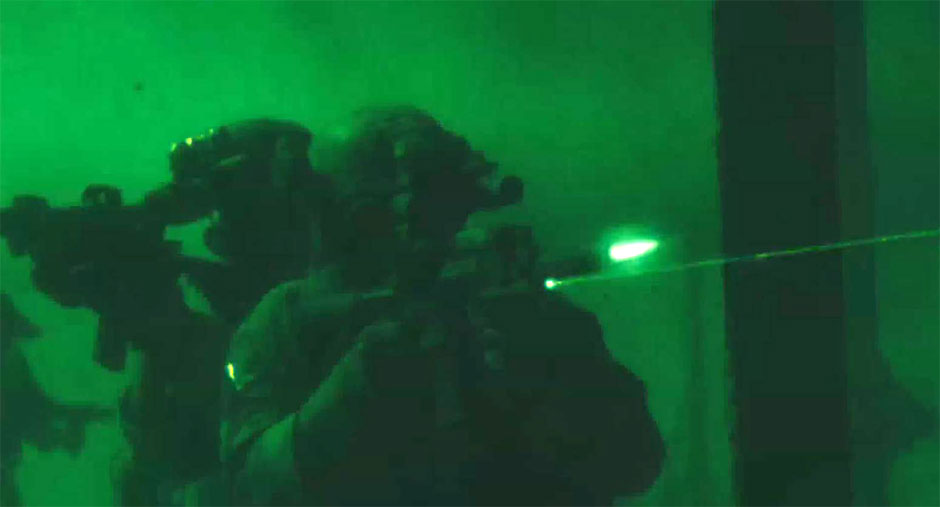
It is a fascinating movie, but a draining one, starting with torture scenes and ending with a recreation of the raid as it went down, shot mostly in tense disorienting night-vision. The character of Maya, or "Jen" or whoever she is, is a fascinating one, a portrait of obsession and the toll it bears—she's repeatedly told that she looks "terrible" throughout the movie—and when she lashes out at her superiors for their lassitude, or just plain pusillanimousness, there is a definite sense of someone unhinged—controlled, but pushed to the breaking point. A fury waiting to unleash, she is our version of a Holy Terror, a match for her enemies, and one can't help but wish her peace...suspecting that it will never happen.
2020 Addendum: Zero Dark Thirty came under some attack at the time of the release for its presentation of torture and its techniques and the implication that information obtained by it led to the critical information that led to the Abottabad raid. The movie is vague enough and the information so voluminous that one comes away with the impression that it wasn't critical to the intel (indeed, the location was confirmed by other means). As for the portrayals being an endorsement of torture, that's a little hysterical—to not portray it would have been 1) a whitewash of what was going on and 2) leaving out a specific chunk of the shaping experience of Chastain's "Maya"—one might just have well kept out the car-bomb attack that killed her colleagues. The character is driven by her experiences, hardened by them...and by her personal need for revenge. Her torture training is part and parcel of it. 

I came away from the film seeing a revenge drama that ended up, not in triumph, but in hollowness. The dead are still dead and the threat is just as real. There's no "Mission Accomplished." Just an "X" placed in a ledger that never empties.

I'll repeat what I said in the asterisked point. Zero Dark Thirty walks such a fine line that one can see whatever they want to in it.

The FBI's notice of bin Laden's death and the Situation Room during the raid.
Bear in mind, one helicopter went down during the raid.

* There are torture scenes, but they're not commented on, and any politicizing of it is so much hot-air—one can see in the film any position they want.  It walks a very fine line, merely presenting, and if someone tries to see their point of view in it, they're merely counter-projecting.  

Wednesday, March 11, 2020

Onward

The Real Hero's Quest
or
"Only Once Is All We Get..."
"Long ago, the world was full of Wonder. It was adventurous, it was exciting, and best of all, there was magic. And that magic helped all those in need. But, it wasn't easy to master. So, the world found an easier way to get by. Over time, magic faded away."
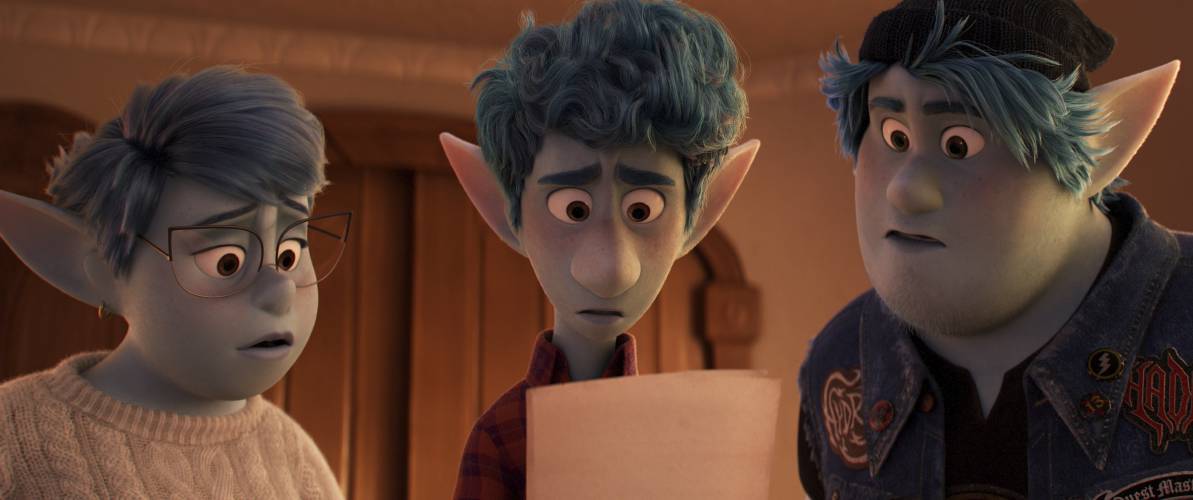
Ian Lightfoot (voiced by Tom Holland) is an elf, with a lot changing in his life: he's turning 16, about to enter high school, and he's scared of everything. His Mom (voiced by Julia Louis-Dreyfuss) has a new boyfriend (who's a policeman...and a centaur, but let's not be specist), his older brother Barley (voiced by Chris Pratt) is a lout, obsessed with with RPG's, especially quest-themed games based on the past, and there's a lot he doesn't like about his life right now, wondering if he had the guidance of his father—who died before he was born—that he wouldn't be so unsure of himself.

But, with a change in schooling comes an opportunity for change of self. Ian makes himself a list of things he wants to do: speak up more; learn to drive; invite people to his birthday party; "be more like Dad." Each item has an empty box next to it that he'll check off when accomplished...at the end of his first day, all of those boxes are empty.

Life in New Mushroomtown
So, it's not the best of birthdays, until after he survives the ignomy of brother Barley picking him up from school in front of potential friends (who invites—and then dis-invites to his birthday party). Mom reveals that Barley and Ian's Dad has bequeathed a boon to the boys when both of them have reached the age of 16. It is a wizard's staff ("I KNEW it! Dad was a wizard!" "No, he was an accountant...") with a parchment written with the very words that start the movie (and this post).
In Onward*, the world was one of wizards and magic. But science and technology took over. You know longer needed an enchanting mage to provide light, once electricity was channeled and utilized, infrastructures built, grids connected, roads built, cars invented and mass-merchandised. As it was said, the world found easier ways and magic in the every-day faded, replaced by industrial wonders and suburbs and highways and gas stations and fast-food restaurants. The world became democratized and needs fulfilled. Oh, there are still elves and centaurs and manticores and sprites and unicorns (knocking over garbage cans and eating the best bits), but society is more about convenience and getting through the 9 to 5.

Oh. And dragons. Pet dragons. If they're troublesome, squirt 'em with a water bottle (especially the fire-breathing ones!).
So, for these suburban elflings to get a magic staff, well, that's amazing! Especially for Barley, who's into that sort of thing. And there's another thing in the parcel—a Phoenix Gem. Dad's gift is a means to conjuring himself up for 24 hours (and 24 hours only) to spend it with his sons—handy to spend as little time in the troublesome teen years and to completely avoid diaper-duty. Not handy to be dead, though.
Ian and Barley attempt to magick up Dad, but fail. But, when Ian—who has the greater need (never having seen his father)—tries, he has more success to a certain degree. It being his first spell-attempt, there's some wasted energy (teens!) and the Phoenix Gem empties and dissipates, with only half-a-Dad showing up from the waist down ("I definitely remember Dad had a top part!")—the rest just being an expectant shimmer-layer of pixie-pixels. This is an issue, especially if you're expecting any meaningful conversation beyond foot-taps. 
So, that's the set-up of the story; the rest of the movie is a hero's quest for another Phoenix Gem to complete the spell...and Dad...before the 24 hours is up in order to have quality time with a Dad who's more than only part-way there. Simple goal: check. Limited amount of time to do it in: check. Complications, of course, ensue, and, of course, important life lessons are learned along the way. But, being this is a Pixar film, there is an emotional heart to the film beyond what we've come to expect from animated films from other digitizers. Goals may be achieved on the surface, but they are not as important as those achieved, unseen, in the heart. Audience tears may drop.
That's where Pixar excels—in the subtext (although, the subtext is a little more obvious in this one than in the absolute best of the studio's films). Onward is an ingenious blending of RPG games and real world in the ingeniously constructed and exquisitely rendered tradition that we've come to expect out of the Uncanny Valley in Emeryville. Sure, it's in a fantasy world, but there are moments where you would swear that something was filmed rather than rendered, and, beyond the RPG setting, director Dan Scanlon—this is a Giant's sized step up from his work in Monsters University—manages to squeeze in other "quest" touch-stones that might be recognized (there is an ingeniously updated reference to the opening of Raiders of the Lost Ark that has a hilarious capper).
Ultimately, what goes unspoken is the trope that it's not the goal rather than the journey itself, but it does it in such a subtle and smart way that one could be excused for not recognizing it as such, and in a way that might (just "might") frustrate those who are looking for connect-the-dots movie-making. Pixar is better than that, and the results are sublime and well-earned. Lesson learned. 
It is not Pixar's best—I just had to rank the Pixar features for The Large Association of Movie Blogs and I would say Onward is solidly in the top third of their output (I still think Ratatouille is the best one they've ever done from a depth perspective, but your results may vary), and one awaits breathlessly for their new one—Soul—in June of this year.


* Onward is not accompanied by a Pixar short, but one of the newly-acquired 20th Century Fox properties—The Simpson's—entitled "Play-Date with Destiny," featuring the non-verbal Maggie Simpson. One may be horrified that the anarchic Simpsons play in front of a Pixar movie, but this one is very clever—the more adult jokes are only written out to be read, so there's nothing that might "weird-out" the kindergartners. The makers of The Simpsons are an ingenious lot.