Showing posts with label Léa Seydoux. Show all posts

Friday, April 28, 2023

Midnight in Paris

Written at the time of the film's release...

"Gertrude Stein Punched Me in the Mouth"
or
"L'époque est toujours plus belle de l'autre côté du pont Einstein-Rosen"

I first came to Chicago in the twenties, and that was to see a fight. Ernest Hemingway was with me and we both stayed at Jack Dempsey's training camp. Hemingway had just finished two short stories about prize fighting, and while Gertrude Stein and I both thought they were decent, we agreed they still needed much work. I kidded Hemingway about his forthcoming novel and we laughed a lot and had fun and then we put on some boxing gloves and he broke my nose.
 "A Twenties Memory" by Woody Allen
Copyright © 1966-1971 by Woody Allen

I've been waiting for Woody Allen to make this film since before he asked to Play It Again, Sam (or even What's Up, Tiger Lily?). 

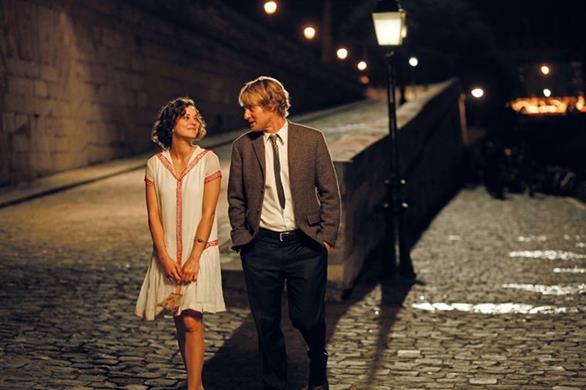
Based on a routine from his stand-up days,* which he later expanded for a piece in "The New Yorker" (see above), Midnight in Paris follows Gil (Owen Wilson) a self-absorbed, neurotically anxious writer of Hollywood fluff ("Wonderful, but forgettable...sounds like something I wrote"), who is obsessed with death,** as he travels to Paris from Pasadena with fiancee Inez (Rachel McAdams, but it could just as well have been Elizabeth Banks) and her conservative family. Gil is working on a novel, long in the gestation, and is distracted by the vapid shallowness that he is about to marry into. Paris is shops, restaurants, museums and snootiness, and to escape the jejeune de vivre, he takes a late-night walk through the streets of Paris and is approached by a vintage taxi.
Entering the cab for Gil is a magical moment for him, on the same plane-breaking as when Tom Baxter (or is it Gil Shepherd) walks off the screen in The Purple Rose of Cairo. He is instantly transported to 1920's Paris and becomes lost in "The Lost Generation" (without the benefit of having survived World War I), meeting Cole Porter (Yves Heck), Ernest Hemingway (Corey Stoll), Zelda (Alison Pill) and Scott Fitzgerald (Tom Hiddleston), all the heroes of his favorite literary era and time, the 1920's. He's enchanted...and as his novel is about that period of time...inspired. He goes back to Inez, gob-smacked, unable to explain where he's been all night, but "alibi's" his adventures as a dream (as they are, certainly in the aspirational sense). He tries to bring Inez to the party, but the magic doesn't work—she's as unthrilled with Gil's stories as he is with her wine-tasting adventures with acquaintance Paul (Michael Sheen).
She leaves. And the taxi arrives, bearing Gil and Hemingway to the apartment of Gertrude Stein (Kathy Bates) and Alice B. Toklas (Thérèse Bourou-Rubinsztein), who are playing judgemental hosts to Pablo Picasso (Marcial Di Fonzo Bo) and his enchanting mistress Adriana (Marion Cotillard). Gil gives his novel to Stein and Hemingway to critique, but he is drawn to Adriana, making her way through the 20's as best she can.
So, the two planes of existence for Gil are set up: his modern-day drudgery on the cusp of a marriage of inconvenience; and his fantasy past, where his dreams are reality and reality can make dreams. You know where this is going.
It doesn't matter, though. This is a "feel-good" Woody Allen picture—the kind people like—where the messages are still telegraphed the way they are in "obvious" Allen movies, the coincidences just a little too convenient, but so full of incident, grace and nuance (and quite a bit of humor) that it goes down well (as Allen groused throughout Stardust Memories, audiences "like his earlier, funnier [movies]"). That Gil is such a sunny presence in the past (and as played by Wilson, he has a guileless charm that doesn't sacrifice intelligence—he's the way you'd imagine Jimmy Stewart would play Woody Allen), even his kvetching is charming and not harsh.  It doesn't matter that you be a history buff and "get" all the references,*** (and we meet Luis Bunuel, Man Ray, Salvadore Dali [Adrien Brody], and on a side-trip, Toulouse Lautrec, Gaugin and Degas).
Of course, Gil is enchanted; he is an era when his heroes are still at the stage he is, becoming themselves, with their best work still ahead of them. His age of magic is their everyday life. The interesting lesson of the film (and what makes it special and wise) is that the knife cuts both ways. The "lesson" is both sour and sweet, but not hope-crushing—a little bit of salt in the creamy fluff.
 
And no, nobody punches Gil in the nose—but you can't help noticing that Wilson's is a little broken.

I mentioned before that I was in Europe. It's not the first time that I was in Europe, I was in Europe many years ago with Ernest Hemingway. Hemingway had just written his first novel, and Gertrude Stein and I read it, and we said that is was a good novel, but not a great one, and that it needed some work, but it could be a fine book. And we laughed over it. Hemingway punched me in the mouth.

That winter Picasso lived on the Rue d'Barque, and he had just painted a picture of a naked dental hygienist in the middle of the Gobi Desert. Gertrude Stein said it was a good picture, but not a great one, and I said it could be a fine picture. We laughed over it and Hemingway punched me in the mouth.

Francis Scott and Zelda Fitzgerald came home from their wild New Years Eve party. It was April. Scott had just written "Great Expectations," and Gertrude Stein and I read it, and we said it was a good book, but there was no need to have written it, 'cause Charles Dickens had already written it. We laughed over it, and Hemingway punched me in the mouth.

That winter we went to Spain to see Manolete fight, and he was... looked to me eighteen, and Gertrude Stein said no, he was nineteen, but that he only looked eighteen, and I said sometimes a boy of eighteen will look nineteen, whereas other times a nineteen year old can easily look eighteen. That's the way it is with a true Spaniard. We laughed over that and Gertrude Stein punched me in the mouth.


** Yes, this is the Woody Allen character.  His films never fall too far from the analyst's couch.

*** I certainly didn't—I had to do some referencing for the line: "That was Djuna Barnes (I was dancing with)?  No wonder she wanted to lead."

Friday, November 5, 2021

The French Dispatch

"Just Try To Make It Sound Like You Wrote It That Way on Purpose"
or
The Good and the Adject-Evil (Not Necessarily in a Bad Way)
 
Wes Anderson's new little chocolate toy-box of a movie is The French Dispatch (of the Liberty Kansas Evening Sun)—written with Roman Coppola, Jason Schwartzman, and Hugo Guinness—centered around the arty-little adjunct magazine that resulted when the son of the editor of Liberty Kansas Evening Sun, Arthur Howitzer, Jr. (played by Bill Murray) spent an extended holiday in the French village of Ennui-sur-Blasé and never returned home, instead creating an supplement for Dad's paper—"a factual report on the subject of world politics, the arts, high and low, and diverse stories of human interest."
 
Already, the town's name had me giggling, as not only is it a hilarious name for a burg (especially in France), but it also is the perfect site (and attitude) from which writers could concoct articles in a "New Yorker frame of mind". The movie centers around that magazine on its final issue of publication, pursuant to the wishes of the editor upon his death, that it cease and all of its assets liquidated. Thus, it consists of "an obituary, a travel guide, and three short articles" that have been culled from the magazine's past.
The obituary is, of course, Howitzer's, and it is inextricably tied to the magazine's history with no future—and reassuring subscribers that they will be refunded for the remaining issues that will not be forthcoming.
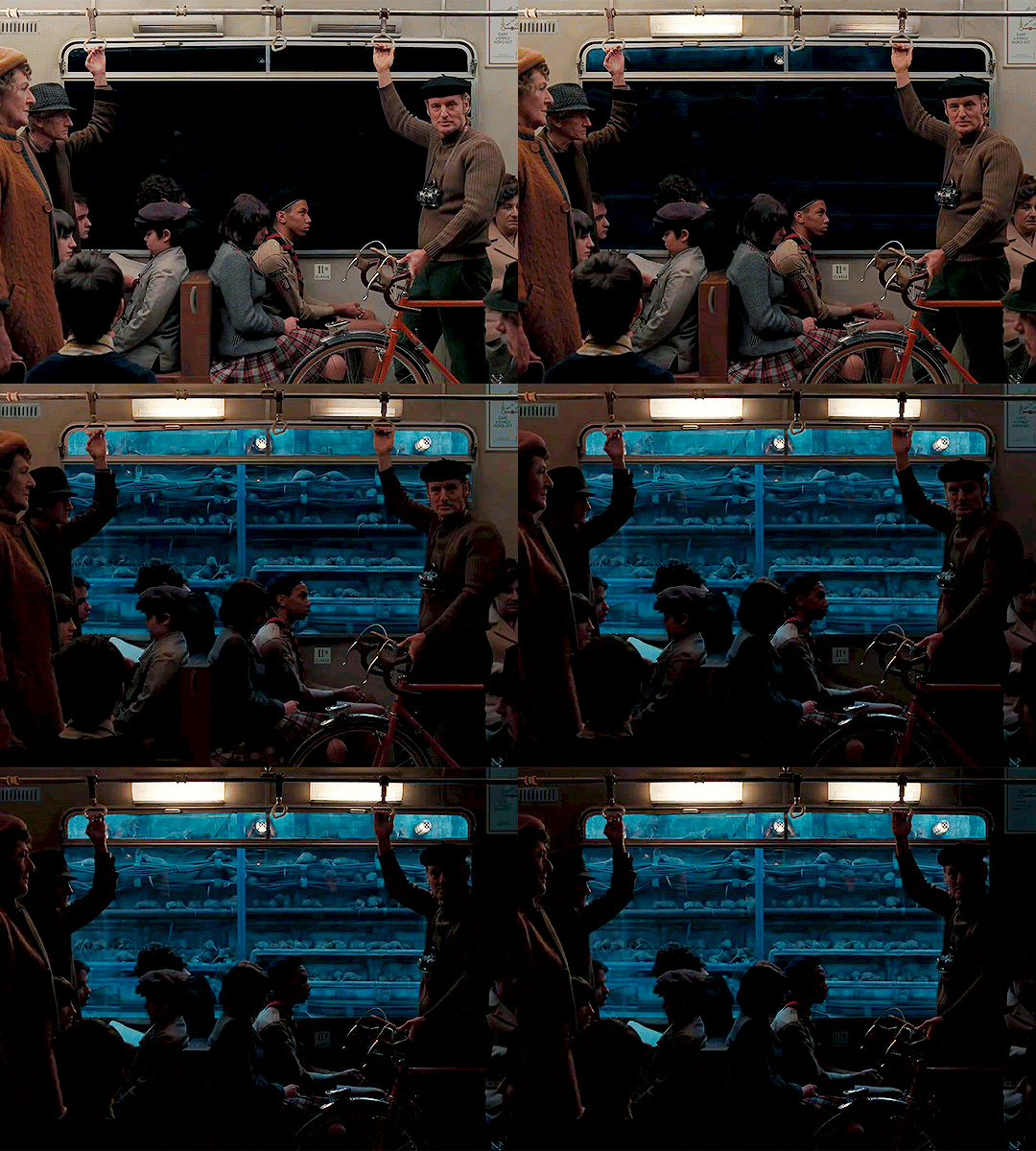
Next is a tour of Ennui-sur-Blasé with bicycling reporter Herbsaint Sazerac (Owen Wilson) who pedals about the village (often precariously) giving a guided overview of its piquant and sordid charms—for example, that it hides a vast population of vermin and scavengers (as illustrated above) and the curious statistic that 8.2 bodies are pulled from the local river every week.
The first of the stories—"The Concrete Masterpiece" tells the story of an art dealer (Adrien Brody), imprisoned for tax evasion, stumbling upon a masterwork by one of the mentally disturbed inmates, Moses Rosenthaler (Benicio Del Toro), inspired by his muse and lover (and guard) Simone (Léa Seydoux). He buys the piece and Rosenthaler becomes a sensation in the art world, but his methods are idiosyncratic to say the least and his latest work, three years in the making, proves problematic to its patron. The story is presented as a lecture by art historian J.K.L. Berenson (Tilda Swinton) and features appearances by Tony Revolori (from The Grand Budapest Hotel), Bob Balaban, Henry Winkler, and Lois Smith.
The second story is "Revisions to a Manifesto" in which a reporter/Witness to History, Lucinda Krementz (Frances McDormand) struggles with objectivity in her reporting of a youth revolt (called "The Chessboard Revolution") in Ennui, led by the charismatic Zeffirelli B. (Timothée Chalamet), who struggles with writing his manifesto—writing it in the cafe doesn't work, nor does writing it in his bathtub—and comes to rely on Lucinda to finish it.
The final story—"The Private Dining Room of the Police Commissioner"—is structured around a television interview (hosted by Liev Schreiber) with the article's author Roebuck Wright (Jeffrey Wright, no relation) who recounts the circumstances of a dining review of the exquisite meals prepared by the police lieutenant chef Nescaffier (Stephen Park) for Ennui's police commissaire (Mathieu Almaric) only to be embroiled in an investigation when the chief's son is kidnapped (by a gang that includes Edward Norton and Saoirse Ronan). It offers a chase sequence done in animation.
Still with me, there?
 
This may be the densest, most convoluted, detailed and realised of Wes Anderson's little confections, linked by his distinctive, reductive style of boxed-in, symmetrical (well, for the most part) compositions, and an acting style that would best be described as "Keaton-esque." The film zips along like a cartoon, heavily narrated and presented with layers of cascading framing devices and in a mish-mash of black-and-white and color in different aspect ratio's that have no narrative function other than to clash with the scene before it. Plus, reality is constantly challenged with animation (mentioned before), deliberate model-shots, and an extremely porous fourth-wall. The phrase I keep seeing in reviews is it's "the most Wes Anderson movie of his movies."
Of course it is. Even as he's stealing tricks and homages from shot-to-shot (but not for very long). It IS "The Most Wes Anderson Movie Of His Movies."
 
But not necessarily in a bad way.
You don't get lost, even when the director takes you down so many rabbit-holes your eyes might pop out of your head and your brain starts to take on a misty quality. Nor is one ever bored—unless one is so churlish as to ask "What's the point?" The film clocks in at an hour, forty-eight minutes and is so crammed with...."stuff"...that boredom seems impossible. Synaptic hemorrhaging, maybe, and a lot of such "stuff" is going to go right over your head, but it's so filled with detail—such as writerly nuance—that one can just absorb the layer of adjectival meticulousness until the next funny-bone prod comes along.
Call it a soufflé, if you will, filled with different textures and flavors, that might not be recognized as one is gorging on it, but might pop up with recognition when contemplated as a grand meal.

Friday, October 8, 2021

No Time to Die

James Bond's Swann Song
or
In The War of Orphans, Winning is Who You Leave Behind
or
"Tell Mother I Died Game" ("Well, It Just Goes to Show No One's Indestructible")
 
The continuity-conscious Daniel Craig era of the James Bond series has had a through-line simmering throughout all of its previous four films—"Don't trust anyone." 

From Craig's first film, Casino Royale, when the newly designated "00" agent James Bond has a moment of romantic weakness with the wrong person, continuing to the next film when he finds that his service has been compromised, and that the allied CIA works to cross-purposes, through Skyfall, where his boss "M" (Dame Judi Dench) sacrifices agents (including himself) indiscriminately, to the last one, where he discovers he can't even trust his past, this version of Bond walks under a cloud of suspicion, never letting his armor down, lest he be betrayed...by anyone. 

By the time of Craig's fourth film, SPECTRE, he has tipped so far over the edge that he draws down on a random mouse to ask it "Who sent you? Who are you working for?"   

As the song (from Quantum of Solace) says: "...someone that you think that you can trust is just another way to die."

The official series' 25th entry*, No Time to Die, sees Craig's James Bond retired in Jamaica and recruited—by CIA pal Felix Leiter (Jeffrey Wright)—for an operation that eventually reunites him with the people he does trust to go after people he can't, something involving a missing scientist. Another one. Hey, the series has been going on for nearly 60 years, everything can't be original and nor would the many "James Bond" devotees not allow the "familiarity factor" to creep into the story ("Where's the Aston Martin?" "Where's the martini line?" "I didn't hear 'Bond...James Bond!" "Is he going 'rogue' again?"**).
Still, with all the Fleming novels having been filmed—in one form or another—and a good smattering of the short stories included, the filmmakers have been hard pressed to keep Bond current, the movie-plots being set "a few minutes from now" with call-backs from past novels and films spattered in, as well as acknowledgments from other sources that the producers use to know that they know they're being watched.*** And the films have for the most part been formulaic—Pre-Credit Sequence/Main Title/Meeting with M/Visit to Q/Two Women (at least) with one being of mixed loyalty/The Sacrificial Lamb/Meet the Villain/Big Finish (with Explosion)/Sting in the Tail With a Challenging Henchman/"James Bond Will Return in..."—so that there were things you could count on. Rules were played with, but some you just didn't violate.
 
No Time to Die up-ends them.
As I mentioned, the Craig films are continuity-conscious. When last we left James Bond (Daniel Craig, pushing it this time, in all aspects—age, acting, etc...), he had crushed the international crime league, S.P.E.C.T.R.E., and brought to ground (literally) its ring-leader, Ernst Stavro Blofeld (Christoph Waltz)—but didn't kill him—instead walking off into the London night with Dr. Madeleine Swann (Lea Seydoux), daughter of the mysterious SPECTRE middle-man Mr. White (seen in three of the Craig's). The last shot of SPECTRE had the two seated in Bond's recently re-constructed Aston Martin, sharing smug, self-satisfied smiles. They were meant for each other.
No Time to Die begins with an episode from the past (not involving Bond, but will), and the story of the two scar-crossed lovers on a European honeymoon of sorts that is ruined when Bond is attacked visiting the grave of...Vesper Lynd (the "other woman" from Casino Royale). Coincidence? Not much of one, and as Swann and Bond are high-tailing it out of there, it's revealed that Blofeld has engineered the whole thing from his prison and implicates Madeleine. Despite her protests, Bond puts her on a train and she's out of his life. Bond and his trust-issues again.
In the past, we'd gotten used to the disappearing Bond-girl act, where after the final clinch of each movie, she is never seen...or mentioned...again. "Who?" But, the fact that Seydoux is even there—and she's the only actress playing the same Bond-woman part over two movies—means that she's special. And that the producers have "borrowed" a piece of music from the series' past (written by John Barry!!) to serenade the Bond-Swann romance means she's more than special. More on that later—Madeleine Swann Will Return.
Five years later and Bond is retired in Jamaica and alone, spending his days fishing, cooking and (probably) drinking. One day, he comes back to his house and sees evidence that someone had been there—someone who smokes cigars. He goes into town, realizes he's being followed, and manages to catch the culprits in the act. It turns out to be Leiter and a State Department official Logan Ash (Billy Magnussen) who are trying to get Bond to help track down Valdo Obruchev (David Dencik), a biochemist who has recently been kidnapped by SPECTRE. Bond had a hand in bringing him in during his tenure, and under the agency's careful watch, the man had been working on something called the Heracles Project, a form of targeted weaponized virus. MI6 lost him and the CIA is trying to get him back.
But, they're not the only one. Also tracking him in Jamaica is a "00" agent from MI6, in fact, the new "007" ("I'll bet you thought they'd retired it"), Nomi (Lashana Lynch), who's also on the look-out for the chemist. Despite her warnings to back off, Bond travels to Cuba, where SPECTRE agents seem to be gathering. Nomi is there too, and with the help of a new CIA agent (Ana de Armas), Bond walks right into a viper's nest.
The Cuba sequence, with its fights, the jokey repartee of Bond and "Paloma," their pauses to drink, while Nomi is skulking in the background looking for opportunity is probably the highlight of the film. It works like a violent dance, with a Cuban jazz background (part of Hans Zimmer's functional score) that gives it verve and a sense of hysteria. That it follows one of the creepiest scenes in a Bond film probably helps to provide that sense of chaotic relief.
But, just because that's the giddy apex of the movie doesn't mean the rest of its bad. There's a hell-bent Aston Martin chase in an Italian villa, a spooky cross-country shoot-out through a foggy Norwegian forest that is terrific, and another example of those spectacular villain lair designs that have always set the series apart from its competitors. 
This is another of those Bond films that stun for how well done the practical effects are, the cinematography—by not one of the upper tier of photographers—is lush and colorful, the editing is crisp and tight (while giving you a sense of continuity and flow—something not apparent in Quantum of Solace), and the sheer kinetic verve of the action sequences goggle. Credit director Cary Joji Fukunaga for his precise direction and making a movie that never feels like it's 2 hours 46 minutes in length ("We Have All the Time in the World," indeed!). It's a bit of a miracle, really.
Fukunaga has also inspired Craig's most intense performance as Bond, part of which must also be credited to Phoebe Waller-Bridge's re-write of the original Purvis/Wade script. Fukunaga's practice of letting the actors "wing it" gives the film a richer, fuller life, much more than the standard Bond direction of "line (beat)/funny line (beat-beat)" that makes the viewing of the older films of the series seem awkward. Here the dialogue fairly scampers when Craig's present, and only slows to a crawl when Rami Malik's puppet-master Safin appears. "He's kinda creepy" is how he's described early and, indeed, he is, reminiscent of a trembling Peter Lorre, with a philosophy that's a bit hard to decipher, though natter on about it he does. The Bond villains have some motivation, whether it be greed, errant activism, or a power grab. Safin is simply crazy, but a self-important, rambling crazy.
Now, this is going to be a spoiler-free review, but, as mentioned, this one up-ends things, but not in a way that anyone who's read a book by Bond-creator Fleming wouldn't recognize. Because the Bond films have only flirted with a strict continuity lately means they can get away with it with no harm done. The older films had a strict "Bond is fresh with each adventure" edict, which the Craig films have ignored. Bond never got hurt in the old films, but now they keep track of the scars. This is Craig's last film—he's been doing it for 16 years, longer than anybody, and wife Rachel Weisz was getting annoyed he was coming home broken. There will be another Bond, but whether the series will be as continuity-conscious next go-'round hasn't been decided. 
Original Bond producer Cubby Broccoli always maintained that Bond should be "at the top of his game" and that nobody would be interested in an "early Bond" origin story. When his kids got control, they tried it with Craig and it's worked. But, now that they've done it, there's no need to do it again. Bond may go a different route, like going back to stand-alone movies. Maybe they'll do Cold War period pieces. Maybe they'll remake a couple of the bad ones. Who's to say? And who's to say who'll be the next Bond. Finding Craig was something of a miracle despite the initial nay-saying, so I'll trust their judgment on the matter.
 
One thing is certain and that is, as the credit says "James Bond will Return." As long as the British flag flies, and the box office receipts are healthy.


* "Official" refers to the films made by EON Productions (founded by Harry Saltzman and Albert R. Broccoli), starting with Dr. No in 1962, and featuring the Ian Fleming titles they had the film-rights to, which—at the time—excluded "Casino Royale" and (owing to an early '60's plagiarism suit) "Thunderball". "Casino Royale" appeared ("unofficially") as an episode of CBS-TV's "Climax" (starring Barry Nelson as "Jimmy" Bond, American) and a 1967 "spoof" film starring David Niven, Peter Sellers and Woody Allen, before EON got the rights to it for the first of Daniel Craig's films. Thunderball became an EON presentation when the fellow who won that lawsuit wanted to make his movie with Sean Connery and worked out a deal with EON to "present" the film—with Connery—thus avoiding any competition that might hurt box-office receipts. However, when that same guy wanted to remake Thunderball (which, contractually, he could do after ten years), things were so contentious between him and EON that both sides battled in court before that remake (called Never Say Never Again and starring Sean Connery) was released in 1983, the same year as EON's Octopussy starring Roger Moore. EON now owns the rights to both the books "Casino Royale" and "Thunderball" (even including those "un-official" movie versions). They've since been doing original stories for ages, (and over several agents), and it's a wonder when some morsel of the original Fleming writing sneaks undercover into the films.
 
** The series' Bond has "gone rogue" in On Her Majesty's Secret Service, Licence To Kill, Die Another Day, Casino Royale, Quantum of Solace, Skyfall, and SPECTRE. It's as if the producers have preferred Bond's role to be less a company man and more of a rebel.
 
*** Hmm. Live and Let Die was put in during the craze for "Blax-ploitation" films, The Man with the Golden Gun was taken out of its novel-locale of Cuba to be set in Hong Kong, Thailand, and Cambodia to catch the "Kung-Fu" craze, Moonraker timed to take advantage of the Star Wars-prepped audience, Octopussy threw in some Indiana Jones action, Goldeneye's Xenia Onatopp was a soul-sister to Never Say Never Again's Fatima Blush, the fight sequences of late owe much to the "Bourne" series, and the Austin Powers movies stole all of the series' leering jokes leaving the Craig films to be a bit more stoic—although the Bond screenwriters stole the "villain-is-a-relation-to-the-hero" bit from Goldmember...as either series might say "Tit for Tat" 
 

Wednesday, September 19, 2018

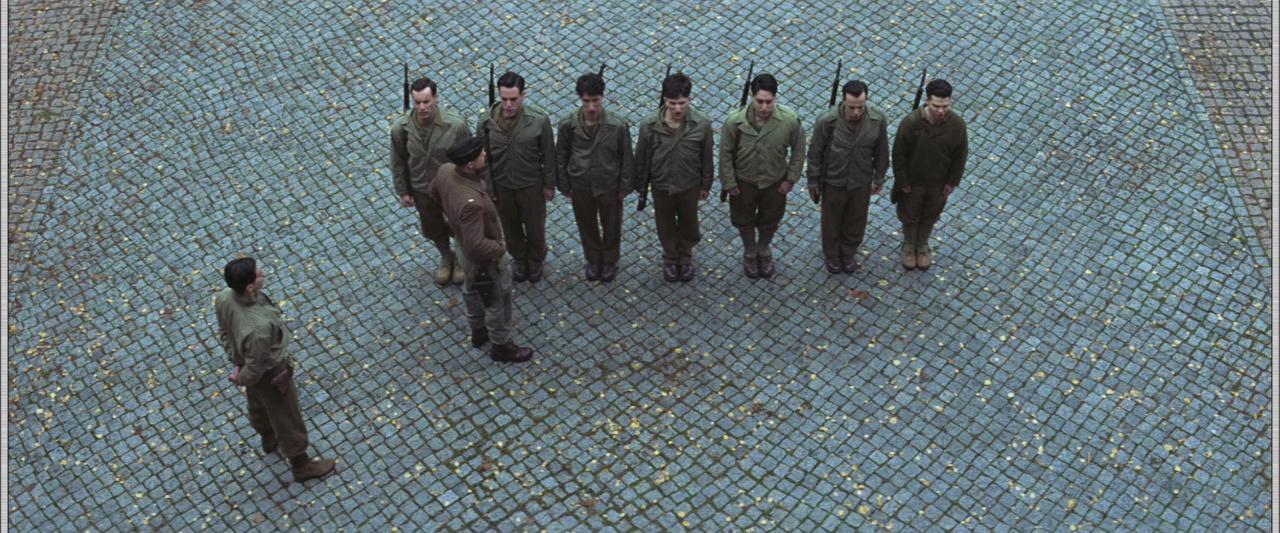
Inglourious Basterds

Written at the time of the film's release...

"Yaknow sumpin,' Utivich? Thyis Maht Be Mah Masterpyiece"

I run hot and cold on Quentin Tarantino. What most people consider his classics—Reservoir Dogs, Pulp Fiction, and Kill Bill, I find one-off regurgitations of other people's films with gear-grating pop-culture references to con the kids. But I did like the Bruce Willis half of Pulp Fiction (written with Roger Avary) and think the world of his jazzing-up of Jackie Brown. I was even surprised at how much I enjoyed Tarantino's half of Grindhouse, Death Proof. Tarantino's slavish devotion to matching other directors' techniques, combined with his lack of focus as a screen-writer (we went through four interminable hours of Kill Bill to get a lecture on comic-books?) have made his regard as a cinemaster seem like "The Emperor's New Clothes" to me.* Combine that with his reputation as a media-whore, who rarely says anything of much value,** explains why I'm always on the fence on QT. One film at a time, Sweet Jesus.
But I know a great movie when I see one, and Inglourious Basterds*** is a great war film, adventure story, spy story and movie-movie. Tarantino's influences are just as obvious, but more than ever, he puts his own sensibility to it, showing a superb command of the camera, composition, and direction in service to an interesting wish-fulfillment of a World War II story, and a paean to the unholy grip of cinema and its power to blow you away.
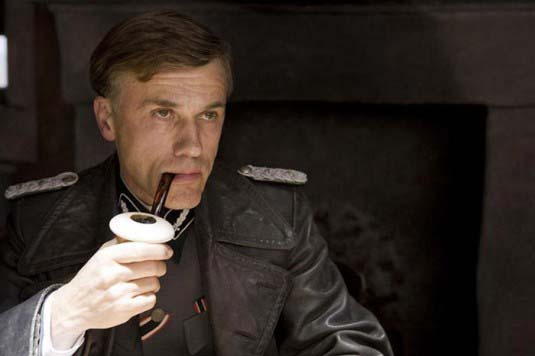
It's "Once Upon a Time in Nazi-Occupied France" (your first clue that you're not going to see a by-the-book WWII movie), and Tarantino begins a long prologue-like scene between a dairy farmer and the chief reason for seeing the movie, Christoph Waltz as SS Col. Hans Landa. Waltz's Landa is solicitous, polite, self-satisfied and more than a bit theatrical. That he is well-versed in languages and their subtleties is beyond question. He has a nickname (a lot of characters have nick-names and noms de guerre, few of which they like)—"The Jew Hunter"—and he has come to this farm-house to ask the farmer if he knows what became of a Jewish family who was known to be living in the sector (their current whereabouts unknown). It is a long, excruciatingly tense scene of false cordiality, heavily dependent on dialogue and subtleties of expression on which Tarantino, unable to fall back on street-language and bursts of giddy technique, maintains an iron grip.**** It's extraordinarily well-done and follows the negative contrast of Tarantino-movie-rhythms that dominates the film: a whole lot of talkin' punctuated by a brief manic explosion of violence, like a rubber band being constantly tightened until it snaps.
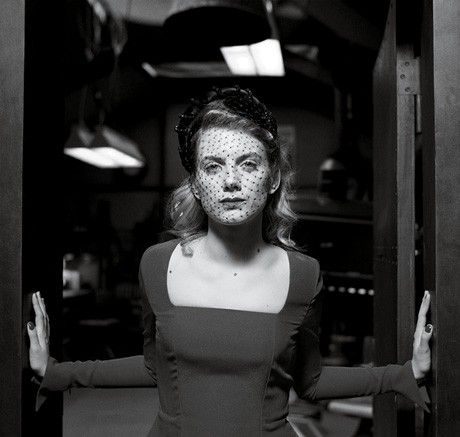
This episode sets up the Big Duel in the film—between Landa and Jewish refugee Shoshanna Dreyfus (Mélanie Laurent, very good in a multi-faceted role), who escapes to occupied Paris and is now running a movie theater, inherited from her aunt. Between the "chapter" showing us this and the opening, there is an introductory chapter to "The Basterds," a group of Jewish mercenaries dropped into France before D-Day as a "wet-ops" team. Their modus operandi is to scare the Nazis by destroying platoons through any means necessary (including clubbing them to death), then sweating information from the last one standing (and quaking). Led by Lieutenant Aldo Raine (Brad Pitt, doing a subtle turn as an unsub-tle comic-relief movie-star hero: "We're not in the prisoner-takin' business," he says at one point, "We're in the Nazi-killin' business. And, cousin', business is a'boomin'"), nicknamed "The Apache" for the way his troop mutilates the Nazi corpses to send a message, scalping the dead ones, and carving a large swastika into the fore-heads of the live ones, branding them for life.
By now, it's apparent that the level of violence in Inglourious Basterds is pretty high—brief, but high. The most violent of the Basterds is Sgt. Donny Donowitz—"The Bear Jew"—the one with the baseball bat, and he's appropriately played by Eli Roth, director of the "Hostel" movies, one of the new sub-genre of horror films known as "torture porn." "Watchin' Donny beat Nazis is as close as we get to goin' to the movies," says Raines to Donowitz's next victim, setting up the major theme of the film. The violence is sometimes excruciating, but the major set-pieces are filmed with quick, intricate cuts and with an overall unsentimental sensibility. Tarantino spares no feelings and good guys get killed with the bad guys early and often and surprisingly.
"The Basterds," being in their unique position behind enemy lines, are recruited to help the British with "Operation: Kino," as explained by General Ed Fenech (Mike Myers, doing his own version of "Basil Exposition"*****) to Lt. Archie Hickox (Michael Fassbender, the epitome of fussy), a former film-critic and intelligence officer in charge of the operation (Winston Churchill, supervises the briefing, as portrayed by Rod Taylor (!!)). But as with most espionage stories, the best laid plans...sometimes require a last-minute re-write.
Ultimately, all the parties converge onto one spot—that cinema in Paris that becomes the center-piece of "Operation: Kino" (or what's left of it), and in a confluence of hidden allies and enemies and dramatic cross-purposes the film reaches a stunning crescendo, a "Götterdämmerung" that would have made Fritz Lang proud. This is all done with a careful precision, a precise plotting, and some superb directions and mis-directions on the part of the director, with the photographic wizardry of Robert Richardson and a soundtrack laden with bravado 60's film-music from the likes of Charles and Elmer Bernstein, Ennio Morricone, and pointed contributions from Billy Preston and David Bowie.
But...but...what the movie comes down to is a movie about movies, which seems a bit puerile, and a bit soon in Tarantino's career to have the medium eating its own tail for subject matter. Sure, he loves the movies. That's always been clear. But the movies he loves are about something...not just that they're great movies. Howard Hawks took his arctic explorers, and air-mail pilots, and posse's and rhino-hunters, and they became metaphors for movie-making and of how disparate groups of talented people unite in a cause, but I can't remember a film he made about movie-makers that wasn't about something else. Here, Tarantino's rough-hewn coalitions band together, and it's about...what a great thing movies are. As a celebration of the cine-mah, it's an orgiastically great success, and I think its his best film.
but...but...

Can we say something more next time? Can we light up the screen to say something more than movies light up the screen? Can we have less fireworks, and more of a reason to have them?

And so I remain on the fence, hoping for the future.

One film at a time, Sweet Jesus.


* Miramax put out a DVD of ChunKing Express as part of its "Quentin Tarantino Presents" series. Frankly, Kar Wai Wong should be presenting HIM.

** I had to turn off an interview with Charlie Rose, as Tarantino spouted out writerly cliches on his prowess as a writer ("First I come up with the characters and they write themselves!") I see, that's why, with a war going on—that we don't see—everybody's as movie-obsessed as QT in Inglourious Basterds. I'd better stop or I'll talk myself out of loving this film, because in the final analysis, it's the movie that matters, not the slob who made it.

*** I'll bet you any money the title is mis-spelled like that to differentiate it from the original The Inglorious Bastards (or Quel maledetto treno blindato, roughly a 1978 "Spaghetti-War" film by Enzo G. Castellari starring Bo Svenson, who cameo's in Eli Roth's Nazi film-within-a-film in Tarantino's movie), Fred Williamson, and Ian Bannen, but on a metaphorical level, it shows a total disregard for the rules, which sets up it's "How I'd Win the War" scenario, belying History. Isn't that what most movies "based on a true story" do? Isn't that the job of the fiction writer?

**** There's a nod to one of my favorite shots in Sergio Leone's Once Upon a Time in the West where Charles Bronson takes 30 seconds or so to relax a smile from his face in tight close-up. Tarantino doesn't copy it exactly, but there's a nod to it.


***** A late-night thought (one which might piss off folks who take Tarantino SOO seriously, but it feels like a "natural"): Myers and Tarantino both suffer from "lazy-eye writing" where it's thought that if you just recall something from a past movie and reference it that that is all that's sufficient for it to "play"—which is why the Myers' "Austin Powers" series is so weak. Tarantino has had a running feud with EON Productions in "the Press" over whose idea it was to make a film of "Casino Royale" (Answer: original author Ian Fleming)—and a balding Tarantino-like henchman named "Elvis" appeared in the Bond movie, Quantum of Solace—why not put Tarantino at the helm of the next Powers-fest (which has been talked about since...well, since the last one). Tarantino would have a giddy field-day with it, the genre, and the chance to gnaw on the red meat that is the Bond movies. It would easily be the best entry of the series. Only problem: during filming, the set would be like walking into a daily cage-match, where two prima donnas walk in and only one can emerge.