Showing posts with label Jacob Tremblay. Show all posts

Thursday, November 21, 2019

Doctor Sleep

Well, We All Shine On (Like Moon-light and The Stars, and You)
or
Wait'll the Talent Scouts Get Wind of Him

There was no reason for there to be a sequel to "The Shining," either the book or the 1980 film adaptation. It told its story and ended. Each told it differently, but there was no ambiguity to either one. King ended his story by having the Overlook blow up in a boiler-room conflagration. And Stanley Kubrick's movie kept the Overlook in one piece, but put the story to an end.

There ARE no reasons to make sequels of any of Kubrick's films—he ended his stories, having said all that needed to be said, even if the ending was ambiguous. There was no next chapter because there was no point. And if you did do a "sequel"—like the ill-considered 2010: The Year We Make Contact—you basically cheapen the story with considerations that are not central to the first conceit and the whole thing gets watered down. "Oh, yeah, and by the way, this could happen tangentially...only it's not as important as the first story, but...blah blah blah—people will have jobs so let's make a sequel."

And so..."Heeeere's...Danny!"

Danny Torrance (Ewan McGregor), of Jack (E.T.'s Henry Thomas) and Wendy Torrance (Alex Essoe), is not doing well. One could say he's following in the family tradition—a victim of PTSD from his experiences when his parents were caretakers at the haunted Overlook Hotel, he is drinking and drifting, short-time jobs, the money of which he'll squander on booze and start the cycle again to losing the work and moving on. But, Danny (as we know) has been gifted—or cursed—with "the shining," a psychic ability of some indeterminence, but which played a large part in saving the life of himself and his Mother when father Jack became swayed by the spirits haunting the Overlook. A "very willful boy," he has lost his will since his Mother's death and shines far less brightly these days, the booze having doused it, like water to flame.
For Danny has been plagued by nightmares. Not just nightmares, but the returning spirits of the Overlook, who have followed him and his Mother to Florida—they never wanted to see snow again—and beset Danny until one day he's given a coaching by Dick Halloran (Carl Lumbley), his friend "in shining" at the Overlook, who teaches him about what he used to do as a boy, a trick taught to him by his grandmother. If one of those old spooks comes back to haunt you, you think up a box and just lock them in it, and they'll never bother you again.
Now, for fans of the original Shining—book and/or film (and they're not exactly a group that like both), you know there's an issue: Halloran appears in the book of "Doctor Sleep" because he survived in the book of "The Shining." But, (can it be a SPOILER ALERT for a movie that's 39 years old?), in the movie, Halloran gets cleaved by an ax in an attempt to rescue Danny and Wendy from their predicament. And yet, he appears in Mike Flanagan's movie of Doctor Sleep, to give little Danny that advice about the mental boxes. Flanagan does a bit of finagling to do justice to both book and film, and satisfy the expectations of both (which is no small task) but he does a fairly good job of keeping his feet on both banks of the river simultaneously, but in the process, he kinda hasta change what "the shining" actually is—not that we knew in the first place.*
Problem solved, and if I remember correctly (and I probably don't because I couldn't get through King's novel), that happened in the first twenty pages. Now, Danny may be able to box those demons, but he can't box the ones inherited from his father. And so he spends most of his life wasted and drifting, until he comes to one town, Frazier New Hampshire, where under the stewardship of Billy Freeman (Cliff Curtis) he gets a job, a room of his own, and starts going to A-A where he meets Dr. John (Bruce Greenwood), who becomes impressed with Dan and offers him a job as an orderly at a hospice that seems to suit him.

That's where the cat comes in.

The hospice has a therapy cat, who has a strange ability. At night, when everything is quiet, the cat will wander the halls of the hospice and open a door and jump on the bed of one of the patients. The cat, named Azrael, has a reputation among the internees—when the cat visits you at night, it means you're about to die. Despite this, the cat seems to be popular and not kicked off beds right and left. Soon, Danny starts to follow the cat on its rounds, and comforting the about-to-die, giving them peace in their last moments.

And he gets a nickname—"Doctor Sleep." Roll credits.

All well and good, if that was all there was to it. Danny finds peace giving peace, his "shining" bringing comfort like a spooky version of Last Rites. But, there are other shiners who don't give comfort at all; they're The True Knot and over the years—and there have been many, many of them—the Knot led by its cult leader "Rose the Hat" (a particularly on-point Rebecca Ferguson) have been luring children with shining abilities and ritualistically killing them...slowly, so as to absorb their shining abilities like a life-force, that manifests itself as a mist, giving them rejuvenation and renewed life. They're like vampires, but for shining, not blood. This is a new wrinkle, that the "Shining" has a physicality, that—with an expanded range of abilities—makes it feel more like George Lucas' midichlorian-based "The Force."
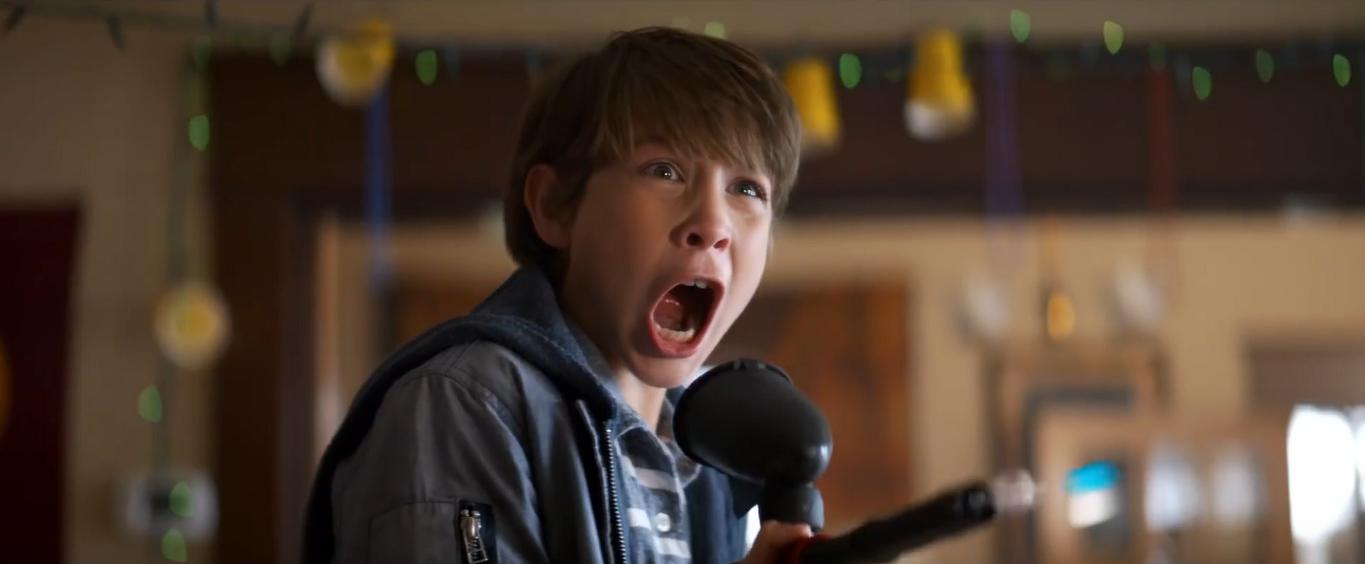
The activities of The True Knot psychically alerts a shining adept teen, Abra Stone (Kyliegh Curran), who is traumatized by the murder of a child (the always amazing Jacob Tremblay) by the group. Abra has been in psychic contact with Danny, the way a HAM radio operator talks with other stations around the world. But the night of the boy's murder, Danny is blasted by Abra's terror and the blackboard the two have used to communicate is covered with the word "MURDER" which Danny first sees in a mirror as an all-too familiar word—"REDRUM"
The movie then turns into a three-way struggle between Danny and Abra and the Knot, and particularly its leader, Rose, a fight that escalates from merely invading each other's thoughts to more murderous physical contact. Pretty soon, everybody is tracking the movements of everybody else and Danny decides to take Abra and stage a last stand at the one place that might be suffused with enough evil energy to defeat Rose—the Overlook Hotel, containing all the ghosts and memories that have haunted Danny's past, including the restless spirit of his father. 
Director Flanagan has done a very creditable job of directing Doctor Sleep, making an intriguing film that stands on its own without depending on the very heavy shadow of Kubrick's film (although he does fall back on it a lot—which we'll talk about later). If there are gripes, they can be directed at King's novel, which gives far more substance (literally) to The Shining ability, which now allows astral projection, mind and body hijacking—"pushing" to use King's phrase from the book and from his novel "Firestarter"—and the capacity to get into people's heads, even those that shine, and messing around with their "files." 
That's a big jump from the psychological manipulation and thought-reading that had been the extent of the earlier versions. Think about it: if the shining ability was originally presented the way it now is, little Danny wouldn't have had to do what he did in the original to spare himself and his Mother. All he would have to have done is take over Daddy Jack's mind. Problem solved.
That aside, there is a bit of diffusion of the original story—the True Knot is too big a group that has lasted too long to not be noticed, even at the time of the first book. In a way, it overshadows the first story, even threatening to swamp it.
Flanagan ignores that, giving the Knot its due, and deftly combining both versions of The Shining, book and film. He takes a lot of tricks from the Kubrick film, not just in creating a near duplicate of the Overlook sets—that was probably a chore—using key images, like the swooping Main Title sequence, digitally altered for effect, recreating the "Here's Johnny" sequence that is so spot on, you will initially think they used the sequence with Shelley Duvall, but, no, that's Alex Essoe playing it perfectly. The film is also bracketed with the same music (Wendy Carlos' distortion of "Dies Irae" and the old tune "Midnight, the Stars and You") as well as the thumping heart-beat Kubrick used to underscore tension.
But, his best weapon is employing the same creepy technique Kubrick used in The Shining, which is purely cinematic—the framing. Kubrick imbued his film with his usual trope, the one-point perspective.** But, with The Shining, he gave it an extra element—nothing. For much of the film, Kubrick centers his one point on a negative space, giving the film a vertiginous depth despite its horizontal perspective.
Most of the time it works, but there are moments when it's jarring—like a shot of Greenwood's Dr. John in his office that is so influenced by Kubrick's shots of the Overlook's manager, Ullman, in his office—in the Overlook Hotel, mind you—that for a moment it took me right out of the movie. That seemed a bit slavish...and unnecessary—an irrelevant echo that is a complete mis-match, despite its adherence to the original.***
But, we can overlook that as maybe taking a good idea too far. For the most part, Flanagan has taken an old haunt and managed to bring it back to creepy life.

Maybe Kubrick was right—how could The Shining be a down-beat movie when it suggests there is life after death? Perhaps there's a corollary of that thought to sequels, as well.


* I suspect it has something to do with midichlorians, but I might be confused...

**


*** That's what I'm talking about


Wednesday, August 21, 2019

Good Boys

F-Bombs (Out of the Mouths of Babes)
or
"Two Weeks in the 6th Grade and I'm a Social Piranha!"

The "R" rating is prominent in the promotions for Good Boys because, God forbid, kids the ages of the stars of it should go see this movie (at the premieres, do they escort them out? I mean, they ACTED the damn thing). But, then, I'm not sure what good it would do to actually let 11-12 year old's see this movie, other than to show them what adults think of them.

Because the movie isn't FOR the age-group it depicts, like a YAF novel. It's for adults to give them a nostalgic laff about the naivete and confusion of that time period between childhood and wanting to be an adult—you realize you can't do certain things adults can do, you're constantly told "you wouldn't understand," you see adulthood as a freedom you covet without realizing the responsibilities that come with it (that give you no freedom at all). It's the last flush of childhood that you can actually enjoy before the mantle of licenses, financial responsibilities and permanent records take away your childhood and make you nostalgic for the way things were.


Which is why they make movies like Good Boys for adults.

There's a grand tradition of this in the movies—"Our Gang," one of my faves The Sandlot ("You're killing me, Smalls"), where kids are trying to act like adults in an adult world, where the adults are almost absent (the comic strip "Peanuts" is like this where there are no adults and the kids talk—as cartoonist Al Capp used to carp—"like psychiatrists" or, as in the animated versions, adults squawk like muted trumpets). If it was a drama, it would be To Kill a Mockingbird—kids not understanding the frailties and failings of adults. But, in a comedy, it's kids trying to negotiate through the adult world without understanding it, and Good Boys takes it to the extreme.
The story follows the issues of "The Beanbag Boys" (called that because...they all have beanbag chairs)—Max (Jacob Trembley, the brilliant young actor from Room), Lucas (Keith L. Williams, who's hilarious) and Thor (Brady Noon, who gives the most mannered performance, but has the most conflicted role)—friends since kindergarten, who are entering sixth grade, which for them is a highly transitional time. Their little clique runs the risk of fraying due to peer pressure, family crises, and the inevitable consequences of growing up and away from each other, but seem determined to stay bonded through thick and thin.
Thor is the most theatrical, but also the one most susceptible to peer pressure—despite his talents, he doesn't try out for the sixth grade school play because he'd be thought of "not cool." Max is starting to notice girls, particularly Brixlee (Millie Davis), who he can't look in the eye while also trying to be apathetic, at the same time the sight of her makes him weak in the knees. Lucas, is the tallest of the three, but is being cut down to size due to the impending divorce of his parents. These are the crises of children, because their stasis is being shattered and change is being forced on them without any regard to how they feel about it. They are completely messed up, but try to hide it behind a veneer of "cool" lest they humiliate themselves.
The events of the movie revolve around Max and his Brixlee fixation. The popular boys are giving them a hard time--Thor is being harassed  for his interest in theater arts, conflicting with Max, who wants to be popular because he thinks it will give him a better chance with Brixlee (an invitation to a "kissing party" That Brixlee is going to becomes his obsession). Big problem, though;  he's never kissed anybody. What if his kissing...well...sucks. To get an education--a horrifying encounter with porn doesn't work because "they never kiss, not their mouths"--Max takes control of his father's drone against his orders ("I use it for work!") to spy on two "old" girls, Hannah (Molly Gordon) and Lily (Midori Francis) in Hannah's nearby backyard. Hannah has a college boyfriend, so the boys "one-up" the traditional spying through the fence to go to aerial reconnaissance. They watch Hannah and Benji--the boyfriend--have a fight right after he delivers some "Molly" to Hannah for a concert that night. Just when the girls go in for a consoling clinch, Max loses control of the droid, allowing the girls to capture it...and hold it hostage.

This is not good. It becomes a hostage situation that goes seriously wrong with a confrontation where Max may have to 'fess up to his Dad and be grounded for the kissing party. But, Thor manages to steal one of the girls' gotcha bags containing the ecstasy (don't worry, the boys don't get access to it--they can't figure out child-proof caps). But, it begins a cat-and-mouse game between the Beanbag Boys and the "old girls" as each has something the other wants. There are the inevitable complications that divert this "Coming of Age" movie into an "Incredible Mess" movie (the kind where relatively simple goals become increasingly out-of-reach by increasing road-blocks, tangents and diverting sub-goals that keep the ultimate goal tantalizingly harder to achieve.
"Honey...yeah...we're not having kids."
The Beanbag Boys turn out to be surprisingly adept at navigating these smaller complications to achieve their ends, even as they risk fraying the fabric that binds them together.
They're not bad kids--in fact, their naivete and embedded anti-drug indoctrination makes them quite charming, despite the beer-sipping (four sips is a crowd-impressing record) and the F-bombs that explode out of their mouths.
They're just trying to make sense of a bizarre adult world that, more often than not, turns them into screaming meemies (and cry-babies--they are constantly crossing the line from sixth grade sophisticates to the behavior of kids in single digits). I'm not sure what kids would make of this if they were allowed to ss it (for one thing, a lot of the jokes will fly right over their heads). But, then, they're not the target audience. Older teens and adults are, and in that context, the movie is a nostalgic comedy as opposed to being about the loss of whatever innocence they still retain.

It's an odd movie. But very funny.


Friday, January 22, 2016

Room (2015)

Inside Out
or 
The Young Person's Guide to Human Cruelty

Room starts with one mystery and ends with another. In between, it warps your mind and makes your realize just how vast the world can be. And how narrow.

It's Jack's (Jacob Tremblay) fifth birthday. He gets up that morning, very excited, announcing to Ma (Brie Larson) that he is, indeed, five, then proceeds his morning greetings of the things in his environment: the chair, the table, the cupboard, the humble things that he is familiar with and has made friends with. His hair is long and has probably not been cut since he was born.

The two watch a little television on a set that is small and has poor reception. Jack thinks the people on the TV are aliens. He has no idea who they are, or where they are, where they come from. Later, he helps Ma make his birthday cake—small, made with few ingredients and a lot of love. He's upset that there are no candles for his cake, but Ma tells him that she needed to get jeans instead. And "Old Nick" can only get a couple things at a time...and then only on Sundays.
 
 
Jack and Ma
Where the hell are we? Is this a bunker in the past or the future? Has there been a nuclear conflagration? Some economic disaster forcing people to live in hovels? What circumstances force them to live like this? And "Old Nick" is a euphemism for Satan—could mother and child be held by some religious cult against their will? One is hesitant to talk too much about the particulars for fear of ruining the surprises and the shocks to the system that the movie brings to the viewer. So, this will, by necessity, be a short review.
But, the opening situation is unusual in that it drops us into a bizarre family life that plays on some of our worst fears in the absence of certainty. It's just mother and child with limited technology and next to nothing as far as available light, which only comes into the space from an overhead skylight. As time goes on and we spend more time with them, clues add to our knowledge of what's going on, and slowly but surely the motives of the mother and child change from survival to escape. 
It must fall to Jack to make the escape, and it's dangerous. He's only five years old, knows nothing of the world beyond the room, and he is tasked with saving himself and the only person he knows in the world. The stakes are high and unknowable to him, but what one worries about is what happens to this test-tube child once he is born again into a world seemingly endlessly from the eight square feet that has been his world.
When that revelation comes, it is amazing (this Tremblay kid is a great little actor), but the movie has far to go. It introduces him to a new world and then turns it upside down, just as it does with Ma. The "room" was never safe, but the outside world isn't, either, where the dangers are unknown and could come around unseen, past every corner. 

The "room" had no unseen corners.

One of the things that causes conflicts and neuroses in people that is either "worked out" by themselves or by therapy is perspective. We are born into our environments, through no fault of our own, and, unless we are very wise or curious, that may be our whole world-view, limited as it is, into adulthood.  That perspective beyond our experience may be what adulthood is—what maturity is—and it is only attained when we burst the bubble of ourselves and our comfort zones. 

Room inspires thoughts like that, which makes me admire it so much. Movies have their "comfort zones" like popcorn and this one definitely thinks (if you will) "outside the box." It stimulates curiosity and puts you in the perspective of real people you might have heard of only in headlines. What is life like for them? 
Room asks "what if?" questions. I like those. "What if" is a great tool for writers and actors, and this film has no uninteresting performances (Brie Larson won a surprising Golden Globe for Best Performance by an Actress, deserved I thought, even though there are flashier and more studied performances this year—and she's nominated for an Oscar for it as well, which can only increase people's curiosities about this fine film) in a cast full of good actors besides Larson and Tremblay, but also Joan Allen and William H. Macy, the latter turning in a tough, tough performance that is clear-eyed and unsentimental.

This one has stayed with me for a long time.