Showing posts with label LilRey Howery. Show all posts

Wednesday, August 21, 2019

Good Boys

F-Bombs (Out of the Mouths of Babes)
or
"Two Weeks in the 6th Grade and I'm a Social Piranha!"

The "R" rating is prominent in the promotions for Good Boys because, God forbid, kids the ages of the stars of it should go see this movie (at the premieres, do they escort them out? I mean, they ACTED the damn thing). But, then, I'm not sure what good it would do to actually let 11-12 year old's see this movie, other than to show them what adults think of them.

Because the movie isn't FOR the age-group it depicts, like a YAF novel. It's for adults to give them a nostalgic laff about the naivete and confusion of that time period between childhood and wanting to be an adult—you realize you can't do certain things adults can do, you're constantly told "you wouldn't understand," you see adulthood as a freedom you covet without realizing the responsibilities that come with it (that give you no freedom at all). It's the last flush of childhood that you can actually enjoy before the mantle of licenses, financial responsibilities and permanent records take away your childhood and make you nostalgic for the way things were.


Which is why they make movies like Good Boys for adults.

There's a grand tradition of this in the movies—"Our Gang," one of my faves The Sandlot ("You're killing me, Smalls"), where kids are trying to act like adults in an adult world, where the adults are almost absent (the comic strip "Peanuts" is like this where there are no adults and the kids talk—as cartoonist Al Capp used to carp—"like psychiatrists" or, as in the animated versions, adults squawk like muted trumpets). If it was a drama, it would be To Kill a Mockingbird—kids not understanding the frailties and failings of adults. But, in a comedy, it's kids trying to negotiate through the adult world without understanding it, and Good Boys takes it to the extreme.
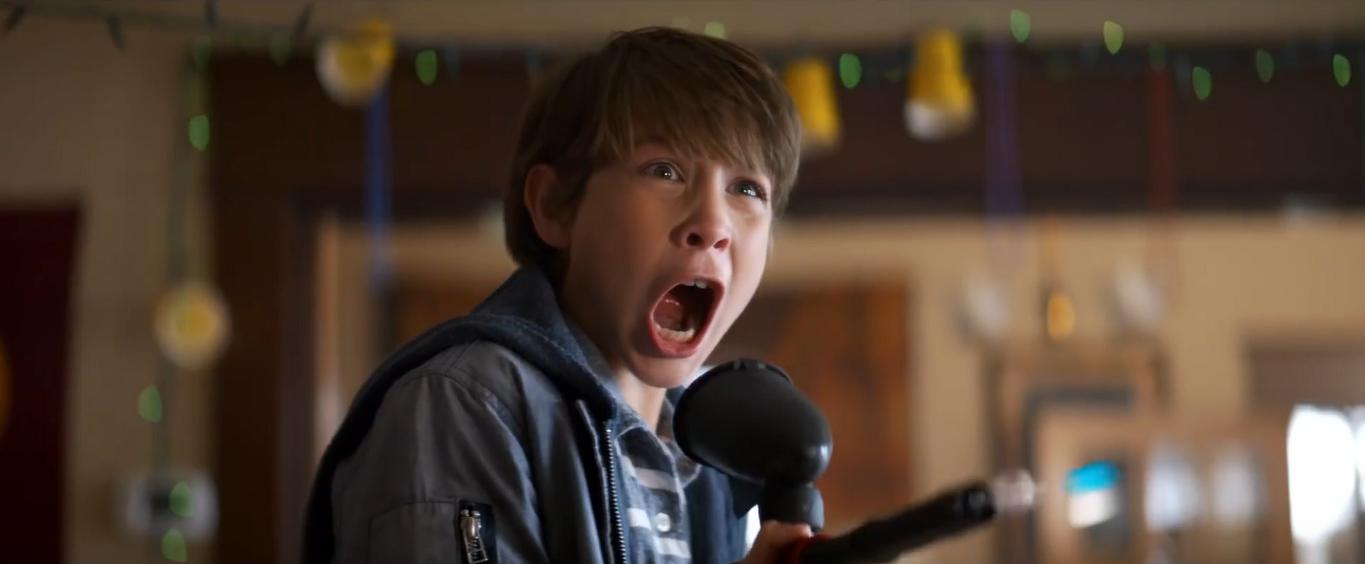
The story follows the issues of "The Beanbag Boys" (called that because...they all have beanbag chairs)—Max (Jacob Trembley, the brilliant young actor from Room), Lucas (Keith L. Williams, who's hilarious) and Thor (Brady Noon, who gives the most mannered performance, but has the most conflicted role)—friends since kindergarten, who are entering sixth grade, which for them is a highly transitional time. Their little clique runs the risk of fraying due to peer pressure, family crises, and the inevitable consequences of growing up and away from each other, but seem determined to stay bonded through thick and thin.
Thor is the most theatrical, but also the one most susceptible to peer pressure—despite his talents, he doesn't try out for the sixth grade school play because he'd be thought of "not cool." Max is starting to notice girls, particularly Brixlee (Millie Davis), who he can't look in the eye while also trying to be apathetic, at the same time the sight of her makes him weak in the knees. Lucas, is the tallest of the three, but is being cut down to size due to the impending divorce of his parents. These are the crises of children, because their stasis is being shattered and change is being forced on them without any regard to how they feel about it. They are completely messed up, but try to hide it behind a veneer of "cool" lest they humiliate themselves.
The events of the movie revolve around Max and his Brixlee fixation. The popular boys are giving them a hard time--Thor is being harassed  for his interest in theater arts, conflicting with Max, who wants to be popular because he thinks it will give him a better chance with Brixlee (an invitation to a "kissing party" That Brixlee is going to becomes his obsession). Big problem, though;  he's never kissed anybody. What if his kissing...well...sucks. To get an education--a horrifying encounter with porn doesn't work because "they never kiss, not their mouths"--Max takes control of his father's drone against his orders ("I use it for work!") to spy on two "old" girls, Hannah (Molly Gordon) and Lily (Midori Francis) in Hannah's nearby backyard. Hannah has a college boyfriend, so the boys "one-up" the traditional spying through the fence to go to aerial reconnaissance. They watch Hannah and Benji--the boyfriend--have a fight right after he delivers some "Molly" to Hannah for a concert that night. Just when the girls go in for a consoling clinch, Max loses control of the droid, allowing the girls to capture it...and hold it hostage.

This is not good. It becomes a hostage situation that goes seriously wrong with a confrontation where Max may have to 'fess up to his Dad and be grounded for the kissing party. But, Thor manages to steal one of the girls' gotcha bags containing the ecstasy (don't worry, the boys don't get access to it--they can't figure out child-proof caps). But, it begins a cat-and-mouse game between the Beanbag Boys and the "old girls" as each has something the other wants. There are the inevitable complications that divert this "Coming of Age" movie into an "Incredible Mess" movie (the kind where relatively simple goals become increasingly out-of-reach by increasing road-blocks, tangents and diverting sub-goals that keep the ultimate goal tantalizingly harder to achieve.
"Honey...yeah...we're not having kids."
The Beanbag Boys turn out to be surprisingly adept at navigating these smaller complications to achieve their ends, even as they risk fraying the fabric that binds them together.
They're not bad kids--in fact, their naivete and embedded anti-drug indoctrination makes them quite charming, despite the beer-sipping (four sips is a crowd-impressing record) and the F-bombs that explode out of their mouths.
They're just trying to make sense of a bizarre adult world that, more often than not, turns them into screaming meemies (and cry-babies--they are constantly crossing the line from sixth grade sophisticates to the behavior of kids in single digits). I'm not sure what kids would make of this if they were allowed to ss it (for one thing, a lot of the jokes will fly right over their heads). But, then, they're not the target audience. Older teens and adults are, and in that context, the movie is a nostalgic comedy as opposed to being about the loss of whatever innocence they still retain.

It's an odd movie. But very funny.


Friday, March 24, 2017

Get Out (2017)

Horror is Best in Black and White
or
"White Girls Do It To You Every Time"

I'm not a big fan of horror movies (I don't see everything), but the genre is extremely useful. Look at a new horror movie and the chances are good that you'll see the debut of an upcoming director fast-tracked to "Big" movies because of their sophomore efforts keeping the budget tight and the shots fast and purposeful. Horror is a great training ground for the movie art of manipulation and getting a rise out of the audience and the list of directors who got noticed slogging through the horror genre are long and frequently surprising. And when horror films are very very good (at being bad), they'll explore sub-texts of society and the psyche, sometimes overtly, or sometimes merely tickling a deeply recessed part of our alligator-brains to make the heart jump and our flight-or-flight instincts surface. Horror reduces us to the basics, removing all the drama and the time-wasting melodrama. Horror comes down to the primary drive of survival.

But survival from what makes it interesting.
After a prologue in which a young man is abducted in a somewhat pedestrian suburban neighborhood,* we focus on Chris Washington (Daniel Kaluuya in a great, understated performance) who is having a certain amount of trepidation over the weekend trip he's taking with his girlfriend Rose Armitage (Allison Williams). It is the usual anxiety any boyfriend might have going to meet his lover's parents, but there's also the added color that he's black—the way the film seats it, the problem is always that Chris is black, not that Rose is white, but the film is rooted in Chris' perspective and Rose has never brought up the issue with her parents, despite her protestations that there will be no "problems" ("He's going to tell you that he would have voted for Obama a third time" and, of course, he does). His buddy with the TSA, Rod (LilRey Howery) thinks it is a bad idea, very bad. Any time a black man goes to the house to visit his white girlfriend's parents is a BAD idea, bruh.
But that's not the only issue. Chris has insecurities and this is just the one on the closest burner. He suspects Rose might be cheating on him, despite her protestations—she protests a lot, you'll find during this movie—but the suspicion persists, groundless as it might be, to the point where it clouds anything else and everything is refracted through that jealous filter.
Chris shouldn't have worried about the parents—they are affluent liberals who are guilty as sin: Papa Dean (Bradley Whitford) is a semi-retired neurosurgeon (and yes, he WOULD have voted for a third term for Obama); Mama Missy (Catherine Keener) is a psychologist/therapist specializing in anti-smoking therapies. They couldn't be more welcoming...with the tightest smiles without benefit of Botox injections. When brother Jeremy (Caleb Landry Jones) joins the party, he's a bit of a creep, but everybody thinks he's a creep, so it's okay. 
Then, there are the servants, who are "part of the family"—they've been around since Dean's parents needed care-taking and the Armitages couldn't bear to part with them, even though they "hate how it looks." Walter (Marcus Henderson) is a groundskeeper, who keeps an eye on Chris, and Georgina, the maid, (Betty Gabriel, who plays creepy as hell and has one of the best repetitive line readings in a movie—"Oh no, no, no, no-no-no-no-no-no-no-no-no-no-no-no-No!"—since Kevin Spacey told Alan Arkin to go to lunch in Glengarry Glen Ross) is a hovering presence. Chris finds them vaguely threatening. "It's not so much WHAT they say, but how they say it..." he tells Rose.
The same could be said for all the guests at a weekend family function—it's not what they say so much, as how unctuously they say it—a little too cheery, a little too welcoming, no conflict, just a little too "TOO". Then, a night-time walk around the grounds makes Chris extraordinarily uncomfortable, and a resulting chat with Missy over tea gets extraordinarily weird. Maybe, she hypnotizes him, sending him to a weird nether-world she calls "the sunken place." Maybe it happened. Maybe it was a dream. Whatever it was, he doesn't want to smoke any more.
Get Out is the work of Jordan Peele, one of the brilliant sketch comedy team Keye and Peele, late of their self-titled Comedy Central show, and there is comedy here, of a particularly cerebral kind—terror and laughter, tragedy and comedy being Arbus twins of each other, each evoking honest instinctive reactions. As a new director, he knows he can get a small-budgeted project green-lit in the horror field, just as he knows that horror doesn't have to have a big budget to sneak in Big Ideas, that it can be as simple a matter as casting an African-American actor as the most competent-guy-in-the-room (as George Romero did in Night of the Living Dead—a move that was made because Duane Jones was the best actor in the cast). Here, Peele makes the "minority experience" real for anyone not living "in the sociological skin," presenting the foundation of dread that the suspicion of the targeted experience on a daily basis with the ignition of blue lights in the rear-view.
"Give me the keys, Rose"
Get Out is smart, funny, and horrific in a wild, bizarre way. Peele has plans for other horror films that one hopes are as wild in concept, but steeped in the psychological reality that this one is. They could do a lot of good by doing bad as all Get Out.

* Interestingly, it is the second use of "Run, Rabbit, Run" (after its use in the bombing sequence of Miss Peregrine's School for Unusual Children) in the last few months. References keep folding back on themselves in movies, just as there are frequently competitions between similarly themed movies that open nearly simultaneously.