Casual Cruelty (Till Human Voices Wake Us and We Drown) or "No Matter What They Tell You, We Women Are Always Alone!"
Alfonso Cuarón has come down to Earth.*Not only that, he's come home and he's revisiting the past. His latest film,Roma(nominated for a Best Picture Oscar) goes a completely different route than his space epic, Gravity, and is a far simpler story than it or his other most notable films, like A Little Princess, Y Tu Mama Tambien, Harry Potter and the Prisoner of Azkaban, or Children of Men. The film covers a year in the life of a live-in servant, Cleodegaria "Cleo" Gutiérrez (Yalitza Aparicio, nominated for Best Actress, with no previous acting experience), working for a middle-class family in the Colonia Roma district of Mexico City, during a turbulent time (both politically and geologically) between 1970 and 1971. With her friend Adelita (Nancy García García), she cleans the house and takes care of the four children of Sofia (Marina de Tavira) and Antonio (Fernando Grediaga), a physician. Also, living with them is Sofia's mother, Teresa (Verónica García) and the family dog, Borras.
We go through a typical morning with Cleo as she scrubs the car-port (where Borras resides), gathers the laundry, then picks up the youngest, Pepe (Marco Graf) at school, prepares the children's meals and prepares for dinner for the entire family. At night, she sleeps above the residence with Adelita—aware that Sofia is keeping an eye on how much electricity they use—and begins the day again. She is a part of the family, but more subject to rebuke than any of the children and seems to be getting more criticism from the mistress of the place, as the family is going through a bit of strain—Antonio is spending more and more time away, saying that he's attending a conference in Ontario.
Cleo feels warm towards the children, especially the youngest boy Pepe, and is very deferential to the two elder women of the house, but she can't help but notice things. Still, she keeps busy and looks forward to spending her one day off, as she's been seeing a boy, Fermín (Jorge Antonio Guerrero), a cousin of Adelita's boy-friend. He's pleasant enough, but very proud of his martial arts training—hey, this was before Star Wars, so he has to be obsessed with something.
But, it isn't long before Cleo begins to suspect that she's pregnant—she tells Fermin on one of their dates to the movie-house, but he begs off to go the "lavabo" and...just disappears, leaving her alone to consider her ride home...and her future. She is deathly afraid of telling Sofia, but her employer is entirely sympathetic and insists on taking Cleo to the hospital to be checked out (and so she can inquire about her husband, whose business in Ontario has lasted much longer than was originally predicted). It turns out Cleo is three months along, and she's told to wait in the nursery when the building is shaken by an earthquake. It's just a tembler, but it's enough to send parts of the ceiling down on the incubators in the facility.
Over the next few months, Cleo gets bigger and the family smaller by the absence of Dr. Antonio. It seems he'll be gone over the Holidays and so Sofia decides to take the family to go see relatives over Christmas and New Years, taking Cleo and Adelita with them, and the servant observes there is talk over land-rights and everyone is well-armed should things become a bit rough. She also notices that Sofia is struggling with her aloneness, as she is only too aware that her husband is not at some extended conference in Canada, something that she is keeping from the children. But, Cleo senses it. She knows what it feels like to be abandoned.
Cuarón's style here is strictly controlled (far afield from the loopiness of Prisoner of Azkaban or the POV at all costs and angles of Gravity) consisting of long takes—not unlike the intention of Gravity; the camera takes a position and remains on point, either swiveling slowly to take in the action as it occurs before it, or tracks along perpendicularly to keep the action in frame. It never rushes or jostles and there is no hint of hand-held work, the camera observes without comment or impending any added drama or or psychological intent to the scene. Even the depiction of a riot—the "Corpus Christi massacre" as it was labeled—is photographed with a camera that bides its time, dispassionately.
Roma is photographed in black-and-white, with what appears to be natural light, only a few shots make use of focus, and for the most part the film has a wide depth of field, everything in range in crisp focus and detail. No tricks, no subterfuge. Just recording the scene as it transpires, all of the action reliant on the figures caught in its boundaries.
That ambivalence in the camera extends to the soundtrack as well, certainly the finest work of the year. There is no music to "goose" the emotions or tell you what to think. Any music is source and appropriate to the period and offers no sub-textual comment, even in irony. And the sound design is complex and ever-present; it is a mixture of natural sound and layers and layers of detail, right on up to the sky and its occasional drone from a passing-by plane coming in and out of frame. The sounds are always there, providing a deeper layer to what is going on on-screen, with the sense that life goes on, all around and off in the distance, no matter what happens to the people in out focus. The world moves on indifferently, no matter the attention we pay to the characters we care about.
I love this kind of movie; it gives you plenty to think about, to observe and take things in.
And what one sees is people in turmoil. But, also impacted by what is going on around them, as the world continues to spin and life moves on. It doesn't matter if someone's heart is breaking, the pedestrians still pass by. Nor does a traffic jam care that in the midst of it, a woman is going into labor on her way to the hospital. Newborns are as protected as can be from the germs of the world, but an earthquake makes no concessions for their youth and helplessness; an earthquake quashes humans and germs alike flat. Acts of selfishness are there because those committing them simply do not care about the impact, only the personal benefit.
And that's where Roma hits me in the heart. The writer, John D. McDonald—he of the colorful Travis McGee detective stories—once saged that "the opposite of love is not hate—they're just two sides of the same coin. The opposite of love is indifference." The world is indifferent. We put God in charge to explain it away, or, in our most kumbaya-moments, link ourselves as one body, troop, congregation or posse, when we're just individual cells commingling and colliding and breaking apart, separate and unequally equal. Laugh and the world laughs with you (if they're paying attention); cry and you cry alone. The world doesn't care. The world's too busy being the world.
That is why seeing the world through Cleo's experiences is so revealing. Her role of servant makes her an ever-present something-to-be-ignored, someone you order to clean the shit and find out, much to your surprise, she's the one you want there when it hits the fan. She is a constant Job on the job, ignored but not ignoring, the paste that holds things together, even under the onslaught of a constant casual cruelty. You care because she cares. I strongly suspect that Roma will win the Best Picture Oscar and it should, despite some great films competing against it. It has the soul of a great movie, telling its story through image and putting you in another world, apart from your own, a magic lantern of communication. The best of what movies can be. But, then, I also cynically think it will be because it has a couple scenes in a movie theater. The movie people like that sort of thing.
What is that sound high in the air Murmur of maternal lamentation Who are those hooded hordes swarming Over endless plains, stumbling in cracked earth Ringed by the flat horizon only What is the city over the mountains Cracks and reforms and bursts in the violet air Falling towers Jerusalem Athens Alexandria Vienna London Unreal
You can do a lot of things with science-fiction...or speculative fiction, if you'd rather. You can take a common problem, take it out of your world or your dimension and force people to look at it with a new eye, empty of pre-concieved visions or prejudices.
And you can do this in the movies, too. Couch a radical concept in a chase movie...say, The Road Warrior, and you immediately wake millions of people up to the concept of non-renewable resources. Al Gore knew what he was doing making An Inconvenient Truth.
Cuarón started his career with the charming A Little Princess and a not-too successful modernization of Great Expectations. He broke out a few years ago with a very entertaining film out of Mexico called Y tu Mama Tambien about a pair of immature teen boys (read: your target audience), hooked them up on a road-trip with a worldly-wise older woman and, amazingly, created an art-house hit that went mainstream in this country. The fact that it was entertaining, engaging and highly sexual was the several spoonfuls of sugar that would occasionally make Cuarón's political detours go down when he would stop the film (cold) to make them. His next film was the third film in the "Harry Potter" series, Harry Potter and the Prisoner of Azkaban, which managed to shake the non-magical dust off the series, streamlined the story and seamlessly integrated the elaborate effects more fluidly into the mix. It felt more like a film than the stodgy musical adaptations the previous films seemed like. The reward for showing less respect to the sacred Potter text was the opinion of high-priestess J.K. Rowling that it was the best of the films.
Fans of P.D.James'**1992 novel "The Children of Men," should have the same respect for Cuarón's distillation for he's made it both more complicated and slimmed it into a hellish chase film that keeps one on the edge of their seat and keeps one guessing every step of the way, while at the same time turning James' version of man's last gasp into something more relevant in a post-9-11/post-Iraq invasion world. James' basic concept and characters are for the most part there, but Cuarón and his army of scriptwriters fashion a future on the eve of destruction: Babies are no longer being born and mankind is facing its last generation...ever. A global flu pandemic may have been the cause, but whatever happened there is no new generation for a world on the brink. When the Earth has no future, what happens? Global destruction, and as billboards around London proclaim "The World Has Collapsed! Only Britain Soldiers On." Literally. The cities are police states. Illegal immigrants are caged and thrown into gulags run by Homeland Security, and the world mourns as the last child born..."Baby Diego," now 18, is gunned down for not giving someone an autograph.
It would be more horrific if it wasn't so familiar. It would be funny if you hadn't already seen it happen.
On November 16th 2027, Theo Fallon (Clive Owen) sees the "Baby Diego" story on the 24-hour news station at the coffee shop, and as he exits, it explodes. He's left with a constant ringing in his ears ("It's your cell's last swan song," his ex-wife, now an revolutionary, tells him. "Enjoy it while it lasts."), and for his pains is given a mission to obtain "letters of transit" for a cargo wanted by the revolutionaries and probably anyone else wanting an edge: a very pregnant woman named Kee, who in this world is looked on...as a miracle. Fallon has been put-upon to to see to the safety of madonna and child. Echoes and echoes of stories we've heard before run through this movie as we follow Fallon and his miracle try to reach a group called "The Human Project" via a ship called "Tomorrow."
It sounds precious. But in Cuarón's telling its horrific. And any lapse into sentimentality is seen as relief. Much has been made of the (apparently) continuous takes of "action sequences"...one takes place inside a car traveling in reverse...and they are jaw-droppingly marvelous things (and all the more effective because there's no editing to be seen, and events happen in seamless "real" time). There's also a sequence that has to be the slowest chase scene ever filmed, but is just as nerve-wracking because of it.
Still...it's not so overwhelming that questions don't come up. Much is made of Fallon's being irresistible to animals...but that would mean the animals are still being born eighteen years after the last human child was born. Maybe it's that flu thing not crossing species, but that the question comes up means you have the time to think about it. I also wondered why no hell-bent revolutionaries would think of shooting out car-tires. Friend FarmerScott wondered if British cars in the future had dome-lights...or for that matter, key alarms. Little chinks in an otherwise armored-up film adaptation that has extraordinary cinematography, production design (as much work went into this vision of the future as in Blade Runner but seems much more real) and stunt coordination. And terrific acting by Michael Caine, Julianne Moore (less neurotic that usual), Chiwetel Ejiofor (who's in every third film I see these days) and Clive Owen as the man who has big shoes to fill.
It's an amazing, hard-hitting, relentless, passionate, smart film. But I can't say I enjoyed myself.
* Both "The Waste Land" and "Children of Men" share the last line "Shantih Shantih Shantih"
It's been a long, bumpy train-ride from Harry Potter and the Sorcerer's Stone to HP7.2. A lot of dropped sub-plots anddead-dropped characters. And because of the voluminous nature of J.K. Rowling's writings, the movies had to give everything a quick once-over in order to fit into each 2.5 hour time-frame. You could be assured that if a character dropped out of sight from the film series, should they return, they were probably going to snuff it (Alas, poor Dobby, see ya "Mad Eye"—oh...I guess we won't). One by one,Harry's supporters and protectors were dispatched by the demon-spawn of He Who Must Not Be Named, and one wondered at what point Harry was going to man-mage up and do what a man-mage's gotta do. After all, it only took Hamlet one play to make up his mind. And Luke Skywalker loved his sister. Everybody's got a breaking point. When was Harry going to stop running and act?Who else had to die for him to say "This stops now, Snake-Eyes?" The series started out strong, but began to suffer from a sameness and lethargy, despite the slew of creatures and SFX fireworks, and the movies revealed the baby-steps it was taking to advance the story, free of the books' engaging detail and ephemera.
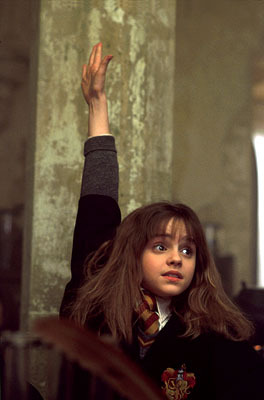
Lumos Maxima... Harry Potter and the Sorcerer's Stone(aka Harry Potter and the Philosopher's Stone) (Chris Columbus, 2001) Year one at Hogwarts.11 year old orphan Harry Potter (Daniel Radcliffe) lives in a cupboard underneath the stairs at his Aunt (Fiona Shaw) and Uncle's (Richard Griffiths). Life sucks. Then a letter in the post turns life upside down and the extended Dursley family goes into hiding—it is a personal invitation to Harry to attend the very exclusive (VERY exclusive) Hogwarts School of Witchcraft and Wizardry. Harry, it seems, is a born wizard, quite famed in that world as an heir apparent, "The Boy Who Lived" in an encounter with the Dark Lord Vol...(shhhh)...an encounter that killed his parents. No wonder the Dursleys want to avoid the wizard world. But, once the truant officer shows up (Hagrid the gamesman, played in all the films by Robbie Coltrane) and Harry gets his school supplies, he takes the train to Hogwarts where he meets his nearly constant companions for the rest of the series, Ron Weasley (Rupert Grint) and Hermione Granger (Emma Watson), as well as Professor Albus Dumbledore (Richard Harris), Professor Minerva McGonagall (Dame Maggie Smith), the suspect and suspicious Severus Snape (Alan Rickman, in the best performance of the series) who takes an instant dislike to Harry (for some reason...), and Ian Hart in the first of guest-starring profswho will appear and disappear. Lord Voldemort tries to make an in-road to the living at Hogwarts (why?), but is defeated by Harry. Lesson learned: There's a big world out there if it is not suppressed.
Columbus' film is loud, big and brash, with wall-to-wall music by John Williams (Williams never learned that there can be too MUCH music), but fills the screen with everyday magical effects—floating candles in the Dining Hall, passing phantoms, "alive" portraits, moving staircases—that other directors forgot or just didn't bother with. The kids are great, but Radcliffe has the weirdest smile—like he's just learning to, which given Harry's past could be true. An amazing cast—something that would be true of all the films. A very good start.
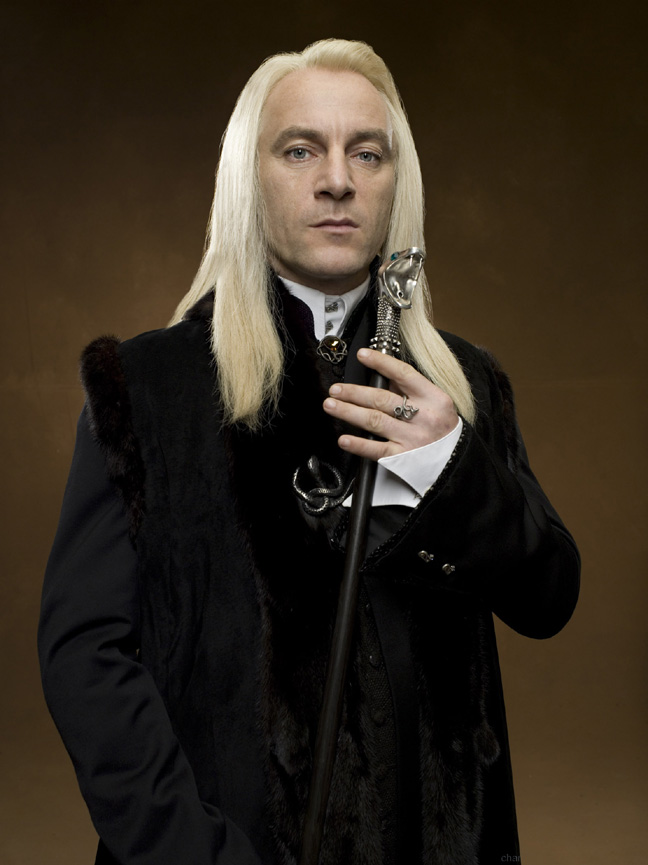
Harry Potter and the Chamber of Secrets(Chris Columbus, 2002) Year Two at Hogwarts. New Teacher: Gilderoy Lockhart (Kenneth Branagh) Harry meets Dobby the House-Elf (voiced by Toby Jones), Lucius Malfoy (Jason Isaacs) and Ron's sisterGinny (Bonnie Wright), who is suspected of opening the dread Chamber of Secrets, releasing an evil that has killed students in the past. Several students including Hermione are "petrified" and it's up to Harry to save them. Turns out Ginny was possessed by the diary of one Tom MarvoloRiddle, which forced her to open the Chamber and release a basilisk—the evil causing all the damage. Harry confronts the spirit of Riddle, realizing that it is Voldemort's second recent attempt at killing Harry (why?), and nearly loses his life in the process. Lesson Two: Harry has a choice in the direction he can go in life.
If the books have a weakness, it is that Harry is born to be a wizard, and everything seems to come easy for him..until somebody actively tries to stop him. With this film, that "ease" already becomes a bit too familiar, and the action is ratcheted up a notch. The attacks on Harry start to affect his friends and he begins to take a more active role in protecting them, even at the risk of himself, although he's always had a penchant for breaking rules. Columbus would move on, taking a producer's credit, and handing the director's wand to an unlikely candidate.
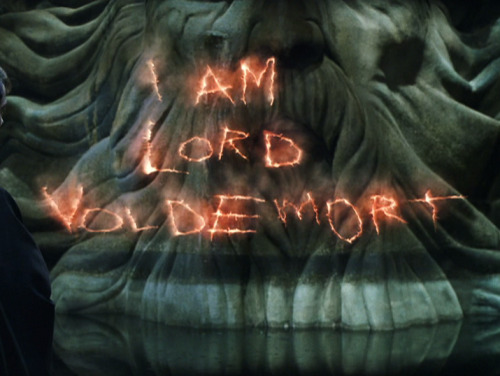
Harry Potter and the Goblet of Fire(Mike Newell, 2005) Year Four at Hogwarts. The kids are getting scruffy looking. New teacher: "Mad Eye" Moody (Brendan Gleeson), and lots of new characters, as Hogwarts is visited by two other wizarding schools for the Tri-wizard Tournament, a sort of magical Olympics. For "some" reason (and that usually involves Voldemort), Harry's name is added as a fourth participant in the games, relationships get frazzled during the Christmas Ball, and Voldemort (a very snaky Ralph Fiennes) returns from the dead. One character dies. And oh! Robert Pattinson's in this one. Lesson learned: Sacrifices must be made.
The films are getting considerably darker, tonally and image gradient and color-wise, taking on a denatured quality—in fact, from here on out, I wouldn't see any of these movies at a drive-in theater, as the two levels of murk would make things pretty much unwatchable. The appearance of Voldemort (and the casting of Ralph Fiennes in the role) is a definite highlight, butthere is one significant death that affects Harry and makes for an extended grieving scene that doesn't work—for the mere fact that the character is only briefly introduced in the film. This will become an increasing problem for the series as more people die in ways that underplayed dramatically. It's a little mystifying.
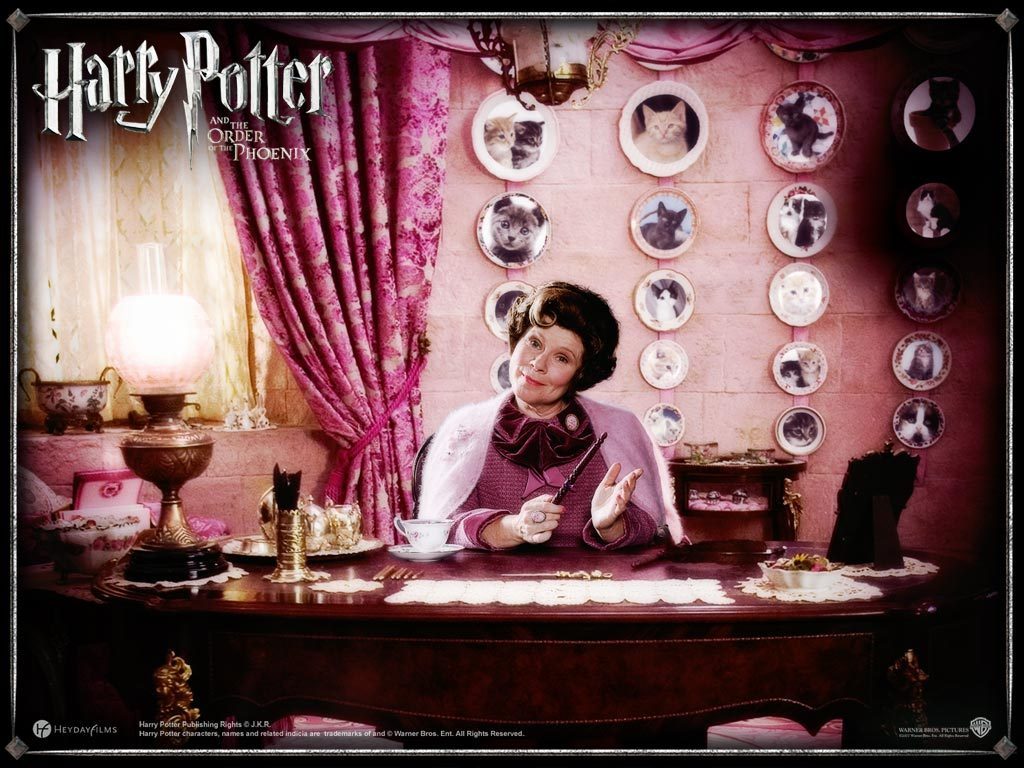
Harry Potter and the Order of the Phoenix(David Yates, 2007) Year Five at Hogwarts, and things get political. New teacher: Dolores Umbridge (Imelda Staunton). Nobody believes that Voldemort is back—especially the Press which begins a smear campaign against the young mage, and the Ministry of Magic appoints Umbredge to keep a watch on Dumbledore and Harry to make sure their "lies" don't get out of hand. In an effort to keep the "children" under control, the prim Ms. Umbredge refuses to teach practical magic and forbids its use. Things are turning decidedly fascist at Hogwarts, and so Harry and friends form a "study group"—"Dumbledore's Army"—to share spells and practice their skills. Lesson learned: a little revolt is good every now and again.
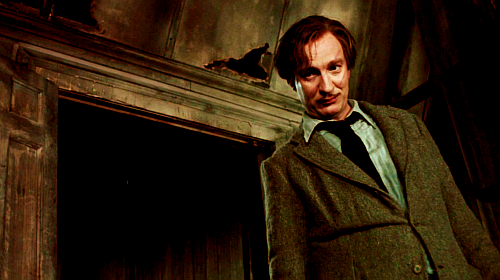
Harry gets his first kiss(for the 'shippers), is haunted by nightmares connected to Voldemort, and given a spell to protect himself from Voldemort's influence, the learning of which leads to the knowledge that his father used to bully Snape. Big battle happens when Dumbledore's Army is captured by Voldemort's forces (including Bellatrix LeStrange, played in full crazy mode by Helena Bonham Carter—she's offset on the good side by Luna Lovegood, played spacily by Evanna Lynch),only to be rescued by Sirius, Remus and other members of The Order of the Phoenix.Another of Harry's allies is killed, but...again...it barely registers. It's the first film in the series of David Yates, who would finish them off (so to speak), and although he gets good work out of the actors, visually, the film's a little dull...with the climactic death oddly not resonant.
Harry Potter and the Half-Blood Prince(David Yates, 2009) Year Six at Hogwarts. New teacher: Horace Slughorn (Jim Broadbent, and seeing how ubiquitous the actor is these days, it was only a matter of time). The sticky relationships get sorted out, and we learn about horcruxes—dastardly little things that contain a bit of Voldemort's soul for safe-keeping. Destroy them all, and Voldemort becomes mortal and can be killed. We've seen a couple already, and Harry vows to take his last year of Hogwarts off to track down the remaining ones to dispense with Voldemort, once and for all. However...
Voldemort is also approaching his end-game, attempting to find a way into Hogwarts anddispense with the one thing standing between himself and Harry. Lesson learned: Death is inevitable, no matter how powerful, no matter how close, no matter how needed.
Harry Potter and the Deathly Hallows Part 1 (David Yates, 2010) Year Seven at Hogwarts, interrupted when The Three drop out and go on the run to protect Harry and find those pesky little horcruxes. The decision to split Deathly Hallows into two films seems unnecessary, given how little really happens in this film: the Three take a look at the situation—Voldemort controls the Ministry of Magic and is even making his influence known in the Muggle World (something that just isn't done), their most powerful allies are dead, and even the Safe Harbour of Hogwarts is vulnerable. They are given three bequests (which will come in handy) and run from Voldemort and his forces, which even includes Professor Severus Snape, now in charge at Hogwarts. The Three are in charge of things that mess up their heads (not unlike the Ring in the Lord of the Rings trilogy) and those ramifications are explored in Part 1—a final test of loyalty before The Big Battle. Will they hold it together as a team, or be splintered apart (Well, what do you think?) Meanwhile, Voldemort finds the wand he needs to accomplish his final goal—killing Harry Potter.
Harry Potter and the Deathly Hallows Part 2(David Yates, 2011) Given how Part 1 is one big set-up and the most lethargic and disappointing of the films, the series had nowhere to go but up for a Final Blowout. And it delivers. Everybody still alive makes a cameo (except for Fudge played by Robert Hardy, and Julie Christie and Kenneth Branagh), and even some of the ones who died get some screen-time. Everything is explained, no magic stones left unlevitated, and no wands kept in their holsters. After a brief moment to catch breaths—the film doesn't even start with the Warner Brothers logo, but just begins where the last one left off, —the Three go undercover in a nice, dizzying episode, and end up back where it all began—Hogwarts—to make a last stand. Lesson learned: Love and family make the difference in a life, power is a worthless goal, and Sacrifice is the measure of a man. I could only smile at the final sentiment of one of the returning dead in agreement "You wonderful boy. You brave, brave man." And thus endeth the Labours and Education of Harry James Potter. Life goes on.
So...now what? Well, it was a good first attempt. As one of my fellow bloggers mentioned, there's enough material in the books that was left unused that the Potter Saga could easily be turned into an "Upstairs/Downstairs" British mini-series to flesh things out and solve the pacing/emotions problems of the films (but can you imagine the cost of such a thing?).
But, this will do. There will be a couple films that one can skip over—there's actually a nice bridge between 3 and 7.2—but for now this will do. Give the snitches and broomsticks a rest.
Nox.
The Crest of Hogwarts. The inscription: "Never tickle a sleeping dragon."
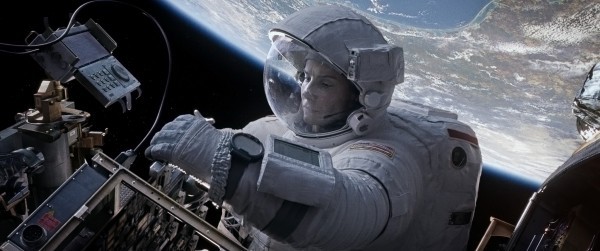
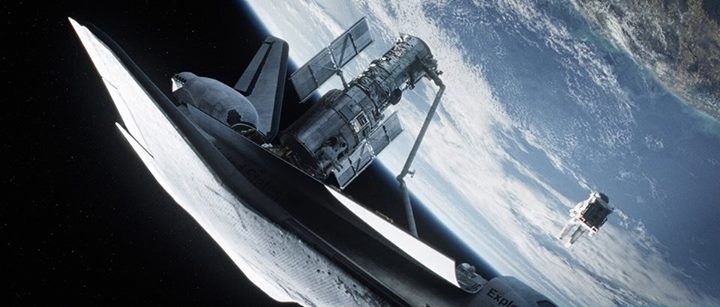
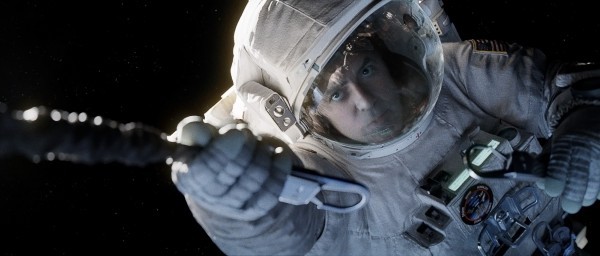
Push-Me, Pull-You or "I'm Tellin' Ya, It's a Hell of a Story" Gravitymay just appear to you the shortest movie you've seen in awhile. It lasts all of ninety minutes, but it rips by, despite long, leisurely takes where nothing much is happening (The opening shot alone is 17 minutes long without a traditional edit). In that, it gets the yin-yang of space travel just so—floating at a relative leisurely pace while simultaneously moving at 16,000 mph, or as one test pilot describes the job—hours of boredom punctuated by moments of sheer terror. Gravity pushes that out a bit, with many moments of sheer terror, but without some trumped up space monster hiding in lunar rocks (Apollo 18) or below the ice (Europa Station). No, it doesn't need anything fancy. It goes for the basics—a limitless indifferent Universe. Up in space, aboard a futuristic space shuttle, terror comes by every 90 minutes or so, as a catastrophic collision between old Russian communication satellites causes a debris field hurtling by tearing holes through what ever fragile life-sustaining contraption we can put up there. Director Alfonso Cuarón (and his co-scenarist son Jonás) put the stakes right up front. "Life in Space is Impossible." They, then, spend the next 90 minutes destroying whatever faith in technology and science you might have. It's an evangelist's dream come true.
That debris field starts out with a few little pieces, but like a cosmic game of "Asteroids" every collision creates more junk, sprays of it, and that just makes everything worse. Space is our garbage field—Cuarón underpins the point by showing us all the junk—pens, screws, cuff-links ("cuff-links??")—floating in zero-g inside the space stations and capsules we put up there in some sort of mad attempt to make normal life in space. It's a cosmic joke that after years of polluting the Earth, our garbage is making space uninhabitable (as if it ever was), too. But, that's a lot of deep thought for after the film is over (as are some anomalies and plot conveniences).*In the watching, Gravity is a fun-ride on so many levels, a visual romp and roller-coaster—the dialogue being mostly tangential and matter-of-fact—as the crew of the shuttle Explorer must deal with the fact that every 90 minutes their equipment is going to take a debilitating series of hits that might burst their protective bubbles just to survive. The film is in mostly long, swooping stretches (the edits, interestingly, in dialogue situations), floating from one aspect to another, sometimes even violating the space of the astronaut's helmet, moving through the screen to get their perspective. The novel aspect of this one is that the zero-gravity that science fictions films have recently taken pains to re-create or avoid has no restrictions in this scenario, there are no walls to bump into; if you go, you go until something stops you, slows you down, or retards your progress, and everything you do, pushes you in the opposite direction. You can swim, but you'd better have an exit strategy for stopping, and spinning in place to turn around isn't going to help, because you're going to keep spinning. And the series of catastrophes, hardships, and just plain pains-in-the-ass keep piling up one after the other, you would think it was Harold Lloyd up there.
Speaking of which, Gravity, besides the scrupulous pixelization of space, also boasts a dynamite sound experience. In space, no one can hear dynamite, of course, but also no one can hear your thrusters whoosh-by, either, really. And Gravity is scrupulous about making sure you don't hear sounds in airless space, unless you absolutely have to. Sounds are restricted to radio chatter (and interference) but also, only those sounds that would transmit through an astronaut's space-suit. So, there are scenes where they're using power-tools? Only you don't hear the metallic grind of power-tools, you hear the vibration of the power-tools motors spinning. But that's it. Satellites get punctured, solar panels are torn off in bursts of shrapnel, but the most you hear is a muffled fwump if something impacts an astronaut, or vice versa. And the theater I saw it in makes use of a Dolby system called ATMOS that pin-points where to put each particular sound as it careens through the theater. It truly is an immersing experience in the theater. For this space kid, despite some hokum here and there, it's the most fun I've had at the movies this year,**and someone is going to have to do something really exceptional to have better sound than this one.
* Three things, quibbles, anomalies, that are SPOILERS: 1) Sandra Bullock's hair is not plastered down on her head, but it's short, and would float around more than we see here (not a big deal, really, just a tech glitch, so the movie could get made); 2) At one point, we spend 10 minutes showing precisely how the whole friction-less world of Newton's laws of motion acts in zero-g, and then creates a cliffhanger situation that completely erases it, unnecessarily; and 3) Every 90 minutes that debris field shows up—IF everybody's in the same orbit, but one is STANDING STILL (which can't happen if you're actually orbiting) or they're going in opposite directions (at which point it would be every 45 minutes and very violently because they're colliding head-on). As far as the plot conveniences, those are fairly obvious. ** There are some nice little in-jokes along the way. My favorite: the unseen voice of Mission Control is Ed Harris, who played Flight Director Eugene Krantz in Apollo 13. I could imagining him having conniption fits down on Earth: "Failure is NOT an option!" "Not on MY watch!"
There is already a sequel of sorts to the Alfonso Cuarón film Gravity, written and directed by co-scenarist Jonas Cuarón. If you have seen the film, it will make perfect sense and add another touch of (dare I say it?) "gravitas" to the feature.
If you have not seen Gravity, then consider this a majorSPOILER ALERT. Don't watch.