The Story: There were a lot of scenes I loved in movies last year, but this is the one I loved the most, and I wanted to put it up before the end of this year. It's just too good.
I've talked a lot here about John Ford...a lot...but probably not enough. The man was a master of the motion picture art form with exquisitely shot films that had a depth and a sense of mystery to them. He told stories straightforwardly, but never felt the need to hold an audience's hand by stating the obvious...not when he could show it. One could sight the many directors he's influenced in this country and internationally...but why?Ford doesn't need defending. His work speaks for itself.
But, the man could be an ogre. A sloppy Irish drunk, he bullied people on his sets, played power games with them and with studio execs, and insisted on shooting in faraway locations...because he knew the suits didn't like to travel.He never shot "coverage" or multiple angles, giving editors just enough to make the picture, but not enough for producers to interfere. He was the boss, the coach, "Papa" and he never let you forget it...if you did, you'd be in "the barrel" subject to his constant scorn.
He was a mean SOB. But, he made beautiful pictures.
Complicated.
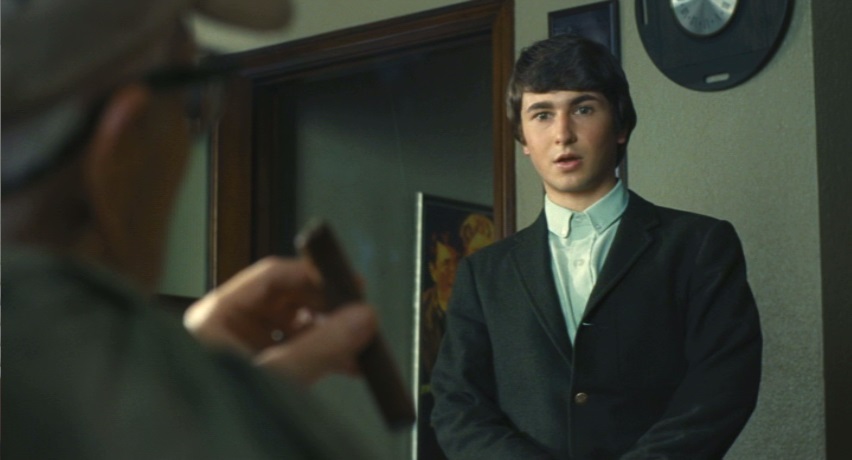
So, when Steven Spielberg inserted the story of his one meeting with Ford in his roman à clef, The Fabelmans, I was just giddy. But not as giddy as who I saw was cast to play Ford.
And, as odd a choice as that may be, it's perfect.Don't credit Spielberg for the idea. Credit screenplay author Tony Kushner's husband, Mark Harris—who has written "Pictures at a Revolution," "Five Came Back" and "Mike Nichols: A Life", great "reads," all—for the inspiration. And Lynch gets it "down." Don't believe me? Check out the clips of "the real" Ford below (as well as Spielberg talking about the casting and telling "the John Ford" story for a junket for Cowboys and Aliens).
Oh, and one other thing—Ford did a scene of himself when he made The Wings of Eagles about one of his favorite screenwriters. Check that one out here.
The Set-Up: Young Sammy Fabelman(Gabriel LaBelle), growing up fascinated—even obsessed with movies—is now pursuing a career in the picture business. During an interview he is made an offer that he can't refuse.
ACTION! (god-dammit!)
BERNIE FEIN
(snapping his fingers!)
You know who you need to meet?! I
mean not for a job, ‘cause...he
doesn’t do that.
BERNIE FEINHow would you like
to meet the greatest film director
who ever lived...
BERNIE FEIN
...and he’s right
across the hall?!
INT. A CORRIDOR AND AN OFFICE, LOS ANGELES - DAY
Bernie Fein leads Sammy out of his office to an office
directly across the hall.
As he’s opening the door:
BERNIE FEIN
C’mon. Wait here a minute.
Bernie goes in. Sammy looks at the office door’s plastic
sign: “SUITE 3B.”
Bernie’s voice can be heard from within.
Bernie comes out and leads Sammy in.
Sammy nervously enters an old, shabby waiting room. NONA, a
secretary, 50ish, dressed in 1940s style, sits behind a desk.
BERNIE FEIN (CONT’D)
Uh, this is Nona. Nona’s gonna look
after you.
BERNIE FEINUm, he’s not here. He’s -
NONA
He’s at lunch.
BERNIE FEIN
Right.
NONA
(to Sammy:)
You want to wait?
BERNIE FEIN
Yeah, he’ll wait.
BERNIE FEIN(to Sammy:)
Sit.
Bernie guides Sammy to a chair and slaps him on the shoulder.
BERNIE FEIN (CONT’D)
Good luck.
Bernie leaves.
NONA
Could be hours.
Sammy nods.
Nona goes back to work.
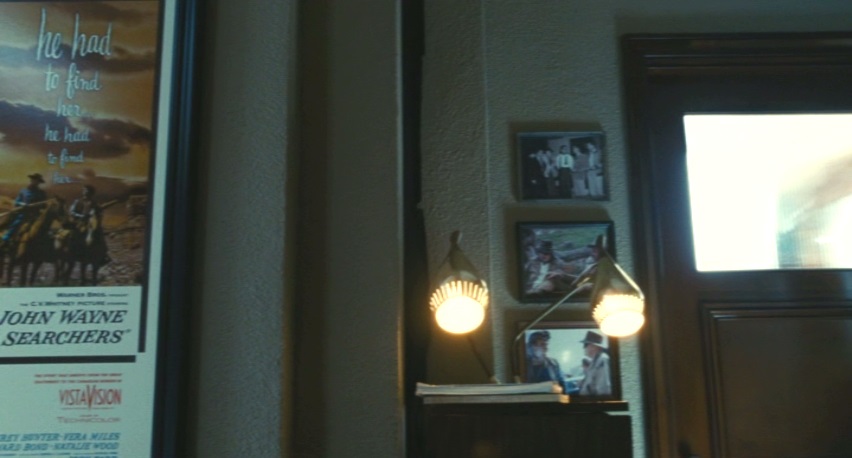
Sammy looks at the old
posters on the walls
(the strumming guitar of The Searchers
score commences in his head): STAGECOACH,
The Searchers score ends
with the sound of a needle scraped off a record,
and JOHN
FORD enters.
He’s 71 but he looks older, tall, gaunt, an
eyepatch over one eye, covering his glasses on that side.
He’s wearing beat-up safari clothes and a cloth safari hat.
He’s holding a partly burned, unlit cigar, the mouth-end
badly masticated.
As he walks past Sammy, oblivious, Sammy
sees that there are perfectly-shaped lipstick kisses on
Ford’s cheeks and in the middle of his forehead.
He goes
past Nona, enters his office and slams the door.
Nona picks
up a box of Kleenex and runs in after him.
Sammy waits.
Nona emerges...
...with a wad of pink-stained wet
Kleenex.
She dumps it in her desk trashcan
and says,
indicating the partially-opened inner office door:
NONA (CONT’D)
Alright kid, you got five minutes.
NONA Probably one.
NONA Stand up.
Sammy stands.
NONA (CONT’D)
Lose the tie. You’ll stand a better
chance.
Sammy nervously removes his tie.
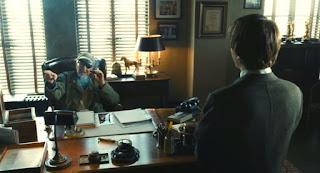
John Ford is at his desk,
snipping the end from a fresh cigar
with a tarnished silver clipper.
Sammy enters
and stands
before the great man, awestruck.
Ford reaches
retrieves a match from a small brass holder
shaped like a cowboy boot,
strikes it on his desk blotter,
lights the cigar
and puffs again and again.
It goes on and
on,
but Sammy drinks this in, not moving a muscle.
Ford takes
the cigar out and licks his lips, his tongue weirdly
distended, like a cat’s. Then:
JOHN FORD
They tell me you want to be a
picture maker.
SAMMY
Um, yes sir. I do.
JOHN FORD
Why?!
JOHN FORD This business -
(he shreds the air!)
- it’ll rip you apart!
SAMMY
Well,
SAMMY Mr. Ford, I -
JOHN FORD
So...
JOHN FORD ...whatta ya know about art, kid?
SAMMY
I just- I love your movies so much -
JOHN FORD NO! ART!!
Ford suddenly points to a big Remington painting, two men on
horseback looking off into the distance with a large butte in
the background.
JOHN FORD (CONT’D)
See that painting over there?!
SAMMY
Uh, yeah,
SAMMY I mean yes! Yes, I do see
it.
JOHN FORD
Walk over to it!
Sammy walks to the painting.
He looks at it, unsure about
what he’s supposed to do.
JOHN FORD (CONT’D)
Well?!
JOHN FORD What’s in it?! Describe it!!
SAMMY
Oh okay, um - so there are...two
guys,
SAMMYand they’re...on horseback
SAMMY and they’re looking for something,
SAMMY so maybe they’re scouting - ?
JOHN FORD
NO!! NO!! Where’s the horizon?!
SAMMY
The - the horizon?
JOHN FORD
Where is it?!
SAMMY
(pointing:)
Oh, it’s, um, it’s at the bottom.
JOHN FORD
That’s RIGHT!
JOHN FORD Walk over to this
painting!
He points at another painting, a Western scene by Charles
Russell.
Sammy examines it: five cowboys in a large, crater-
like ditch.
Their horses are tethered by a small pool of
water at the center of the depression while the men are all
hunkered around the ridge, rifles ready, forming an armed
perimeter.
JOHN FORD (CONT’D)
Well?!
SAMMY
Right, okay, so there are five
cowboys, you know, they -
JOHN FORD
(in a RAGE:)
NO NO NO NO NO!!!
JOHN FORD WHERE’S THE
GODDAMNED HORIZON!!!!!????
SAMMY
(flustered, pointing to
the top of the painting:)
Um, it’s there!
JOHN FORD
WHERE?!?!
SAMMY
AT THE TOP OF THE PAINTING!
JOHN FORD
ALRIGHT GET OVER HERE!
Sammy obeys, walking to Ford’s desk.
JOHN FORD (CONT’D)
Now remember this! When the
horizon’s at the bottom, it’s
interesting. When the horizon’s at
the top, it’s interesting.
JOHN FORD When
the horizon’s in the middle, it’s
boring as shit!!
JOHN FORD Now good luck to
you -
Sammy smiles.
JOHN FORD (CONT’D)
- and GET THE FUCK OUT OF MY
OFFICE!!
Saturday is, primarily in these parts, "Take Out the Trash" Day.
Brass Target(John Hough, 1978) General George Patton was a rather colorful part of the Second World War, but, like many generals of that conflict, he was consigned to the realm of obscurity, despite his considerable efforts to the war effort.
That was until 1970 and the release of Patton, which went on to win the Oscar for Best Picture of its year, thanks in no small part to a (pardon the pun) commanding performance by George C. Scott. Patton—and Scott's performance—went beyond merely reviving the story of the man and his accomplishments but also catapulted the general (as well as his foibles and eccentricities) to the echelons of Myth. Those who see newsreel footage of the real Patton are often surprised at his high-pitched voice, his thick Virginia accent, and his rather tentative way of speaking, none of which Scott chose to portray in his characterization. The cult of Patton-worship after the film's release—especially among conservatives—can be construed as a response to Scott's strong portrayal, rather than to the man himself.
Another thing that Patton didn't portray was the matter of Patton's death, choosing instead to fade to black as the general walks his dog near to a quixotically-resonant wind-mill, keeping the spirit alive. Patton, who seemed most comfortable in the role of warrior, ironically died soon after the fall of Berlin, eight months into the peace, the result of injuries sustained in an auto accident—his limousine was going too fast across a railroad line and smashed into a truck, and the 60 year old General was the only injury. He'd broken his neck; two crushed vertebrae. He lay in traction for 12 days before succumbing to a blood clot in his heart on December 21st, 1945.
But, it can make money. The Patton death controversy didn't pop up until the 1974 publication of "The Algonquin Project" (or "The Oshawa Project," internationally) byFrederick W. Nolan, who cooked up a plot to assassinate a Patton-like commander (re-named George R. Campion) in order to keep him from investigating the theft of 250 million in Reichsbank gold being shipped to Frankfurt, a inside-job robbery that claims 59 American lives.
But, when the film-rights were sold and the project made, the commander's name was changed back to its source, George Patton, and the film followed the rest of the fantasy-land speculation, completely ignoring that Patton wasn't killed in the car-crash, but only injured. His surviving and subsequent 12 days of traction are completely ignored.
Instead, we get a sub-par plot of Army Intelligence officers (round up the usual suspects: Patrick McGoohan, Robert Vaughn, and Edward Herrmann) who pulled off the gold heist—in an elaborate plan that could have gone wrong in many ways, not least of which is that gold is heavy and difficult to transport. Once the theft is discovered, Patton is determined to find out whodunnit—he's livid over the loss of life—and it is arranged that before he can get very far into the investigation that he be killed by a hired assassin, Peter Shelley (Max von Sydow).
It is up to OSS Major Joe De Lucca (John Cassavetes) to determine who was behind the robbery, a task complicated by the plan's similarity to a mission De Lucca himself had masterminded against the Nazis some time earlier. That puts him in the sights of Patton's investigation, but for De Lucca, it merely means that whoever's behind it knows of him, his tactics and has enough security clearance to know what's what in the particularly-secretive-because-it-is-so-new OSS.
There are complications—enough to distract De Lucca from the obvious—and bodies begin piling up, only verifying to him that he's on the right track. And then, there's some romantic entanglements which serve no dramatic purpose other than to put Sophia Loren in the picture.
It's a lousy movie, but I can see why people wanted to do it—money. Cassavettes took less film roles later in his career as he was concentrating on film-making, and this one probably paid for a couple of his. Points to the movie for that. And he also might have also wanted a chance to play with von Sydow (playing another inscrutable assassin—he seemed to be doing that a lot in the paranoid '70's), whose character plays two roles, one in very plain sight as a diplomat and one in the shadows as a very undiplomatic hit-man (the two careers seem to be mutually exclusive in attitude and temperament and either job could impair, if not jeopardize, the other—different color contact lenses notwithstanding).
Great disguise there, Max.
Superman, at least, puts on a pair of glasses.
But, one shouldn't quibble about details, especially sophisticated ones, as the whole plot is built on the substantial lie of Patton being assassinated. It's a wonder they didn't do it in modern dress, as focused as they are on "accuracy".
It's taken me a long time to actually sit down and watch this movie, as I knew the Patton history, and knew that the central focus was a canard, so why bother? But, 45 years of blissful ignorance of the inanities of the thing I can chalk up to a "win". I'm just glad I didn't waste any of my money on it. As its failure at the box office helped lead M-G-M to shut down its film-making division—in 1979 M-G-M honcho Kirk Kerkorian announced that they were a hotel company—the studio probably wished the same thing. Ironically, I watched it on Turner Classic Movies (Ted Turner having bought the studio's assets in March, 1986, primarily for its film library), so I guess there's something of a happy ending, after all.
But, Warner wanted someone else besides Robert Preston—who had played the role magnificently on Broadway—to play the traveling con-man, Harold Hill. James Cagney, Bing Crosby, and Cary Grant were all approached to star and all refused, Grant adding that not only would he not star in it, but if Preston wasn't cast, he wouldn't even go to see it! Warner was about to sign Frank Sinatra, when show creator Wilson reminded Warner that he had final approval of casting written into his contract, and he wanted Preston and no one but Preston.
Robert Preston was cast. And performed quite magnificently.
The role played to his strengths...and weaknesses. Preston languished in the outskirts of in-demand stars. He was a good actor, but a wily character actor, not exactly star-material. Handsome, sure, but of a face-type that better suited antagonists than protagonists. He could be comfortable twirling a mustache, but whether sporting one or clean-shaven, he was an aggressive charmer of indeterminate virtue.
This quality made him a perfect match for the role of Harold Hill, a grifter in salesman's clothing, who travels city to city like a circus caravan, bamboozling the local rubes into buying musical instruments for their restless youth to form "boy's bands". Once he's pocketed the cash, he splits town before the instruments arrive, as he couldn't provide any instruction in how to use them, anyway. He SAYS he does, but what grifter can actually do what he says he can?
So, Harold Hill brings his brassy blue-sky ideas to River City, Iowa, where he and a former crony, Marcellus Washburn (Buddy Hackett) start spreading the word of what a wonderful opportunity a boys' band would be to the city's rambunctious and temptation-susceptible youth. There is, being Iowa, skepticism, from the school board, the River City Mayor (played by the inimitable prevaricating Paul Ford) and, in particular for the story's purposes, the city's librarian and music tutor, Miss Marian Paroo (Shirley Jones), but it isn't long before he starts making in-roads with the populace. Not an easy thing to do, for (as the song says) they're "so by God stubborn" they "can stand touching noses for a week at a time and never see eye to eye."
To maximize profits, and still be ahead of the law, he plots a good defense against the offense—he deflects the school board by playing on their voice-characteristics to turn them into a singing quartet, and then decides to seduce the "old maid" (sorry) "sadder but wiser" librarian to short-circuit her logic systems.
It is rather difficult to think of the 27 year young (at the time of the filming) Jones as "an old maid"—she was the same age as ingenue Susan Luckey, who played the Mayor's teen daughter—but, The Music Man is one of those stories where one has to suspend disbelief (after all, the movie hinges on the mulish River City dwellers suspending theirs).
One also has to suspend time and movie momentum, as well. In its 2 hour 31 minute length, there are 22 songs, meaning that the story comes to a full-stop every 5 minutes and change. It would be frustrating if Meredith Wilson's material wasn't so darned good...or so syncopative, a quality that seems to act as a natural buggy-whip to make the festivities move along at a good clip. There is one speed-bump, at the extended "'Til There Was You" sequence where one can actually feel one's pocket-watch tut-tutting. But, the song is so good—Heck, The Beatles even "covered" it!
Future director Ron Howard scopes out an overhead shot
And that's the main draw here. As good—and enthusiastic—as Preston, Jones and Company are, it is the treasure chest of songs that keep the movie percolating from scam to scam, subterfuge to subterfuge, before reaching some genuine feeling with agendas no longer hidden and ending with pure fantasy. That's quite a story arc.
Sure, it's corn. Pure-bred American corn. But, there's nothing as sweet as corn plucked right from the stalk. The Music Man, for all its brass, is just as sweet.


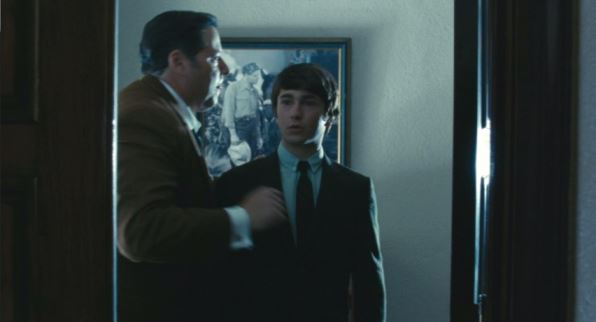


 Sammy looks at the old
posters on the walls
Sammy looks at the old
posters on the walls