Saturday, July 8, 2023

The Art of Getting By

"Whatever..."
or
"What's Next, Basquiat? (Whoa-Whoa-Whoa-Who-o)"
 
George (Freddie Highmore, the excellent kid from Finding Neverland and Charlie and the Chocolate Factory, practically grown up) is a senior at a tony prep school in New York, in danger of getting kicked out. He's depressed. Not because he's going to get suspended, but because he's coming to grips with the fact that life is short and nobody gets out alive. So, he doesn't pay attention in class, doesn't do any work and uses his books as doodle-canvas, some of which is very not bad. His teachers (Jarlath Conroy, Ann Harada, Alicia Silverstone) know he's smart but are frustrated that he couldn't begin to apply himself. His principal (Blair Underwood) cuts him every break, but he just doesn't apply himself. "Life is meaningless," he tells a teacher when picking up assignments. "And that includes the homework, unfortunately."
He tells
his mother (Rita Wilson) and step-father (Sam Robards) "I've got it under control," but it's just a delaying tactic. He's too smart for his own good, but like most students, he doesn't know what he doesn't know. That's where life comes in. But he won't get there, by being so insular, cut off from everybody.
After another stale-mate with the principal, he goes up to the roof to smoke, where
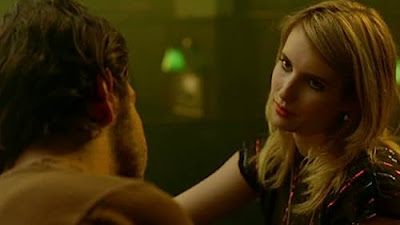
Sally Howe (Emma Roberts) is smoking. A teacher comes up and George becomes Sally's knight-in-shining armor by pretending to be the one dragging.  Later, she confronts him about why he did it. "I'm the teflon slacker," he says.  "I'm more used to getting into trouble and I'm better at talking my way out of it."  He and Sally become friends...then things get complicated.

They do, but they don't.  
His habitual failure to commit extends to their friendship, as well, and it's a little hard to determine why—maybe he's just not willing to apply himself, or maybe he has such a fear of failure (or a fear of success, where he could lose everything). But it's pretty clear that he'll take a "wait and see" attitude with everyone...and everything.
He enjoys spending time with Sally, who's popular and a knock-out and seems to find him intriguing in that way that geek-writers think women are attracted to geeks. And she seems to want to "go there," but he's all "we're just friends" despite the time he spends with her when he'd normally be in his self-imposed solitary confinement. No wonder she sees other guys...which he thinks of as some kind of betrayal. 


What does he think would happen?
That question, and so much of the film, is intriguing and keeps your interest (like a train-wreck does), as long as there are no consequences to his actions. But, once they all start piling up, The Art of Getting By stops getting away with it. Then, it becomes frustrating (in about the same capacity as that "me stupid" feeling you get for delaying writing that term-paper for so long). Then, writer-director Gavin Wiesen swerves in his little game of "chicken," in a wish-fulfillment fantasy that even Woody Allen, schlub-fantasist that he is, would mock if he saw it.

Wiesen casts his film well, and his direction of the actors shows he's not afraid to take risks.* And the screenplay shows promise. But, that ending is a big "Fail." Maybe it was imposed to get distribution, but, man.... Like the protagonist, there is so much potential there, that just gets wasted. 
* Roberts is a heart-breaker, the teachers (even Alicia Silverstone) play tough with their characters, and props to anyone who hires Elizabeth Reaser and doesn't squander her talent (as the "Twilight" films do). 

Friday, July 7, 2023

Walking Kurosawa's Road: Rashomon (1950)

The inability to write about the films of Akira Kurosawa to my satisfaction led me to to take a different path: start at the beginning, take each film in sequence, one after the other, and watch the progression of the man from film-maker to Master. I'm hoping I can write more intelligently and more knowledgeably about his work by, step by step, Walking Kurosawa's Road.

Rashomon
(aka
Rashômon aka 羅生門) (Akira Kurosawa, 1950) It all changed here. This is the point—and this is the film—where Kurosawa got "noticed" by an international audience. Oh, he'd been toiling in the fields for a decade. But a war got in the way. Then, an occupation, with its incumbent censorships. Lack of distribution and maybe a ticklish subject matter or two that had kept his films on the island also hindered the world knowing what Japan had known—they had a great film-maker in their midst. One who'd been watching other countries' films with interest, reading other culture's writers, and began melding and refining and merging his own culture with them to create something new and richer, an alloyed kind of film that spoke across divides, across seas and oceans and spoke to everyone.
 
He'd already made great films. Few had seen them. Rashomon, however, was a film that was so good, that happenstance of availability fell by the way-side. 
 
Rashomon was actively sought out.
 
It was, evidently, enough for America's Academy of Motion Pictures to give it an "Honorary Oscar" (in 1952) for "most outstanding foreign language film" and, eventually, to create a category to recognize excellence in "foreign films." Maybe to avoid the competition.
"I don't understand. I just don't understand. I don't understand it at all." 

A woodcutter (Takashi Shimura), a commoner (Kichijirô Ueda), and a priest (Minoru Chiaki)—from Kiyomizu Temple—sit out a down-pour at the ruined Rashômon gatehouse. The newly-arrived commoner finds the woodcutter and the priest in a confused stupor over "a strange story," "a horrible story" that they've just heard at the courtyard garden. A story, the priest says that "may finally make me lose my faith in the human soul."
 
The woodcutter and the priest have just from court where they have testified in a trial against a thief, Tajômaru (Toshirô Mifune), accused of rape and murder.
 
The Testimony
The woodcutter explains how three days previously he was walking the road between Sekiyama and Yamashina, when he stumbled on a woman's hat in the bushes, a trampled samurai cap, some cut rope, an amulet case...and a dead body.  
 
The priest tells of how he encountered the victims, a samurai and his wife (Machiko Kyô and Masayuki Mori) on that fateful road the day of the crimes.
Tajômaru, the bandit, is up next. In the woodcutter's telling of the trial, he is bound but defiant, his testimony is filled with braggadocio and contains little that doesn't make him seem a formidable man. The bandit tells of seeing the samurai and his wife on the road, and lusting after the woman, lured the samurai away with the promise of selling ancient swords. He attacked the samurai and tied him to a tree-stump. Then, went to the wife and told her the samurai had taken sick and leads her to the forest to where she sees him tied up and helpless.  
 
Kurosawa then starts a sequence of shots that sets up the power-dynamic between the trio as they glance at each other, realizing and assessing the situation. Stylized, almost ritualized, if you ever wondered where Sergio Leone got his ideas for staging his climactic stand-offs, it's here. The sequence ends with the camera moving around the wife's head, as Leone circled Henry Fonda's in Once Upon a Time in the West.
The wife, seeing her husband bound and helpless, takes matters into her own hands and attacks the bandit with a knife, but he overpowers her and rapes her. The wife, in her grief and shame, begs the bandit to duel her husband for the events, saying that she will go with whoever wins the battle. The men fight a masterful duel "crossing swords 23 times" according to the bandit (according to the woodcutter), but in the end, the bandit wins the battle. The wife has run off. He takes the samurai's sword and leaves.
 
The priest concludes that men lie because they are weak.
The wife then testifies on the events (as related by the priest). She says that after the assault, the bandit left, and she freed her husband. She begs her husband for forgiveness, but he only looks at her contemptuously, blaming her for the assault. She then tells her husband to kill her and relieve her of the shame, but  the husband does not move, continuing staring at her. In her distress, the woman faints. When she recovers, he husband is dead, stabbed in the chest with her own knife. She flees the scene, attempts to drown herself, but fails.
The commoner hears all this and contemptuously says that women use tears to hide their lies.
The samurai's story is heard through a medium (inserting one more layer of narrative prejudice). The samurai says that, after the assault, the bandit offered to marry the wife, which she accepted, but only if the bandit killed her husband. This angers the bandit who drags the wife before the samurai and makes him an offer: release the wife or kill her. The wife runs off with the bandit pursuing her, but he loses her in the woods. He returns to the samurai, releases him and apologizes, leaving the samurai alone. The samurai, defeated, dishonored, kills himself with his wife's dagger.
 
But, the spirit-samurai makes the assertion that the dagger was taken from his chest, although he couldn't identify who.
Who is right? Who is telling the truth? There is no question that
Tajômaru is guilty of the crimes of stealing and rape—but the murder? Did he kill the samurai? Did the wife? Was it suicide? Those are the practical questions in Rashomon, and, unfortunately for those looking for absolute truths, the testimony and evidence are not conclusive. We've seen (or heard) the witness testimony and they conflict, due to circumstance, emotion, trauma, societal rigors, and with the ramifications of what had happened.
The truth is, there is one more version of the story in Rashomon. One more interpretation of events. But, one can't even trust that. Ultimately, this is not a detective story that reveals the truth at the end (and Kurosawa did have a yen for detective stories). At its core, it is a tale about how enigmatic truth is. Truth, the whole truth, and nothing but the truth may be sworn to in courts of law, but they are a nearly unattainable goal, especially couched in a story format. Stories, in and of themselves, are interpretive, hued by perspective, the version of events, and who is doing the telling. Court lawyers are masters of spinning the truth, shading it, undercutting it, sewing doubt.
But, there are no lawyers in Rashomon, just common people...and a priest, who is sustained more on faith than proof. So, when all is said...and done...we are still left questioning what we have seen, with no reckoning of justice (whatever that is) being done or of a resolution in the tenuous balance between good and bad. There's no moral here in this telling of the tale and it's no fable. Ultimately, Kurosawa presents the argument that no film, no picture...no art?...can be trusted for truth as it's all interpretive, all suggestive. And though movies and their makers may strive for verisimilitude, truth will be forever out of reach.
 
All we can ask for is the good intention, the kind act, the unselfish sacrifice, the question "Can I help?" even knowing that truth cannot be trusted in anyone else but ourselves...if we're being true to ourselves. It's like a ray of sunlight dappling through the canopy of a forest. All the better to see ourselves true. 

Wednesday, July 5, 2023

American Gangster

Written at the time of the film's release...

"That's What's Wrong with America. You can't Find the Heart of Anything to Stick the Knife In"

American Gangster tells the story of Frank Lucas, who, for a time in the 60's and 70's, ran the most successful narcotics operation in Harlem. The film is based on a "New York" magazine article from an interview with the real-life Lucas, so it must be based on fact, right?*

Ridley Scott's played fast and loose with facts before (1492, Black Hawk Down), so one should take the credit "Based on a True Story" with a kilo of salt (or a pound of cocaine). 
 
But, that aside, how is the movie?
It tells the parallel stories of Lucas' rise in power on the Harlem streets by "cutting out the middle-man" smuggling in raw opium from Thailand, and manufacturing a concoction called "Blue Magic" that had twice the potency, but at half the cost, with the story of the cop who eventually busted him, a down on his luck detective named
Richie Roberts who's too honest to be trusted by the New York Police. 
While Lucas starts to make his version of the American Dream, Roberts continually has his legs knocked out from under him--his wife leaves him, takes his kid, he struggles with classes to better himself (public speaking, law), his partner turns junkie, and implicates him in a murder. The movie drips with irony at every turn, constantly showing the easy path of Crime and the tough road of Law Enforcement, that recalls that epitome of the thesis—"
The French Connection."
**
In a montage of Thanksgiving, Lucas is shown with his entire family at a stereotypical Thanksgiving spread (and in one of the more heavy-handed of Scott's directorial choices frames it like
Norman Rockwell's "Freedom from Want" painting, while Roberts, makes a cold sandwich of canned turkey-spread and potato chips over the kitchen sink. But then the director re-ups it by showing junkies shooting up between their toes in grimy bathrooms, and a mother passed out in bed, while her child is screaming in the room. Whatever glamour Lucas may enjoy, Scott is particular about showing the cost in human misery. No one gets off "Scott"-free.
Washington takes aim at a rival...
...and it's Idris Elba!
Sometimes the tables are turned. Lucas occasionally has troubles in the operation, and however much he may espouse core-values of honesty and integrity, the very nature of his business starts to rot his dreams for his family. And the more Roberts investigates, the closer he comes to his target, the more his team of "Untouchables" gel, and his investigation and life begin to come into focus.
Ridley Scott misses as much as he hits. For every good film (The Duellists, Alien, Black Hawk Down, Thelma and Louise), there is a terrible one (Legend, 1492, Someone To Watch Over Me, G.I. Jane, Hannibal, A Good Year), and some that have just enough quality in them (Blade Runner, Gladiator, Matchstick Men) that his directorial brio can compensate for weaknesses and messy scripts. But here, he has a cracker-jack script by Steve Zaillian, no worries about creating "a world" out of whole cloth, and a stunning cast that includes Clarence Williams III (uncredited), Joe Morton, Armand Assante, Josh Brolin, Cuba Gooding, Jr., the magnificent Ruby Dee, Ted Levine, Roger Bart, Carla Gugino, Chiwetel Ejiofor, and top-lined by Russell Crowe, but especially Denzel Washington. When these two heavy-weights get together, their scenes crackle with invention. Everybody does incredibly lived-in work.
And nobody less than the director. This is Ridley Scott's best film in ages. At times the details get a bit murky, but Scott does so to keep a multi-faceted story moving at a brisk pace. And he pulls off some amazing little camera tricks that stun, and some of the most unpretentious action-sequences put to film. Those action sequences are rough stuff--the film begins with the immolation and point-blank gun-down of a mob rival--and the junkie sequences are harrowing, so one should be warned. But missing it would be missing a great film.
* Merely a casual glance at the internet will disprove a lot of myth from fact. Lucas did not work for crime boss "Bumpy" Johnson for 15 years, but five (he's been in prison before), he was not with him when he died, did not marry "Miss Puerto Rico," or own "Small's" nightclub. And that's just the start for Lucas. The real Roberts is a bit miffed that to attract Crowe, they beefed up his part by making him more of a loser. Lucas admits that the film is "about 20% true."
 
** The names "Eddie Egan" and "Sonny Grosso" are invoked early on, and Crowe's Roberts employs a foot-chase under the "El" that figured so prominently in the movie.

Tuesday, July 4, 2023

Ride With the Devil

What to post on July 4th? I've done versions of Yankee Doodle Dandy almost to death. There isn't a Capra film that feels appropriate. 

But a Western...I've got a couple that I want to spend a bit more time on—both dealing with the "Native Question" (not sure why there was ever a question to begin with). But, looking at some "ready-to-go" things I'd done in previous years, this one jumped out at me. A Western at a critical juncture in the Nation's History (and there's never really been a time that wasn't) when we were in danger of blowing up the results of "The Democratic Experiment" due to the same issues that destroyed past dynasties, autocracies, kingdoms, and dictatorships...even home-owner associations—the power of greed and the greed of power. You can say all people will be equal, but inevitably somebody's going to be more equal than others. And character plays a big part in how that works itself out (if you're paying attention).
 
Also it's a complicated story, in the way that American history—outside of the beginners' text-books—can be complicated, that tests preconceptions and prejudices. As a democracy should.

So, here is that most American of genres, the Western, directed by Taiwanese director Ang Lee, which actually seems apropos, telling the story of a nation of immigrants. It's a great movie that nobody went to see. As I said, it was "wrongfully overlooked" but also, I think, vastly underappreciated.
 
 
"On the Western frontier of Missouri, the American Civil War was fought not by armies, but by neighbors. Informal gangs of local Southern bushwhackers fought a bloody and desperate guerrilla war against the occupying Union army and pro-Union Jayhawkers. Allegiance to either side was dangerous. But it was more dangerous still to find oneself caught in the middle ..."
 
The story of Quantrille's Raiders and the Missouri Irregulars were a sorry part of the Civil War story, but its tales of guerilla raids between two groups, the "bushwhackers" and the "jayhawkers," criss-crossing the Kansas-Missouri border, it's history with Quantrille, Bloody Bill Anderson and Jesse James and the murderous raid on Lawrence, Kansas in 1863 have been explored, somewhat tangentially, as the first battles in the Outlaw West.
Director
Ang Lee may seem an odd choice for a Western of this nature, but such was the case when he directed Sense and Sensibility. Versatile, facile, and able to make universally accepted films across genres, there seems little Lee cannot succed at whether period romance (Sense and Sensibility), spy-noir (Lust/Caution), martial arts flick (Crouching Tiger, Hidden Dragon), even cross-blending sci-fi/horror and superhero movies (Hulk).
Ride with the Devil
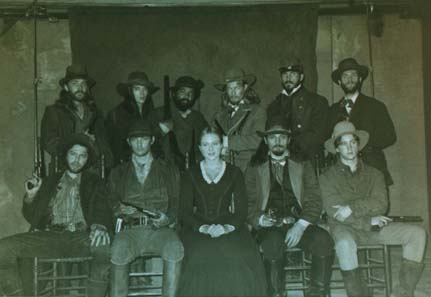
, with a screenplay by James Schamus (now head of Focus Features) was not a box-office success when it opened, perhaps as it was an unconventional western with controversial elements: four young people, Jake Roedel (Tobey Maguire), Jack Bull Chiles (Skeet Ulrich), George Clyde (Simon Baker), and Daniel Holt (Jeffrey Wright) all find themselves fighting as Confederate guerillas during the Civil War as "bushwhackers," not so much as they believe in the Southern cause—Holt is a freed slave—but because of issues with loyalty, friendship and attacks on their families. Soon, they're conducting murderous assaults on established Union positions with deadly accuracy, which Lee stages with a brutal efficiency: quick cuts, fast pace and attention to the damage a round bullet can inflict.
Housed for the winter in a make-shift shelter
, they are looked after by Southern sympathizers, with particular interest paid by a war-widow named Sue Lee (Jewel), who begins an affair with Chiles and offers support and food during the harsh winter. It's a nicely paced gritty portrayal of life led as an outlier, and the elements are mixed as to keep one guessing about what will happen next.
The revelation here is
Tobey McGuire, heretofore usually playing callow youths (which is why he was picked to play Peter "Spiderman" Parker), here he's got a versatile range of situations, starting out as a disillusioned follower, then his own man of a kind, backed by a steely gaze that turns durn creepy at times, and an "on-the-edge-of-cracking" voice that lolls over dialogue. Nice work, and Lee makes the most of him, using the boyish qualities of McGuire for moments of humor, terror and combinations of both.


Wrongfully overlooked.