or
"What'd He Wanna Do That For?"
"A Prairie Home Companion" is one of the best shows on the radio (the best being "This American Life," but we'll save that for later...or better yet, check it out for yourself on the link). Over the course of its 30 year run, this less-than-"Grand Ol' Opry"-wanna-be has presented home-spun music of all genres--from Gospel to Grand Opera (and has seemingly unearthed every folk-artist extant in the country) and combined spiritual optimism (albeit Lutheran, which takes the joy out of it) with a cynical farm-land realism, all reflecting the philosophy and upbringing of its host Garrison Keillor, whose low story-telling voice is as lulling as cattle moaning in the pasture at night. Keillor writes it all, performs in most of it and serves as ringmaster, finally capping it off with his stool-talk reverie, The News from Lake Wobegon, land of low expectations ("Where all the women are strong, all the men, good-looking and all the children are above-average"). Old time radio techniques and phony commercials--for "Powder-Milk Biscuits" ("Heavens, they're tasty and expeditious!") or for "The Ketchup Advisory Board" wind their way through everything, with just enough toothsome satire to leaven the bitter with the sweet. It's Community-Theater of the Mind, a staple of Public Radio, and manages to embrace and cherish both red and blue states in it's musty woolen blanket of nostalgia.
In the long string of Saturdays that I've listened I've heard moments of great beauty that I'll never forget,** while, on the other hand, I've wondered more than once why Keillor needs to sing so damned much. It's been a comforting friend on lonely cross-country drives, and it's been known to make a car load of rowdies quiet in contemplation.


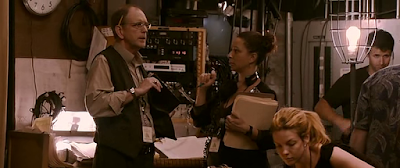
 And the reaction is usually "What'd he do that for?"
Amidst the songs by long-time PHC participants, the bits and skits, the players**** hook up and separate and talk over each other in a life-like muddle, Keillor's self-initialed character is constantly correcting the details of the various versions of History that he's concocted, and Death (in the form of Virginia Madsen) wanders the theater. Madsen's a wonderful actress—she deserved her Oscar nomination for Sideways and to win it, as well—but she's not terribly convincing in the part. Not entirely her fault. It's written as clueless and all-knowing, deeply philosophical and naive--Streep would have had difficulty with it. Plus, it's a little unclear just how she operates. Some people who see her, die. Some don't. Some folks who are unaware of her die. It's inconsistent. You'd want Death to have some kind of definite procedure, but I guess that's asking too much of a Grim Reaper. Death doesn't have rules.
 But it's significant that before the final song, Death makes one final
appearance and she heads our way until she obscures the camera in
white.
A Prairie Home Companion was Robert Altman's last film. He died at age 81 on November 20th, 2006.
 And as he said, "The death of an old man is no tragedy." Especially one who
could still challenge an audience right up to the end.
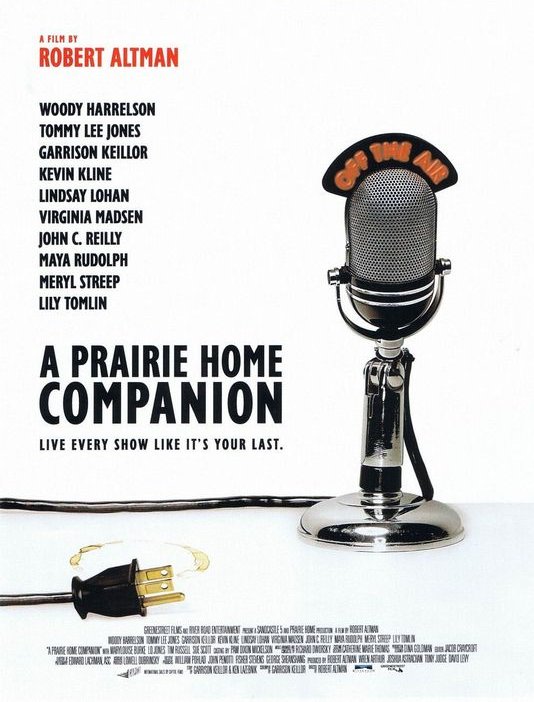
"Live Every Show Like It's Your Last." The last bow's yours, Bob.
**** How's Lindsey Lohan, you gossip-mongers ask? Good, actually! How're you?
"A Prairie Home Companion" is one of the best shows on the radio (the best being "This American Life," but we'll save that for later...or better yet, check it out for yourself on the link). Over the course of its 30 year run, this less-than-"Grand Ol' Opry"-wanna-be has presented home-spun music of all genres--from Gospel to Grand Opera (and has seemingly unearthed every folk-artist extant in the country) and combined spiritual optimism (albeit Lutheran, which takes the joy out of it) with a cynical farm-land realism, all reflecting the philosophy and upbringing of its host Garrison Keillor, whose low story-telling voice is as lulling as cattle moaning in the pasture at night. Keillor writes it all, performs in most of it and serves as ringmaster, finally capping it off with his stool-talk reverie, The News from Lake Wobegon, land of low expectations ("Where all the women are strong, all the men, good-looking and all the children are above-average"). Old time radio techniques and phony commercials--for "Powder-Milk Biscuits" ("Heavens, they're tasty and expeditious!") or for "The Ketchup Advisory Board" wind their way through everything, with just enough toothsome satire to leaven the bitter with the sweet. It's Community-Theater of the Mind, a staple of Public Radio, and manages to embrace and cherish both red and blue states in it's musty woolen blanket of nostalgia.
In the long string of Saturdays that I've listened I've heard moments of great beauty that I'll never forget,** while, on the other hand, I've wondered more than once why Keillor needs to sing so damned much. It's been a comforting friend on lonely cross-country drives, and it's been known to make a car load of rowdies quiet in contemplation.

But anyone going into
Robert Altman's
A Prarie Home Companion or "PHC" is due for a bit of a shock. Written by Keillor (from a story by him and Ken LeZebnik), it incorporates familiar bits and pieces from the broadcasts
throughout. Characters come to life in the form of show-stalwarts cowboys
Dusty and Lefty (played in the film by Woody Harrelson and John C. Reilly) and private eye Guy Noir (played by Kevin Kline
as not hard-boiled, so much as hard-up), as well as the subjects of one of
Keillor's Wobegon yarns-the Johnson Sisters (Lily Tomlin and Meryl Streep). There's an old country music type named Chuck Akers (played by L. Q. Jones), who stands in for the PHC perennial guest,
Chet Atkins. Why, I even remember the episode the Penguin joke came from. But the
radio show itself is used as backdrop to the intertwining stories of the
participants on the last night of the show, which overwhelms the conceit
of using the show in the first place.

And then...it's about death, primarily.
Which must make every blue-haired old lady in the audience go, "What'd they do that for? It's supposed to be 'A Prairie Home Companion!!"
A little back-story: Keillor had written a screenplay for Altman called "Lake Wobegon Days," about a local boy coming home to bury his father (it sounds alarmingly like Elizabethtown!)

Altman rejected it, saying: 1) "The death of an old man is not a tragedy" and 2) "I want to make a movie of 'A Prairie Home Companion,' instead!" I can just see the sour-lemon look on Keillor's face when Altman said that! "What does he wanna make a movie of that for?" he no doubt grumbled. "I've been doing that for years! And it's RADIO!"

Yup. But it's also live, which means chaos, and Altman always loved chaos. And it has music, which to Altman means
community, and PHC ends, as the show usually does, with a group-sing of an
old gospel standard--kinda shaky and maybe a little off-key, but still,
it's everyone putting aside their differences and pulling together to make
something nice, a trope that goes back to the films of Howard Hawks. And it ends with a grace note—an
impromptu final bow from the wings.***
Altman's been making that kind of film for years, and death has always
been a player, in
M*A*S*H (whose so-familiar theme song is entitled "Suicide is Painless"), McCabe and Mrs. Miller, Nashville, The Player, Short Cuts, and Gosford Park. And The Long Goodbye.

Amidst the songs by long-time PHC participants, the bits and skits, the players**** hook up and separate and talk over each other in a life-like muddle, Keillor's self-initialed character is constantly correcting the details of the various versions of History that he's concocted, and Death (in the form of Virginia Madsen) wanders the theater. Madsen's a wonderful actress—she deserved her Oscar nomination for Sideways and to win it, as well—but she's not terribly convincing in the part. Not entirely her fault. It's written as clueless and all-knowing, deeply philosophical and naive--Streep would have had difficulty with it. Plus, it's a little unclear just how she operates. Some people who see her, die. Some don't. Some folks who are unaware of her die. It's inconsistent. You'd want Death to have some kind of definite procedure, but I guess that's asking too much of a Grim Reaper. Death doesn't have rules.
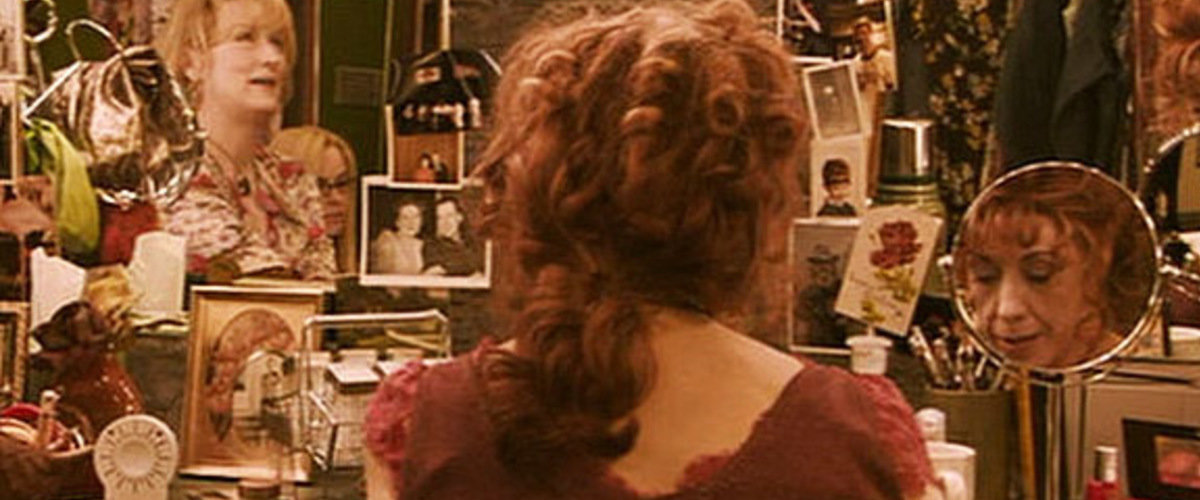
A Prairie Home Companion was Robert Altman's last film. He died at age 81 on November 20th, 2006.

"Live Every Show Like It's Your Last." The last bow's yours, Bob.

* The German Title of "Once Upon a Time in the West," translated, means "Play me a Song of Death"
** a college chorus group solemnly singing John Lennon's "Julia" will haunt me for the rest of my life, and even a sing-along with a crowd in Buffalo last week, made me dab my eyes and smile at the cleverness with which it was done (It's "Angels Watching Over Me" in Segment 2 of the link)
*** Courtesy of the always-wonderful John C. Reilly. But before that, one of the joys of the film is an impromptu bit by Meryl Streep, where she runs from the stage, grabs Keillor, who's already shambled off, drags him, surprised, back for a short, sweet dance--then turns around and leaves him, his arms holding her memory, as he watches--not sure what to do next. Then he turns and shuffles off-stage again. It feels spontaneous, and it feels perfect for both characters...and for Keillor in real life.
**** How's Lindsey Lohan, you gossip-mongers ask? Good, actually! How're you?


