Showing posts with label Victor Saville. Show all posts

Wednesday, May 20, 2020

Dark Journey (1937)

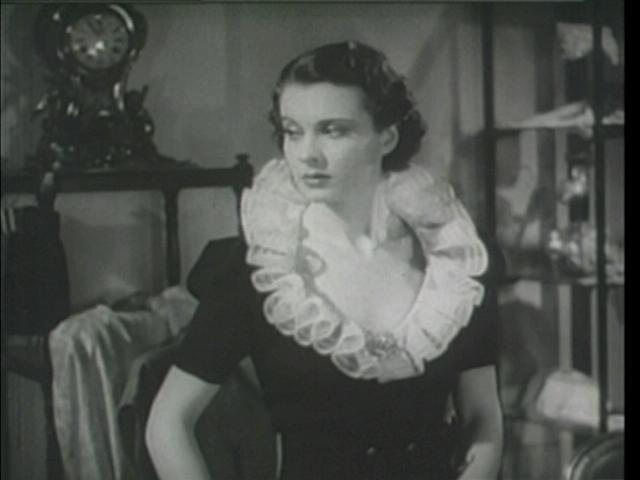
Dark Journey (Victor Saville, 1937) All's fair in love and World War I—but when love and war are running congruently, neck and neck, that's when things really get dicey. Especially when the warring lovers are spies, spying on each other. There's Madeleine Goddard (Vivien Leigh) is a designer and couture diva who regularly makes a shopping run between France and Switzerland, cloaking her activities as an agent for the British. She moves through the hoi-poloi (who never seem aware there's a war going on) attracting all the best customers, none of them suspecting that her decorative scarves and pattern swatches contain secret plans and schematics. Her assignment—find out who's the head of the German intelligence agency, Section 8. Enter the snakily charming Baron Karl von Marwitz (Conrad Veit), a German deserter who caddishly trolls the gargantuan supper-clubs with their high ceilings and higher society for the more low hanging fruit of females. It is through one of his companions that he becomes acquainted with Madeleine, becomes smitten and just a little stalkerish with her. For some reason, she finds this attractive and the two begin a wary relationship.
Yeah, well, hunt a tiger...and opposites attract, and all that. It isn't giving away any state secrets that the revelations that ultimately come about are a little less than surprising. Nor is it surprising that two intelligence agents so visibly hiding in plain sight might not actually be that effective (C'mon kids, it's called "undercover" for a reason). Imagine the dinner table conversation: "What did you do today?" "Nothing. And you?" "Same thing." Double crossing does not "go" with star-crossing.
Anyway, you thought YOU had a complicated relationship. This was a few years before Leigh would toss away such behavior with a dismissive "Fiddle-dee-dee." And it's fun to watch the complications that ensue when the two spies are a little too loose with their lips. It's amazing that WWI was won at all.
The costumes and sets are lavish (and very un-WWI era). Leigh and Veidt do very well conveying conflicting loyalties, but the plot is a bit spare in details as to be confusing. It's never really determined who has the upper hand—is Madeleine basically a "honey-trap" to seduce the German and get him where he can easily be captured, or is it all a misinformation campaign by either side. Whatever it is, the romance is the least charged of the themes in the film, even though Leigh and Veidt try their damnedest to be anything more than inscrutable. It's an interesting spy melodrama, it's just that there's not a lot to love.


Saturday, July 2, 2016

The Silver Chalice

The Silver Chalice (Victor Saville, 1954) Legend has it that when The Silver Chalice was first scheduled to appear on television, Paul Newman—who made his debut in the film—purchased an ad in Variety emploring people not to watch it. The movie was horrible and he was terrible in it, being the reasons.

Paul Newman was rarely wrong. And I can only hoist a glass of Newman's Own Virgin Lemonade to him that he was right on the money about this one.


No doubt designed to repeat the success of 20th Century Fox's 1953 adaptation of The Robe, The Silver Chalice is quite another kettle of loaves and fishes. Sure, they're both religious epics based on historical novels surrounding Christian relics and filmed in Cinemascope (to lure the crowd from their little television boxes). Sure, they have charismatic young stars making names for themselves (Richard Burton, Paul Newman). Sure, they're both movies.
Newman, trying to look casual in a toga.
But, The Robe is big in scope and epic in scale. A "cast of thousands" kind of thing. The Silver Chalice looks like it was shot in the studio with available crew as extras. It starts out with crowded street scenes, but eventually everybody goes home and the streets are deserted and bare, often resembling a bare stage with some odd architecture that might fit well in a movie designed by William Cameron Menzies. The interiors are "Star Trek" (the series) simple, done with an emphasis on stretched space for Cinemascope and design. The exteriors are achieved by model overlays obscuring the stages and lights.
The sets are "Star Trek" simple. 3rd SEASON "Star Trek" simple.
The plot is rather simple, too: Basil (Newman as an adult), a talented sculptor in Greece, is sold to a rich childless nobleman (E.G. Marshall) to be his son and heir, much to the consternation of Mr. Noble's brother. When the patriarch dies, Basil is sold into slavery, due to the corrupt machinations of the brother, the magistrate, and the craven testimony of one of the witnesses. Basil becomes a sculptor for a local artisan wanting to increase his trade. Upon adulthood, he is sold to Joseph of Arimathea, one of Christ's apostles, who tasks Basil with creating a silver chalice for the cup Jesus used at the Last Supper, to be designed with the faces of the Apostles and Christ.
Things are tough in Lego-Jerusalem
There is a side-story of the slave girl Helena (Natalie Wood as a child, Virginia Mayo as an adult—which defies belief) who becomes the courtesan and assistant of Simon the Mage (Jack Palance), a magician of simple illusions. Simon is approached by a sect leader (Joseph Wiseman) in Jerusalem, who sees the rise of Christianity as a "sapping of manhood" of the populace rising against Rome by following the ways of love and peace. In Simon, he sees an impressive, less passive alternative to Jesus and his miracles ("A true miracle is nothing but a good trick," says Wiseman's rabble-rouser, "They were VERY good," says Simon admiringly).
Helena and Basil have a "thing," but he is attracted to Deborah (Pier Angeli), a devout Christian. Although Basil does wonders with the faces of the Apostles, he has a block when it comes to Jesus, unable to capture his face to anyone's satisfaction. It is only when he travels to Rome, and with the love of Deborah, that the true face of Jesus is revealed to him.
Let's just call this bust of Jesus a work in progress.
The design of the The Silver Chalice (credited to Rolfe Gerard) is cheesy, a low-budget compromise to the vistas and exotica of DeMille and The Robe and the religious mainstays of the 1950's. But, the dialogue is the issue, a too-formal-by-half torturing of "marmish" speaking that turns lines of dialogue into paragraphs.* Nobody does well with this falderal, but Newman can't seem to find a grasp of it or any sense of human feeling to it. He sounds like he's reciting. The ones that fare best are the stentorians—like Alexander Scoursby and Lorne Greene—who deal with the purple dialogue by playing it without any sense of humor or irony, reading it like it was the Gettysberg Address, not unlike the way DeMille's actors intoned their way through his films. A lot of the acting is egregious with Wiseman coming off the best—he plays everything like he's grousing about a bad meal—Newman the worst, and Palance...Palance is off doing his own thing, but then, he's playing something of a demented charlatan, which is sometimes amusing, sometimes very puzzling.
Palance: what the hell is he doing...what the hell is he WEARING?
It's a mess, not unlike watching an Ed Wood movie, but with the disappointing sense that there is taste and intelligence not working somewhere. It just goes to show that if you're making a religious movie, you need a miracle or two to pull it off.

* Shakespeare is easier than this drivel. Harrison Ford threw a great line at George Lucas during the filming of Star Wars: "You can't speak this shit. It can only be typed." But that stilted B-dialogue of the old serials is brilliant next to this narration posing as dialogue. Newman must have had a hell of a time trying to dig out "the truth" of this doggerel with $5 words. There is no "method" here, only madness.