Showing posts with label Tod Browning. Show all posts

Thursday, October 8, 2020

Freaks (1932)

Oh! It's October. Guess I should be paying attention to Horror films. 

Freaks
(Tod Browning, 1932)  During the pre-Code days, the director of Dracula was given an edict by Irving Thalberg of M-G-M to "outdo" Frankenstein and so produced this mind-blowing soap opera about dysfunction in a circus, with the ambition to show that "they" are as normal as "us" (even though that's hardly a three-ringing endorsement!). The film was deemed "exploitive," despite casting the human rarities as "good guys" and the venal "normals" as "bad guys," as folks couldn't get past the visuals and pay attention to what the film was actually saying. Thus, the film was banned in some countries for many years (and there are still probably some antiquated laws on the books in some U.S. states prohibiting the showing of it—in which case, tough luck TCM!)


We are introduced to the story in flashback as a carnival "barker" presents one particular exhibit, the story of it being what makes up the bulk of the movie. And despite the physical hardships of the various displays, the human rarities seem more concerned with the gossipy interactions, than with dealing with, or suffering, their handicaps. The mongoloids (called "pinheads") are happily in a family unit, the siamese twins are dealing with in-law problems (as well you could imagine), the half-man/half-woman sets him/herself apart from the others, eyeing in the various male/female conflicts by looking inward, and the midget couple are squabbling—he has eyes for the beautiful trapeze artist (but then, he's a social climber), while she has set her sights considerably lower.
Browning has measured, semi-respectful fun with the populace, saving his contempt for the true freaks at the circus—the angry strong-man and the high-flying trapeze artist. They're mean-spirited, wicked people out to exploit weakness—and there's a lot of it in this circus. The metaphor is pushed hard, the lessons imposed in a Grand Guignol style that climaxes in a thunderstorm when the oppressed take on their oppressors (there's one image that's particularly striking—Prince Randian "the Human Torso," born without arms and legs, unstealthily but menacingly approaches his intended victim with a knife between his teeth. One wonders if he can accomplish the task, but one is quite sure he will and it won't be pleasant, having seen how dexterously he opens a box of matches and lights his own cigarettes). Exploitative? Certainly. But it's also a radical statement of revolution meant to make the complacent less so, given the context with which the film operates—one only imagines an updated version for these times with the Strong Man berating the half-man for the "entitlement" of having arms (ignoring that he has no legs). A bizarre, though-provoking film—if one can get past the distractions up-front, and get into the tent where the real show is. 
  

Friday, October 11, 2019

Dracula (1931)

Dracula (Tod Browning, 1931) Filmed version of the stage-play* featuring its matinee-idol, Bela Lugosi. As with "Frankenstein," there had been other versions of Count Dracula's British Invasion, including one (Nosferatu by F.W. Murnau) that got around copyright issues by calling its "vampyre" "Count Orlok."** As with Universal Picture's earlier productions of The Phantom of the Opera, The Hunchback of Notre Dame and The Man Who Laughs, the film is heavy on theatrics, but, this time, is a bit lean in the make-up department, although Lugosi did wear painful silvered contact lenses to enhance his seductive glare. Lugosi's elegant monster, with his slash of a mouth, and eyes wide open while balefully squinting with a laser-like intensity manages to still evoke "the creeps" to this day.

Tod Browning's direction is full of subtle touches--the sudden appearance of the Count's "brides," for example--and not-so-subtle--a shot of Jonathan Harker on Dracula's staircase is shot through a spider web, and Dwight Frye's performance as Renfield is babblingly over-the-top, as is required of so many actors in the horror genre.

As we wrote of the primal homosexual aspects of Frankenstein, Dracula is the straighter blood-brother--the heterosexual aspect of humanity gone hysterical. Dracula's attacks start as seductions, but his acts are akin to rape--animalistic and savage--and linked to sexuality--penetrative, taking blood and passing on the disease of vampirism to his victims. sapping life-strength and energy. And it's all under the guise of civility and position, of manners and societal restraint. But underneath throbs the bestial urges--hidden by day, and only alive at night. Sure, it's nice to bask in the glow of celebrity, but make sure the smile isn't hiding fangs.
Count Dracula, then, is one big hard-on, that by light of day, crumbles to dust. That his bane are religious icons and his own lack of reflection (self-knowledge) only reinforces the metaphor. He's never gone out of style, no matter how straight-laced or free-loving the times. Dracula is one popular "playa."
With the times, the incarnations of "Dracula" have become increasingly sexual over the years, *** only making more obvious what Bram Stoker and Tod Browning buried in the sub-text. "Dracula" is, and always has been, the personification of serial criminal sexuality--which can only be curbed by the light of day. Dracula is The Forbidden, and carries the risk of damnation for seeking it. Besides the purifying rays of the sun, the surest way to kill a vampire is a blessed stake...through the heart.
Frankenstein-homosexuality. Dracula-heterosexuality. Of course, these haunts were conjured during the repressed Victorian era. But what horrified them, still carried a tingle, just as their stories intrigue us and our children, thrill us, and haunt our dreams. No wonder the Religious Right condemn them, or any aspect of the occult.
Hollywood makes a vain attempt (or stab) at killing them, but these monsters of the Id keep coming back, rising from the grave (or the ashes) to stalk another day...er...night. How do you handle these monsters/urges?

The answer next Friday


*Adapted from Bram Stoker's 1897 novel by Hamilton Deane and John L. Baderston. A Spanish-language version was filmed simultaneously (the English version during the day and the Spanish at night) using the same sets, directed by George Melford and starring Carlos Villarias, Lupito Tovar, and Eduardo Arozamena. BOTH versions are in the National Film Registry.


** "Dracula" did not go into the public domain until April, 1962.


*** A guided tour of coffin-dwellers (PLEASE, no flash pictures!): Christopher Lee's athletic, animal Dracula in the heaving Hammer films, Frank Langella oozing Byronesque charm in the 70's stage version and 80's film version, Barnabas Collins, cutting a swath through the ladies of daytime soap-opera on "Dark Shadows," Anne Rice's tortured, damned rock-star vampires, and right on up to current day with the throbbing vampiric (though chaste) teen romances of the "Twilight" series.

Thursday, October 27, 2016

Mark of the Vampire

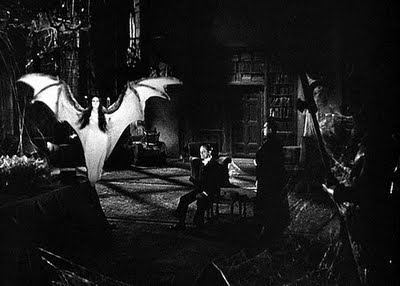
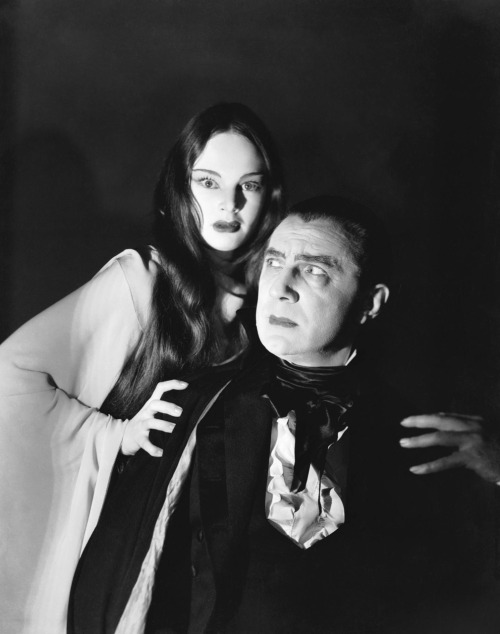
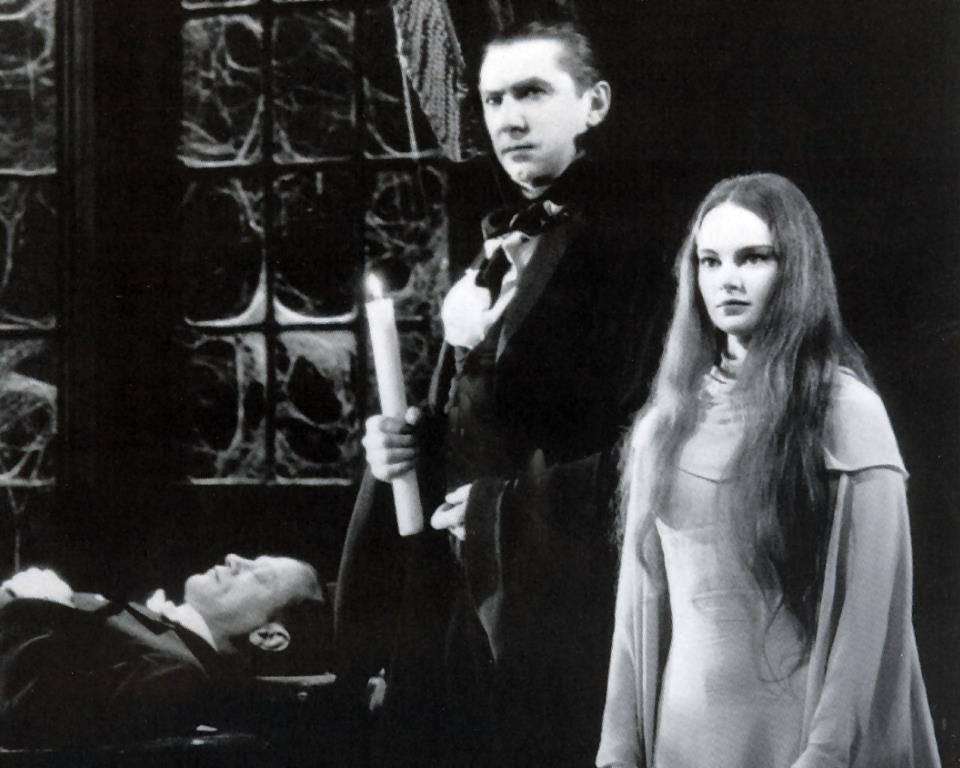
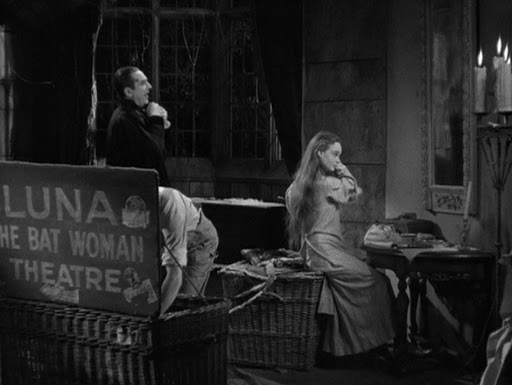
Mark of the Vampire (Tod Browning, 1935) Oooh! Here's a Hallowe'en nugget! Bela Lugosi as a vampire in a film directed by the original director of Dracula, Tod Browning? What could be better than that?

Well, just about anything, but all is not lost. The film is full of Browning's atmospheric touches—which made Dracula so creepy—and he does himself better here with extensive fog effects, a "real" flying vampire, and a hot she-vampire that's creepier than Lugosi, himself.


A remake of Browning's London After Midnight (a Lon Chaney silent film classic considered lost), this version is re-set in Prague. Plans for the wedding of Irena Borotyn (Elizabeth Allan) and Fedor Vincenti (Henry Wadsworth) are dampened when her father, Sir Karell Borotin (Holmes Herbert) is found murdered, two holes in his neck and his body drained of blood.  The police are baffled, but not the townspeople, who blame it all on Count Mora and his daughter Luna (Bela Lugosi and Carol Borland), who the locals think reside in the Borotyn castle near town, despite being dead for many, many years

The marriage is postponed, the case, being investigated by Inspector Neumann (Lionel Atwell), goes cold and Irena goes to live with her guardian, the Baron Otto van Zinden (Jean Hersholt). And, wouldn't you know it?  Right before the wedding can occur again, another attack occurs—this time Fedor turns up double punctured after walking by the Borotyn castle. Then, Irena is attacked. Things are getting to be a real pain in the neck, so the inspector brings in noted vampire specialist Professor Zellen (Lionel Barrymore), who suggests a two pronged attack (naturally), they'll dig up the body of Sir Karell to see if he in thrall to the vampire, and they'll search the Borotyn castle for Mora and Luna.
There's more to this than meets the eye, and far less with a twist ending that makes horror fans see red
Still, before they stake these vampires, Browning's atmospherics are fun, effective and slightly risible and although it disappoints for toying with the audience (and for the many 20/20 hindsight "but if..." questions after), it's genuinely creepy.

Sunday, October 18, 2015

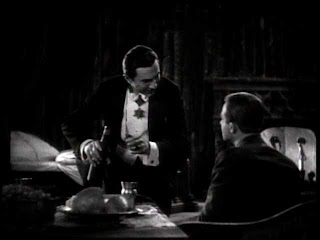
Don't Make a Scene: Dracula (1931)

The Story: And now, submitted for your pleasure and Hallowe'en pre-functioning, this cautionary tale of getting into the real estate trade.

Poor, poor Renfield. Not only did he take the place of Jonathan Harker in the transition from Bram Stoker's novel to the 1931 movie version of Dracula, but he was also played by Dwight Frye, whose over-the-top capering would inform many a hunched lab assistant in the years to follow (If he had a nickel for every time he said "Master..."). The changing of Renfield to the man Count Dracula has over for dinner simplifies the story somewhat, but also severs the tragic ties that Stoker's story eventually leads to in the fate of Mina Harker.

In the film Ed WoodTim Burton partially chronicles the friendship between the hapless titular director and the fading film star Bela Lugosi. Here is the man in his prime, in fact, his pinnacle. Bela Lugosi never had greater fame than as the vampire Count, playing him to ecstatic reviews on Broadway and then on film—a few times, in fact, where he bolstered ever-weakening scripts, breathing life into them quite counter to his role as a blood-sucker.

And it's not a theatrical performance, as the impressionists have made it.* The secret to Lugosi's Dracula is a preternatural stillness—the creepiness instilled by one who stares at you for too long. A stalking look that bides its time. That stillness is used all too rarely in horror films, but you can still find it on occasion. In fact, I'd bet the Oscar Anthony Hopkins won for his Hannibal Lecter in The Silence of the Lambs is partially owed to Bela Lugosi.

Stillness is also part of Tod Browning's directing scheme: there are...a lot...of awkward...pauses, emphasizing Renfield's unease, and very few of Browning's shots move—this was, after all, one of the early sound movies and the cameras were bulky and inflexible—but when they do move...cover your throat. Here, he trucks the camera towards Dracula when he sees the blood seeping from Renfield's finger, in a sort of cinematic blood-rush?

Mention must also be made of a lighting technique that is employed in Dracula's close-up's—the strip of light that emphasizes the eyes (for certain shots Lugosi wore painful reflecting contact lenses). There is a more technical term, I'm sure, but a director of acquaintance always referred to it as "Kirk lighting," as it was employed often to show William Shatner's Captain Kirk on the original "Star Trek" in moments of distress/sorrow.

The Set-Up: Renfield (Dwight Frye) has arrived at the Transylvanian castle of the Count Dracula (Bela Lugosi). The Count has written in interest of leasing Carfax Abbey in a fresher clime. And Mr. Renfield has endured quite a bit for his client in transit. The last carriage ride was particularly upsetting. But now he has entered the Count's castle and is dwarfed by the immensity of the foyer, which is in some disrepair...and seems to be infested with...armadillos. Now, his host descends the vast stair-way gated by huge spider-webs to show him his room and see to his needs.

A meal has been prepared.

Action!


THE CASTLE FOYER

Renfield enters the Count's castle, he's dwarfed by the ancient entry-way and looks around warily, his attention distracted by bats hovering by a window and strange creatures that seem to appear from the crevices of the walls. He doesn't even notice his guest walking quietly down the stairs.

DRACULA: I am...Dracula.
RENFIELD: It's really good to see you. I don't know what happened to the driver and my luggage and...well...with all this, I thought I was in the wrong place.
Dracula: I bid you welcome.
Dracula pivots and heads upstairs.
Offstage: Wolf call
DRACULA: Listen to them...children of the night. What music they make!
The Count turns and ascends the stairs, seeming to pass through vast collections of spider-webs the criss-cross the landing.Renfield follows Dracula, breaking a path through the spiderwebs.
DRACULA: A spider spinning his web for the unwary fly.
DRACULA: The blood...is the life, Mr. Renfield.
RENFIELD: Why, yes.
RENFIELD'S BED-CHAMBER
Enter Dracula and Renfield
DRACULA: I'm sure you will find this part of my castle more inviting.
RENFIELD: Oh, rather! It's quite different from outside. Oh, and the fire! It's so cheerful.
DRACULA: I didn't know but that you might be hungry.
RENFIELD: Thank you. That's very kind of you.
RENFIELD: But I'm a bit worried about my luggage. You see, all your papers were in...
DRACULA: I took the liberty of having your luggage brought up. Allow me.
RENFIELD: Oh, yes. Thanks.
The Count takes Renfield's coat and bags to an aft-chamber, the doors seeming to open on their open, and shortly he returns.
DRACULA: I trust you have kept your coming here...a secret?
RENFIELD: I've followed your instructions implicitly.
DRACULA: Excellent, Mr. Renfield, excellent. And now, if you're not too fatiqued...
DRACULA: ...I would like to discuss the lease on Carfax Abbey.
RENFIELD: Oh, yes. Everything is in order, awaiting your signature.
RENFIELD: Here...here is the lease. I hope I've brought enough labels for your luggage.
DRACULA: I am taking with me only three...boxes.
RENFIELD: Very well.
DRACULA: I have chartered a ship to take us to England. We will be leaving...tomorrow...evening.
RENFIELD: Everything will be ready.
DRACULA: (pointing to bed) I hope you will find this comfortable.
RENFIELD: Thanks. It looks very inviting.
Renfield cuts his finger on a paperclip.
RENFIELD: Ouch!
DRACULA stealthily approaches Renfield
Renfield's crucifix falls over the cut finger.

DRACULA turns quickly away, as if stricken, shielding himself with his cape.
RENFIELD: Oh, it's nothing serious.
RENFIELD: Just a small cut from that paperclip.
RENFIELD: It's just a scratch.
DRACULA: (pouring a glass of wine) This...is very old wine.
DRACULA: I hope you will like it.
RENFIELD: Aren't you drinking?
DRACULA: I never drink...wine.
RENFIELD: Well...
RENFIELD (drinks): ...It's delicious.
DRACULA: And now, I'll leave you.
RENFIELD: Well, good night.
DRACULA: Good night, Mr. Renfield.
Dracula lingers at the door, watching his guest.
Dracula exits. Renfield is left to survey his surroundings, and is overcome with a wave of sleepiness.

Dracula

Words by Hamilton Deane, John L. Balderston, Garrett Fort, and Dudley Murphy, Louis Bromfield, Tod Browning, Max Cohen and Louis Stevens

Pictures by Karl Freund and Tod Browning

Dracula is available on DVD from Univeral Home Video.


* My favorite is "The Count" from "Sesame Street." He even gets the dramatic "wine" pause right: "I am the Count! I love to count...things."