Showing posts with label Otto Wernicke. Show all posts

Wednesday, October 27, 2021

M (1931)

M
(aka M-Eine Stadt sucht einen Mördor, Fritz Lang, 1931) A rash of child-murderers in the Weimar Republic led Fritz Lang and his then-wife Thea von Harbou to use it for what Lang wished to be a film about "the ugliest, most utterly loathsome crime."

He could only have topped it if he'd stayed in Germany and waited a few years. Indeed, when he was attempting to arrange the start of filming, he was refused the use of Staaken Studios, as the head of production was a Nazi and thought the working title—"Murderers Among Us"—would be critical of the up-and-coming political movement. One wonders why, if he thought that was the case, he wanted to be a Nazi Party member in the first place. Actually, given History and given people, one no longer wonders.
 
But, Lang's M had more things on its mind than just a film about a child murderer. Lang's films usually did.
Lang presents the emotional issue in one shot.
 
The film begins with an ironic sequence—children in a circle out on a street playing a counting-out game (where when a child is pointed at, they drop out, or disappear from the game) with a rhyme that has to do with a "man in black" who makes "mincemeat" out of children with a "cleaver's blade." One by one, children get eliminated. How's that for foreshadowing? The song is an annoyance to one of the women at the tenement who is taking her laundry up to be washed, and when she complains about the kids, the washer-woman says "At least if we hear them, we know they're safe."
Then, it's a good thing this is Lang's first film utilizing sound. And a cacophonous world it is, with street-noises, off-screen alarms and sirens...even the passage of time when her little girl doesn't arrive for her regular lunch is emphasized mockingly with a cuckoo clock. In fact, after the titles, the first thing we hear is that children's on-the-nose game-chant. When the little girl is late, the woman no longer depends on sound and goes looking, asking the other kids coming up the stairs if they'd seen her. Then, as if to emphasize that she's not coming, Lang shows her empty place at the table, the yawning empty staircase to her flat, the still basement—then, outside, telephone wires to which gets stuck a balloon that we had seen a man buying for her, then the girl's ball as it rolls...and becomes still.
Horrible things are done in this film, but Lang shows them off-screen, suggestively, and lets the audience do the dirty work, making us culpable. But, we're not alone in this. As fear grips the city, everyone becomes suspicious of each other. Talking to a kid on the street? You could be the murderer! The accusations are made directly to the camera, as if we're the guilty ones. Suspicions turn into accusations, and the police, under considerable political pressure starts to ramp up their investigation, looking in all those empty spaces for victims, rousting criminal hang-outs for clues, making the city sweat, especially those dens of iniquity where aberrant behavior are ever-present.
While the populace looks over their shoulders, buying up the hysterical headlines in the newspaper, squinting at any suspicious activity (or even not suspicious!), the criminal element begins to feel the heat and they determine to catch the pedophile by the means the police don't have at their disposal—their own spider's web of a network utilizing beggars on the street to keep an eye on every child. The police, meanwhile, are narrowing down their suspects and starting to close in. It's just a matter of who catches him first, the authorities or the outlaws.
We already know who it is: we've watched him (Peter Lorre) work, watched him write taunting letters to the paper, watched at how close he gets to getting caught and slip away. But, it's the investigations that take him out of the shadows and provide him with a name and a familiarity. We've listened as he whistled "In the Hall of the Mountain King" and fretted, even if we haven't seen him, but felt the tension increase. Then, when he's been marked, we watch as he struggles to avoid detection only to realize that it's not the police he has to fear, but everyone around him. The tables have been turned. The populace are no longer potential victims, but potential threats.
Murderers as victims. Criminals as detectives. The audience as co-conspirator. Lang's film—his favorite of his career—subverts so many elements to such devastating effect that's it's no wonder anyone who wants to make a thriller—at least a smart, cynical one—has borrowed from Lang's playbook for many years. And his parlaying of a black and white world into one where the colors are switched was so alarming to the Nazi's that once they seized power, they banned the film in July of 1934 (although they did use clips of it in their anti-Semitic propaganda). Seems they didn't want any moral complexity for the masses. Black is black and White is right and they got to choose what was good and evil in the Universe (they chose wrong). Lang saw child murderers as vermin. But, he also saw vigilantism and mob-think as dangerous, as well. The message he said he wanted to convey was "watch your children" not only to keep them from harm, but prevent them from becoming monsters, as well.

Wednesday, May 12, 2021

The Testament of Dr. Mabuse

The Testament of Dr. Mabuse (Fritz Lang, 1933) A man hides in a warehouse that is shaking with the vibrations of heavy machinery in an industrial area of town. Two men come in and open a storage container behind which the man is hiding. The dust and dirt from the lid fall over the hiding man and he involuntarily flinches, exposing his foot behind the container. The two men see it, and while one takes out a black-jack to kosh the fellow, the other urges discretion and they leave the way they came. The hiding man, gun in hand, comes out from his hiding place and listens at the door. The other men are on the other side listening. The man steels his courage, pops a couple pills, takes a swig from a flask, and charges through the door. 

No one is there. He looks around. The coast is clear. He exits the building. Just in time, he throws himself against the building as a slab of concrete falls right where he'd been standing. Alarmed, he runs down the street, only to see three thugs at the end of the block waiting for him. He turns and runs the other direction down an alley. At the end of the alley, two men wait with oil drums. they push one off the truck and it rolls down the street towards our man. He dodges out of the way, just as the drum explodes in a violent explosion that rains fire throughout the alley. 

And that's just the film's first six minutes.
Welcome to the paranoid world of Fritz Lang. It's a world just like ours—but with actual conspiracy theories coming true—and dialed up to "11." Conceived in Germany in its early death-throws between World Wars I and II, when the first war's defeat inspired a dangerously enervating arrogance, Lang used movies to show the best and the worst of societies only too eager to lie to themselves out of some misbegotten quest for power, and it could come from government, from industry, even the motley interests of a lynch mob.
Those were inspired by what was happening in Germany. But, Lang's fantasy instigator was a master racketeer, capable of single-mindedly disrupting the delicate balance of life—Dr. Mabuse. Created in 1921 by the author Norbert Jacques, the Bad Doctor first appeared in a massive two part film project in 1922, then Lang brought him back in a sequel The Testament of Dr, Mabuse, (partially based on an unfinished Jacques novel) even though the previous film had seen the evil manipulator turned mad by the perceived souls of his victims. But, even that cannot stop Mabuse.
All the masterminds of crime you could name—Professor Moriarty, Fu Manchu, Ernst Stavro Blofeld, Hugo Strange, Hannibal Lecter—they don't hold a suddenly-snuffed-out-candle to Mabuse, Fritz Lang's "man behind the curtain," so powerful he can control his vast drug, counterfeiting, terrorism, assassination and extortion rings from his near catatonic state inside a Berlin mental institution, his minions receiving their instructions from a mysterious source, who might be Mabuse himself. 
Lang made three movies about Mabuse--one in 1922
Mabuse, Der Spieler, and in 1960, The Thousand Eyes of Dr. Mabuse, his last directed film. This one, the middle of the trilogy (or actually tetrology if you count "Inferno" as the second chapter of Der Spieler), was made under the unapproving gaze of the Nazis, and subsequently banned by Goebbels, prompting Lang, one of the stellar visionaries of German cinema (MMetropolis) to flee the country for Hollywood. 
And what a vision it is, reflecting the paranoia of National Socialist Germany. Men are sniped while trapped in traffic jams, or nearly blown to bits with barrels of gasoline thrown down narrow alleyways. Among the plots that Mabuse inflicts are plans for jewelry heists and a long-running counterfeit scheme. But, along the way will be death-traps with no exits and only the inexorable ticking of a hidden bomb, and the sabotage of Mabuse's lab, designed to provide a distraction for the mad man's escape, while the city of Berlin is threatened with a resulting cloud of poison gas. 
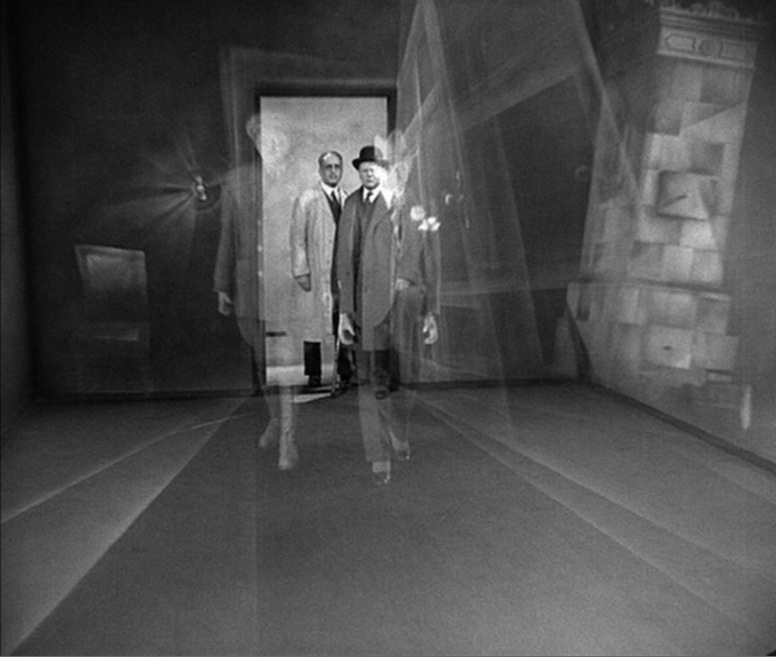
Lang even uses the limitations of the film-frame itself to keep you on edge, as lethal chunks of concrete fall from out of frame to threaten those trapped inside it. No one is safe, and little is what it seems in the web that Mabuse spins, even unconsciously. Lang expertly uses double exposures—some almost miraculous ones—to lend a disconcerting bizarreness to the look of the film.
Two men try to stop the mad-man's plot: the personally beleaguered police Commissar Lohmann (Otto Wernicke), who is brought into the madness by the psychological cracking of a former detective, and one of Mabuse's gang, Thomas Kent (Gustav Diessl) who lost his penchant for killing after a stretch in prison and the love of a good woman (Monique Rolland). The men, the authority working outside and the man on the inside, must resolve their own distrust of each other when confronted by an over-arching nemesis, whose power extends even beyond the grave.
One sees in this, the inspirations for
Hitchcock and 007 (the film ends with an impressive series of chain-explosions), that not only evolved the thriller genre, but the action film as well. But leave it to Lang to take Mabuse's evil and take it to the next level, a supernatural one, influencing people's minds like a Jedi Master, such is the criminal hypnotist's power. No one's safe, in reality or beyond. 

Now, that is genuine creepiness.