Showing posts with label Neville Brand. Show all posts

Saturday, October 15, 2022

The Ninth Configuration

The Ninth Configuration
(aka Twinkle, Twinkle, "Killer" Kane) (
William Peter Blatty, 1980) Blatty started out his colorful career as a writer—turning out "John Goldfarb, Please Come Home!", "I, Billy Shakespeare", and the first version of this story ("Twinkle, Twinkle, 'Killer' Kane!") before turning to screenwriting for films with Blake Edwards and others. He went back to novels after flirting with Hollywood, and his first, "The Exorcist" became a best-selling phenomenon, and the resulting film, which was the first horror film to be nominated for a Best Picture Oscar, won him the Best Screenplay statuette that year.
 
Blatty returned to writing, taking his 1966 "'Killer' Kane!" book and re-configuring it as "The Ninth Configuration," shopping around a screenplay for a potential film but with the caveat that he direct it. There were no takers. So, Blatty put up his own money for half the film's budget—the other half funded by Pepsi-Cola*—and Blatty began shooting in Hungary without a distribution deal.
Which is crazy. But, then, crazy is what The Ninth Configuration is about. And some of it is inspired craziness.

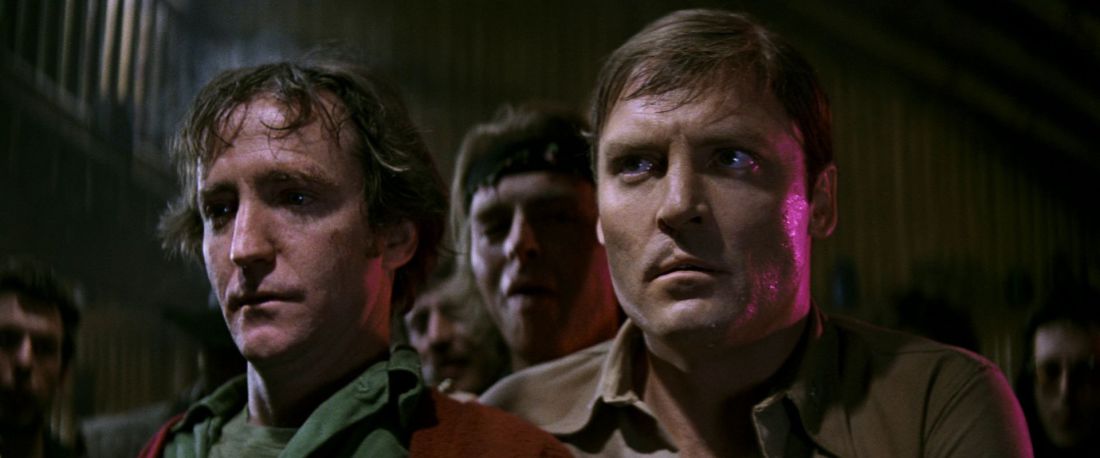
"Some time in the 1970's" Colonel Hudson Kane (Stacy Keach) is being assigned to oversee an overcrowded veteran's mental health facility in the Pacific Northwest, with the mission to determine who's genuinely insane and who's faking it to get out of service. He is informed by the acting head Col. Fell (Ed Flanders) that the patients are all eccentric. Kane knows this already; when he arrived, the first guy who claimed he was in charge was an inmate and he was pretty convincing. It's no wonder the military staff is having a hard time keeping order. But, order is just an idea that a group of people agree upon. These guys can't agree on anything.
There's Lt. Reno (
Jason Miller), who wants to put on a production of "Hamlet" but performed by dogs ("Someone has to do it!"). Maj. Nammack (Moses Gunn) thinks he's a super-hero. Then, there's Billy Cutshaw (Scott Wilson), former astronaut, who, on the way to the Moon, suffered a mental breakdown. Kane takes a particular interest in him, as Cutshaw engages him in arguments about the existence of God and who seems to really want answers and challenges Kane on his own beliefs. When Kane asks Cutshaw why he aborted his mission in space, Cutshaw merely gives hima St. Christopher medal.
Kane decides that his best strategy is to let the lunatics run the asylum, which may not be effective, but is very entertaining. Blatty has an interesting trope in his writings and The Ninth Configuration is no exception—he starts out funny, softening the audience up, and then turns deadly serious into matters that far outreach whatever set-up he has. Blatty's Configuration stretches the scenario as far as it can possibly go before it snaps. The film has divided its very niche audience for decades (a problem compounded by the various edits of the film over the years), but it has some ardent supporters among the larger film community.
It also has some fairly amazing shots, that, at times, makes you snap your head 360° with just how audacious they are (Blatty was a first-time director when he made the film) and reminds one that his later film of Exorcist III was as good as the original, and probably better. If there is a weakness, it might be in Stacy Keach's performance that was directed to tamp down any telegraphing of what was going on at the film's core. 
And there is, at the core, that theological question—why is it easier to believe in the devil because evil exists, than it is to believe in a God with the presence of so much good. That's the central theme (as in The Exorcist) and it persists here, as well, with Cutshaw challenging Kane to give an example of a purely unselfish sacrificial act to prove the point of a deity. Kane doesn't have much of a response, but his deep dive for memory may be what causes later issues.
But, there is a neatly framed argument that he gives for the existence of God:
"In order for life to have appeared spontaneously on earth, there first had to be hundreds of millions of protein molecules of the ninth configuration. But given the size of the planet Earth, do you know how long it would have taken for just one of these protein molecules to appear entirely by chance? Roughly ten to the two hundred and forty-third power billions of years. And I find that far, far more fantastic than simply believing in God."
Blatty may be fudging on the numbers, there—it's something to ask Neil de Grasse Tyson—but it's an interesting argument, even with an infinite amount of space. It's certainly easier than getting dogs to play Shakespeare...or monkeys to write it.


* Pepsi had funds in Europe that could not leave the country of Hungary, so the filming took place in Budapest, rather than the location stipulated in the Pacific Northwest.

Saturday, February 15, 2020

Kansas City Confidential

Saturday is "Take Out the Trash" Day

Kansas City Confidential (Phil Karlson, 1952) One of director Phil Karlson's 1950's movies, the crime expose The Phenix City Story (released in 1956) was just put into the National Film Registry. You know the one where they vote in 25 films every year for films that are "culturally, historically, or aesthetically significant." Karlson was another of those "maverick" directors, he could work in any genre, but spent a long time as an assistant director and quit that job so he could direct at bargain basement studios, where he could make movies the way he wanted to with little interference as long as he could keep the finances down.

One gets the impression from watching his movies, that he'd just as soon throw a movie camera into the audience's face as do something fancy to get your attention. He made movies that were cynical, had no interest in authority, and where one could feel the grit right underneath the emulsion. It's why Desi Arnaz hired him to direct the pilot of the TV-show "The Untouchables," he wanted a low budget 20's-30's noir-equivalent. His most famous movies are the sequel to Willard called Ben, and the movie where he made his fortune, the original version of Walking Tall with Joe Don Baker.

But, Quentin Tarantino's seen his movies. Watch Kansas City Confidential (and you can below—it's public domain on the Interwebs, although M-G-M retains the broadcast/movie rights to it) and you see where his Reservoir Dogs came from.
Only Kansas City Confidential isn't so cute with the dialog or the cultural references. 
It begins with a hand-drawn map, a clock on the wall and a notebook filled with the names of low-life's. "Mr. Big" (we'll call him, as played by Preston Foster) notes the activities of the bank across the way at opening time. He notes the activity—a regular one by Western Wholesale Florists to the flower shop next door, the arrival of the early-birds to do bank-business, and the arrival of an armored car a few minutes later. He carefully checks off the routine. Then, he makes phone-calls to numbers in that notebook.
The instructions to the three men on the other side of the phone-calls are the same. There's a job. Meet him at Room 302. Baker Street Hotel. There will be a big pay-off. First on the list is Pete Harris (Jack Elam), the proverbial nervous little man in a shabby room. He chain-smokes, has gambling debts—craps is his vice. He will be the King of Spades. When Harris comes to the door, he comes armed, but the man in Room 302 makes quick work of dis-arming him and slapping Harris to attention. Harris is shocked by the man in Room 302; he is masked, gives no name, no details, but promises a pay-out of $300,000 to start a new life in another country.
Next on the list is Tony Romano (Lee Van Cleef), a sharpie with creases in his suit as sharp as his cheek-bones. He likes the dames and he likes poker, but he isn't so lucky. He's smarter than Harris and a bit too sure of himself, but 300k, he'll play along. He'll be the King of Clubs. Finally, there's the cop-killer Boyd Kane (Neville Brand) who chews bubble-gum nice and slow, doesn't talk much but sweats a lot, and he's such a high-risk that he takes the job.
It's a typical day at the bank. Western Wholesale Florists shows up to make the delivery. Driver Joe Rolfe (John Payne—sorta Robert Mitchum without the sleepy eyes) has the misfortune of nearly running over a bank customer who says "Why doncha watch where yer goin'?" He's going to not make that mistake again the whole movie. He makes the delivery and takes off, none the wiser, as the armored car parallels up. Then, while the guards are in the bank, another truck with the same Western Wholesale logo slides up behind it. When the guards with the money-bag come out, the Florist truck pulls up alongside, two men in masks jump out the back, cudgel the guards and throw the bag to a third man waiting in the back. They pile in and squeal off, leaving the too-late, too-old bank-guard to fire at their long-gone retreat.
The delivery van speeds to a waiting moving van, and it ramps into the hold. The crooks, still in their masks, want their pay-out, but Mr. Big tells them to shut up and keep their masks on—they're too "hot" and the money is, too. Nobody knows anybody's name, making them all "cop-proof and stool-pigeon proof." "Big" hands each man a stipend for them to travel to Tijuana and await instructions and half-a-playing card to serve as I.D. at their rendezvous in the future. Then, one by one, they jump out of the moving van—it's up to them to make it to Tijuana, to wait for a cable-gram for what's next.
Good day for them. Bad day for Rolfe, who gets pulled over in his delivery van during his work-day and gets man-handled by the police, and his afternoon-deliveries get ransacked looking for the stolen dough. Hauled in for questioning, he gets roughed up and accused—what was he doing in that van? His job that he got from his parole officer after a stretch on gambling charges. Rolfe is a good suspect. Never finished college to be an industrial engineer, did a stretch in the service earning a Purple Heart and a Bronze Star ("Try buyin' a cup o' coffee with 'em," he snarls), and is trying to earn money to go back to school. Well, tough luck, kid. He just lost his job—he should understand says his boss—Western's clients are "very conservative people, you know how it is."
The bank's reward, put up by its insurance company is a quarter of the $1.2 million stolen from the bank. 30k. Rolfe would love to have that, but he doesn't know a thing, even though he gets beaten up by a couple of very aggressive cops every day of his three-day holding stretch, thinking he might. Finally, they can't hold him any more—the duplicate delivery van has been found—and he gets released to find his mug plastered all over the front-page. No sense looking for work with that resumé. So, he goes on a one-man reconnaissance mission to find "the guys who framed me." With the help of a buddy he served with on Okinawa, he gets a line on Pete Harris—you can find him in Tijuana.
There the details stop for you. But, you get the gist—innocent man, desperate and hard-boiled, and with just enough brains to make him dangerous, especially to thieves with no honor and no idea who their "friends" are. But, once they all settle for that meeting in a Mexican resort town, they all—how did Raymond Chandler metaphor it?—"stand out like a tarantula on an angel-food cake."
Karlson was not a subtle director (remember what I said about throwing the camera?). There's a lot of casual violence, where people slap each other around with little provocation other than things are moving a little too slow—good thing the film's black and white, there'd be a lot of bruising make-up to apply—and even though the location's supposed to be Mexico, there's a lot of sweat going around. When the film's "good girl" (Colleen Gray) interrupts Rolfe getting a good beating, everybody starts to act "un-chalant" and saying they're just talking, to which she replies "...must have been a warm discussion." Nice.

It's also tough to keep track of the fire-arms in Kansas City Confidential. Everybody's got a gat and they flash them a lot...or get caught reaching into their jacket-pockets. What was Bogart's line? My, my, so many guns, so few brains."
Except the one behind the camera. There are a couple fluff's here and there, not every "i" is dotted, not every double crossed, but Karlson makes sure Kansas City Confidential has the bad good's and it's a solid film noir where the world is so much against you that swapping it for the business-end of a gun actually feels pretty good. It may be "Take Out the Trash" day here, but every so often you find a nugget buried.

Got 90 minutes to kill? This one will keep it a misdemeanor.