The Ninth Configuration (aka Twinkle, Twinkle, "Killer" Kane) (William Peter Blatty, 1980) Blatty started out his colorful career as a writer—turning out "John Goldfarb, Please Come Home!", "I, Billy Shakespeare", and the first version of this story ("Twinkle, Twinkle, 'Killer' Kane!") before turning to screenwriting for films with Blake Edwards and others. He went back to novels after flirting with Hollywood, and his first, "The Exorcist" became a best-selling phenomenon, and the resulting film, which was the first horror film to be nominated for a Best Picture Oscar, won him the Best Screenplay statuette that year.

Blatty returned to writing, taking his 1966 "'Killer' Kane!" book and re-configuring it as "The Ninth Configuration," shopping around a screenplay for a potential film but with the caveat that he direct it. There were no takers. So, Blatty put up his own money for half the film's budget—the other half funded by Pepsi-Cola*—and Blatty began shooting in Hungary without a distribution deal.

Which is crazy. But, then, crazy is what The Ninth Configuration is about. And some of it is inspired craziness.
"Some time in the 1970's" Colonel Hudson Kane (Stacy Keach) is being assigned to oversee an overcrowded veteran's mental health facility in the Pacific Northwest, with the mission to determine who's genuinely insane and who's faking it to get out of service. He is informed by the acting head Col. Fell (Ed Flanders) that the patients are all eccentric. Kane knows this already; when he arrived, the first guy who claimed he was in charge was an inmate and he was pretty convincing. It's no wonder the military staff is having a hard time keeping order. But, order is just an idea that a group of people agree upon. These guys can't agree on anything.
.jpg) There's Lt. Reno (Jason Miller), who wants to put on a production of "Hamlet" but performed by dogs ("Someone has to do it!"). Maj. Nammack (Moses Gunn) thinks he's a super-hero. Then, there's Billy Cutshaw (Scott Wilson), former astronaut, who, on the way to the Moon, suffered a mental breakdown. Kane takes a particular interest in him, as Cutshaw engages him in arguments about the existence of God and who seems to really want answers and challenges Kane on his own beliefs. When Kane asks Cutshaw why he aborted his mission in space, Cutshaw merely gives hima St. Christopher medal.
There's Lt. Reno (Jason Miller), who wants to put on a production of "Hamlet" but performed by dogs ("Someone has to do it!"). Maj. Nammack (Moses Gunn) thinks he's a super-hero. Then, there's Billy Cutshaw (Scott Wilson), former astronaut, who, on the way to the Moon, suffered a mental breakdown. Kane takes a particular interest in him, as Cutshaw engages him in arguments about the existence of God and who seems to really want answers and challenges Kane on his own beliefs. When Kane asks Cutshaw why he aborted his mission in space, Cutshaw merely gives hima St. Christopher medal. Kane decides that his best strategy is to let the lunatics run the asylum, which may not be effective, but is very entertaining. Blatty has an interesting trope in his writings and The Ninth Configuration is no exception—he starts out funny, softening the audience up, and then turns deadly serious into matters that far outreach whatever set-up he has. Blatty's Configuration stretches the scenario as far as it can possibly go before it snaps. The film has divided its very niche audience for decades (a problem compounded by the various edits of the film over the years), but it has some ardent supporters among the larger film community.
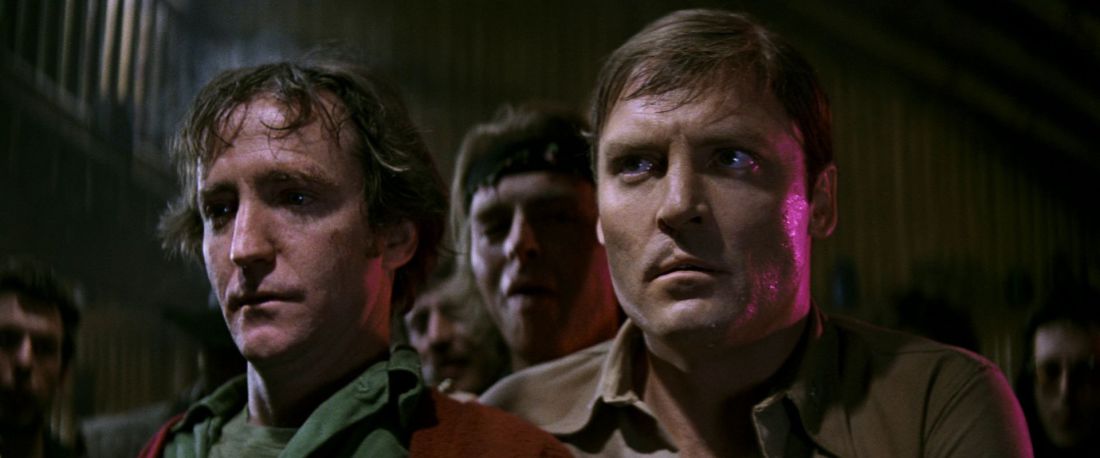
 It also has some fairly amazing shots, that, at times, makes you snap your head 360° with just how audacious they are (Blatty was a first-time director when he made the film) and reminds one that his later film of Exorcist III was as good as the original, and probably better. If there is a weakness, it might be in Stacy Keach's performance that was directed to tamp down any telegraphing of what was going on at the film's core.
.jpg)


"In order for life to have appeared spontaneously on earth, there first
had to be hundreds of millions of protein molecules of the ninth
configuration. But given the size of the planet Earth, do you know how
long it would have taken for just one of these protein molecules to
appear entirely by chance? Roughly ten to the two hundred and
forty-third power billions of years. And I find that far, far more
fantastic than simply believing in God."

Blatty may be fudging on the numbers, there—it's something to ask Neil de Grasse Tyson—but it's an interesting argument, even with an infinite amount of space. It's certainly easier than getting dogs to play Shakespeare...or monkeys to write it.


* Pepsi had funds in Europe that could not leave the country of Hungary, so the filming took place in Budapest, rather than the location stipulated in the Pacific Northwest.


