Showing posts with label Michel Piccoli. Show all posts

Sunday, April 6, 2025

Danger: Diabolik!

Saturdays are traditionally "Take Out the Trash" Day...

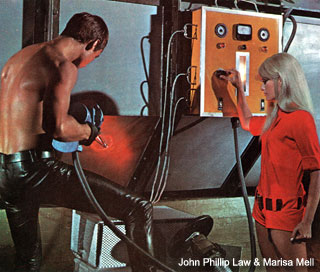
Danger: Diabolik! (Mario Bava, 1968) Mario Bava's psychedelic adaptation of the Italian comic about a master-thief, who preys on the pompous and the puerile, owes an awful lot to the 1966 "Batman" TV-show (though the panel of "experts" in the DVD Features documentaries say "Oh, no, no, nothing could be further from the truth!" Holy Denial's-not-just-a-river-in-Egypt!*). At the time, the Batman-camp style of doing things was spreading throughout many tried-and-true properties that had previously only skirted the edges of parody and satire. The popularity of the TV "Batman" sent them right over the edge into mock-serious comedy and "camp".
  
And, so, too does Danger: Diabolik, with its dutch-angles (though "Bava'd" with more extremity), shadowed wide-screen compositions, chromed model-work that looks like it might have come out of a Super-marionation series and dodgy blue-screen work, which looks like it could have been done for episodic television.
Plus, folks, c'mon...it's based on a comic-book property...with comic book sensibilities. The beginning even rings like a "Batman" episode with a dastardly crime as a masked man (our "hero" played by John Phillip Law) runs rings around the local constabulary and the Treasury, stealing $10 million, foiling the law's diversionary tactics, and hiding his tracks with multi-colored smoke generators (you may well ask "why does he need multi-color smoke when regular smoke will do?" but then that would be logical), stealing their riches and making them appear like fools.
Then, mission accomplished,
he drives his souped-up Ferrari to his high-tech underground lair with his mini-skirted girl-friend (name of Eva Kant and played by model
Marisa Mell) in tow to indulge in some high-tech something-or-other, and then some nude frolicking in all the money. It makes as much sense as anything else in the movie.
Inspector Ginko (
Michel Piccoli, playing it fairly straight) of the local Constabulary is embarrassed, flummoxed and at a loss of how to deal with such a nefarious threat, and things reach a crisis point when the Minister of the Interior (Terry-Thomas), who has just reinstated the death penalty especially for the crisis, is forced to resign after a humiliating experience orchestrated by Diabolik at a public press conference. Ginko is given special powers to deal with this menace. So, when a local Mafioso named Valmont (Adolfo Celi) calls him to offer his own under-handed services to capture the super-criminal, Ginko is only too happy to agree.
They bait a trap for Diabolik involving a priceless emerald necklace with both the police and mafia waiting to apprehend him and the master-thief has to climb a sheer tower (using his "Diabolik-Super-Suction-Handholds!") to get to the one room where he thinks the necklace might be. Diverting all the security-cams (using a polaroid!), he manages to snatch the necklace, as well as double-cross Valmont—who has kidnapped Eva!—and gets him killed in the process, as well.
But, the ultimate Diabolik coup happens when he arranges for several ministerial buildings to blow up, resulting in the loss of every citizen's tax records, which the government fully expects won't deter people from dutifully paying their taxes. 
They're wrong, of course, and so, to forestall economic catastrophe,  a big-whopping share of their gold supply is made into a big, whopping ingot to be sold to try and keep the government solvent. Diabolik, naturally, plans to steal it. I mean, a several-ton gold block that will be impossible to move? How tough can it be?

And, of course, he's figured out a way to spend it...
Over-the-top, bombastic...and mind-numbingly absurd, Danger: Diabolik is true to its comic roots, but the tone is puerile and is devoid of the gravitas Bava brought to his Italian horror films.
Apparently, it was a troubled production from the start.
It started out in 1965 as a production of Italian producer Tonino Cervi to be directed by Seth Holt and distributed by Dino De Laurentiis. But after some filming was done with leads Jean Sorel and Elsa Martinelli, De Laurentiis pulled the plug on the film, ordered a new script and hired Bava to make a quick, cheap production that he would produce in tandem with another film based on a European comic property, "Barbarella." Bava borrowed Barbarella's upcoming actor John Phillip Law to be paired with Catherine Deneuve as Eva, but the two had no chemistry on-screen and Deneuve and Bava frequently clashed on-set. Bava replaced her with model Marissa Mell. Bava had made a name for himself with his well-regarded horror films done on the cheap, and he managed to pull off a miracle given the frenetic circumstances, only spending $400,000 of the film's proposed $3 million budget, money De Laurentiis was able to spend on his next production, Barbarella.
It didn't help the lead performances much, though. Law does all of his acting with one eye-brow (although one can hardly blame him, as when he's masked that's all of him you can see!), which is one muscle more than Ms. Mell is willing to use. Adolfo Celi is the mafioso willing to deal with the police to get the master-thief out of his hair. The tone is a malevolent light-heartedness, combining James Bond with comic book hi-jinks. Nothing is meant to be taken too seriously, which might explain why Terry-Thomas is inexplicably in the cast! 
 
The movie did inspire Roman Coppola's CQ, a few years back, and since 2021 there have been three more "Diabolik" films recently produced, directed by the Manetti Brothers.

* You want a definitive proof? During Terry-Thomas' short scene at The Minister's press conference, Diabolik and his moll, Eva Kant, crash it posing as reporter and photographer. Diabolik's camera-flash emits something plainly labeled as "Exhilarating Gas" (basically laughing gas to disrupt the press conference). And to ensure that they aren't affected by it they take out a little pill bottle clearly labeled "Anti-Exhilarating Gas Capsules" because, gosh, international criminals don't want to get their capsules mixed up. Everything was labeled in the "Batman" TV show from the Bat-computer to the Bat-Anti-Shark Repellant (although that was from the movie).

Thursday, July 19, 2018

Atlantic City (1980)

Atlantic City (Louis Malle, 1980) I've made no secret of my prejudices against the directorial style of Louis Malle: He's one of the handful of directors I know who can make salacious subject matter dull. In college, after seeing Lacombe Lucien  and Pretty Baby in a period of three weeks, I started repeating the same joke whenever any person dared mention his name. I'd sneer that the perfect Louid Malle film would be two guys in a room talking and Malle using three cameras to film it.

And what happens? He makes My Dinner with Andre.

And...I like that movie!

So, I don't seek out Louis Malle films, though I've endured a handful of them. And he's the exception that proves the rule. I approach his films with caution rather than openness. "Alright, prove me wrong!" is in my head before I watch a Malle film. Or, in Hitchcock's words: "Enchant me."*
Not fair, I suppose, but I went through that same ritual when I popped Atlantic City into the DVD player. But that's how it is with me.

And hey, Atlantic City is a pleasant surprise. An English language film (written by playwright John Guare) with an eye toward the sordid side of American life, set in a transitional Atlantic City before it was "Trumped" up into "Vegas-East." The crumbling facades make an apt back-drop for the toothless lions and hapless turks trying to score The Good Life.
Burt Lancaster and Kate Reid turn in terrific performances: he, a retiree living a fantasy life as a former High Roller that never was; and she, a bed-ridden glamuor queen in crumpled disarray, entombed in her boudoir.
Then, there's the gal he anonymously peeps at night as she ritualistically cuts lemons and squeezes the juice on her skin. To him, it's a stolen moment of sensuality. For her, she's trying to remove the stink from working at a Casino fish-fry. She's Sally Matthews (Susan Sarandon) and she's just recently been hit up by her ex, who shows up in town with a wad of stolen heroin in the shape of a nest-egg, and Sally's kid sister--who just happens to be carrying ex's kid. Messy. Complications ensue.
What's marvelous about the movie is the perfect setting for the parade of wannabe's and never-was's in a tourist city whose seedy veneer is being stripped away to the crusty re-bar underneath. Of course, it's to be replaced by just another false-facade. but, like the city, everybody's in transition: to a better life, to a better understanding of life: to a shallow grave.

It's pleasant and seamy, but then Malle's always been attracted to the under-belly of civilization and the psyche; here, the psyche's are good impressions deep, and there's just the faintest whiff of good intentions in the air, that despite the squalor gives the movie an almost sunny disposition.
There are things that made me wince—a too-long stutter of a reaction shot in an unexpected farewell scene, and a too-cute End Crawl with Michel Legrand's poppy chansons being demolished out of existence by a wrecking ball. But, a nicely done, excellent film from one of my least-favorite directors.


* Said to Anthony Perkins on the set of Psycho when the actor told Hitchcock he had an idea for walking up the Bates staircase, but he had to show it to him: Perkins walked up the stairs with a feminine gait to his hips, Hitchcock roared with laughter, and that's how it appears in the film.

Friday, April 27, 2018

Holy Motors

Rich Man, Poor Man, Beggar-man, Geek...
or
The War of the Grease-paint...

All the world's a stage, And all the men and women merely players; They have their exits and their entrances, And one man in his time plays many parts...
William Shakespeare

You may be an ambassador to England or France
You may like to gamble, you might like to dance
You may be the heavyweight champion of the world
You may be a socialite with a long string of pearls
But you’re gonna have to serve somebody, yes indeed
You’re gonna have to serve somebody
Well, it may be the devil or it may be the Lord
But you’re gonna have to serve somebody
                                                                      Bob Dylan 


The latest film by Leos Carax, Holy Motors, is a fascinating polyglot of life imitating art or vice-versa, and by the time it's over, you're not sure which.  It's a film brimming over with tantalizing ideas ranging from the rational to the surreal that it puts the brain into over-drive while constantly changing the landscape, shifting gears episodically while maintaining a singular day-in-the-life storyline for its central character Oscar (Denis Lavant), a trouper if ever there was one.  Oscar is an actor of extraordinary gifts.  In a gigantic white-stretch limo, driven by his scheduler Celine (Edith Scob of Eyes Without a Face, which Carax nods to briefly), he applies make-up, dons costumes, prepares for the next gig on the schedule in a rolling tour of Paris, all precincts, all life-styles, and most importantly to Carax, all genres.

In one scene, he's a motion-capture artist in a completely empty studio performing fight moves, running gun-battles, and a bizarre alien love-scene without a clue as to what the finished product will look like.  In another, he's a gangster sent to assassinate his doppelganger. 
On to the next gig—Oscar in Holy Motors
His assignments are given to him in a notebook with all the specs and requirements.  He opens up his kit of make-up prosthetics, ruffles through his rack of costumes, Celine lets him out and he's on-stage.  As the jobs go from one to the other, the questions bubble up: who is he working for—not only for the booking agency, but also, who are the clients?  Reality blurs.  A call from a teenage daughter could be his real daughter, but one suspects not—he's wearing a wig, and she's never seen again.  The gangster segment could be for anybody.  But, how about the segment where he's a disfigured geek who interrupts a photo-shoot with Eva Mendes--is it to throw off the photographer or to transform the model from a fantasy figure into a person of emotional worth, phantom of the opera-style.  And who is the death-bed tableau for, as the woman he plays it with is also an actress (one suspects that it might be for the loyal dog sleeping on the bed).  An encounter with another actress (Kylie Minogue) turns into a musical number, and a wacko marching band-with accordions-could be for anybody.
But, those are the details.  Ultimately, it's a fantasia about the roles we play in our everyday lives.  We adjust, we tinker, take on different suits and attitudes with every situation that crosses our path in the give-and-take of daily life.  We make an entrance, role-play, act-out, ad-lib, pose, and exit stage-right.  All the world's a stage and we all gotta serve somebody, the devil, the Lord, or ourselves.
Holy Motors keeps you guessing and keeps you challenged, and is one of those rare films that elicit bigger thoughts than the whole, leaving questions that anyone can answer, given their respective roles.