Showing posts with label John Cazale. Show all posts

Friday, February 7, 2020

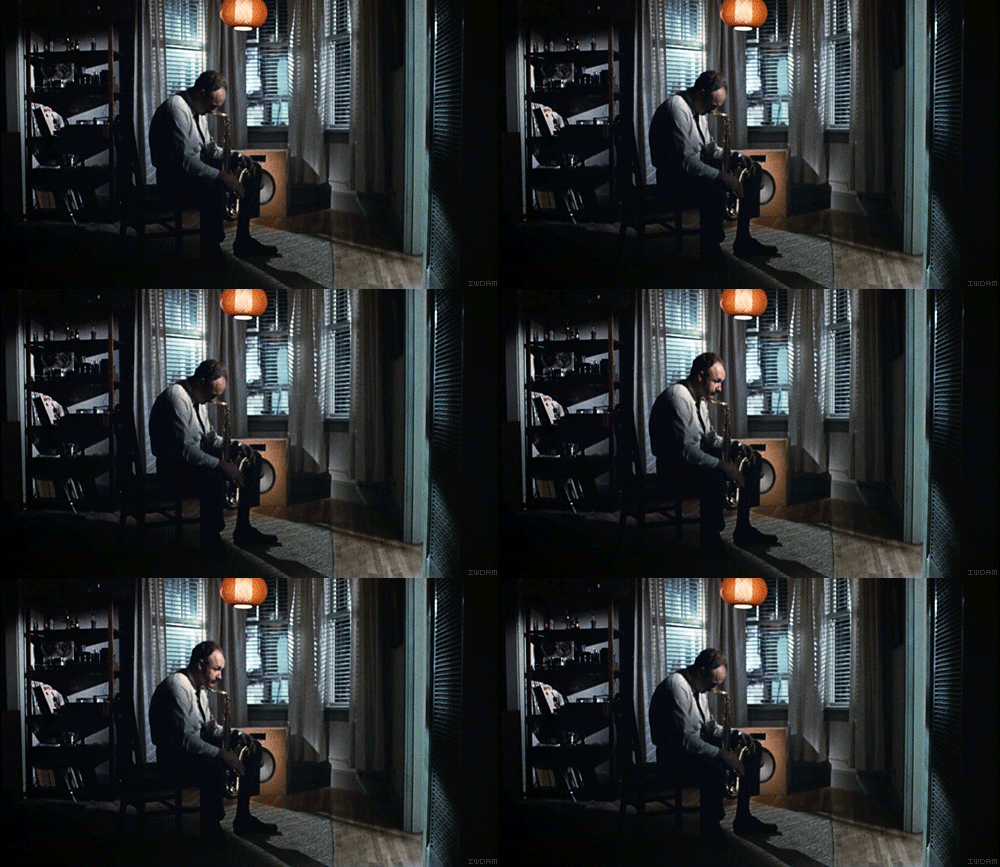
The Deer Hunter

The Deer Hunter (Michael Cimino, 1978) The Oscars are coming up and, with it, so many posts on Social Media about what "The Oscars Got Wrong." We all have our opinions, and mine is just as valuable (or worthless, in my mind) as anybody else's whose wasting their time reliving the past in an alternate universe where THEIR movie (well, not theirs, but their PREFERRED movie) might have taken home the Oscar for Best Picture—as if that were the arbiter of value. Time is the more deciding factor, away from the campaigning, the parties and the pressures of voting.*

After so many years since its release, and so much acclaim (including winning the 1979 Best Picture Oscar**) as an acknowledged "classic," The Deer Hunter does not seem to have the sustaining power that a classic should have. When it aired on television, it aired reverently uncut and "without commercial interruption"—a sign of "respect" from the tube-jockeys (but it could also indicate a lack of sponsor-spine enough to commit) and as much as I "enjoyed" the film when it came out, finding it "deep" and "meaningful" when I first saw it in theaters, I still have to ask, though, "What in the Hell is it trying to say?"

Or is it actually trying to say anything?
The story of five working class guys from Pittsburgh, and their rituals—marriage, hunting, country—becomes shattered when three of them enlist to go fight in Vietnam and find themselves (in a highly unlikely but dramatically convenient scenario) all prisoners of war in the same North Vietnamese prison camp, where ritualized torture by a daily game of Russian roulette among the prisoners is the order of the day, while their captors bet on the survivor. It's a rather stupid way of torturing your prisoners—giving them a loaded weapon, after all—and it eventually does become a means of escape back to America, where, when they return, nothing is the same, and despite the heroic efforts of one of them (Robert De Niro), things can't go back to the way they were.
Okay. It's a movie "in the tradition" of The Best Years of Our Lives—another "Best Picture"-winner—but, where William Wyler's film takes a real look at the issues facing the returning soldier at the end of World War II—unemployment, disability, PTSD, the lack of discipline and rigor in American life—The Deer Hunter merely takes on the attitude of "that's the way it goes..." and goes ritually, as everybody else gets on with the day-to-day, damaged (as the country was damaged).
The reason might be in its origins; where Wyler was determined to tell a story about returning soldiers and the crises they faced, Vietnam didn't even figure into the screenplay the way it was first envisioned. It started out as a story ("The Man Who Came to Play") about four guys going to Vegas and participating in a game of Russian Roulette. That was the original treatment. Once Michael Cimino and scenarist Deric Washburn got hold of it, it became a treatise on comradeship (and exclusively male comradeship one should point out), war, and self-destruction. 
And patriotism. Or...something. And, again, I think it has something to do with how ritual sustains us and numbs us, simultaneously. But, the screenplay went through so many revisions—and was basically re-written on-set—it's hard to say if anything about it had a solid structure or philosophy. At one point, Cimino wanted to cut out the Russian roulette aspect of it (until he was begged not to by one of the original scenarists). And characters were switched around. Originally, it was the pragmatic Mike—the De Niro character—who stayed in Vietnam, endlessly playing Russian roulette (which makes sense given it was his mental will power and tenacity that got the others through the ritualized torture, and his philosophy of "one shot" would seem to be the mantra of the man for whom hunting was a personal test).
The film, as it stands, focuses on a trio of Pennsylvania steelworkers—Mike Vronsky (De Niro), Nick Chevotarevich (Christopher Walken) and Steven Pushkov (John Savage)—and their friends Stan (John Cazale), Axel (non-actor Chuck Aspegren, a steelworker who'd befriended De Niro and Walken) and John (George Dzundza), who runs a local bar. Mike, Nick, and Steven are all going into the military, but before they do, they have two big events to attend: the marriage of Steven to Angela (Rutanya Alda) and one last weekend hunting trip. During the wedding it is established that both Mike and Nick love the same woman, Linda (Meryl Streep), but at the wedding Nick asks her to marry him when he gets home. Also, Nick promises Mike to bring him back home if something happens to him in Vietnam. 
During the hunting trip (Steven does not attend due to his honeymoon), Mike and Nick leave the others behind—Mike is annoyed that Stan and Axel are unprepared and a little drunk—to hunt a deer. Mike has rules: it is his intention to take down a stag with one shot. If he can't, it shows a lack of discipline and intent and he tells Nick that he is the only one of the party who would understand that and so is the only one he will go hunting with. Mike manages to take down a buck and the group drive into town, triumphant.
In Vietnam, Mike, Nick and Steven are captured by the North Vietnamese and thrown in a river prison camp. During the day, they are taken out by their captors and, for their amusement, made to play Russian Roulette. Steven is very nearly killed and Mike, with Nick, fearing that Steven has had a complete breakdown, decide they will use the torture as a means to escape. They increase the betting odds by convincing the NVN of putting three bullets in the gaming pistol. And, once the odds of getting a live chamber on the first fire are good, Mike turns the pistol on his captors and the three make their escape.
The three are separated: Steven with two broken legs from the escape attempt is sent to hospital, Nick is having trouble coping with the stress and one night is seen by Mike at a gambling den where Russian roulette is played. Mike finally gets home, avoids a welcome home party and is told the next day by Linda that Nick has gone AWOL. Steven is in a local VA hospital, a paraplegic, his wife is catatonic. Mike visits Steven and insists he go home and is also told that Steven is being sent money from Saigon. Being the benefactor to be Nick, Mike travels back to Vietnam to find his friend and fulfill his promise.
The performances in this 3 hour film are strong, despite the thin material. De Niro's performance is magnetic, despite being ultimately unknowable, Walken's is heart-breaking, Streep's performance, in a role that was underwritten and that she ultimately had to fill in herself, is strong, and Dzundza's (in his first film performance of any consequence) is full of heart and verve. It is John Cazale's last film performance before his death and another bold depiction of weakness. If the performances in the film are strong, so, too, are the cinematography of Vilmos Zsigmond, and the detailed editing by Peter Zinner (with an uncredited assist from the rigorous Verna Fields).

Those aspects, and the time in which the film was released (1978, three years after the war officially ended) allowed it to "play" to American audiences, providing a catharsis for the soul-splitting war that had deeply affected the country, with its emphasis less on the war, but its aftermath, something not seen in previous Vietnam-themed films that year, like Go Tell the Spartans and The Boys in Company C and far afield of earlier films like The Green Berets, and without the political baggage of Coming Home, which followed it in theaters. Most Americans could not relate to what was going on in the war, wanted to avoid it (and Hollywood was economically leery of depicting it), and by centering it in the homeland, allowed it to touch hearts, as we all relate to weddings and funerals...and less to jungle-warfare.
And we relate to patriotism. Although, I think the film's coda, with an awkward end-singing of "God Bless America"—although it may seem to mean something—is just as significant as the sing-along to "Can't Take My Eyes Off of You." 

And I mean that. It's not the subject of the song so much as the group-think that goes along with the blending of voices. We've seen a fracturing...of the country...of friendships...of marriages...of lives. But we can still come together...if only with platitudes. And easy touchstones. It's comfort. It's expected. It's ritual.
But, does it mean anything? Perhaps Cimino attempts to give us the answer when he has Michael say to Stan: "This is this." Take it for what it is. It doesn't have to mean anything. It simply is. But...that's not good enough.  
So, okay, then. Forty years (Good Lord!) after the fact. The Deer Hunter. Beautifully shot. Beautifully acted. But ultimately hollow. Stare at the trappings all you like. Heap on your belief-systems and your graspings for significance, like the many awards it garnered, until that is what it is known for. But, "this is this" says nothing—The Deer Hunter is as desperate in searching for meaning as the times in which it was made...and comes up missing the mark.

It isn't so much vogue as vague; it is non-communication posing as artistry. 
"One Shot..."


* Believe me, there is pressure—I used to vote for the Emmy's and the deluge of material (that I felt duty-bound to watch) and the voting by deadline was a headache. Plus, you'd look at the list of nominees and sometimes say to yourself "I didn't like any of those!" And you'd have to vote. Eventually, I just got sick of it and stopped doing it.

** In those days when the Best Picture category was relegated to only five nominees The Deer Hunter competed against Coming Home, Midnight Express, Heaven Can Wait, and An Unmarried Woman. Other films nominated that year—but not for Best Picture—included Superman, Interiors, Days of Heaven, The Wiz, The Boys from Brazil, Grease, California Suite and The Buddy Holly Story. Other films released included National Lampoon's Animal House, Comes a Horseman, Jaws 2, Capricorn One, Billy Wilder's Fedora, Robert Altman's A Wedding, Every Which Way But Loose, and the original Halloween.

Thursday, January 11, 2018

Olde Review: The Conversation

This was part of a series of reviews of the ASUW Film series back in the '70's. Except for some punctuation, I haven't changed anything from the way it was presented, giving the snarky, clueless kid I was back in the '70's a break. Any stray thoughts and updates I've included with the inevitable asterisked post-scripts.

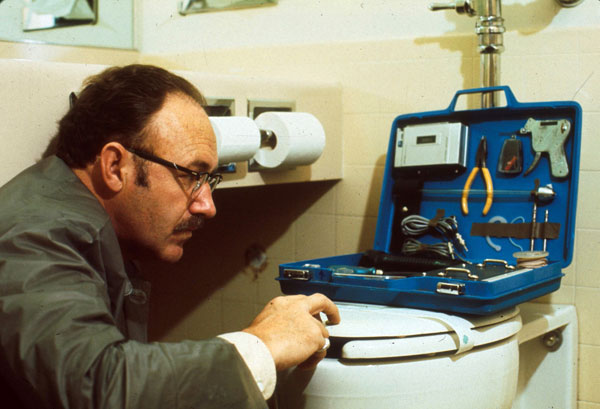
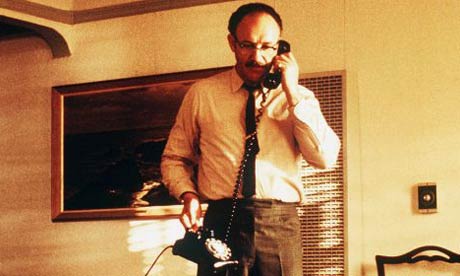
The Conversation (Francis Ford Coppola, 1975) Harry Caul (Gene Hackman) is an electronics expert dealing in surveillance. His latest assignment is to record a conversation between two very innocent young people in the park. It's a routine assignment, one that Harry handles with a perfectionist's care. But after he has the raw tape—after he has clarified it and re-channeled it—he hears a whispered fear that these two kids may get killed by Harry's employer. Old haunts plague Harry—past assignments he has carried out that led to his victim's deaths. And so he goes to confession to confess what may be a future sin. Confession—where one's private actions that are considered to be sins are revealed to a priest in order to free the sinner of guilt. But this too, is a surveillance—an invasion of one's privacy—ritualized in the name of religion. Surveillance is a part of our lives, then. And privacy is an illusion.

That scene in the confessional is about as close as
Francis Ford Coppola comes to really dealing with surveillance in his film, The Conversation. Despite what many critics have said, Coppola makes no judgements on this subject. Surveillance is simply there as a device to be used for the movie. It's neither good nor bad. It's there to provide Coppola with a means of getting into a rather shallow appearances-are-deceiving mystery story—it's a very weak imitation of Antonioni's BlowupWhen Harry Caul is caught in a surveillance trap ala his own devising, are we supposed to feel some satisfaction in this? Just because he's getting screwed, like he screwed all the others? Is surveillance justified in retribution, in other words? No. How can we take satisfaction in that? For surveillance — the ripping open of one's privacy — is being used, and nothing, really, not even revenge should make us condone it.
Awright, already, W______is it a good movie?


Okay, okay. Yeah, it's a good movie. It's...entertaining, in a shock-lull-shock-lull sort of way. Coppola has made a good movie, despite my reservations as to his morality on the subject. It's an o-k script—a little spare at times—with a lot of loose ends, and his direction is always assured. Gene Hackman manages to flesh out Harry Caul enough to make him an interesting person to watch for the couple of hours we do. And there is fine supporting acting from
Allen Garfield, John Cazale (the weak brother, Fredo, in The Godfather), Frederic Forrest, Cindy Williams (she's good, despite the fact that she's totally mis-cast) and Robert Duvall (who is on for a very short time and doesn't receive a credit). But, the one thing that is technically outstanding is the sound of the film, produced by the work of its chief editor Walter Murch. Murch also worked on "The Godfathers" for Coppola, and creating what he terms "sound montages" for George Lucas' THX-1138 and American Graffiti. His talents with editing and sound mixing are outstanding,and hopefully Murch will, himself, be directing his own films.

Broadcast on KCMU-FM on January 27-28th, 1976


Murch would, indeed, direct one film (so far)—Return to Oz, in 1985—and it tanked. His intention was to make a genuine adaptation of one of L. Frank Baum's "Oz" books, rather than what the public was expecting—a sequel to the 1939 classic The Wizard of Oz. And his heart-felt, but scary, recreation of Baum's world didn't click with audiences. One would be sad if Murch didn't then personally supervise the entire post-production process of about one film per year. Films like Julia, The Godfather: Part III, Romeo Is Bleeding, The Unbearable Lightness of Being, Ghost, The English PatientFirst Knight, The Talented Mr. Ripley, K-19: The Widowmaker, Cold MountainJarhead, and Francis Coppola's latest films. Busy guy. Eclectic talent.


This movie has dogged me my entire career, because it was assumed that, because Harry Caul could electronically filter out steel drums from the background of a murmured recording enough for you to hear what the people were saying that any sound facility could do it, too. No. Not really, you can't. You can tune, you can attenuate, you can try reversing the polarity of a channel to eliminate shared sounds on both channels of a stereo recording, but steel drums? That's a good one. They call that "Movie Magic."
But the kid is right...this is warmed-over Blow-up without the illusion of film-making, or illusion of illusion that makes that film so compelling. At least it's better than cold, left-over Blow-Up like Brian De Palma's Blow OUT (in that, field-audio recorder John Travolta must piece together a Chappaquidick-like incident from his sound-recordings and pictures taken from a "Zapruder"-like film--it doesn't pass the incredulity test). And Coppola has to resort to a "cheat"—he changes the actual recording, the one element in the movie that has to be set in stone, to come up with his conclusions. One could make a case...blah blah blah, the fact is, interpretation or not, he planted a card in the deck.

It is, though, a really good paranoid thriller of the type that seemed to be born of the post-Watergate era. And Hackman's insulated Caul is another example of how that actor can take an under-written part (deliberately, I should say--Caul doesn't talk much on purpose) and make him a living, breathing human being you can recognize and, despite his many failings, sympathize with. There is one actor I didn't mention because I didn't really know who he was...yet. He'd made a living doing parts on television, and done a small role in American Graffiti, but after this film he was about to quit acting and go back to carpentry when a role in a sci-fi movie by Coppola's pal George Lucas changed things for him. Harrison Ford has a small role as "The Director's" menacing assistant.

Oh...the reason I made such a big deal of the confessional scene? I used that to start off the recorded version of this review.

In 1995, The Conversation was chosen to be a part of the National Film Registry by the Library of Congress seeing it as "culturally, historically, or aesthetically significant."