Showing posts with label Gerrit Graham. Show all posts

Wednesday, October 25, 2023

Olde Review: Phantom of the Paradise

This was part of a series of reviews of the ASUW Film series back in the '70's. Except for some punctuation, I haven't changed anything from the way it was presented, giving the kid I was back in the '70's a bit of a break. Any stray thoughts and updates I've included with the inevitable asterisked post-scripts. 
 
Phantom of the Paradise (Brian De Palma, 1974) Too few people know about Brian De Palma's Phantom of the Paradise. Too few people know about Brian DePalma. He is one of the best of the young, young crop of film-makers—the under-30 branch*—and he is quite taken with great directors of the past and their great movies. And so, very often, he will borrow a scene from these directors.

Foremost among the borrowees is Alfred Hitchcock. In fact, De Palma has made two films almost totally Hitchcockian: 1973's Sisters,
** and this year's Obsession.*** Phantom of the Paradise came between them, and although it lacks the total Hitchcock commitment, and the many beauties that commitment brought about in Obsession, The Phantom is an altogether enjoyable musical-comedy/horror-satire about the rock industry (kinda whets your interest, doesn't it?) It takes the old "Phantom of the Opera" story into the 20th Century glitter-rock scene, as a young man (William Finley) disappointed in love and betrayed by a rock entrepreneur named Swan (Paul Williams)****, finds himself deformed and deranged, haunting Swan's Paradise Rock Emporium.
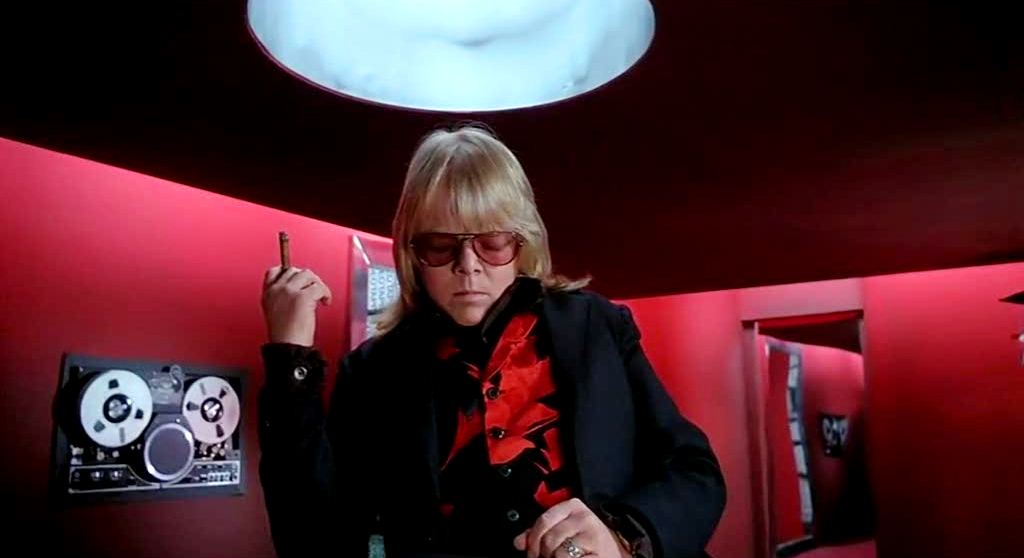
Swan is played by Paul Williams, and before you make some expectorating noises, I should say he is properly sinister and comic in the role. He also wrote the songs for the film's exemplary score, which covers a variety of rock-styles, none of which sinks to his regular lonely-introspection fare.
William Finley, who played a mad doctor in Sisters plays the deranged "Phantom," and
Jessica Harper,
***** who with Diane Keaton participated in the send-up of Bergman's Persona in Woody Allen's Love and Death (see how all these films tie together?), portrays a young and naive innocent who wants to be a "star(!!)" As Obsession borrowed from almost all its ideas from different Hitchcock films, Phantom borrows a lot of plots from success-stories of the past, and incidental scenes from The Godfather, White Heat, and Psycho. But De Palma manages to make this pastiche of film totally his own and in a perverse way, totally enjoyable. Go see it. You may just become a Brian De Palma fan.******

Next weekend, The ASUW film series devotes itself to "The Thriller" as interpreted by such cinema staples as W.S. Van Dyke, Bernardo Bertolucci, Roman Polanski, and Lina Wertmuller.******* 
 
Broadcast on KCMU-FM on November 5th and 6th, 1975

Man, I was a big Brian De Palma fan back in those day. Fortunately, he rarely disappointed with his movies. Oh, there are the duds in his CV--The Fury, Home Movies (which he did with a class he was teaching), Wise Guys, The Bonfire of the Vanities (compromised by studio and De Palman cold-feet), and he would grow out of his "Hitchcock" obsession of the 1970's, and just sneak some of the Master's craft into his pictures (like Dressed to Kill, Blow Out, Body Double, Mission: Impossible, Femme Fatale, and Snake Eyes). He is still a fine film-maker, who pushes the envelope as far as subject matter and technique. His most recent film--Redacted--was a raging film against the Iraq War that scared its distributor into quietly burying it in theaters (it opened locally at The Crest, usually the last stop before video). As of this writing, his next film is a long-in-the-works prequel to his very popular version of The Untouchables--written by playwright David Rabe this time, instead of playwright David Mamet.
But enough about De Palma! What about Phantom of the Paradise? I have fond memories of it, and was impressed with the soundtrack—Williams did some wicked parodies of song-styles that scored satiric points as well as the film. It was inevitable that someone would take the era of Glam Rock and mix it with Gothic Horror. 
Across the pond, Richard Sherman's Rocky Horror Show opened on stage in June 1973, and it's not inconceivable that De Palma might have heard of it. But Phantom is rooted in "Faust" and "The Phantom of the Opera," while "Rocky Horror" takes its cue from the RKO horror films and Frankenstein, and, more importantly, The Bride of Frankenstein. The fact that both came out on the tails of the "Glam" era were the big influences, with Rocky being its step-child, and Phantom using it for texture—and Phantom is more concerned with the phony excesses of the music biz, while Rocky embraces them.
One could make the case that Phantom was influenced by Rocky Horror, but the timing's way off—Rocky Horror wasn't that huge a hit at the time of Phantom's creation (right after De Palma directed Carrie) and wouldn't be filmed until a year later. So, though they have the same roots, any resemblance is a very specious one.

* DePalma is now 67.

** After Psycho.

*** After Vertigo.

****No, really, he's good. Very good. So are the songs he composed for the film.

*****For awhile, Jessica Harper seemed to be in every good movie that came out, and a few bad ones, too. She's still acting, but she's doing more singing and writing for kids. Her last movie role to date was in
Spielberg's Minority Report.

 ****** Just don't go see Bonfire of the Vanities after it...

******* Those would be The Thin Man, Chinatown, and The Conformist. The Vertmüller film was Love and Anarchy, which I'll re-post once we get October Hallowe'en out of our systems.

The View from 2023: No more asterisks (I really over-did it on this one), but let's update a few things that were in the original and in the re-review. DePalma is now 83. He has two movies currently in development, but not that Untouchables Prequel—which was titled Capone Rising, it is in development Hell. Jessica Harper (bless her heart) is still acting.

Wednesday, June 28, 2023

Hi, Mom!

Hi, Mom! (Brian De Palma, 1970) Second full-length film (although it seems more a comedy pastiche in final form, like the Zucker Brothers were making at the time) that De  Palma and his producing buddy Charles Hirsch cooked up, seemingly as a sequel of sorts to Greetings (retaining Robert De Niro and his "character" John Rubin), while having absolutely nothing to do with that first film.  

Ostensibly about a young film-maker who wants to make "peep-show art" out of filming the real lives of his neighbors in the co-op across the street—shades (opened, naturally) of Rear Windowit meanders into Rubin's plotting a relationship with one of his subjects (Jennifer Salt), while at the same time becoming involved in an experimental theater group, staging a radical audience participation vehicle called "Be Black, Baby!"

That last segment may actually be one of the first "mockumentaries."
Mean-spirited (but in a smart way), with that stagey kind of improv quality to it that only works 40% of the time, it feels like De Palma taking off the gloves, cracking his knuckles and using his camera like a fist against complacency. It also has that bi-partisan cynicism to it that's very refreshing—for instance, "Be Black, Baby!" is shown being presented (in grainy black and white on a rounded edge square screen) over a parody of NET,* now called NIT—National Intellectual Television. It's a chortling, vicious piece of satire done in multi-parts (with the Rubin segments interrupting and becoming more and more inconsequential, the "peep-art-show" concept having long been abandoned**), starting with citizens being accosted on the street about their failure to know what it means "to be black in America," then more segments that are less cinema verité, but have a good improv feel, and then the actual presentation of the play in which privileged whites are challenged, force-fed "soul" food, beaten, robbed and arrested (with one attempted rape thrown in for good measure), before being released to the outside world again—"Hope you enjoyed the show!"—at which point, they're interviewed about their experience (the best line in the whole thing is "Clive Barnes was right!"). In one swell foop, art, pretentiousness, and "touchy-feely" moccassin-walking are given the mau-mau, and come up wanting.
It's "bad-kid movie-making" with a smart-alecky breeziness ("Hi, Mom!") that beats any number of elaborately formal set-pieces that De Palma has subsequently staged. One misses this "turk" De Palma
***—the one that would do things that upset audiences, and sit back, cigar in his teeth, saying "Wait'll you see the next one!" Maybe it's not De Palma's fault. Maybe we've just become insensitive enough that nothing he can produce shocks us anymore.


If that's true, imagine how miserable Hitchcock would be.

* The percursor to PBS.

** The best segment in the Rubin sandwiching sequences is one where he meticulously plans a seduction of Betty Shaefer—Salt's character—in order for him to film it—yes, a sick idea, but quaint in these days of "sex-tapes".  But, things go awry when he arrives at the apartment and she tries to pull him into bed immediately, while he does his best to keep anything from happening, a lovely little turn on sexual roles, expectations, and how much power a director "actually" has. De Niro does his best work here, hemming and hawing and making excuses, constantly glancing at his watch and re-buttoning every shirt-button she's unbuttoned,  and trying to use any of his by-now useless preparations in order to delay, delay, delay (you might say "the worst laid plans")

*** And he might, too.  In an interview, the director has said that the "Be Black, Baby" segments of Hi, Mom! are the best thing he's ever done.  Sad to think that, after all his successes, the elder De Palma looks back and sees this edgy, slap-dash sequence as the epitome of his career. But...if one is dissatisfied with one is doing, with all the compromises and concessions to getting a picture made and marketed, it's easy to look back on the brash days and say "That's when I had the freedom to do anything I wanted!" After the bludgeoning De Palma's films of The Bonfire of the Vanities and Redacted took, one can see that a bit more clearly.  He could make that kind of film today. But, the market...and the critical elite...will bash it down.