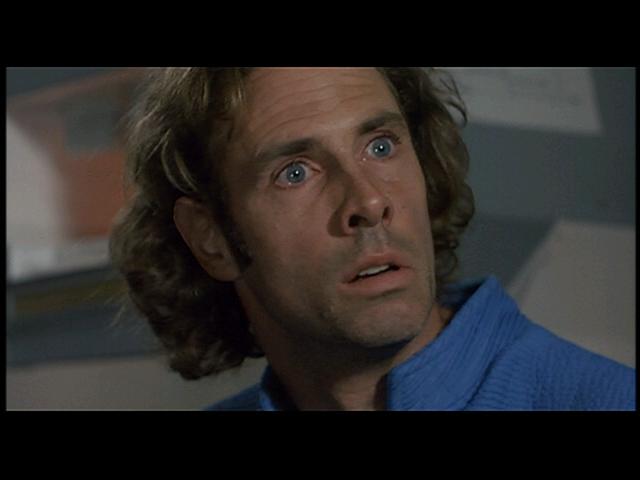
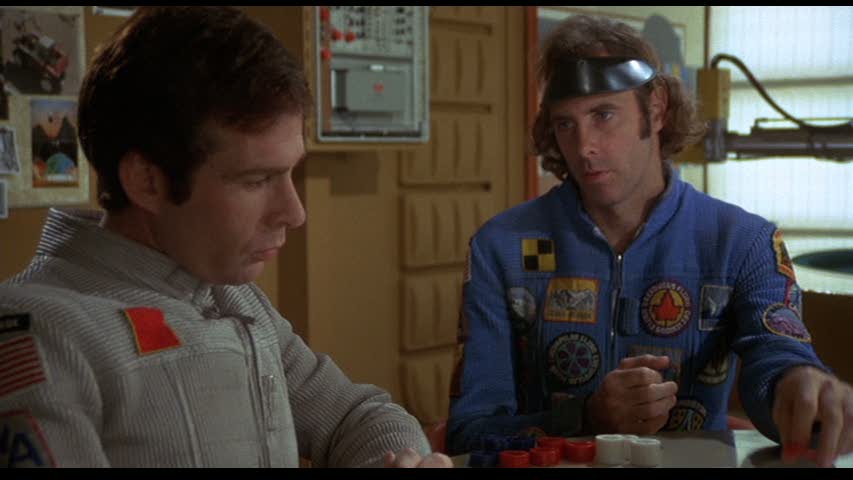
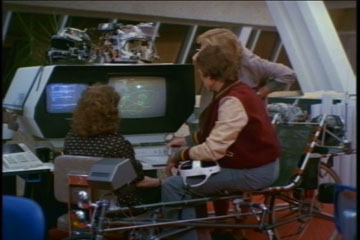
Silent Running(Douglas Trumbull, 1972) In the years before Star Wars, science fiction films were few and far between, even after the space-jump that had been accomplished with the film 2001: a Space Odyssey. Oh, there were a couple here and there—not counting the low-budget exploitation ones—and it seems I saw just about all of them. In 1972, though, one came out that combined concerns of both Earth and space in one earnest little package. Silent Running postulates a world so over-populated that the planet becomes overrun with cities, the flora (and some fauna) are rocketed into space in hot-house festooned transports until such a time that the Earth can find space for them again.
Questions immediately come up: no room for vegetation, eh? Where does the planet get its oxygen? It's phyto-plankton? It seems that if you take vegetation out of the equation that the Earth's food pyramid will pretty much collapse in on itself, and with it, the human population who are subsisting on...what?...space food sticks? Soylent green?
Things quickly go to seed when word comes up from Mission Control that Earth doesn't give a rip anymore—budget cuts or some such—so they should just jettison the space-green-houses, blow 'em up, and return home. Rather than commit planticide, Lowell chooses, instead to go all-PETA and decide that his fellow agro-nauts' best function would be as fertlizer. A bit extreme, maybe, but we are talking about Bruce Dern here. And, to hide his crimes, he sends the ship into a collision course with Saturn's rings to try and convince Mission Control the ship will be destroyed. However, pesky-persistent techies that they are, NASA manages to find him, and Lowell must come up with a way of saving the plants and allaying any suspicions.
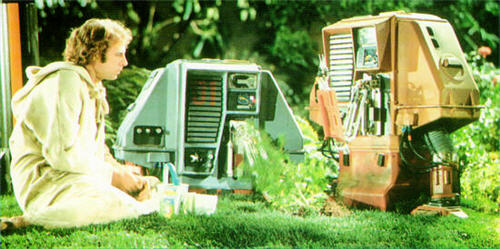
In Silent Running, Trumbull managed to make an ecological low budget sci-fi film, with illusion work that rivaled 2001—he even managed to make a realistic looking Saturn, something that wasn't possible years before with the Kubrick film. His robots were strange little non-humanoids forms that suggested walking amplifiers, and the story (and Dern's acting) makes them sympathetic little synth's. The ships designed for Silent Running were subsequently used for stock footage for years in such shows as "Battlestar Galactica" and Trumbull's considerable work served to influence the look and techniques that would be applied in Star Wars.*
Though Silent Running is not the greatest of films, it is not through lack of trying, as director, star and art team stretch their budget impressively and play it for all the drama it's worth. But the story is a little skimpy, the protagonist a bit bi-polar, and the conclusion not exactly rousing. A good study in movie-making, if not necessarily story-telling.
Brainstorm(Douglas Trumbull, 1983) In this age of ever-present social media, it's hard to imagine that scientists and engineers and biologists might envision a life more intimate than what it already is. But they are, unlocking the secrets of the brain, leading to neural pathways controlling prosthetics. We're starting to see the markers in the brain for Alzheimer's, and hooking up devices to bring sight to the blind. New breakthroughs are becoming so matter-of-fact that the conversation wanders to the idea of sharing thoughts and experiences by direct link, which is considered semi-possible (even if you're not Elon Musk). And with exploration of virtual reality becoming more and more sophisticated, it is downright plausible. But what will that do to us? Sensations, sights, sure. But what of sharing thoughts? As it is, the brain is one of the great secret places; what would happen if we should unlock that Pandora's Box, and we have no more place to hide? Would it make us better people, or worse. Would the safety of our Dr. Jekyll's stand the scrutiny of our hidden Mr. Hyde's.
Special effects wizard Douglas Trumbull, who directed Brainstorm, (one of the just two feature length films he made, the other being Silent Running, concentrating his energies on technological advancements) uses that as the basis for this film and somewhat sidetracks the implications of such a device for a direction that is for more ethereal and mind-blowing (and personal for the main character), while also giving him a chance to do a third act special effects tour de force.
But, as the project becomes more sophisticated and the potential expanded, the power of the device becomes increasingly invasive—emotions are transferred, sensations communicated, not just in the reality of perception, but in the stored interpretation, as well. Nightmares can be communicated and transferred. Thus, hard-wired, they can experience another person's recorded memories, thoughts...even emotions...more real than real, with the exception that they're not yours.
For the investors, the value of the brain-scans is obvious—weaponize it. The military could find all sorts of uses for just such a technology (but how are you going to get enemy troops to put on the receivers, geniuses?) Beyond training and communication and some invasive interrogation possibilities, the uses of such a device seem limited, fulfilling only the latter half of "the winning of hearts and minds."
The possibilities soon move beyond precipitous roller-coaster rides and flights over the Grand Canyon, as the scientists do their own beta-testing on themselves. For Brace, it renewshis memories of the first blush of romance with his ignored-for-science wife, Karen(Wood, whose character's job is tostreamline the helmetfor consumerFahrvergnügen).
Everybody who's seen the film remembers this sequence, but I'm including it to boost internet hits.
For another of the researchers, it's straight to sex (The "go-to" place for all new technology among civilians), causing him to suffer a breakdown when he splices an endless loop of "the little death" (Buddy, like they say in the ads, if it lasts more than four hours, call your doctor!), and in the ultimate trip, Reynolds, rather than dial 9-1-1, has the wherewithal to turn on the machine and record her death experiences while suffering a fatal heart attack.
Fletcher's Reynolds shares an out-of-body experience.
That last tape becomes an obsession forWalken's Brace,risking everything to take that journeywith the proviso that he has an "Off" switch for The White Light—a Cosmic Clapper if you will—while everybody else in the company (and seemingly the world) is trying to stop him. For the writers, it's a chance to create a redemptive character arc for Walken's driven Brace, to go beyond his own obsessive drive to complete the work and literally get inside somebody else's head to the Undiscovered Country. For director Trumbull the techie, it's an opportunity to pull out all the FX stops with journeys through memory bubbles, a Boschian vision of Hell, and a slit-scan trip down Heaven's main thoroughfare, complete with angelic Hosts.
Quite the show. But, in its attempts to present its Stairway to Heaven, the art design gets a little busy and too specific in its architecture, while making the actual journey a bit disorienting (for instance, was the trip through a simulated Hell necessary?). It's a bit too high-tech for its own good, as beautiful as it is, for a process that's as old as life itself and seems a little fussy in its side-tracks. Taken in context with the more teasing glimpse of the afterlife afforded by, say, Hereafter, it might be too much of a God Thing.
Presentation is of primary importance to the film, seeing how it is experimenting with themes and film formats—the dramatic scenes are shot a fairly normal (for the time) 35mm with an aspect ratio of 1.7 to 1 while the "machine-scan" segments are shot in Super-Panavision 70 with a widescreen aspect of 2.2 to 1.* Usually films taking on that scheme of things, come off a little cutesy (see More American Graffiti), or have all the charm of a demonstration disc. But, inBrainstorm, the jarring transitions seem necessary, dramatically proper, and perfectly suited to what's happening on-screen.
As ambitious as all of this was, the film never found an audience. Brainstorm has always seemed snake-bit for one reason or another...and unfairly, I think. It is notorious for beingNatalie Wood's last film, as she died in a midnight boating accident during the filming, an event that has always had an element of the unknowable about it. No one knows why she rowed away from her boat in the middle of the night, making it the subject of gossipy speculation, and thus, irrelevant to the film, even as it overshadows it. Some of her scenes went un-filmed, but the majority of her work made it to the finished movie, and there are no continuity bumps noticeable from her absence. But the event did cast a pall over the film, probably to its detriment, as Death is already one of the film's major players.
But there's another reason it's unlucky. It premiered at the dawn of home-video, and if ever there was a film that needed to be seen full-screen in a roadshow presentation, it is Brainstorm. I had the happy occasion to see it at a press preview where it was one of the attractions that would be demonstrating the wide screen glory of the new Grand Cinemas Alderwood, north of Seattle, which, bucking the then-trend of cracker-box multiplexes, were built large in scope and multi-channeled in sound to take advantage of the post-Star Wars spectaculars that were starting to flood theaters, after the previously timid response of the studios to large format fare. The Grand was the perfect place to see it large enough to encompass the full-width of the big-screen sections, but intimate enough to keep you from feeling cheated when the smaller format drama scenes took precedence.
And that was something home-video and cable screenings never could duplicate—the awesome transitions from the scenes of scientists and technicians toiling over the wires and ramifications of their brainwave recorder to the hyper-dimensionality of the gizmo's playback in action. For that is the crux around which the film and its unique formatting revolves.
During the film's initial release on home-video (VHS and BETA), that format juggling was completely abandoned...AND, as was the practice of the time, the film was presented full-screen ("formatted to fit your television screen"), which completely nullified the work Trumbull did to separate the two realities. It wasn't until the advent of DVD's and the trend away from full-frame to widescreen format (the better to fit on your new widescreen television) that people finally saw what all the fuss was about. Further improvements were made when the film was "remastered"
For Trumbull, the experience of making the film under compromised conditions and the death of Natalie Wood during the filming (which delayed the completion of the film and its release two years later), left a personal mark—he has vowed to never make another Hollywood film again.
Douglas Trumbull died in 2022.
The machine's test-pattern.
* Trumbull originally wanted to shoot the "machine'scan" images in his patented "Showscan" format, which used 70mm film recorded at a speed of 60 frames per second, rather than the usual 24 fps. The film's distributor, M-G-M, probably considered the cost and logistical nightmare of supplying theaters with all new equipment and asked Trumbull to compromise, although his original conceit that the "scan" images look more realistic the dramatic scenes is still fairly-well communicated.
 Silent Running (Douglas Trumbull, 1972) In the years before Star Wars, science fiction films were few and far between, even after the space-jump that had been accomplished with the film 2001: a Space Odyssey. Oh, there were a couple here and there—not counting the low-budget exploitation ones—and it seems I saw just about all of them. In 1972, though, one came out that combined concerns of both Earth and space in one earnest little package. Silent Running postulates a world so over-populated that the planet becomes overrun with cities, the flora (and some fauna) are rocketed into space in hot-house festooned transports until such a time that the Earth can find space for them again.