The Last Man Standing
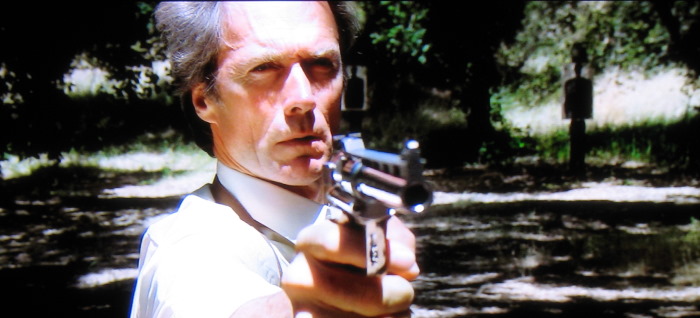
It is a typical image in the films of Clinton Eastwood, Jr., actor-director: one man facing a ring of guns trained on him, and through skill and sheer force of will (and quick editing) taking down their ranks until he is the last man standing. It is The Big Joke in the Sergio Leone horse operas* and the tradition continued when Eastwood or others held the directorial reins. In Joe Kidd, Eastwood drives a train through a building to get "the drop" on a bunch of targets. Don Siegel put a more realistic spin on it in his first Dirty Harry movie, making it a faster-paced urban assault, kin to the big shoot-out of High Noon, and Eastwood showed how the psychological element did the trick in his Oscar-winning "Best Picture," Unforgiven. Gran Torino, which, at the time, Eastwood said was his final acting bow, ended the conceit, showing that the trick only works in the movies (but not that particular movie) turning that confrontation into a sacrifice for the greater good.
There's one thing about the Eastwood style—economy. He rarely exceeds his scheduled shooting days or his budget, frequently saving his investors money. His crew is usually the same, although, typically, he has survived many of his frequent collaborators like the Surtees family of cinematographers, composer Jerry Fielding and his long-time production designer Henry Bumstead. His early films are full of flashy zooms, rack-focus tricks and other director star-turns, but he's lost those. In style, he became more like Don Siegel than Sergio Leone, with just a hint of Samuel Fuller—just cantankerous enough to irk people. But, on-set he's prepared, quiet, rarely directing his actors but collaborating with them, and rather than shouting a blustery "Action!" to start filming, he'll merely say "When you're ready." He's beloved by actors and he's worked with a lot of the best, winning them frequent awards, young and old. He is a throw-back to the business days of film-making, when art would come from challenges, rather than unlimited budgets full of waste. And with no intention of quitting making films, he's still standing, the last of his breed.
 Play Misty for Me (1971) Most directors cut their teeth on the horror genre. As an actor, Eastwood started out in Revenge of the Creature (1955). But as a director, he started with this homicidal maniac/slasher movie, about a stalker (Jessica Walter, hysterically over the top) who obsessively makes requests and makes demands on a jazz DJ (Eastwood) in sunny Carmel. Music has always been important to Eastwood, and here, he based an interminable montage around Roberta Flack's "The First Time Ever I Saw Your Face," (which subsequently became a huge hit, prompting as many requests to radio stations as Misty), and a long sequence done vérité style at the Monterey Jazz Festival. There is a cameo by friend and mentor Don Siegel, in case the lad got himself in trouble, but first-timer Eastwood brought it in on-time and under budget. Despite the jerks in pace, it's an interesting time-capsule of 70's soft-jazz California style, and as a thriller, more cunning and to the knife-point than the similar Fatal Attraction. It proved so popular to audiences that its distributor, Universal, despite their low expectations, had to extend runs of it to please theater owners.
 |
| Almost as a good luck talisman, Eastwood used his friend and director Don Siegel in his first movie. |
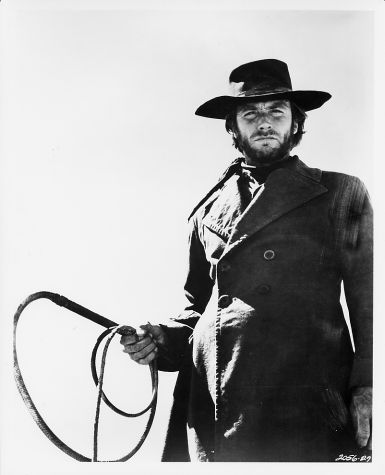
 High Plains Drifter(1973) If Play Misty for Me reminds one of Don Siegel's unpretentious directorial style, High Plains Drifter recalls Sergio Leone's formal and stylized spaghetti westerns that made Eastwood a star. Out of a simmering, shimmering desert landscape, a stranger "with no name" comes to town, and begins to disrupt things, going so far as to paint the town red...literally, taking pity on the small and disadvantaged, and killing or humiliating the ones who wield power.
 It's a revenge story, with just a shade of the spooky, as it's indicated The Stranger is the vengeful spirit of one of the town's lynching victims. The author was Ernest Tidyman, who was a "hot" screenwriter at the time having written both Shaft and the Academy Award-winning The French Connection.

 Breezy (1973) And now for something completely different. The story of a May-December romance between a 19 year old hippie Edith Alice "Breezy" Breezerman (Kay Lenz) and a middle aged real estate salesman (William Holden) was written by Play Misty For Me scribe Jo Heims, a friend of Eastwood's (and as Misty made a lot of money, the team was a good bet), and although it tries to feel "with it" it's basically an apologia for dirty old men. It gave Eastwood the director a chance to work with a big star and a great actor (and also Kay Lenz), without having to get in front of the camera himself, and he mercifully keeps it from getting too icky by photographing the love scenes in silhouette. One of those movies that hasn't aged well, mostly because the argot isn't as much of "a gas" as it used to be, and Lenz doesn't feel natural saying it. Holden, however, can mine gold from tin-ear dialogue. Eastwood's junior film has no action (although Lenz is very naked for a chunk of it), so it had no appeal for his loyal action audiences. And as a director, he makes a few missteps that the studio seems to have taken pains to correct—like a misaligned angle on Holden that was evidently blown up from a wider Eastwood shot. Despite the tinkering, the studio showed no confidence in it and dumped the film in theaters with little promotion (what there was merely accentuated Eastwood's role behind the scenes).** When the two characters go see a movie on a date, the movie they see is High Plains Drifter.
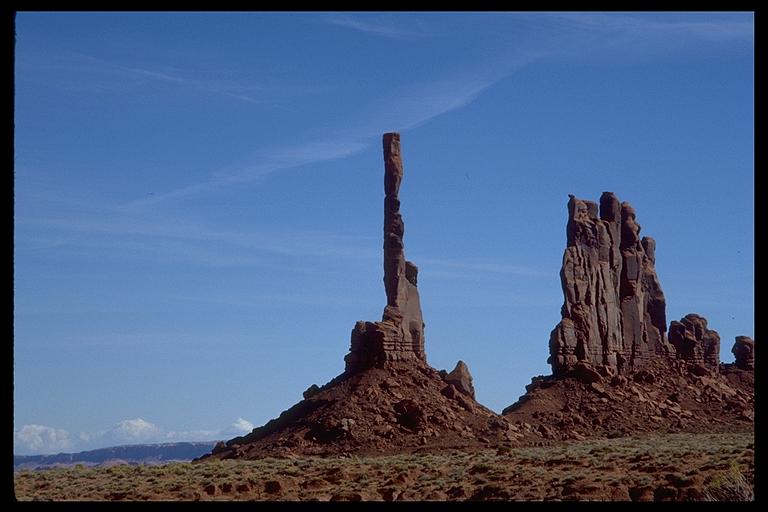
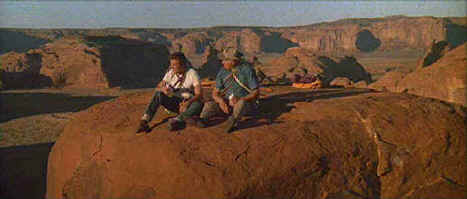
 The Eiger Sanction (1975) "Trevanian's"*** best-selling tongue-in-cheek spy novel was an odd choice for director Eastwood, but became one of necessity. Universal wanted him to star, but finding a director to ascend the Devil's spire in Monument Valley (where the training exercises were filmed) and the actual ascent of the Eiger was more problematic. But, just as he took over directing duties for Don Siegel in the ladder-truck rescue sequence of Dirty Harry, Eastwood did double-duty in the climbing sequences, making them even more impressive because it's obvious he is there and doing the stunts himself—something that couldn't be said for Sylvester Stallone and Tom Cruise when they made similar climbing moves. But, where Trevanian's humor is subtle and a little wise, it has all the panache of a sledge-hammer in the film. It's a particularly ugly exercise in stereotypes and subterfuge, that plays a bit more sluggishly on-screen. It would be Eastwood's last film directing for Universal, which, because it always seemed like a television studio masquerading as a film company, only humored their big star's ambitions. With its next film, Eastwood's production company, Malpaso would set up shop at Warner Brothers. Nice score by John Williams, written about the same time as his classic Oscar-winning score for Jaws.
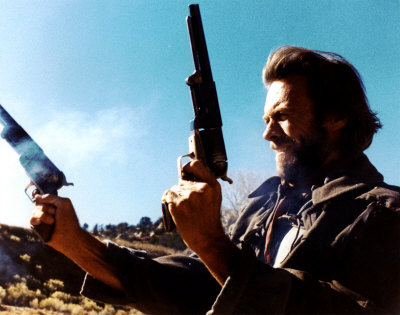
 The Outlaw Josey Wales (1976) Warner Brothers signed onto a Philip Kaufman film, but it was hi-jacked by Eastwood (his Malpaso Films production company was paying for it, anyway), and Eastwood might have seen the potential to control a truly good film. The story of a Civil War berserker warrior out for revenge against the Union Army that slaughtered his family starts out as your standard "dig two graves" story (albeit against Union troops and allying with threatened Natives) and turns into an odd story of one man's rejuvenation, as he finds himself, through no fault of his own—and certainly not for trying—becoming the patriarch of an odd new family of outcasts and victims. One of the two films (the other being Little Big Man) where Chief Dan George's odd combination of Native dignity and comic straight-man's timing made an indelible portrait far beyond Hollywood stereotyping. First movie with Sondra Locke, who would, with this film become a part of the Eastwood Stock Company (along with Bill McKinney and, later, Geoffrey Lewis). Eastwood starts out with some fancy rack-focus shots, but settles down and keeps the story...and the juggling between dead-pan comedy and ruthless action...moving amazingly smoothly. Eastwood's favorite film of his.
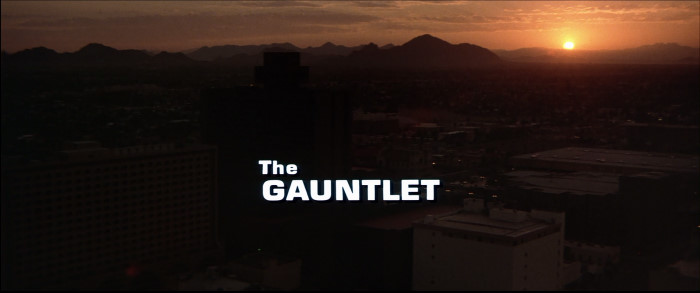
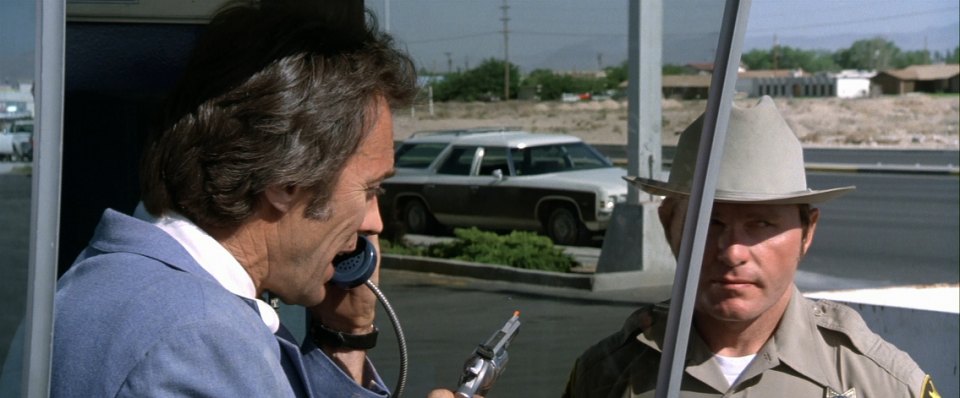
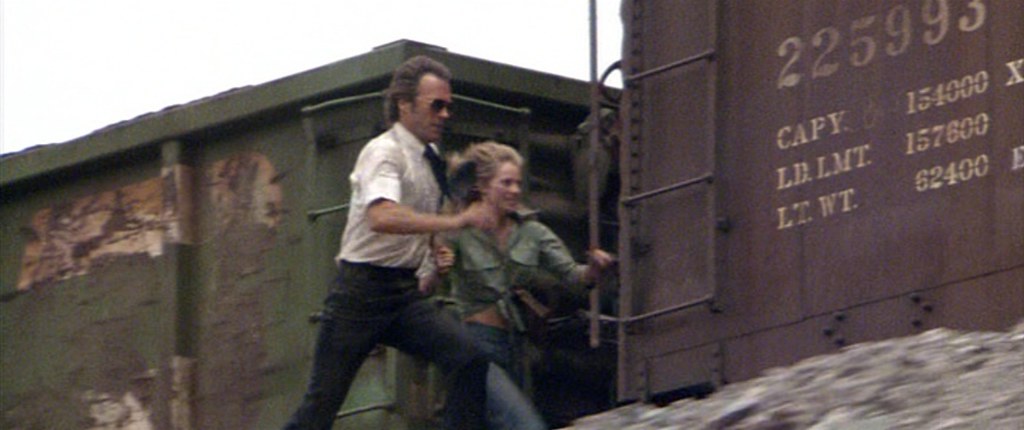
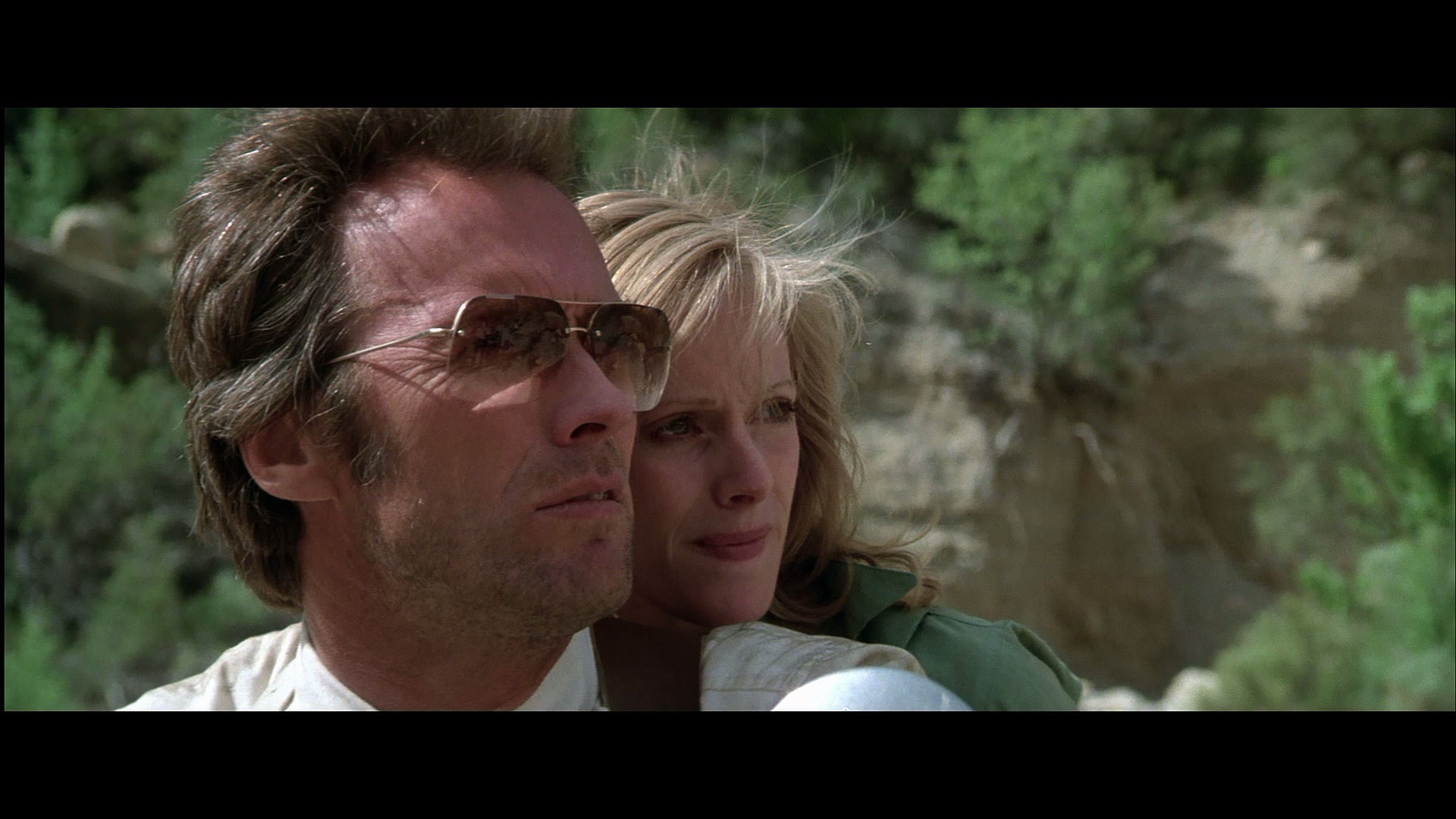
 The Gauntlet (1977) What seemed like a minor exploitation film after Josey Wales looks like something more with the passage of time. The film establishes a long-time Eastwood trademark opening—the dawn helicopter shot over an urban landscape (in this case, Phoenix, Arizona backed by an Art Pepper-John Faddis led jazz score) that establishes a moral blank slate, something that the swooping shots of Carmel in Play Misty for Me, didn't seem to contain. It's an odd combination of a potty-mouthed Tracy-Hepburn style duel of the sexes**** with the plot of Richard Donner's later 16 Blocks, but played out in the desert wasteland between Las Vegas and Phoenix. Boozing detective Ben Shockley (Eastwood) is sent to Vegas to retrieve a key witness in an influence trial only to find that there's a betting line of 50 to 1 against hooker "Gus" Malley (Sondra Locke) making it to testify. None too subtle in the acting and writing departments, the film has a surrealist glee in putting the mis-matched couple in all sorts of contained vehicles that are then chewed up by police-fire that recall the LAPD's 1974 overkill of the SLA's Headquarters in Compton. Maybe it's a metaphor for Locke and Eastwood feeling like they were taking too much heat over their backstage affair, but at times the movie is almost giddy with gun-fire. It presaged Eastwood's experiments with deliberate comedy with the "Every Which Way" Bakersfield flicks and his exploration of darker characters in the 80's. The two would come together somewhat uneasily in his next film.
The exquisite poster—also somewhat tongue in cheek—was painted by fantasy artist Frank Frazetta.****
 |
| So...why did they call it The Gauntlet? |
 Bronco Billy (1980) Endearing, if troubling film to his fan-base. Eastwood's Bronco Billy character is a thing of fantasy, sort of the way Raymond Chandler described Alan Ladd—"He's a ten year old boy's view of a hero." That's the point here. Billy lives in a black and white world of doing the right thing and setting an example for "his little pard's," as a psychological rejection of reality. And his traveling band of mis-fits and outsiders are a family whose wagons are encircled against a world of compromised values and predatory business. Inside the circus tent, they're safe from an encroaching outside world. They're heroes. Outside, they're draft-dodgers and cripples and un-employables. Even Bronco Billy is humiliated in a face-down. Audiences rejected this compromise of the traditional larger-than-reality Eastwood character. But those who saw Bronco Billy and enjoyed it, saw the inklings of a lighter Eastwood characterization, weaker, gentler but just as resolute even in the face of impossible odds. Because someone's gotta stand up "for the little pard's."
 Firefox (1982) Pretty lunk-headed action film where director Eastwood got to experiment with a form of science fiction and the new science of special effects (Star Wars' John Dykstra supervised the FX scenes). The story, however, is behind the times with a soon-to-be out-of-date Cold War espionage story of a one man hijacking crew who smuggles himself behind the Iron Curtain to steal Russia's new thought-control guidanced stealth plane. Once he's in the thing, though, the inexperienced pilot has to dogfight with a bunch of experienced Russian MIG's—no easy task, especially when the plane only answers directional commands...that are thought in Russian.
Okay. Now, stop and think about that for a moment. "...that are thought in Russian." Any specific accent? Nyet, not too convincing, but Clint learned about computer guided motion-control FX and managed to bring the film in under budget, tricky to do with special effects.

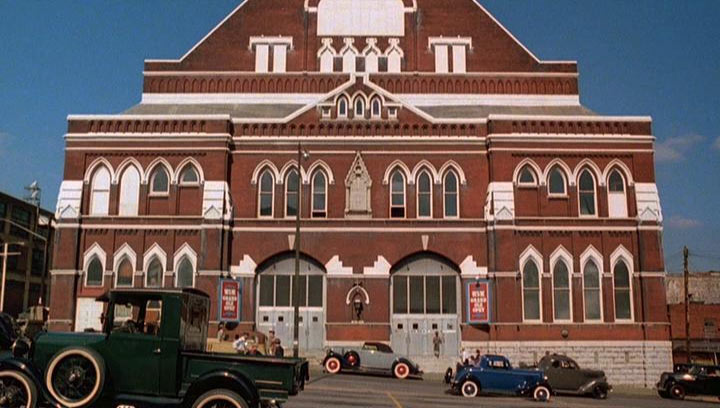
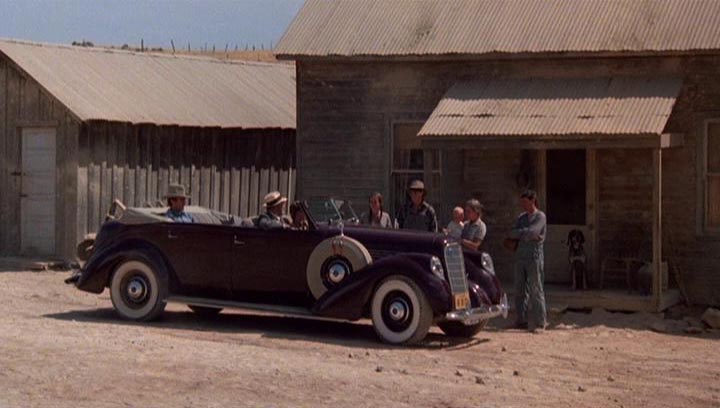
 Honkytonk Man (1982) One of those personal Eastwood projects that didn't sync up with the public taste is due for a re-appraisal, but has long been considered a low point in Eastwood's career. Actually, he was beginning a renaissance that the "Dirty Harry" movies and Bakersfield comedies couldn't have prepared the public for. Honkytonk Man is a showcase for Eastwood's interest in music and stretching his skills as director and actor in other fields than action/adventure. Maybe Eastwood the Man was also thinking about the family he abandoned for Sondra Locke, for this was the first of a few Eastwood films where his kids were major players in them. Young Kyle Eastwood plays the nephew of tubercular singer-songwriter Red Stovall, asked to audition for The Grand Ole Opry at the height of the Depression. Too sick to drive, the nephew and Uncle know this may be both of their only chances to escape crippling poverty, so with Grampa (John McIntire) in tow it turns into a picaresque road movie with a slew of great character actors in early parts, like Barry Corbin, Matt Clark, Verna Bloom, and Tracey Walter as well as country-western stars Porter Wagoner, Ray Price, David Frizzell, and the last appearance on film of country star Marty Robbins. A lot depends on your view of Eastwood's singing voice—the character is tubercular after all—but walk into it with no pre-conceptions and you might be surprised.
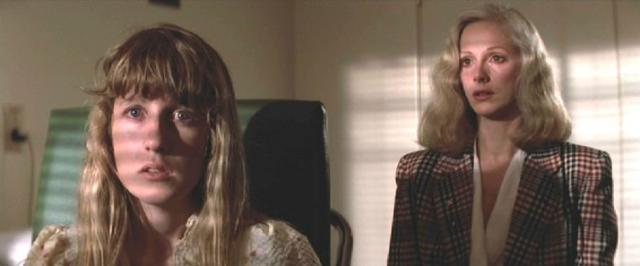
 Sudden Impact (1984) If HonkyTonk Man was an admirable failure at the box-office, it made no appreciable dent in Eastwood's popularity at the box-office or in popular culture. Indeed, this film, the only "Dirty Harry" film directed by Eastwood himself became ubiquitous for one single line of dialogue. In one of the typical "Last Man Standing" scenes in the "Dirty Harry" series, Inspector Harry Callahan is left standing off against a criminal with a hostage. "Go ahead." says Eastwood laconically. "Make my day." So emblematic of cock-sure, if clueless, bravado, even President Ronald Reagan used it in his "negotiations." A second-rate "Harry," Sudden Impact fulfilled audience expectations while just avoiding the giddy excesses of the later The Dead Pool. Sondra Locke plays yet another rape victim seeking revenge. Harry has his loyalties tested and gets a great big new gun. One of the characters is rumored to be based on a troublesome star. And Albert Popwell, the actor who was asked "Do you feel lucky, punk?" in the original, moves up the acting ladder this go 'round to become one of Harry's unfortunate partners.
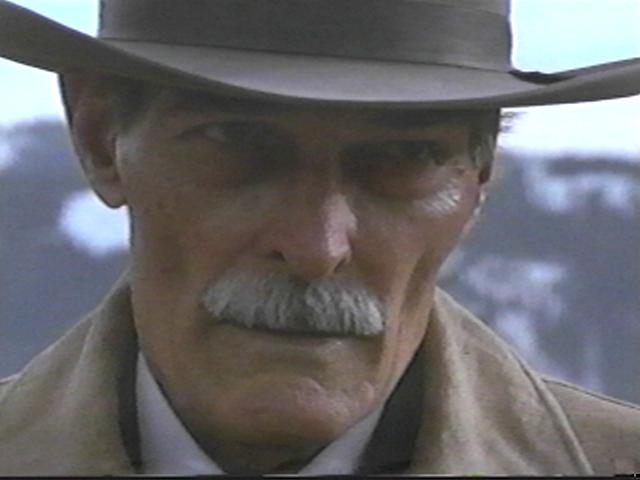
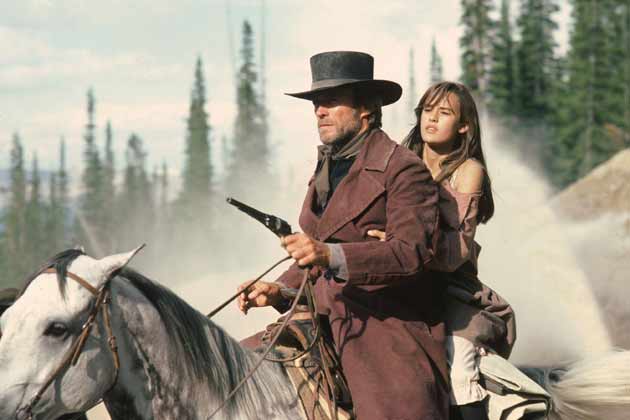
 Pale Rider (1985) Highly reminiscent of High Plains Drifter, but with a more rustic feel and a high mountain location (in both Idaho and California), Pale Rider features another "Man with No Name" to shift the balance or power in a town dominated by a mining magnate (Richard Dysart) and a fascist posse of lawmen, led by the star of TV's "Lawman" John Russell. The main difference between HPD and Pale Rider—Eastwood's direction has become so self-assured that the film looks great and the director gets great performances out of Dysart, Michael Moriarty, and Carrie Snodgress and young Sydney Penny (who became a soap opera fixture). The other difference is Eastwood's Pale Rider is a bit less obtuse when it comes to the origins of the character. Dispensing with flashbacks, it's implied that "Preacher" is a ghost, the "pale rider" which is Death, come to set things right. If so, it is the first unambiguously spiritual film Eastwood has ever made until his next directorial effort...for television. Pale Rider was nominated for the "Palme D'Or" at the Cannes Film Festival—the first Eastwood film so recognized. It would not be the last.
Next Time: Clint Eastwood, Part 2-"Actor/Director" to "Director/Actor"
* That scene is, as a lot of the film, a direct steal from Kurosawa's Yojimbo.

** Universal tries to make some hay from a film it had no confidence in, by putting Eastwood's face prominently in the poster, although Eastwood is only seen (barely) as an extra.
*** "Trevanian" was the pen-name of communications professor Dr. Rod Whitaker, who wrote an eclectic series of novels, ranging from spy spoofs to historical fiction between 1973 and his death in 2005. "The Eiger Sanction" and "The Loo Sanction" were Trevanian's first books, featuring an art professor who moonlights as a government assassin, Dr. Jonathon Hemlock. In the "Eiger" book he is recruited by the CII and its monstrous albino overseer to eliminate a climber on a planned assault of the Eiger in the Swiss Alps. By turns whimsical and hard-boiled, the book was a best-seller. But the movie version was dismissed by the author as "vapid."
**** Glenn Kenny sees it more as Eastwood's Frank Capra movie, especially It Happened One Night. Wouldn't argue with that.
***** Here's the Frazetta artwork in all its garish glory.