Showing posts with label Jason Schwartzman. Show all posts

Saturday, September 28, 2024

Megalopolis

Marcus Unrealius
or
Utopias Turn to Dystopias
 
"Look back over the past, with its changing empires that rose and fell, and you can foresee the future too."
Marcus Aurelius, Meditations

More than a decade ago, at a second-hand book store, I picked up a tome called "The Greatest Movies Never Made,"* which detailed a lot of films that had been proposed, had gotten to the script stage or pre-production and then for whatever reason, it was never made—films like Jodorowsky's conception of Dune, Hitchcock's Kaleidoscope, Philip Kaufman's Star Trek film: Planet of the Titans...
 
 
Now, that book was written a couple decades ago, but the sound of it was intriguing, although a little vague about the details.** It sounded like Fritz Lang meets Ayn Rand in a sci-fi setting. But, Coppola was determined to get it made.
A concept drawing of Megalopolis that I remember from that book.
 
And now, using his own money, he has, at the age of 84. 
 
"A man's worth is no greater than the worth of his ambitions."
 Marcus Aurelius, Meditations
 
Based very loosely on events known as the Catilerian Conspiracy, Coppola's film tells the story of Cesar Catilina (Adam Driver), nephew of the rich and powerful Hamilton Crassus III (Jon Voight) and head of the Design Authority of New Rome in the "Third Millennia, 21st Century," a city divided between the extremely rich and the poor. Catalina has access to a wonderful substance called Megalon—another wonder-element along the lines of adamantium or unobtainium—the purpose of which is simultaneously vague and omni-versatile. With it, Catilina intends to build a "perfect school-city for the future" in the heart of New Rome, while the Mayor of New Rome, Francis Cicero (Giancarlo Esposito) would rather build a new casino, another pleasure-dome for the rich and idle. At a televised unveiling for the proposed gambling complex, Catilina interrupts by reciting Hamlet's soliloquy (almost all of it) and accusing Cicero of being nothing more than a slum-lord.
But, before one gets any further into the plot, there is one curious thing to mention: In the preliminary sequence of the film, it's shown that Cesar seems to have the ability to stop time. Walking precariously to the edge of the Chrysler Building, he leans over and stops time—the fleeting clouds halt and the traffic below comes to a standstill with nary a honk. And in that gap, Cesar rights himself, defying gravity and moves back away from the edge. That would seem to be a really big story-point, but except for another sequence where he does it and some business about losing the ability later in the script, not much is done with it. Is it a fantasy (could be)? A vision (there is evidence of such in Megalopolis)? A delusion (there, too)? As a thesis statement for a movie, it's a powerful one, but rather than hammer it home, it's a neglected conceit. 
 
The movie will have a lot of those.
"The art of living is more like wrestling than dancing, because an artful life requires being prepared to meet and withstand sudden and unexpected attacks."
 Marcus Aurelius, Meditations
 
If Cesar was just in conflict with Mayor Cicero, things would be easy, despite the considerable clout the Mayor commands (aided and abetted by characters played by Jason Schwartzman, Dustin Hoffman, and others). But, there's others including his cousin Clodio Pulcher (Shia LaBeouf), heir to the Crassus fortune, who despises Cesar and seems to live for outliving his uncle to gain his inheritance, a deep-seated attraction to debauchery and finding any means to thwart Cesar at any cost. Then there's Wow Platinum (Aubrey Plaza), a tele-"journalist" with a ravenously ambitious streak attracted to power, starting first as Cesar's mistress and then marrying Crassus with the aim of becoming a rich and powerful widow. 
All of these characters are, to say the least, self-obsessed, but, then, so is Cesar, even if his devotion is to seeing the creation of his Megalopolis and done to his precise vision of what could be possible with Megalon. Aiding him in his quest are his chauffeur/historian Fundi Romaine (
Laurence Fishburne), and a fascinated acolyte, former good-time girl Julia Cicero (Nathalie Emmanuel), daughter of the Mayor, who begins to become fascinated with Cesar after witnessing him stop time during the demolition on the Megalopolis site (how come she isn't frozen and does anybody else notice that...?...let's not quibble as you're not going to get any answers).
The film follows the burgeoning relationship between Julia and Cesar and the various machinations to discredit our hero and his ambitions, even as we're led through the decadence and the moral lassitude of the upper-crust of New Rome, living like there's no tomorrow while the vast majority of New Rome can only gawp at them through chain-link barriers. Oh...and there's one other complication—A Russian space station has become de-stabilized in orbit and will probably land square on New Rome causing mass destruction on a convenient scale.
Coppola has been working on this project since Apocalypse Now, actually starting filming it in 2000—that's where he's getting the city-spires reflecting golden hour magic on a grand scale—but financial ruin, studio cold-feet, 9-11, and his fortune-making wine business all delayed progress, while he dabbled in small films with smaller budgets to see how he could make things more economically. All the time events in the press influenced the script, concept-artists came and went, and Coppola tinkered, re-wrote and tinkered again, the idea always in the back of his mind.

"It is the responsibility of leadership to work intelligently with what is given, and not waste time fantasizing about a world of flawless people and perfect choices."
 Marcus Aurelius, Meditations

So, how is it? A bit of a mess, really. But, a glorious mess. Not unlike his movie Twixt, and not unlike the Redux cut of Apocalypse Now—with the pace-killing French plantation scene which the under-the-gun Coppola finally cut completely, making a tighter more-focused film. One should always be wary of Directors' so-called "dream projects"—sometimes they're just too close to the things to be rigorous about it and lose the sense of the audience's dispassionate perspective. It's nice to have complete control, as long as you don't Ayn Rand the thing to death with the "purity" of your vision. There are whole little bits where the actors are encouraged to improvise (I'm thinking of a scene in Cesar's office where he's supervising co-workers in forming an odd human pyramid to create a geometric shape that—although it might have been fun to do on-set at the time—seems completely nonsensical and...unnecessary to advancing the story) that might have been better left on the cutting-room floor.

Though this be madness, yet there is method in't. 
 Hamlet (Polonius, Act 2 Scene 2)
William Shakespeare
 
But...but...there are moments where the imagery is just too exquisite to ignore. Coppola has always had a great eye, whether as a consumer or as a producer of movies, and there are odes to Fritz Lang (especially his Metropolis which is a spiritual cousin to this), German expressionism in general—even an ending nabbed from The Great Dictator—and his own experiments with practical effects in Bram Stoker's Dracula, Apocalypse Now, and techniques of the silent era—so many irises, split screens, and layered images (his way of showing the satellite's destruction of New York is far more interesting than just another CGI shock-wave and he had one act of violence that propelled me out of my seat) that you can't help but be dazzled.
But maybe not seduced. For all the luxuriousness of the visuals, the story is a little threadbare, lacking some connecting tissue that might have propelled the story along, little details (something Coppola is so good at) that might have prevented some thought-stuttering that wrenches you out of the flow of  experience that a more assured story-narrative would ensure. There are just too many leaps of faith that make the watching less comfortable and more precarious.
It also might have something to do with Coppola being much more versed in the Catilerian Conspiracy than your average movie-goer. Although there's nothing wrong with aspiring to connect with the lowest common demoninating audience, I doubt that many folks will recognize his references—"Oh, yeah, that 'vestal virgin' thing!"—and be merely puzzled as they go over your head like so much satellite debris.
"Everything we hear is an opinion, not a fact. Everything we see is a perspective, not the truth."
Marcus Aurelius, Meditations
 
So, what do we have in Megalopolis?  Let's call it a tentative failure. One should always be cautious with first impressions, even though one should trust their instincts. But, the shock of the new may blind-side you—it happened with Apocalypse Now, after all—and I'm always a bit cautious with late-era directorial efforts, like the casual dismissals of Stanley Kubrick's Eyes Wide Shut or John Ford's 7 Women, both of which get better with every viewing. And one should always give extra credit to a director swinging for the fences even if they never get out of the infield. 
One might go forward by looking back. Coppola has made a wide variety of films, some of which have connected with audiences and some that haven't. With very few exceptions—I'm thinking The Conversation—they have dealt with interconnectedness, of people relating to each other despite differing perspectives, and different personal agendas.
And they're about family, whether it's a formalized family or not, nuclear or not—of the stoic and disciplined against the passionate and unprincipled. And they're about ambition and how it can inspire...or destroy. Those conflicts can exist in any person, but most obviously in artists. It's like Coppola has been making autobiographies about his own conflicting artistic instincts in the same way Howard Hawks' "teamwork" movies were inherently metaphors for making movies. A much younger Coppola would have made Megalopolis end as a cautionary tale. The older, wiser, more hopeful Coppola ends this one with positive reconciliation.
 
Perhaps reappraisals can start with that.

“The first rule is to keep an untroubled spirit. The second is to look things in the face and know them for what they are.” 
 Marcus Aurelius, Meditations
 

* Or something like that. I lent it to someone and, as I'd read it cover to cover, I didn't care if I got it back. Since it's publication, there've been a couple of other books with similar titles about the same subject. 
 
** Coppola always played things tight to the vest. I read an interview with Coppola in Andrew Sarris' "Interviews with Film Directors" where he was asked about what his next movie was (this was around the time of The Rain People) and he answered "I've written a script called "The Conversation". It's about a guy on his 50th birthday." Technically true, but he left a lot of it out.

Tuesday, June 27, 2023

Asteroid City

Meep! Meep!
or
Margot Robbie's in the Tupperware
 
“Asteroid City does not exist. It is an imaginary drama created expressly for the purposes of this broadcast. The characters are fictional, the text hypothetical, the events an apocryphal fabrication."

Well, of course they are! It's a Wes Anderson movie!
 
Early on, with Anderson's movies—back before they got really stylistic with consistent lateral camera moves and a severe one-point perspective, and looked like they could have happened in the "real world"—there was a depth to the subject matter that was undeniable. That has remained to this day, even while the visual look of the films have become more juvenile and seem to be contained in toy-like play-sets that defy good construction practices or even three-dimensionality. Characters became types moving around in play-houses that seem to be defiantly artificial...like shooting in a western town that were deliberately shown to be propped up stage settings and mere facades. Most directors try to expand their horizons along with their budgets and to take pains to make things more realistic and less like pre-planned photographed dramatizations. Not Wes Anderson.
Hitchcock said of Spielberg that he was "the first one of us who doesn't see the proscenium arch" noting that Spielberg grew up with film, rather than the stage. But, Anderson is going a different direction. He WANTS you to see the proscenium arch, and will go out of his way...with a child-like glee...to make sure it's noticed and appreciated to be artificial. His new film, Asteroid City is one more step in that direction as it's story looks like it takes place in one of Maurice Noble's desert landscapes in the Road-runner cartoons.*
But, that's one aspect of Anderson's film (he usually has at least two he's presenting in his movies). Usually, he's as stringent in his story through-line as he is with a tracking shot (his The French Dispatch, with its a handful of stories, being an exception). This one, he's made a layered story, through several simulated media—television, stage, and film—each one has its place in the film and each one is subject to being violated, one by the other.
Now, Asteroid City tells the story of what happens when a bunch of "super-genius" kids arrive with their families at the titular city—famed for its vicinity to  the "Arid Springs Meteorite" impact crater—for the "Junior Stargazer/Space Cadet" convention put on by "The Larkings Foundation" and the U.S. Military under its United States Military-Science Research and Experimentation Division. They're to be given awards for their inventions—it should be noted that those inventions (jet-packs, destructo-rays, projecting on the Moon) were not viable in the setting of 1955, but would be just the sorts of things kids would want to invent. Each family have their issues and quirks, and they become unwitting witnesses to a major event in the history of mankind.
So, that's the plot. But, it's not the whole movie. We begin—in black-and-white and a square Academy ratio—with a television program (of the arts-programming "Omnibus" variety) where the host (
Bryan Cranston) intones that they are presenting a special production of a play by famed playwright Conrad Earp (Edward Norton) called "Asteroid City" and after a brief episode where Earp meets actor Jones Hall (Jason Schwartzman), we begin with a wide-screen version of the play in the colors of a faded post-card you'd find in a rack at a tourist trap.
Augie Steenbeck (played by Jones Hall played by Jason Schwartzman)—photographer—arrives (barely) at 'Roid City with his three daughters Andromeda, Pandora, and Casseiopeia as well as his son Woodrow (Jake Ryan), who is participating in the awards contest. Augie was a war photographer, still has shrapnel in his head, and takes his station wagon in to be serviced (by mechanic Matt Dillon)—it having given up the ghost miles down the road. It's decided that they will stay in town for the convention, rather than stay with Augie's father-in-law, Stanley Zak (Tom Hanks).
Stanley is concerned about this, but he's more distressed that Augie hasn't told the kids that Augie's wife/his daughter died two weeks ago, and don't you think it's about time to do that? So Augie stoically tells the kids—"Are we orphans now?" "No, I'm still alive."—which affects them all deeply, despite Woodrow being steeped in all things science and the three daughters, embracing mysticism seeing themselves as witches (well, two witches and one vampire). To allow the kids to grieve, Augie lets the kids bury their mother's ashes (contained in a Tupperware container) temporarily in the car-park until their grandfather can arrive to take them to his home for a more proper burial.
Also there for the awards ceremony is actress Midge Campbell (played by Mercedes Ford, played by
Scarlett Johansson), who is studying her lines for a new play and develops a curious relationship with Augie—seeing as their neighbors and all. Like the majority of the actor/characters, they are demonstratively undemonstrative, and—if I may use the word again—"stoic." These are, after all, adults in the 1950's, having lived through a ghastly world war, only to see it emerge with advances in technology and weaponry that dwarf, and could ultimately consume them. The many small inconveniences of living in a desert tourist trap not to far away from a nuclear test-site, leave them unfazed.
It is only when a cosmic event happens that is ultimately beyond their understanding that things change. Asteroid City, due to that happenstance is shut down and quarantined, leaving the temporary residents stranded. But, true to their nature—or perhaps the nature that Conrad Earp has given them—they react more to the minor annoyances that the quarantine imposes, rather than the perspective shock that its cause should have created.
Seems a bit like real life, doesn't it?
Anderson and consigliere Roman Coppola were writing this in 2020, so the COVID quarantine may not have been the genesis for the project, but filming during COVID restrictions certainly did, necessitating the recasting of Bill Murray when he came down with the plague. Still, when the outrage in real life is over the inconvenience of wearing masks rather than the loss of more than a million souls (you can't make this stuff up!), one can infer that it was on the creative minds.
Six feet apart?
But, there is one attitude shift present from the happenstance; Anderson abandons his persistent horizon-bisecting in the frame for something else—overhead shots looking down on the players. Oh, everything still has that one-point perspective, but from above with no horizon in sight, putting (in camera-terms) the people on screen at a disadvantage, making them smaller, vulnerable, putting them in their place—at least from the perspective of an observing extra-terrestrial. It's a bit jarring, but completely apt. It's the only evidence of a new perspective in the movie.
So, I found it fascinating, but then, I always look forward to Anderson's films. They may not come to an all-encompassing conclusion, but instead take on the mantle of a childish inquiry without answers. They make me feel a little younger, where playfulness was everyday, and not in those moments in between crises. They embrace innocence, but leave plenty of room for cynicism and mild bemusement, rather than a-musement. And the cultural touchstones he invokes are pretty sophisticated, even if he's not being sophisticated about them. I'm all in for that.
 
I hope he never grows up and loses it.
And Asteroid City is the perfect come-back for all those scary A-I generated parodies of "visionary director" Wes Anderson that are flooding YouTube now ad nauseum. Whatever the "brave new world" of AI generates, Anderson will always top it. I find that reassuring.

 * Anderson even throws in an occasional stop-motion road-runner just so we get the point.
"Wow"
 
Some more shots from Asteroid City, just because they amuse me... 

Friday, June 2, 2023

Spider-Man: Across the Spider-verse

Whenever There's a Gang-Up/You'll Find the Spider-Man/Woman/Thing/Concept
or
Every Spider-Thing Everywhere All at Once

At the end of Spider-Man: Across the Spider-verse, I imagined a camera floating up to the theater-rafters, while I looked heavenward, my hands gripped into fists and screaming: "Noooooooooooo!"

It didn't come out of nowhere. During the last 45 minutes of the film (it's 2 hours, 20 minutes), I felt a mild panic coming on; the movie didn't feel like it was rounding third and starting to wrap things up—if anything, it was getting MORE complicated without any impending resolution. The reason? There isn't one. The movie ends with a terrible situation for hero Miles Morales (Shameik Moore), who's left beside himself, and the formation of a new Spider-group to save the day—led by Gwen Stacy (Hailee Steinfeld)—and another group—led by Spider-man 2099 (Oscar Isaac) hunting him with the intent to...well, I don't know what their intent is, but the very presence of Miles Morales and the events from the previous film put everything (and I mean everything) in danger. 
 
Then there's a "To Be Continued" graphic.
DAMN!

My absolute love for the previous film, Spider-Man: Into the Spider-verse, is readily apparent to anyone who read that review. I still maintain that it's the best Spider-Man movie brought to the screen*, and (unfortunately) I still do.
Oh, not that this new one is bad. It still has the verve and the audacity of its eclectic visual style, its almost brilliant vision of blending-in classic comic-book traditions in its story-telling, as well as exceptional voice-acting, and at a slightly quicker pace than its predecessor (as we've come to expect the visual tricks that are second-nature in this new one). It also is very smart, thinking outside the box-frames, while also slightly dismissive of standard super-hero tropes and jabbing (lightly) at them. It knows that you can't have a Spider-man film without the shadow of soap opera looming over it and that tragedy is attracted to the character, like, well, like goofy super-villains.
So, what is the tangled web of Across the Spider-verse? It starts out with a challenging thesis statement: "Let's do things differently this time. So differently." It's Gwen Stacy, the Spider-Woman/Ghost-Spider/Spider-Gwen of alternate Earth-65, contemplating her back-story of her gifted life being over-turned by being bitten by a radio-active spider giving her spider-powers, shouldering "great responsibility," vilified by the press and the police (one of whom is her father) and how her crime-fighting career led to the death of her best friend, the brilliant student Peter Parker (Earth-65's Peter Parker). Parallel universes have pretty narrow parallels. While fighting an alternate-Universe version of the Vulture at her New York's Guggenheim Museum, she is aided by two other spider-heroes: Miquel O'Hara (Isaac)—Spider-man 2099 of Earth-928 and Jessica Drew (Issa Rae), the Spider-woman of Earth-616. O'Hara is in charge of an elite corps, the "Spider-society" whose mandate is to keep a stable multi-verse. With me so far? Good, let's go to Earth-1610.
Earth-1610 is where "The Ultimate" Spider-man, Miles Morales, lives. It's been a year since the events of Into the Spider-verse, and the experience has changed him. He's an established Spider-man in his New York—even the police (including Miles' father) like him. He is the epitome of a friendly, neighborhood Spider-man, but his folks—despite his high grades at school—think he's a bit of a flake and are worried about him and his future. For example, he's late for everything, his attendance in class is kind of spotty despite the high grades, and they're really thinking about whether he should move home rather than applying for that big fancy New Jersey college to learn about particle physics. They want him to be more "grounded"—and he does get grounded in ever-increasing amounts throughout the movie.
And speaking of "spotty" there's a weird new super-villain in town. He's Dr. Jonathon Ohnn (Jason Schwartzman), who got caught up in the big particle accelerator/collider explosion of Into the Spider-verse and has turned into a being who can create holes—or "spots"—in space in order to transport himself to other locations on Earth-1610. Spidey encounters him trying to transport an ATM from a convenience store while on his way to his college evaluation with his folks and leads Miles on a "holey" confusing and disorienting fight throughout New York-1610 before making one trip to many and transporting him self to a "void"—let's call it "The Holy Sea" like in Yellow Submarine—where he plots his escape by using another collider to increase his powers across space...and other dimensions.
Such a being can be quite a disruption to the fabric of time and space, so the "Spider-Society" recruits Spider-Gwen to travel to Earth-1610 to track this "Spot" guy and capture him before he can do any significant damage. Gwen (rather unwisely) shirks her duties as "spot-remover" to set up some automatic detector-gizmo, and instead goes to see the neighborhood Spider-man, whom she knows is "friendly." As Miles and Gwen have feelings for each other that haven't been awkwardly expressed yet, it's a "best of/worst of both worlds" parallel universe situation.
Well, Gwen's negligence causes an emergency and Jessica Drew contacts her to get her spider-self to Earth-50101—and the island of Mumbattan—where Spider-man Pavitr Prabhakar (
Karan Soni) and the Spider-Punk Hobie Brown (Daniel Kaluuya) have their hands full while The Spot successfully increases his powers with that Earth's particle accelerator. Unbeknownst to Gwen, Miles hitches a ride on her dimensional transport.
So, how are you doing so far? Head hurt a little? Getting a little tough to tell Spider-person from Spider-person and Earth from Earth? Okay, I'm going easy on you, because here's where it gets really difficult to parse: Miles' transport-hitching causes an anomaly, as he saves an important personage who would have died if he wasn't there, and that created something called a "Canon Alert" (which I found hysterical) over at Earth-928 with the "Spider-League".
Miles disrupted a key event that's supposed to happen to every Spider-man—a personal loss that will define their character—and poor Spider-India is set on a parallel track that is essential for every Spider-man story (and apparently they can't just go rogue and kill Pavitr's Aunt Maalai (or whatever) in order to set the trajectory right. This is not good, and it gets worse...and more complicated.
But, I'll spare you, and not spoil anything else. Believe me, there are a load of surprises in Across the Spider-verse from cameos and funny details to just the whole concept of the thing that takes a lot of Into the Spider-verse and re-weaves its web into something quite beyond the standard Spider-fare...although I do suspect that Miles is going to have a "Spider-man No More" moment (but against his will this time). I mean...it's "canon!"
That whole "Canon Alert" concept is just mind-bogglingly funny (even if it's treated so seriously). There are certain comic-book stories and ideas that creators just don't touch because they are "canon"—Krypton exploded (you can't bring it back), Bruce Wayne's parents were shot in an alley (you can't say "just a flesh wound"), and Uncle Ben and Gwen Stacy have to die...and stay dead. Oh, they can be "cloned" (when the comic publishers get desperate), but you can't have Peter Parker (or what-Spider-ever) wake up one day, hold his aching head and go "it was all just a horrible dream" and go have a breakfast of Uncle Ben's converted rice. After all, these things take place in Manhattan, not "Dallas."
But, as you can tell, this thing is complicated. In fact, it's so complicated, it's almost an assault, and when you add in the creators' visual dynamism, their tendency to throw a joke into every dead space, and general pace of the thing, your brain could approach synaptic anarchy. It might have to contain a warning—not the "flashing lights" one, but the "do not see while pregnant" "may cause seizures" "do not see if allergic to spiders" warnings on TV (or movie, for that matter) pharmaceutical commercials.
I'm just saying that the experience is in-to-the-tense, and not for the faint of heart or the faint of sight. It is a certainty that one is going to miss a lot on the first viewing in a theater, and although it sounds heretical for me to say, I think that both Across the Spider-verse and its predecessor are more intended (by their creators) for repeat-viewing by disc or streaming than in the theater (although one can't discount the level of detail that can one can appreciate in the massive viewing experience**). I say that reluctantly, as I think the theater experience for watching a film can't be topped, despite noisy neighbors, restless kids, and rattling food-wrappers.***
So...I say "go." Guardedly. Just don't come back in the comments section blaming me for the migraine or PTS-ADHD or the adrenal jitters—or your "spidey-sense" on over-tingle—as a result of seeing this (my reaction was to crave a hamburger). Blame it on the tangled web woven by Spider-Man: Across the Spider-verse.
 
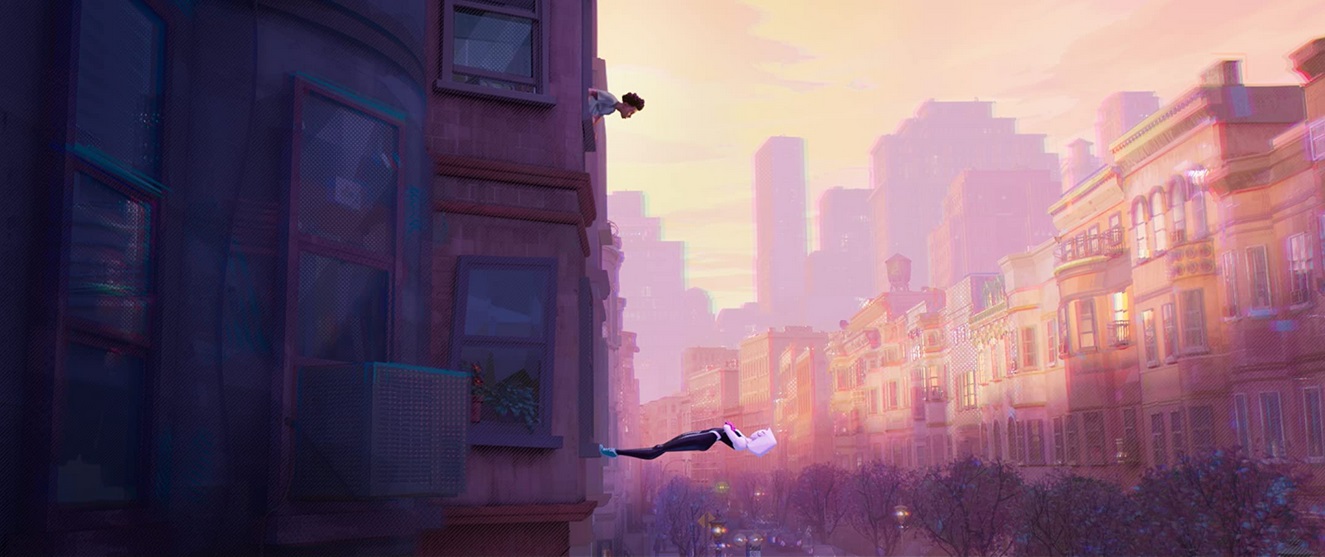
 As usual, with these animated sorts of things, I just have to share some frames from the film 
that just stuck out at me as particularly beautiful and that I didn't have room for in the text.
*...and one of the best super-hero movies ever.
 
** I saw it in XD, which was impressive, especially if one is appreciating things like the weave in Miles' Spidey-mask, or the half-tone shading of colors simulating the look of old comic-books.

*** Oh. And Maria Menounos. She really annoys me.