The Story: Rio Bravo, Howard Hawks' return to the Western genre—he'd been dabbling in comedies and even a widescreen historical epic, The Land of the Pharoahs, since he'd made his last, The Big Sky in 1952—was a return to form. Once again he worked with his star from Red River, John Wayne, and he loaded it (as he knew he'd have to) with a lot of strong, new talent who could hold the screen with Wayne, including Walter Brennan and Ward Bond, who'd worked with him before, but also Dean Martin, who was striking out on his own as a solo actor after years of appearing on-screen with his comedy partner, Jerry Lewis—if Martin could hold his own against that whirling dervish, the calmer Wayne should pose no threat, Ricky Nelson, who was something of a teen-idol from his work on television, and Angie Dickinson (who'd actually appeared with Wayne before in his cameo in I Married a Woman), who was 28 at the time, and combined glamour and tom-boyishness in a way that made her "one of the boys," perfect for Hawks who was known for creating some of the strongest female characters on the screen.
At the center of it, though, he had Wayne "that big strong oak" (as Katherine Hepburn described him) from whom he evoked the "pater familias" character in Red River which would serve as the template for Wayne for the rest of his career (and which made Hawks' pal and movie-rival John Ford remark "I didn't know the big sonuvabitch could ACT!"). Wayne is, at once the most harried of the characters and the one everybody is looking up to and trying to please. He has a "code" that takes some time to decipher, but the upshot of it is he doesn't take fools gladly, but does take his responsibilities very seriously, leading by example and with few words. In fact, the sequence that opened the movie is noticeable for having as few words as possible.
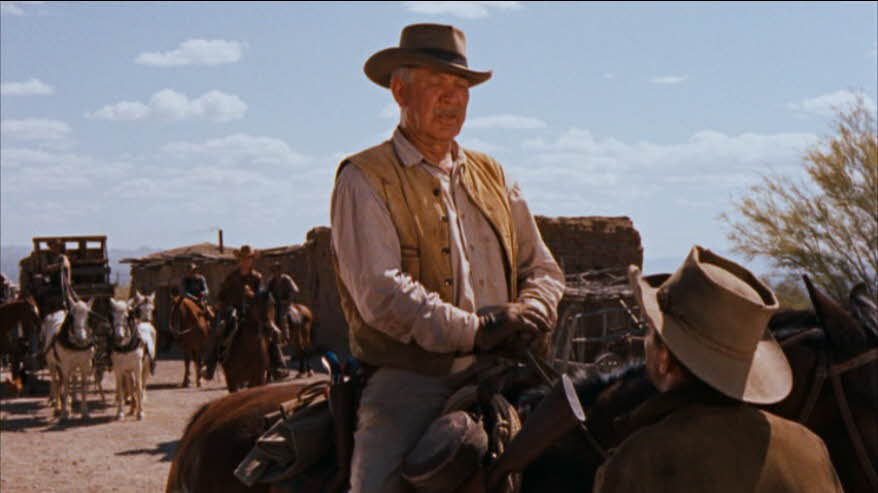
This scene has a lot of words from several quarters, as it has to explain the fallout from that opening sequence. For wagon-master Pat Wheeler, he wants to know why this familiar rest-stop all of a sudden has so many guys with guns around the perimeter asking nosy questions. Then, there's this guy at the city limits that he almost kind of recognizes who's throwing his weight around, telling him what he can do with his wagons. For an old free-ranger, this is a big adjustment from the wide open prairie. In fact, things in town are starting to make him chafe. The movie is badly in need of some exposition to set up the chief narrative thread—the barricading of the Sheriff and deputies in the jail by the Burdette family and their hired gun-men-a defensive position that recalls the situation of the Alamo, which the Burdette gang uses to a psychological advantage against the under-the-gun Chance and his crew. That's where Wheeler comes in (literally); he's needed to have the situation—and the stakes—explained.
That's the "what." The "why," and Chance's reasons behind them, will have to wait for another time and another "...Scene."
The Set-Up: The movie starts with a wordless ten-minute sequence where "Dude" (Dean Martin), dry and in need of a drink, enters a saloon and is teased by the bar-hounds and especially by a drunken Joe Burdette (Claude Akins). When a bystander tries to interfere, Joe shoots and kills him. In another saloon, Sheriff John T. Chance (John Wayne) and Dude team up to arrest Joe and take him in. But, Joe's arrest is only the beginning of their troubles.
Action!

DISSOLVE TO:21. EXT. EDGE OF TOWN DAY The wagon train is approaching Rio Bravo. At one side of the road is Boot Hill Cemetery. Beyond it toward town we see a man on horseback waiting in the middle of the road. The wagon train passes Boot Hill and nears the waiting man. There is a rough barn here at the side of the road. The barn has a yard in front of it with trees and a horse-trough. From the road there is a clear view right down the main street of Rio Bravo, but the barnyard is so placed that it is hidden from the viewpoint of anyone looking toward it from the town.
The man sitting his horse in the middle of the road is the Dude. The Dude wears a star, a Sheriff’s deputy.
He is a small man, almost frail-looking. At one time his name had been a legend on the Texas border. They had talked of his speed with a gun, of his deceptive mild manner, of his friendship with the Sheriff, John T. Chance. But that was the past. Now for two years Dude has been on the bottle, two years as the town drunk. He wears a battered hat, ragged clothes, run-down boots. He is unshaven and very close to the shakes. But for the time being, under stress, he is sober and desperately efficient.
Wheeler rides up to him, but Dude speaks first.
PAT WHEELER: What is all this?
DUDE: Hello, Mr. Wheeler.
Tell your men to stay with the wagons till they're told different.
WHEELER: Who the devil do you think you're ordering around here?First Burdette's men stop me and now you stand there and try....
WHEELER:
Say, seems like I ought to know you.
DUDE: Think you do, Mr. Wheeler.
WHEELER:
Yeah, I remember you now.
That star you're wearing
kind of threw me off for a minute.
Aren't you the fellow...
WHEELER: ...the Mexicans used to call borrachin?
DUDE: That's nearly right. Only it's borrachon.
WHEELER:
I don't think I've ever seen you
like this before.
DUDE: You mean sober? You're probably right.
You know what borrachon means?
WHEELER:
My Spanish ain't too good.
DUDE: It means drunk.
Now if the name bothers you,
they used to call me "Dude."
Now are you going
to tell your men or do l?
WHEELER: I'll tell my men.
He rides back down the line of wagons giving orders to his men.
WHEELER: Stand by the wagons, everybody!
Pass the word.
22. EXT. EDGE OF TOWN DAYAs the wagons move on, a funeral procession comes out from town, heading toward Boot Hill. The hearse is preceded by JUANITO, a Mexican boy who thumps a slow beat on a Mexican or Indian stretched-hide drum. A few mourners follow behind. The funeral and the wagon-train pass each other in the road, Wheeler, Colorado, and the wagon-drivers taking off their hats as the hearse goes by. The wagons continue into town.
23. EXT. STREET DAY On one side of the street is the jail, a strongly built adobe structure with barred windows. Across the street from it is the RIO BRAVO SALOON.
The townspeople show by their actions that they are nervous and expecting trouble.
As the lead wagons come up the street John T. Chance, the Sheriff, walks to the middle of the street, carrying a rifle.
Wheeler rides to meet him.
WHEELER: Chance, what's going on here?
People stopping me. Everybody telling me
what I can and can't do.
Next thing, you'll be telling me what to do.
SHERIFF JOHN T. CHANCE: Pat, I will tell you.
WHEELER:
What?
CHANCE: Stop your wagons.
WHEELER:
Oh, I give up.
Chance smiles and holds up his own hand to stop the wagons.
WHEELER:
Now don't tell me what's going on.
Just leave me wandering around in the fog.
WHEELER: I like it. I'm getting used to it.
It makes me feel so good.
CHANCE: You better look out, Pat,
you'll blow up and bust.
WHEELER:
Listen, Chance, remember me?
Your old friend Pat Wheeler. Now, will you please--
DUDE:
Hey, Chance!
DUDE:
What do you want to do about this outfit?
Do you want to take their guns?
CHANCE: Got any new men with you, Pat?
WHEELER:
No, nobody except Colorado here.
CHANCE: Where'd you take him on?
WHEELER:
Fort Worth.
CHANCE: What does he do?
COLORADO: I speak English, Sheriff...
COLORADO: ...if you want to ask me.
CHANCE: All right, buster, what do you do?
COLORADO: I'm riding guard.
CHANCE: Pretty young for that, aren't you?
COLORADO: Just how old do you have to be, Sheriff?
WHEELER:
You remember Ryan from Denver,
don't you?
CHANCE: Rocky Ryan?
WHEELER:
That's his boy.
He tells me the kid's faster than he was.
CHANCE: He better be, packing a pair of guns.
COLORADO: Now, Sheriff, if it's the two guns...
COLORADO: ...that
bother you, I could give you one of them.
I could let you have them both.
They wouldn't do me too much good.
(glancing at the jail window)
COLORADO: That fellow in the door there...
COLORADO: ...
has a shotgun on me.
(Chance, surprised, also looks at the window, where a shotgun barrel shows)
CHANCE: Stumpy, didn't I tell--
STUMPY: I know. I'm going. I'm going.
CHANCE: You can keep your guns, Colorado.
COLORADO: Thanks, Sheriff. I don't want any trouble.
CHANCE: Well, then don't start any.
COLORADO: I won't, unless I tell you first.
CHANCE: That's good enough.
CHANCE: Pat, you can put your wagons
in that corral.
WHEELER:
I ought to do just that.
CHANCE: What?
WHEELER:
I'm just guessing, you understand.
It seems to me that you've already got
some trouble here.
CHANCE: You're guessing right.
WHEELER:
It so happens that part of our load
there is fuel oil and dynamite.
WHEELER: Would you like to have that
sitting next to you?
CHANCE: No, I wouldn't.
DUDE: They could put them over there
by the creek.
Near the Burdette warehouse.
If it's going to blow
that's just as good a place as any.
CHANCE: Show them the way, Dude.
CHANCE: You can go along, Colorado.
COLORADO: Is that the way you want it, Mr. Wheeler?
WHEELER:
Go ahead.
CHANCE: Let's get out of the middle of the street.
WHEELER:
Now that you're satisfied
and that the kid's got his guns...
WHEELER: ...would you mind telling me
what this is all about?
CHANCE: We've got Joe Burdette in here.
WHEELER:
Joe Burdette in jail? Nathan's brother?
CHANCE: That's right.
WHEELER:
What are you holding them for?
CHANCE: They were about to bury the reason
when you were coming in.
WHEELER:
Murder?
CHANCE: No other word for it.
WHEELER:
No wonder this town's in such a mess.
What does Nathan say about this?
CHANCE: Nothing. He's not talking. Just doing.
You saw part of it.
He's got this town so bottled up
that I can't get Joe out or any help in.
CHANCE: There are men over there watching us.
CHANCE: They're his.
CHANCE: I can't make a move
without him knowing it.
WHEELER:
Who you got helping you?
CHANCE: You met half of them.
WHEELER:
You mean that fellow with the badge
that stopped me, and who else?
CHANCE: Stumpy. You know him.
CHANCE: He's watching Joe and guarding the jail.
WHEELER:
A game-legged old man and a drunk.
That's all you got?
CHANCE: That's what I got.
WHEELER:
If I ever saw a man holding the bull
by the tail, you're it.
It's a good idea putting my wagons
where they're safe.
Guess I better see they did it.
WHEELER: I'll see you later.
Wheeler goes off with the wagons.
Rio Bravo
Written by Leigh Brackett and Jules Furthman (and Howard Hawks)
Pictures by Russell Harlan and Howard Hawks
Rio Bravo is available on DVD and Blu-Ray from Warner Home Video.