Showing posts with label Carol Channing. Show all posts

Tuesday, May 10, 2022

The Line King: The Al Hirschfeld Story

The Line King: The Al Hirschfeld Story
(
Susan Warms Dryfoos, 1996) Graphic artists, cartoonists, caricaturists do not make interesting subjects for documentaries. There's only so much you can do with somebody drawing a line—it's not interesting in and of itself because there's always that missing element, which is the magic that goes into it before pencil or pen hit paper. It's the brain at the other end of that pencil that makes it interesting and, if the documentary is doing its job, explains the magic that results in the line.
 
Fortunately, Al Hirschfeld was still alive at the time this was being recorded (he died in 2003, just shy of his 100th birthday). Stationed primarily in New York, he traveled the world in his life and settled back in The Big Apple, where he was a fixture in illustration, primarily for The New York Times art section, but also The New Yorker, Collier's, TV Guide, Rolling Stone, even creating a cover for an Aerosmith album. He did poster illustrations in the silent era, and his art was featured in postage stamps of those same silent comedians. A segment of Disney's Fantasia 2000—the "Rhapsody in Blue" segment—is based on his precise, serpentine, and almost embroidered style. The "genie" in the studio's animated version of Alladin is also based on his work.
Then, of course, there is the puzzle of it. Readers of The Times could count on two brain-teasers every issue—the crossword puzzle and Hirschfeld's drawings. After his signature of every piece would follow a number, that being the number of times he had hidden the name "Nina" (his only child's name) into the filaments of his pieces. It became a part of New York life along with thin pizza, egg creams, and the aggressively walking blind.
At the time of first filming, his second wife—mother of Nina—was still alive. By the time filming was complete, she was dead and Hirschfeld talks about the effect on him. He would dutifully take a pad and paper to a theater before opening night to get a sense of the show, and begin the pain-staking work of getting it ready for publication.
Susan Warms Dryfoos' film is grainy—a lot of it done in low light—with far too many interviews with NY hoi-polloi talking about Hirschfeld on various opening nights before it sinks in that he was an important part of any opening.It times you know they're talking of "the talk around town"—the reputation—than any first-person knowledge, but then, there's gotta be gossip. Those elements are catch-as-catch-can, with celebs and opening night regulars gushing, champagne in hand, about their personal experience with Herschfeld, before they're attention is pulled by some other bright light. The segments with the artist are less hectic, in low-light and lower energy, which is something of a relief. It puts in sharp contrast the hermetic life of a singular artist, even if his subjects are lit by klieg lights.
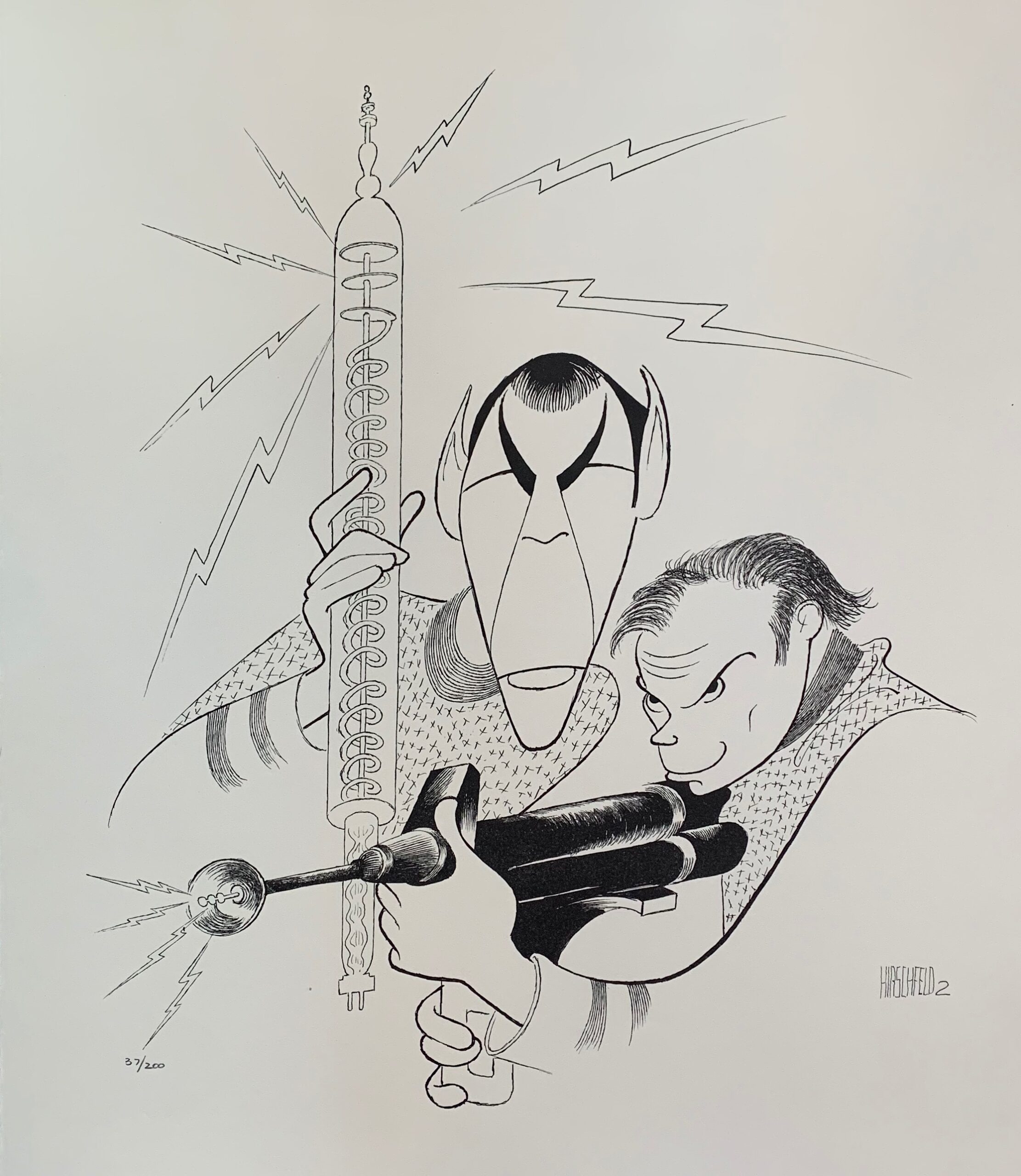
Those are the parts that are gold, plus the looks at his work semi-contemporary or long past, several of which—of subjects that appear frequently on this site are below:
Three ages of Orson Welles...


Saturday, November 27, 2021

Skidoo

Saturday is traditionally "Take Out the Trash" Day...and they don't get much more trashy than this one...

Skidoo
(Otto Preminger, 1968) Legendarily off-kilter comedy by that "master" of comedy, Otto Preminger, who, in his effort to make a movie that was "with it" perpetrated a film so far without "it," that one wonders why nobody told him it might be a bad idea...for any director. 
 
It might have been because there wasn't anybody at Paramount Pictures who had the power or the industry knowledge to be credible to a movie veteran like Preminger. Paramount had been "acquired" by Gulf and Western in 1966 and its chairman Charles Bluhdorn had made his mark in auto parts, zinc mines and manufacturing and was furthering his mint-making by buying up properties and tinkering or selling them off. Preminger was making films for Paramount and was a "studio property" who'd had a history of making edgy films that would challenge taboo's, but whose recent films were considered both artistic and financial failures.
This did nothing for the fortunes of Paramount, which, if you look at the films being released in that period (before bringing on Robert Evans as head of production) betrays of a long line of losers with the odd hit—usually a foreign acquisition, like Alfie and films that might be interesting (Seconds) but didn't attract an audience. The industry itself was seeing a downturn in receipts with more color TV's in homes and a calcified audience that wasn't getting any younger. Preminger thought he had a solution—make a movie that would appeal to "the kids."
Retired hitman Tony Banks (Jackie Gleason) has his evening of television interrupted by a pair of mobsters, Hechy (Caesar Romero) and son Angie (Frankie Avalon), who have orders from their boss "God" (this will be revealed as Groucho Marx, his first film appearance in eleven years) to knock off "Blue Chips" Packard (Mickey Rooney) who is due to testify before a Senate committee on organized crime. Banks begs retirement, but when a buddy (Arnold Stang) is found dead, he goes along with the plot for the safety of his wife Flo (Carol Channing) and his daughter Darlene (Alexandra Hay).
The idea is to have Banks smuggled into the same prison as Packard and then whack him—or "kiss him" in the mob parlance used in the film. He is incarcerated with Leech (Michael Constantine) a psychopath and "The Professor" (Austin Pendleton) a technical wizard arrested for draft-dodging. Meanwhile, Darlene's new boyfriend Stash (John Phillip Law) and his gang of "hippies" are being hassled by the police for their anti-establishment ways and Flo, being a bit of a free spirit herself, helps them from being arrested for living in the streets and invites them into her home.
Tony already has guilt feelings about whacking "Blue Chips" but when he mistakenly takes a tab of acid provided by The Professor, he gives up on the idea and instead tries to find a way of breaking out—involving lacing all of the food in the prison with LSD and escaping by makeshift balloon when everybody is high as kites.
The movie's heart might be in the right place, but it's mind is utterly lost. Maybe they were thinking they were making an all-out all-star comedy like It's a Mad Mad Mad Mad World—a favorite of writer Mark Evanier, and who takes the opportunity to trash Skidoo every time it comes out of hiding. Sure, there are grudging pleasures: it features performances by the Big Three Batman TV villains with Romero, Frank Gorshin and Burgess Meredith, all acting, as does everyone in the film,in a manner that would charitably called "broad." Small parts with Richard Kiel and Slim Pickens. The notion that they filmed part of it on John Wayne's yacht. The score by Nilsson is harmless—he sings the End Credits—but it's not exactly good, either.
Nor is the film by any stretch of the imagination, even stretched pharmaceutically. There are sequences—a musical number with dancing garbage cans for instance—that are so badly thought out and executed that it is doppler-shifted into inscrutability in post. There is a cold-sweat chill of desperation over the whole enterprise. Sometimes even that can be cruelly funny. But not here. Even the casting of grizzled—if professional—veterans can't remove the stink of mercenary pandering and witless and dull-edged stabs at satire.
It's a mess. And not a funny one. Not even the knowledge of incompetence—as with the films of Ed Wood—can save it. One can only look at it with the hope that the bottom of the barrel has been reached. But even that hope gives no comfort. 
 
Bad trip, dude.